- The paper introduces a post-processed symmetry restoration protocol that averages over symmetry-transformed configurations to project out Trotter errors.
- Numerical results demonstrate improved error scaling, reducing symmetry violations in the 1D XY and Schwinger models from quadratic to quartic or higher orders.
- The method is hardware-efficient and easily integrated with existing quantum algorithms, offering robust error mitigation for near-term quantum simulation.
Symmetry-Based Trotter Error Mitigation via Post-Processed Restoration
Introduction
The paper "Mitigating Trotter Errors via Post-Processed Symmetry Restoration" (2606.20242) addresses a fundamental challenge in digital quantum simulation: the failure of Trotterized quantum circuits to preserve the symmetries of the target Hamiltonian, resulting in unphysical leakage and symmetry-violating algorithmic errors. The authors introduce a post-processing protocol that leverages symmetry operations—either applied to the initial state or interleaved between Trotter layers—to systematically project out symmetry-violating components of Trotter error, with demonstrable improvements in simulation fidelity. This protocol is especially crucial for near-term quantum devices, where circuit depth and qubit connectivity are strict bottlenecks.
Trotterization and Symmetry Violation
Trotterization approximates the ideal time evolution e−iHt for a many-body Hamiltonian H as a sequence of exponentials of local terms, facilitating implementation with hardware-native gates. However, decomposing H into non-commuting sub-Hamiltonians generally breaks the symmetries present in H, as these decompositions do not commute with symmetry operations. As a result, Trotterized circuits drive quantum states out of symmetrically allowed subspaces, manifesting as symmetry-violating errors (Figure 1).
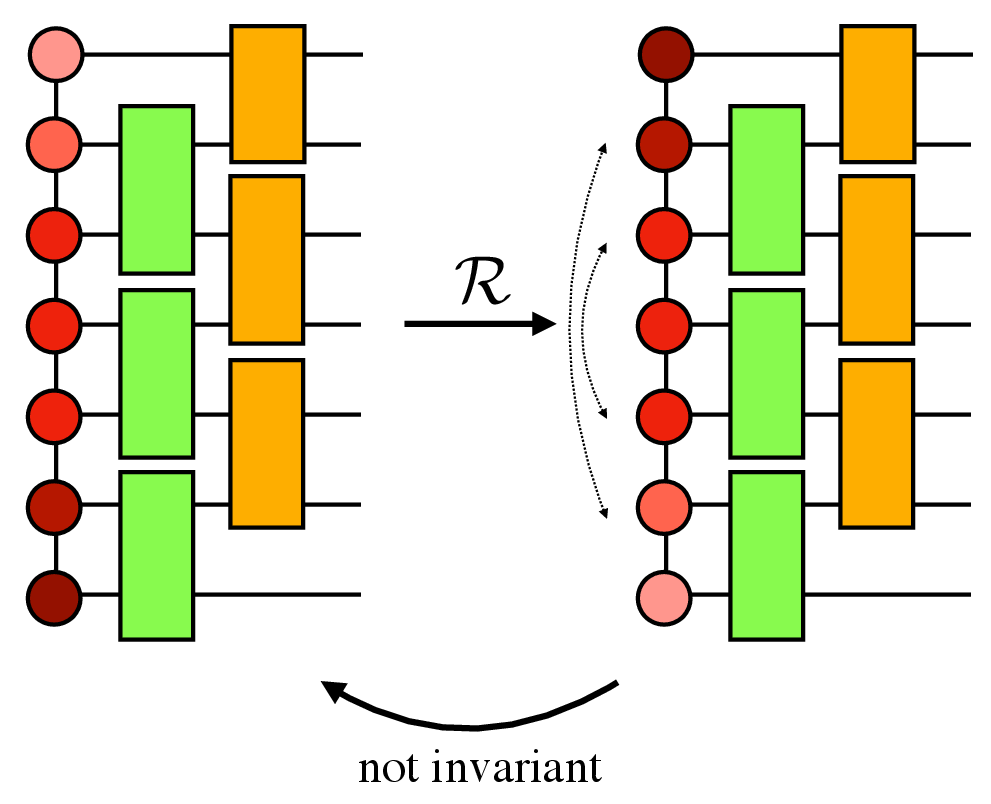
Figure 1: Inconsistency of symmetry operations in quantum circuits; physical symmetries such as reflection R are explicitly broken during Trotterization, inducing unphysical Trotter errors.
This loss of symmetry is detrimental in domains where conservation laws, selection rules, and topological protection are required for physical validity, including condensed matter systems and lattice gauge theories. Previous remedies such as post-selection or in-circuit symmetry protection are often prohibitive in resource overhead.
Post-Processed Symmetry Restoration Protocol
The authors propose a protocol in which an ensemble of quantum simulations is performed under symmetry-transformed configurations. Specifically, one either prepares symmetry-related initial states or interleaves symmetry operations (not necessarily unitary, accommodating anti-unitary symmetries such as time-reversal) between Trotter steps. Classical post-processing averages over measurement outcomes, suppressing symmetry-violating contributions while leaving ideal dynamics invariant.
The mathematical structure relies on the group-theoretic block-diagonalization of Trotter errors: averaging over symmetry operations projects out symmetry-violating terms, constraining the system dynamics strictly within irreducible representation (irrep) subspaces. This procedure is hardware-efficient, requiring only shallow circuit modifications or state preparation, as opposed to in-line enforcement of non-local or anti-unitary gates.
Numerical Demonstrations
Reflection Symmetry in the 1D XY Model
The protocol is validated on the 1D seven-site XY model possessing spatial reflection symmetry. Naive Trotterization breaks this symmetry, as shown by the error scaling in direct simulation. By symmetrizing via initial-state preparation and averaging, dominant symmetry-violating Trotter errors are projected out.
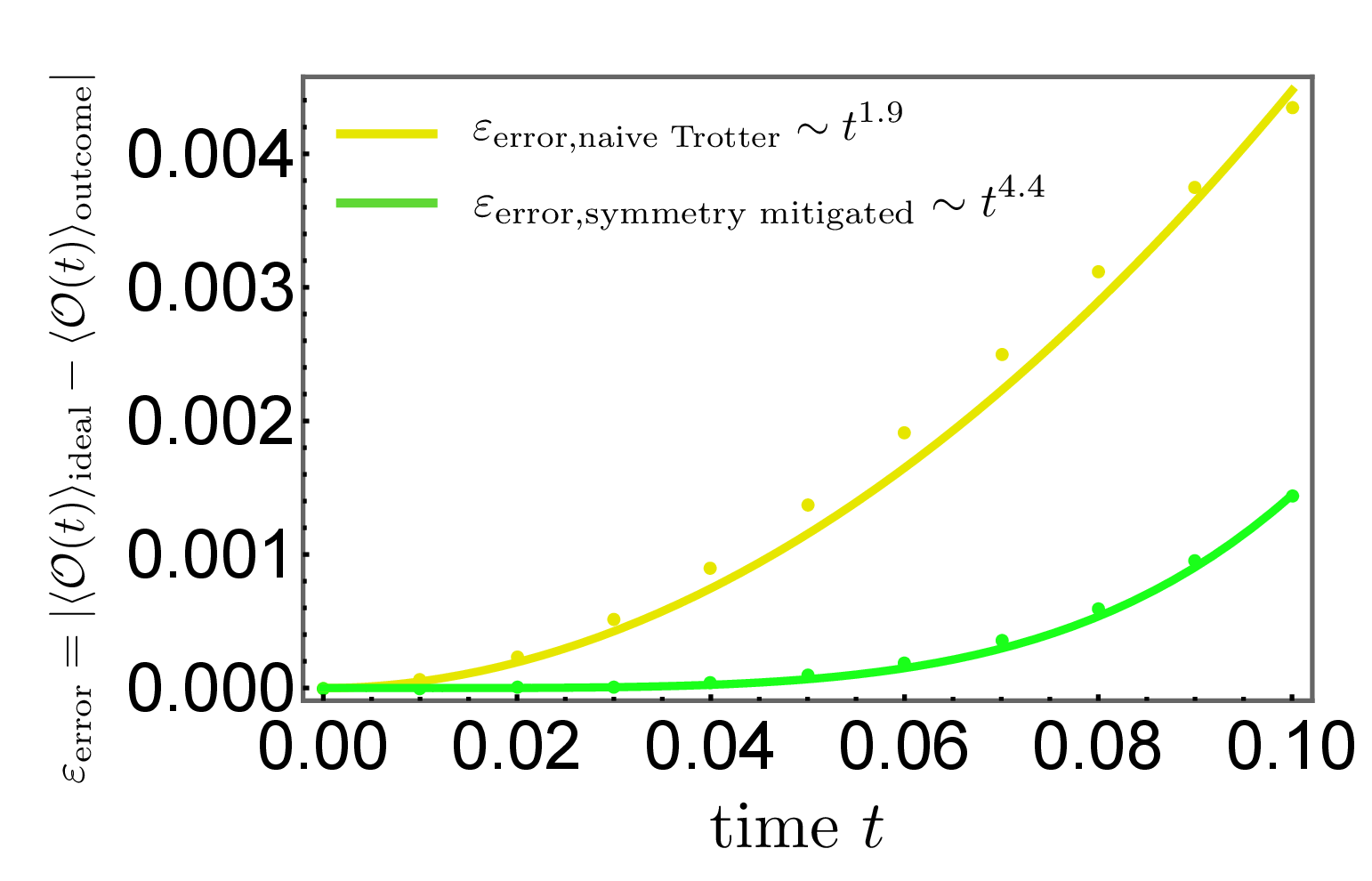
Figure 2: Symmetry-mitigated results for the XY model; post-processing protocol suppresses Trotter error from O(t1.9) to O(t4.4).
Strong numerical results indicate a significant scaling improvement: the Trotter error is suppressed from nearly quadratic to quartic, confirming the elimination of leading-order symmetry violations.
Gauge Symmetry Restoration in the 1D Schwinger Model
In quantum simulations of lattice gauge theory, such as the 1D Schwinger model, maintaining gauge invariance governed by local Gauss's law is critical. Trotterized circuits inevitably break gauge symmetry, causing physical states to leak outside the gauge-invariant subspace. Unlike spatial symmetries, gauge mitigation via initial-state symmetrization is ineffective; interleaved gauge transformations must be applied between Trotter layers and averaged.
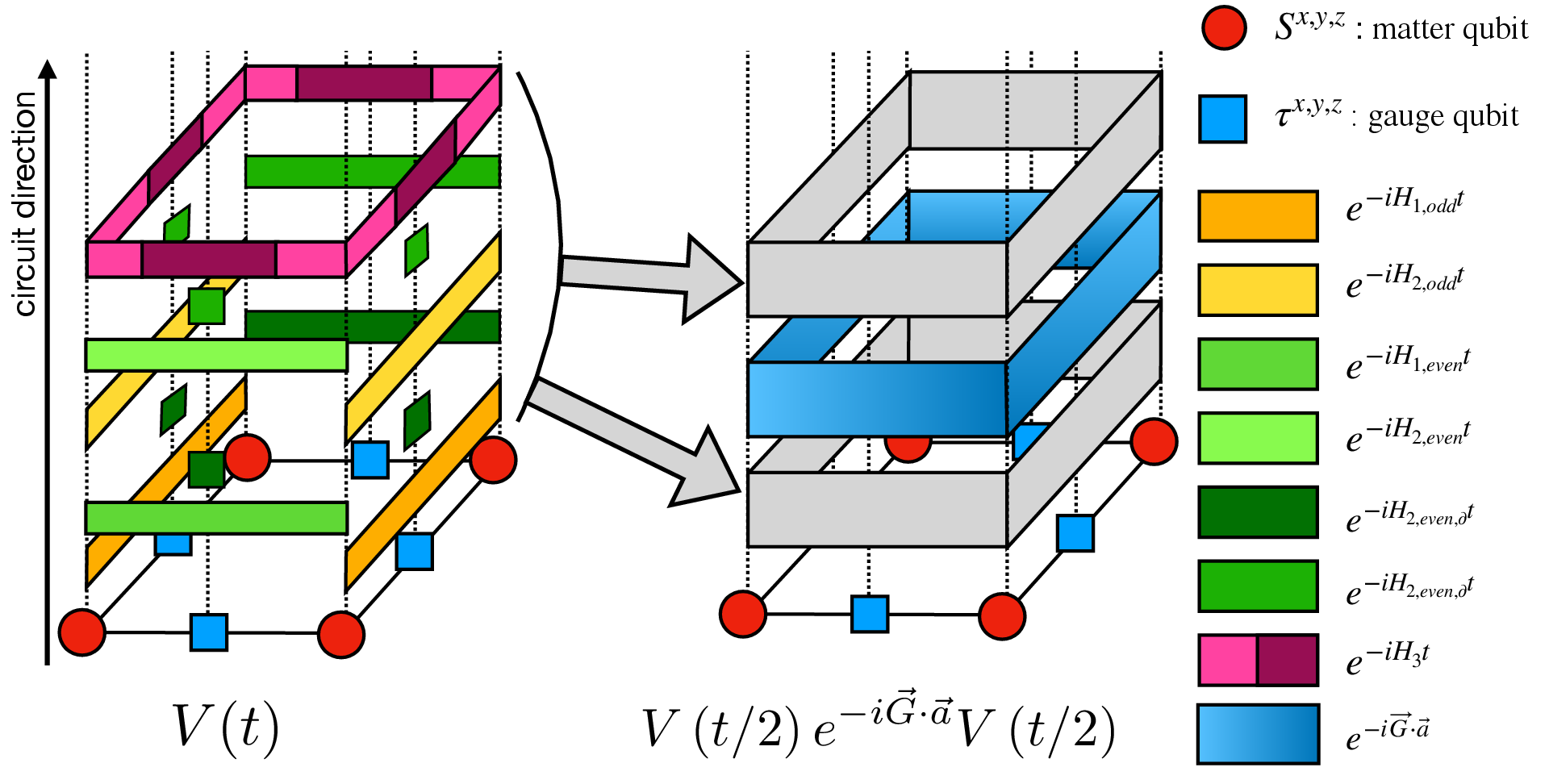
Figure 3: Trotterized circuit for the Schwinger model; intermediate gauge transformations are interleaved between Trotter layers to mitigate covariant errors.
Discrete gauge twirling, implemented via strategic selection of gauge angle sets between layers, reduces gauge violations substantially. Quantitative measurements of ⟨Gi⟩ show suppression from O(t4.5) scaling to O(t7.1), establishing robust mitigation of unphysical errors.
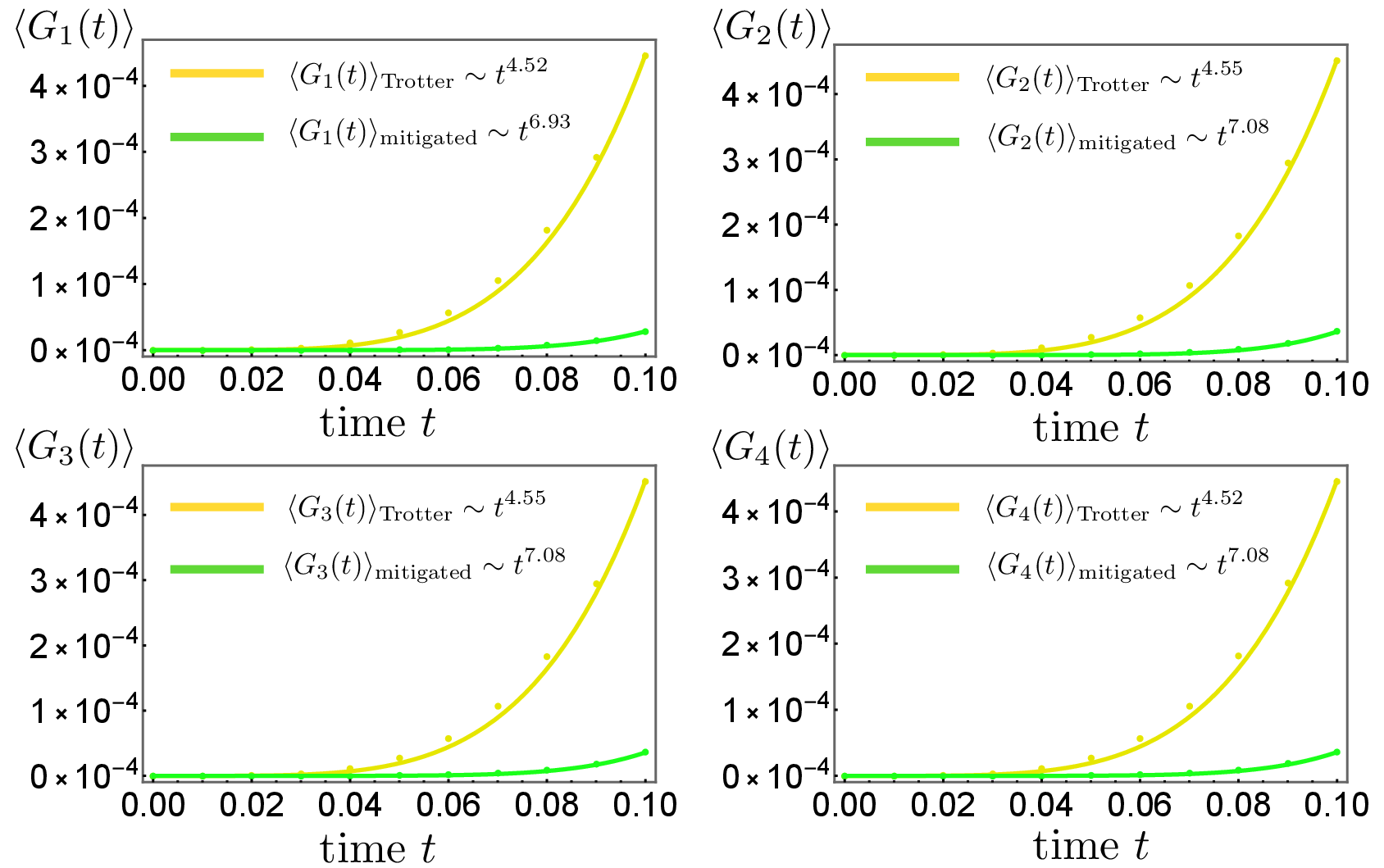
Figure 4: Gauge violation measurements demonstrate reduction in symmetry-violating error via intermediate gauge twirling in the 1D Schwinger model.
Implications and Generalizations
The protocol has several notable implications:
- Scalability and Hardware Efficiency: The classical post-processing approach adds negligible quantum overhead and is compatible with shallow circuits and limited connectivity. Non-local and anti-unitary symmetries are accommodated, making the protocol viable for near-term quantum hardware.
- Simultaneous Multisymmetry Mitigation: For Hamiltonians with composite symmetry groups (e.g., spatial, particle number, and time-reversal), the averaging protocol symmetrizes over all relevant subgroups, restricting dynamics to correct physical subspaces.
- Extension to Non-Commuting Observables and Continuous Symmetries: When observables do not commute with symmetry operations, measurement in the symmetry-transformed basis retains efficacy for leading-order error, though higher-order correction structures require further analysis. Continuous symmetries (such as H0 and H1) can be twirled via discretization and optimization of parameter sampling.
- Physical Error Channel Simplification: Symmetry averaging also tailors physical error channels, suppressing off-diagonal noise components and converting complex hardware noise into tractable Pauli or depolarizing channels, synergizing with error mitigation techniques such as zero-noise extrapolation and probabilistic error cancellation.
Conclusion
The post-processed symmetry restoration protocol introduced in (2606.20242) offers a formal and practical solution to symmetry-violating Trotter errors in quantum simulation. By leveraging group-theoretic properties, the protocol efficiently projects out unphysical error terms, enabling high-fidelity quantum simulations across a broad range of systems (including those with challenging non-local and anti-unitary symmetries) within near-term hardware limits. The demonstrated polynomial improvement in error scaling and general applicability underscores the protocol's utility. Its integration with randomized compiling, advanced Trotter and product formula algorithms, and physical error mitigation is anticipated to further advance quantum simulation capabilities, including deep-time dynamics and complex gauge theory computations.

