- The paper proposes a Trotter decomposition that leverages local SU(2) symmetry to cluster Hamiltonian terms, cutting down circuit complexity and error.
- Using three-qubit clustering, the method achieves a 4–5× reduction in circuit depth along with significant improvements in state fidelity.
- Implementation on frustrated spin systems shows preserved conservation laws and enhanced simulation accuracy in realistic noisy environments.
Beyond Commutativity: Redesigning Trotter Decomposition via Local Symmetry
Motivation and Background
Product-formula—or Trotter—decomposition is foundational for simulating many-body quantum dynamics and digital quantum simulation. Conventionally, the Hamiltonian is partitioned into sub-Hamiltonians based on (pairwise) commutativity, enabling sequential implementation of time-evolution gates. However, this standard approach creates significant circuit depth and commutator-induced errors in systems with dense connectivity, frustration, or local multi-site interactions (e.g., frustrated spin systems, nontrivial topology, and correlated electron systems). The fundamental limitation is the mismatch between the algebraic partitioning (driven by commutativity in a given local basis) and the physically intrinsic symmetries that often govern the system's dynamics.
The work "Beyond Commutativity: Redesigning Trotter Decomposition via Local Symmetry" (2605.16016) directly addresses this bottleneck by proposing and demonstrating a symmetry-guided, structure-aware decomposition that goes beyond commutativity. Instead, the authors exploit local SU(2) symmetries to cluster Hamiltonian terms based on their algebraic and physical structure, particularly using three-site clusters relevant to frustrated lattices and models with chiral interactions.
SU(2)-Classified Triangular Decomposition
Rather than enforcing commutativity among local Hamiltonian terms, the authors introduce a decomposition criterion rooted in local SU(2) symmetry. The core idea is to partition the Hamiltonian into clusters such that each local Hamiltonian commutes with all generators of a specific local SU(2) algebra. This approach directly respects the physical symmetry, avoids unnecessary fragmentation, and allows for more efficient circuit implementations.
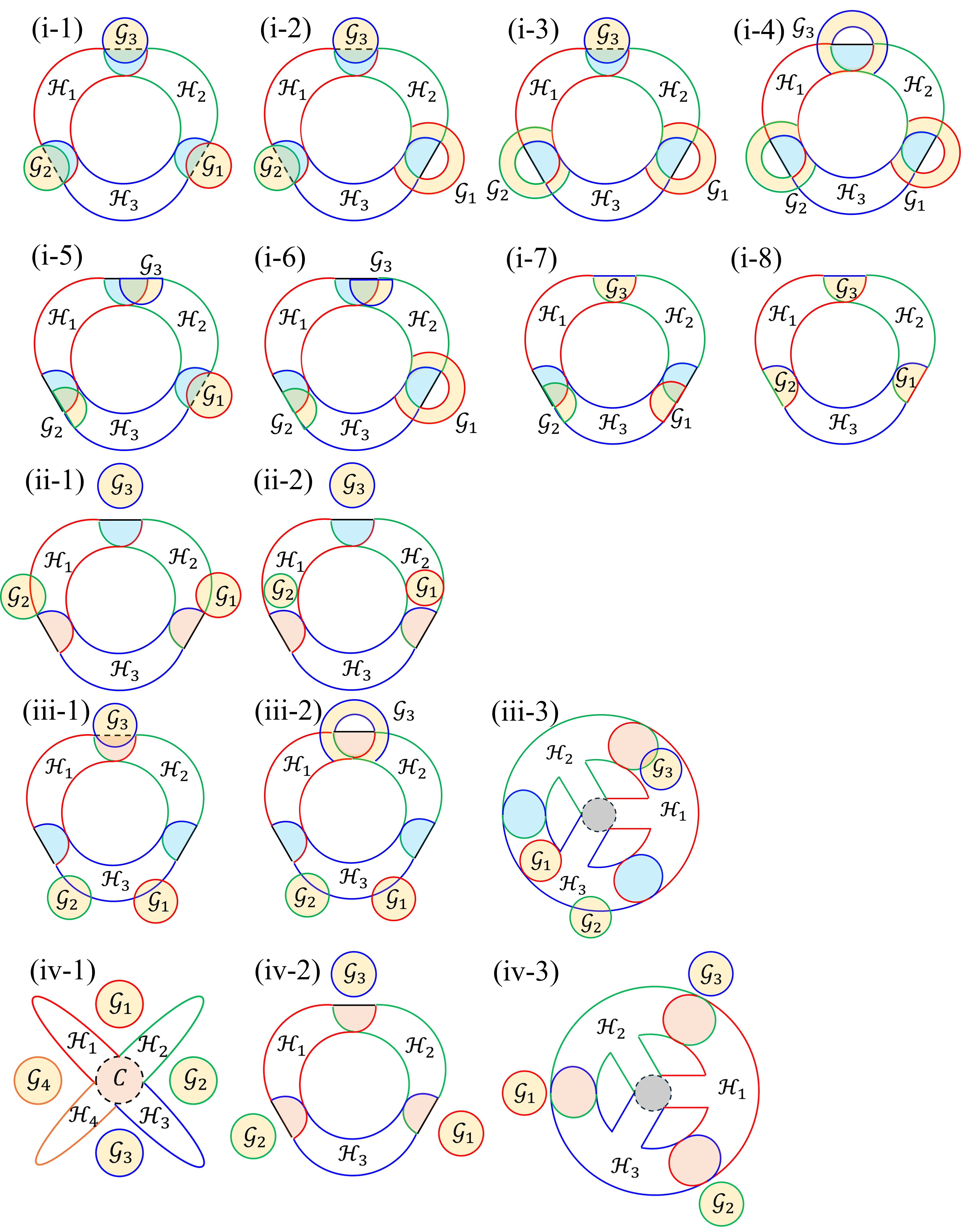
For three-qubit operators, all possible local SU(2) symmetry classes can be encoded within four classes, meaning any three-qubit Hamiltonian of interest can be decomposed into at most four clusters, each associated with a block-diagonal structure: a single-qubit SU(2) sector and a commuting two-qubit SU(4) sector. This enables circuit factorization, reducing the complexity of propagator implementation. The decomposition is algebraically formalized in Theorem 1 of the paper.
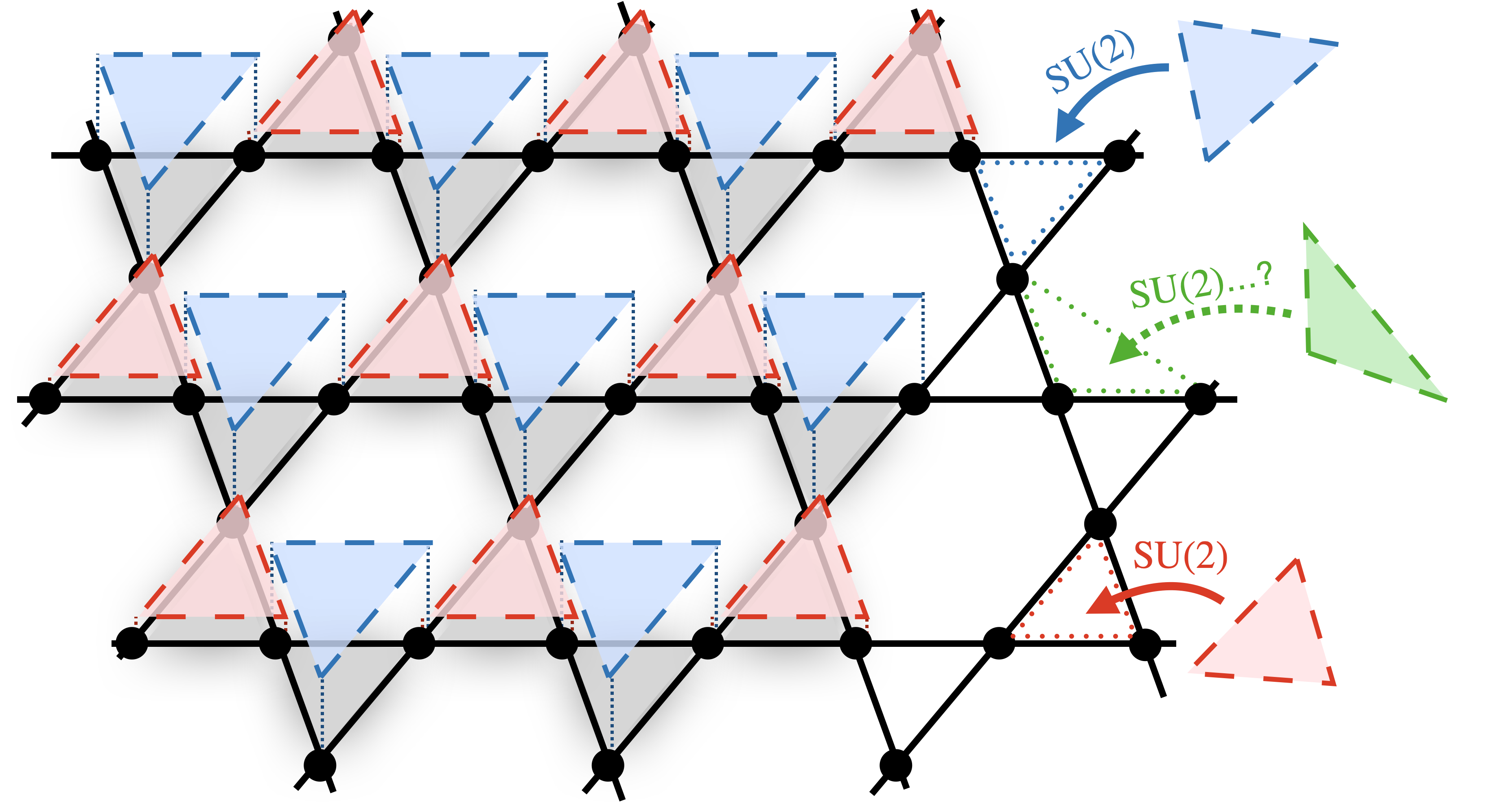
Figure 1: Schematic illustration of an SU(2)-respecting triangular decomposition on a Kagome lattice. Red and blue triangles indicate distinct symmetry-respecting clusters.
The paper further provides the explicit algebraic structure of the generator space, demonstrating how the four symmetry classes and their effective SU(2)⊗SU(4) factorization exhaust the physically meaningful clusterings of three-qubit interactions.
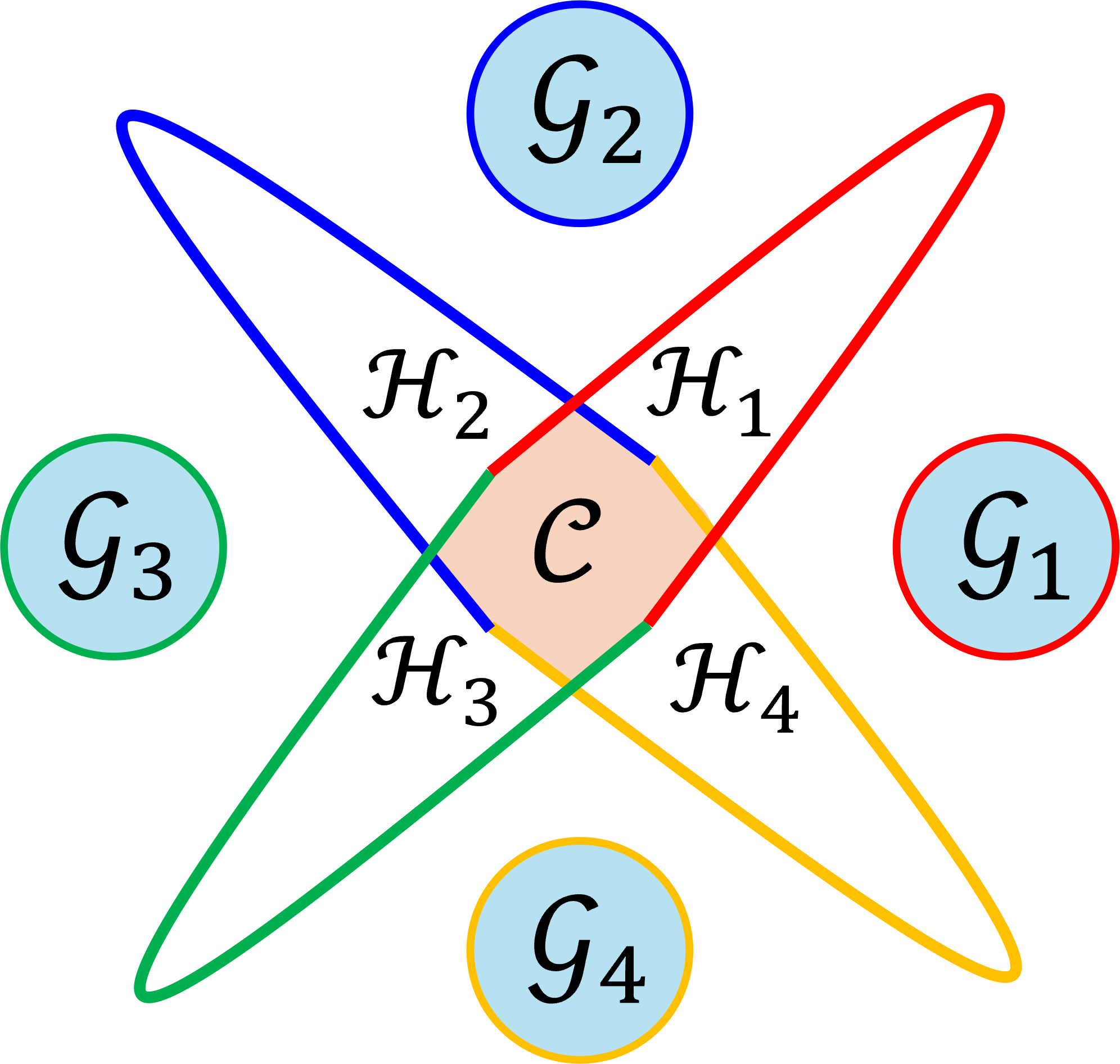
Figure 2: Algebraic structure of the generator space of three-qubit SU(8) operations. The intersection regions and clusterings by class are explicitly shown.
The circuit-level realization of such block-encoded propagators leverages efficient Clifford circuits and KAK decomposition, significantly reducing the CNOT count compared to generic three-qubit gate synthesis or more brute-force Schur-transform-based compression.
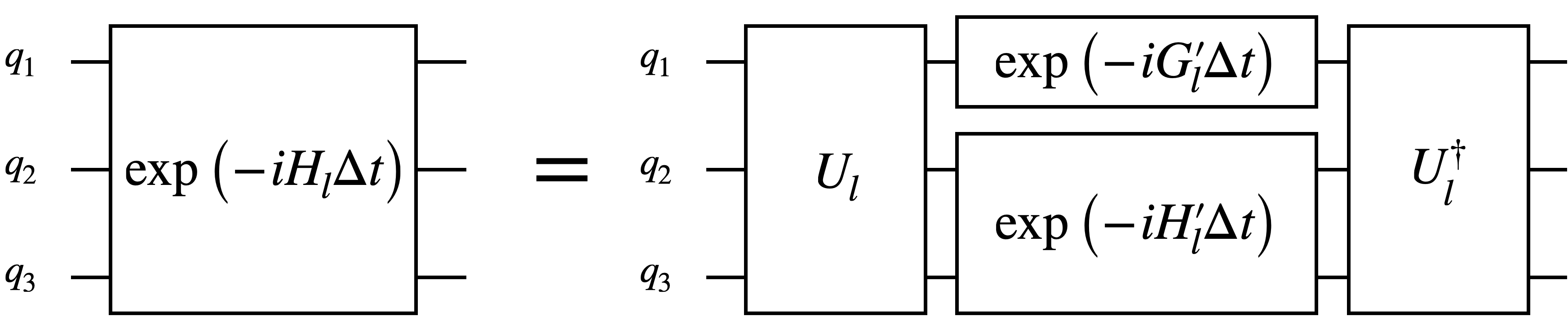
Figure 3: Quantum circuit realizing a symmetry-classified three-qubit propagator as a single-qubit and two-qubit evolution, sandwiched by symmetry-encoding unitaries.
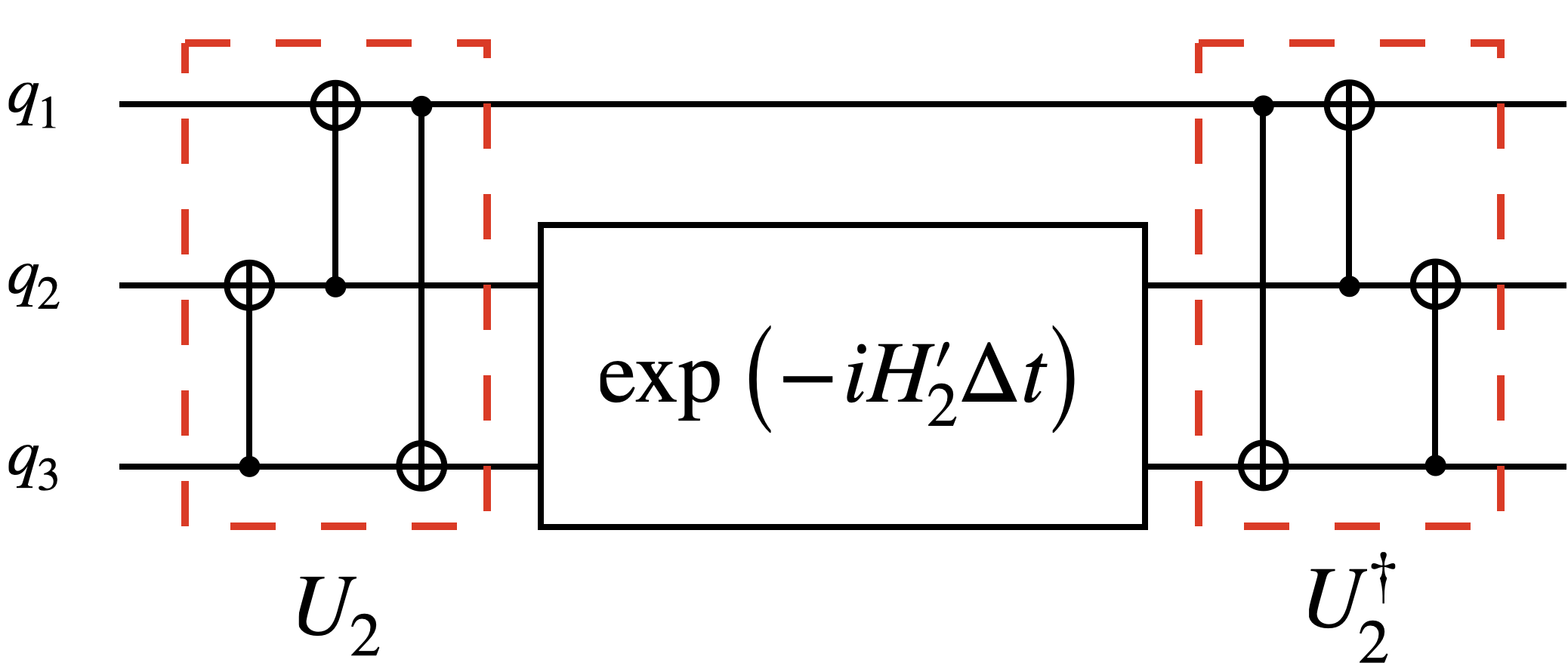
Figure 4: Efficient circuit for an SU(2)-encoded class-l=2 three-site propagator using only three CNOT gates as encoder/decoder.
Implementation on Frustrated Spin Lattices
The authors provide a broad suite of examples, with special emphasis on frustrated Kagome Heisenberg models with spin-chirality interactions—a class that notoriously challenges both classical and quantum simulation. The conventional commutativity-based Trotterization requires up to ten clusters per Trotter step for such models due to the entanglement structure and non-commuting chiralities, directly translating to deep circuits and substantial approximation errors.
By contrast, the symmetry-guided decomposition groups all local interactions within each up/down triangle, reducing the number of clusters to two (for the Kagome case), each corresponding to a non-overlapping set of triangles. These block clusters are directly implementable using the efficient propagator circuits described above, both for Heisenberg SU(2)0 and three-body spin-chirality Hamiltonians.
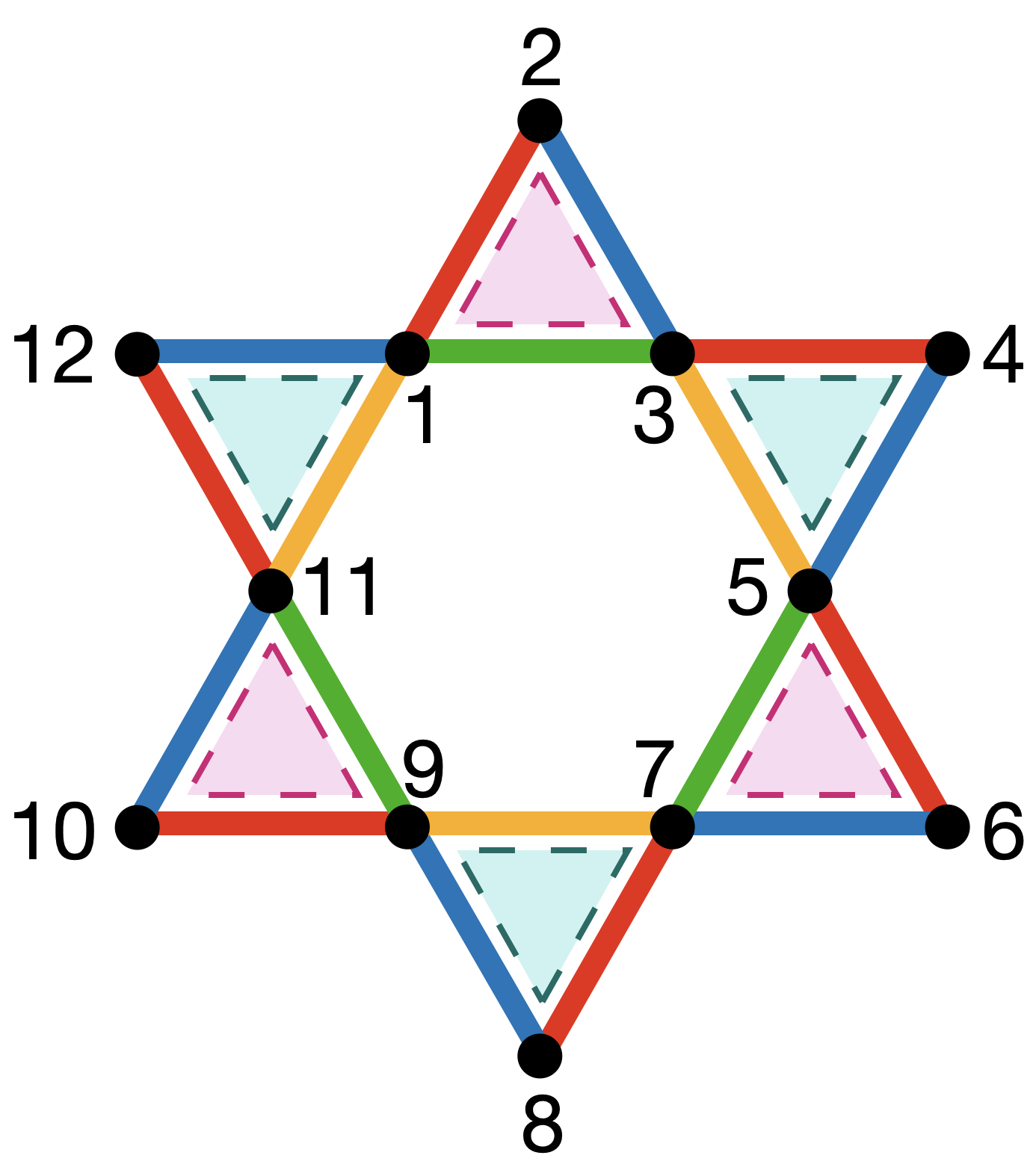
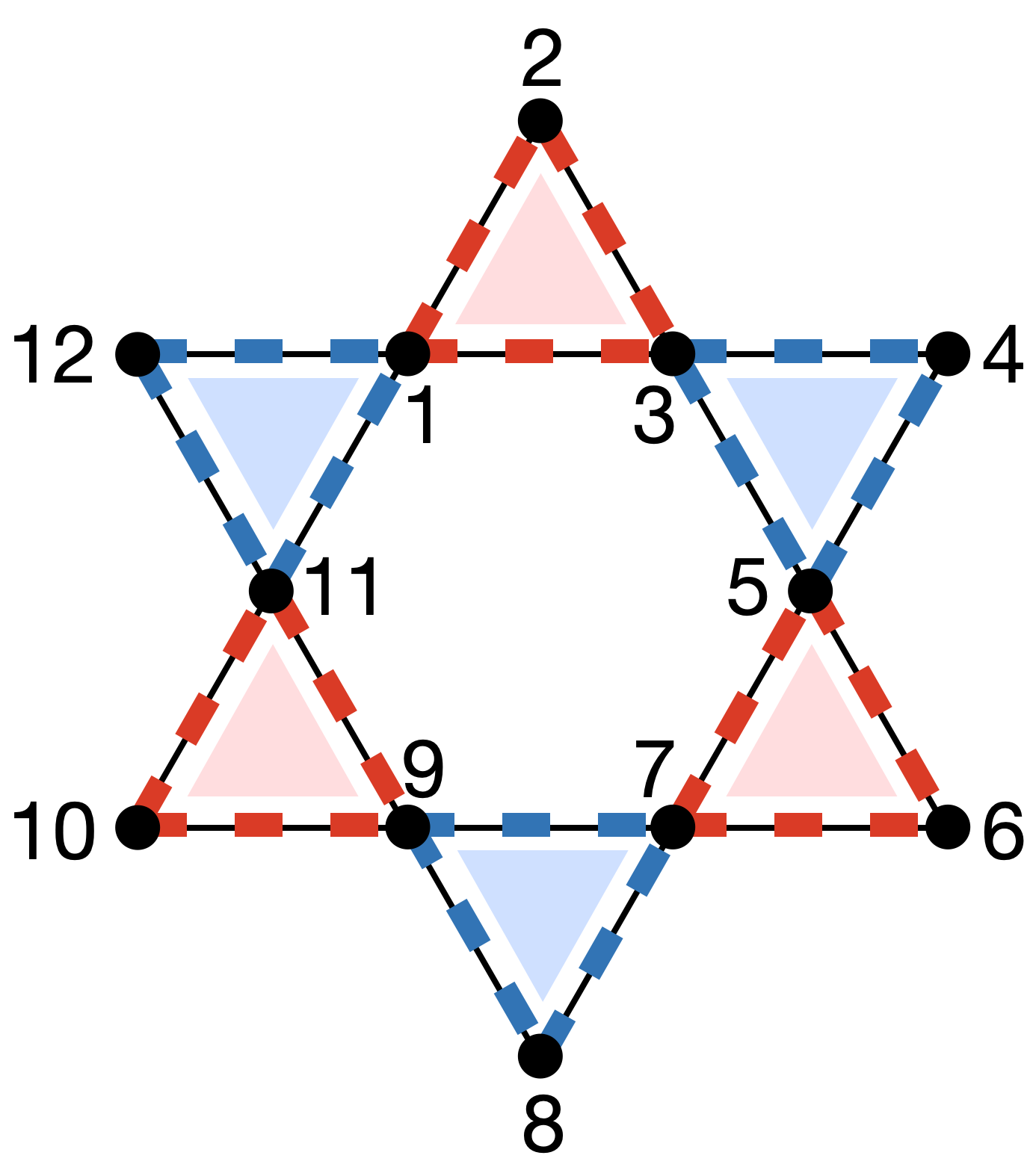
Figure 5: 12-qubit Kagome lattice with conventional (left) and SU(2)-based (right) clusterings; the latter requires only red and blue triangle clusters, drastically reducing per-step circuit width.
The circuit structure of a full Trotter step under both decompositions demonstrates the concrete reduction in sequential gate layers and commutator-induced error sources.

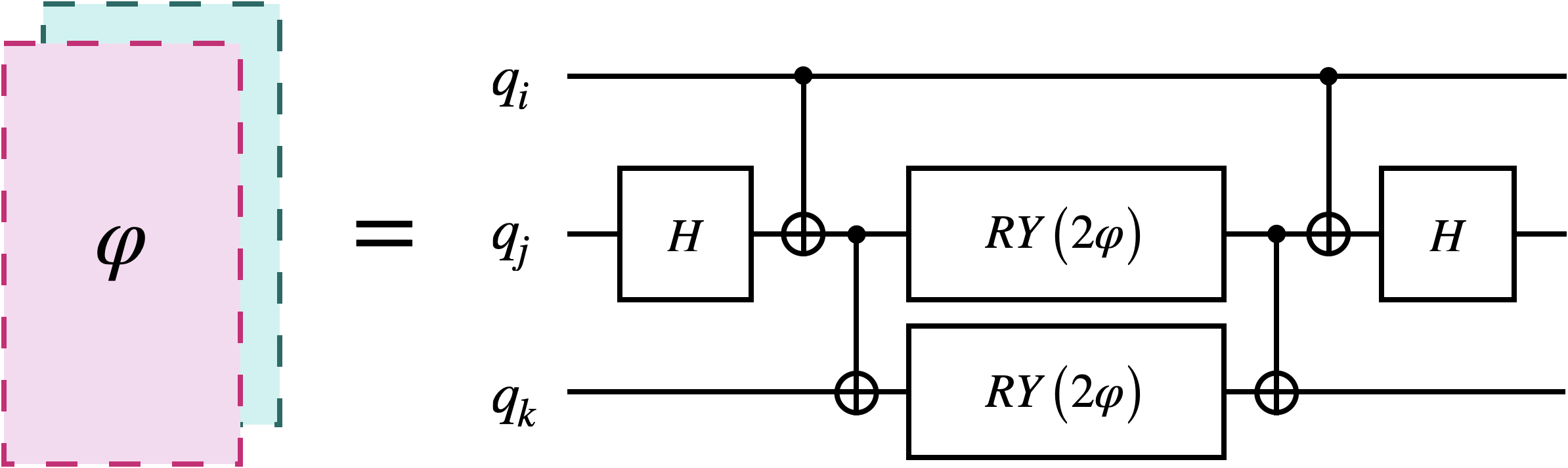
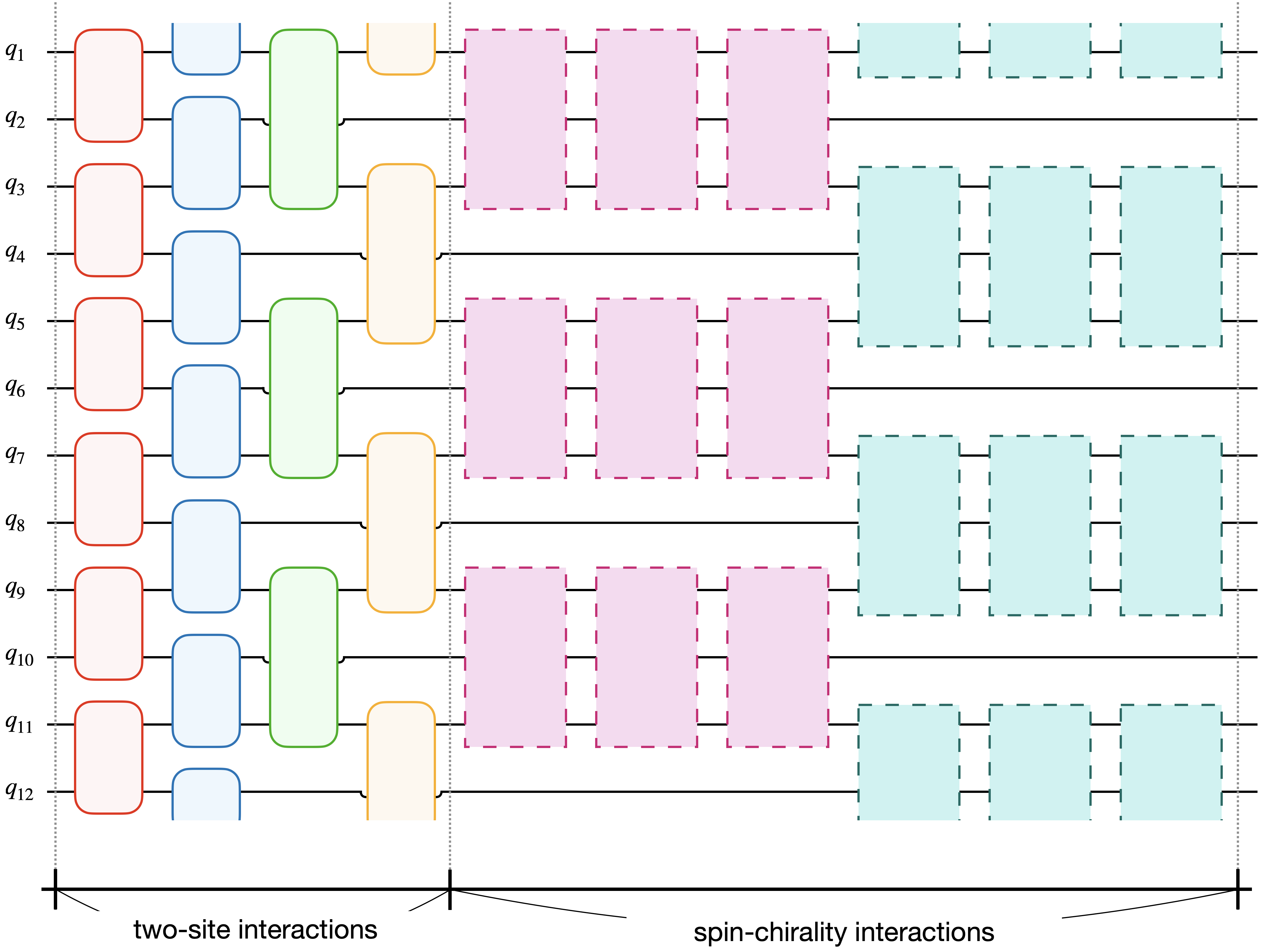
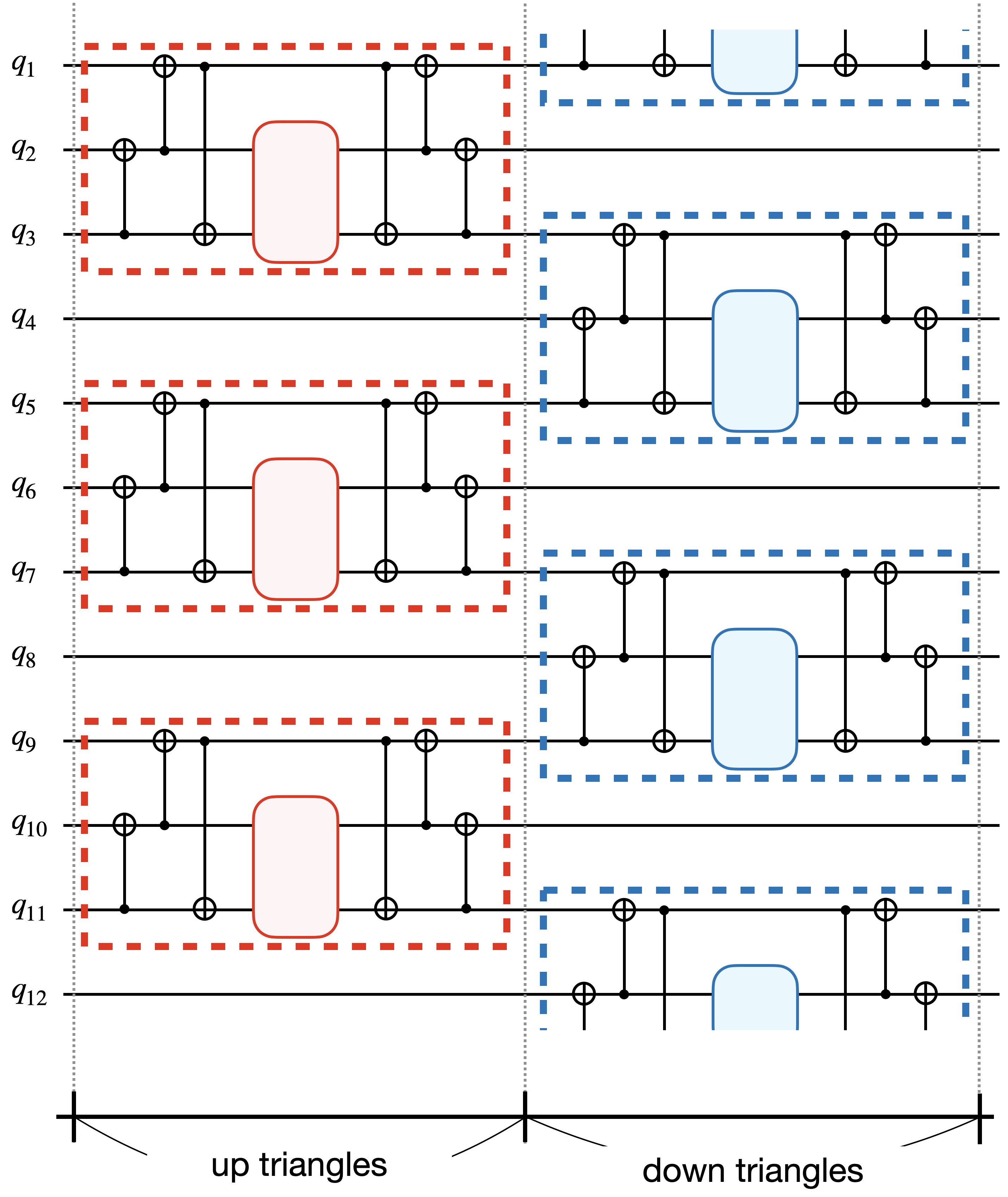
Figure 6: Elementary circuit blocks and first-order decomposition; (c) conventional approach, (d) symmetry-based, color-matched to Hamiltonian clusters.
Numerical and Analytical Results
Quantitative evaluation is a highlight. The proposed approach achieves more than three orders of magnitude reduction in state infidelity and estimation bias for average spin-chirality observables, both in noiseless simulation and when incorporating realistic depolarizing and dephasing noise.
Notably, the authors demonstrate that:
- The SU(2)-guided decomposition enables exact implementation of critical propagators associated with both two-body Heisenberg and three-body chiral terms.
- Circuit depth per Trotter step is reduced by a factor of 4–5 (for the models considered).
- Second-order product formulas become feasible without doubling the circuit depth when only two symmetry clusters are needed.
- Error reduction per CNOT and per non-Clifford gate is amplified, highlighting resource efficiency especially relevant for realistic near-term and early fault-tolerant devices.
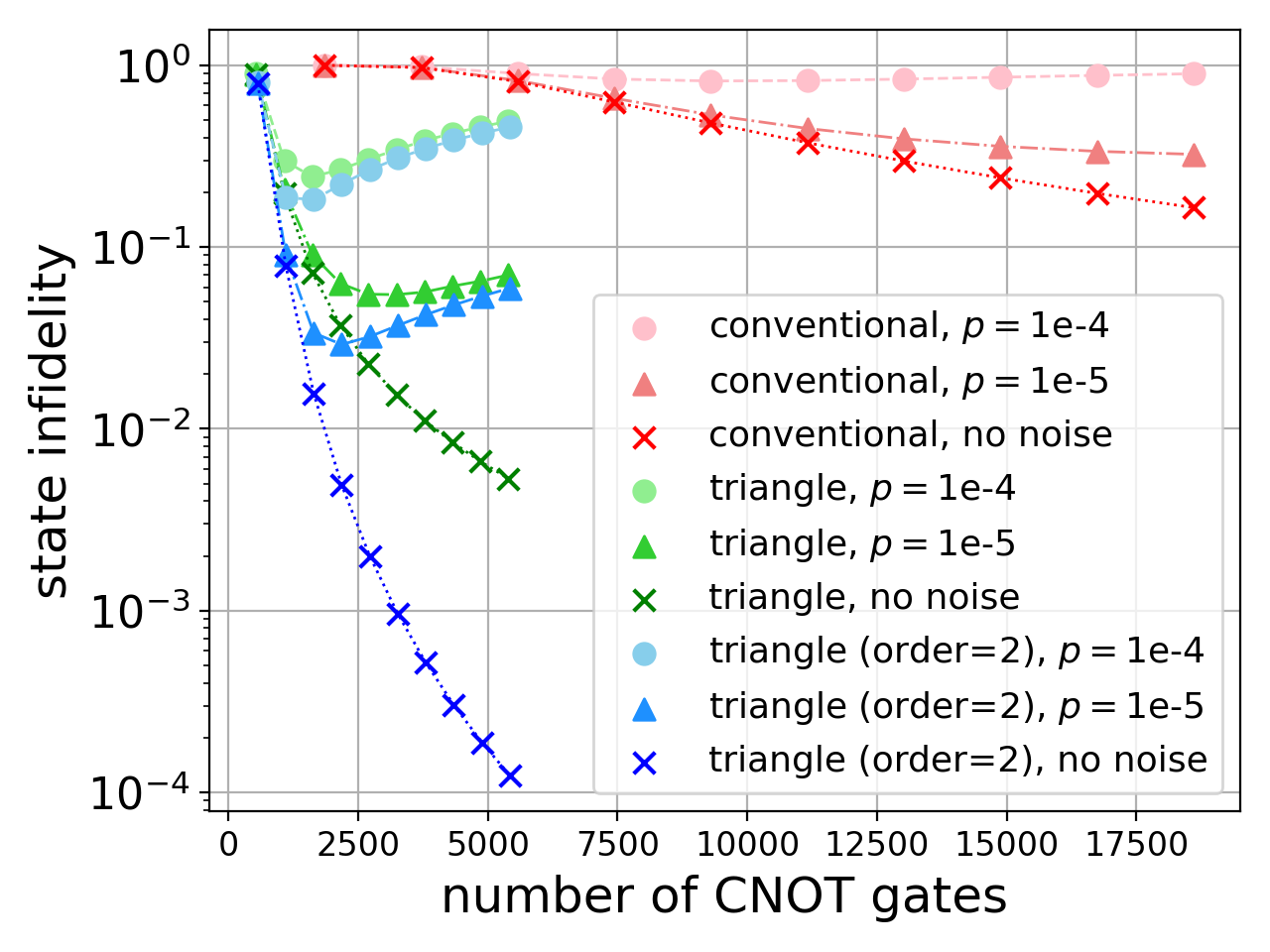
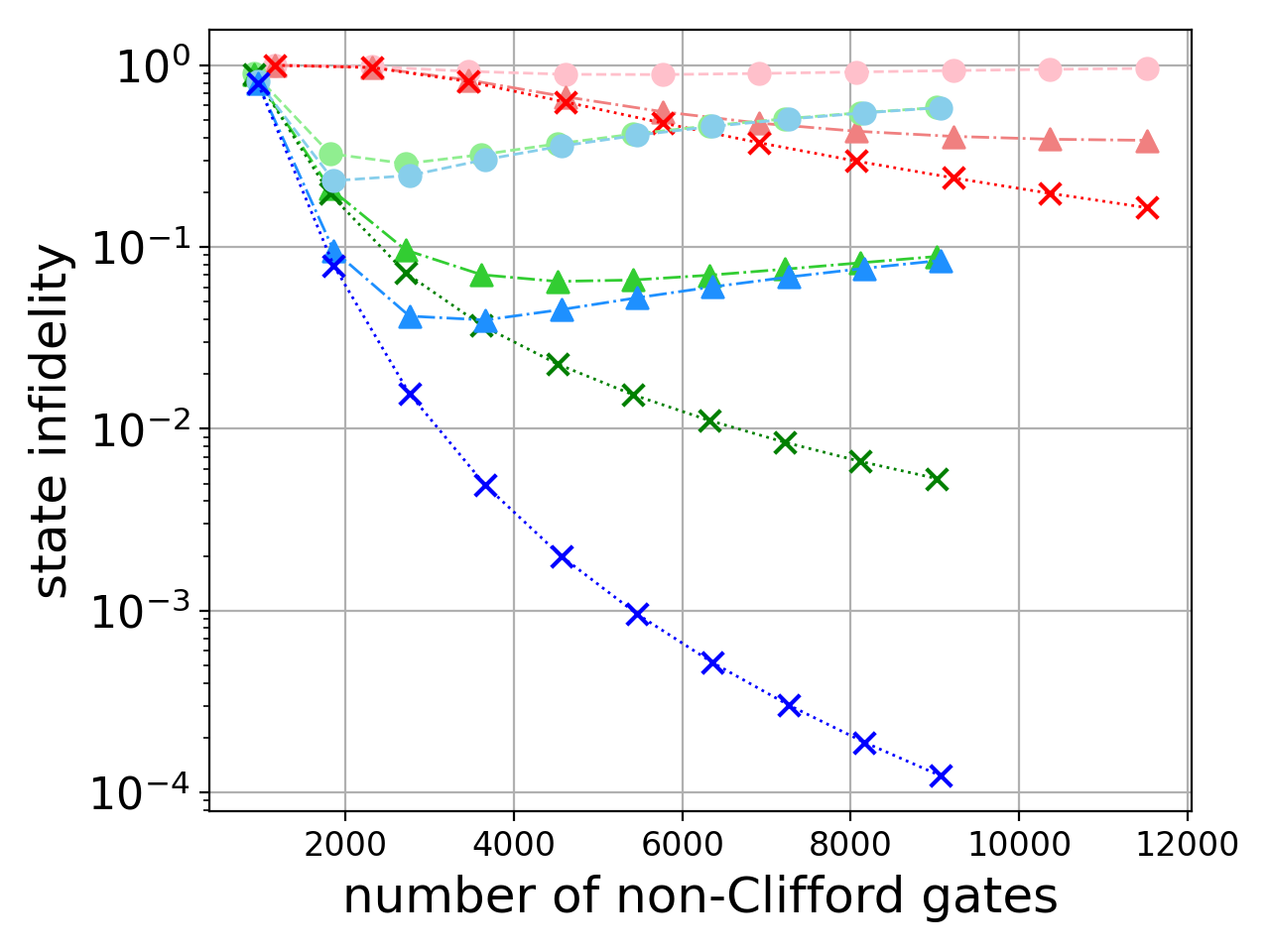
Figure 7: State infidelity as a function of circuit depth (CNOT count, non-Clifford count), comparing conventional and symmetry-based approaches, for multiple noise levels.
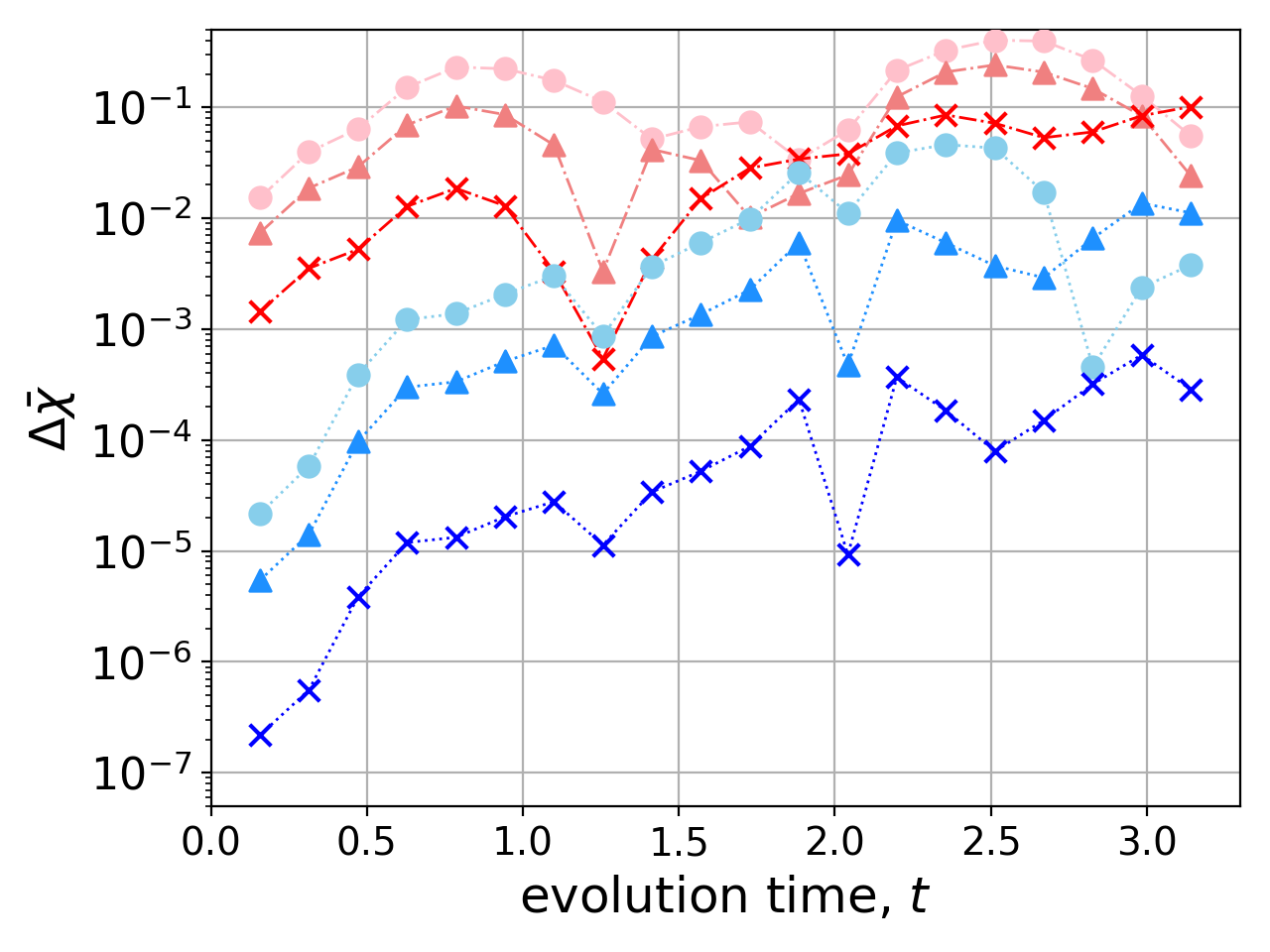
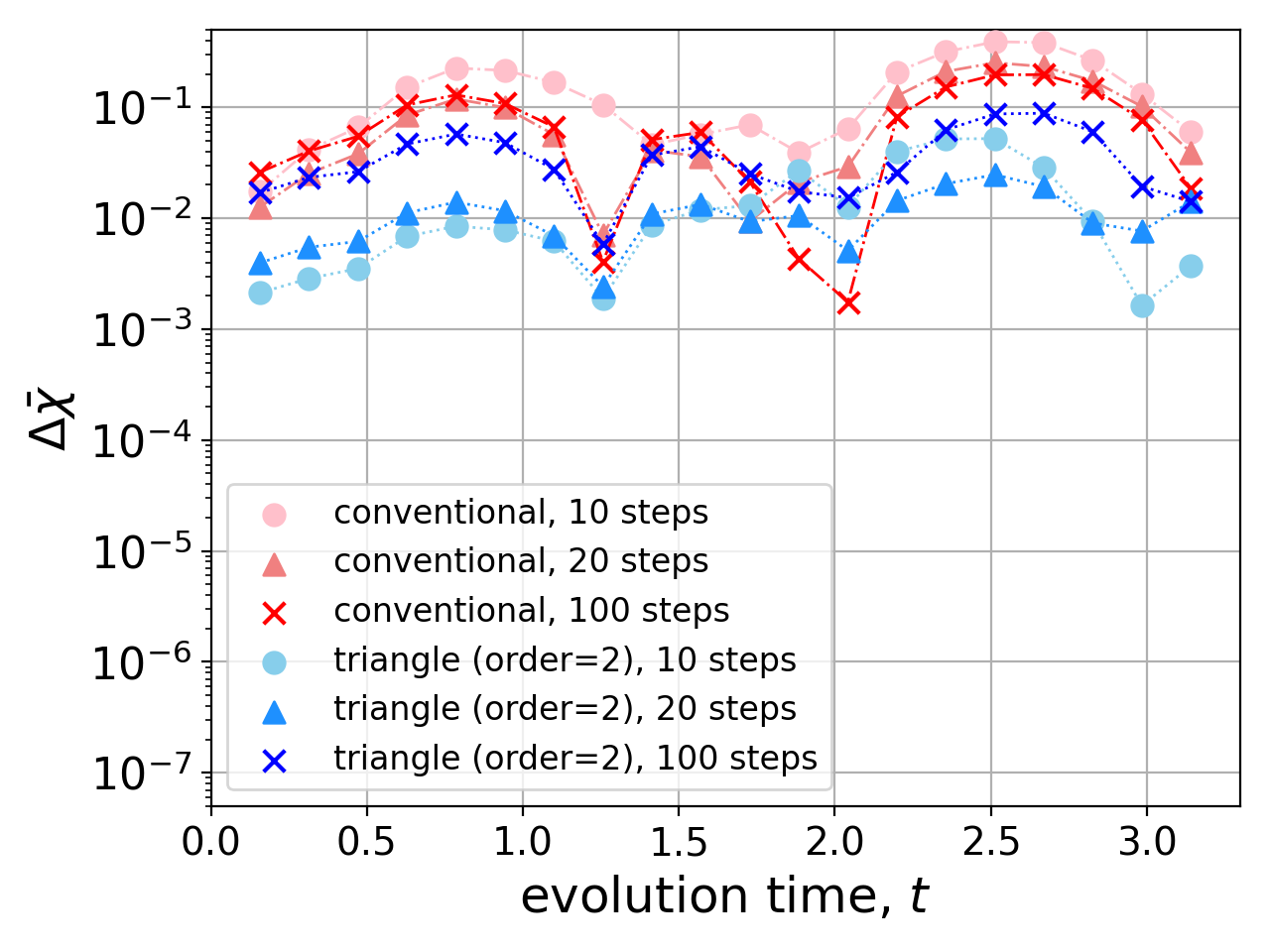
Figure 8: Estimation bias in average spin-chirality as a function of evolution time and Trotter step count, showing several orders of magnitude improvement under symmetry-based decomposition.
Furthermore, the method preserves exact global conservation laws (e.g., total spin) at each Trotter step, which conventional commutativity-based schemes generally violate, potentially leading to unphysical dynamics.
Applicability and Generality
While detailed case studies focus on Heisenberg/Kagome systems with chiral interactions, the theoretical framework and decomposition criteria directly generalize to a wide range of spin lattices and Hamiltonians exhibiting local SU(2) structure. The method is not representation-specific and can be hybridized with commutativity-based clustering when symmetry is partially present. Example decompositions for Ising chains, 1D/2D Heisenberg models, and higher-order interaction systems are discussed and analytically tabulated.
Implications and Outlook
By extending product-formula Hamiltonian decomposition from commutativity-based to symmetry-aligned clustering, the paper implements a more physically faithful digital simulation protocol. This has the following consequences:
- Practical Impact: Reduced error and circuit cost per step lowers the threshold for quantum utility, enabling access to larger, more correlated models on current and near-term quantum hardware.
- Conservation Law Preservation: By aligning decomposition with the system's physical symmetries, global quantities conserved by the Hamiltonian are preserved under time evolution—critical for physically meaningful many-body simulation.
- Extensibility: The method provides an archetype for future decomposition strategies, such as block clustering guided by different Lie group symmetries, embeddings for fermion-to-qubit mappings, and further integration with error mitigation or randomized Trotterization frameworks.
Future Directions
The paper notes several open avenues:
Conclusion
Symmetry-guided, structure-aware Trotter decomposition realigns digital quantum simulation with the intrinsic algebraic structure of the target many-body system. By moving beyond commutativity and employing local SU(2)1 symmetry as a guiding principle, this framework offers substantial reductions in circuit cost and Trotter error, rigorous preservation of conservation laws, and broader applicability across complex systems. The approach sets a new direction for Hamiltonian simulation design, opening realistic pathways to quantum advantage in simulation of highly entangled condensed matter and quantum chemistry problems (2605.16016).