- The paper shows that integrating historical user queries with population-level demand signals significantly improves intent disambiguation in e-commerce search, yielding up to 90% F1 improvement for gender predictions.
- It details a dual-module framework combining static profiling and time-sensitive personalization to accurately infer latent attributes such as size, gender, and age.
- Empirical evaluation on 900 annotated query-user pairs validates that personalized behavior data reduces candidate categories and enhances relevance before document retrieval.
IntentTune: Personalization and Population Signals for Resolving Ambiguous Query Intents in E-commerce Search
Motivation and Problem Scope
Accurately inferring user intent in e-commerce search is critical for optimizing retrieval, ranking, and user satisfaction. However, a large proportion of practical search queries are under-specified; token-level queries like "boots" or "shirt" provide insufficient explicit information regarding key dimensions such as gender, age group, or size. This ambiguity leads to degraded downstream retrieval, with existing models frequently categorizing these inputs as "unspecified" and thereby impairing relevance and conversion. While prior work in query understanding and intent detection has largely focused on inferring attributes directly from query text or broad assignment using global user activity, there has been limited exploration of integrating persistent, fine-grained user behavioral signals at the intent-inference stage of the retrieval pipeline.
IntentTune Framework
IntentTune is introduced as a systematic framework that addresses the resolution of ambiguous intents in under-specified e-commerce queries by leveraging two complementary sources:
- Population-level demand patterns: Aggregated marketplace behaviors distilled via category prediction models trained on historical search data.
- User-specific behavioral signals: Individualized behavioral context derived from past queries, browsing sessions, and static profile metadata.
Ambiguous queries that elude precise specification from baseline query understanding models—responsible for extracting size, age, gender, and category dimensions—are routed to IntentTune for supplementary disambiguation.
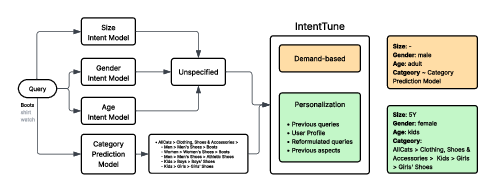
Figure 1: Overview of the IntentTune framework for routing ambiguous queries to population-based or personalized modules for intent inference.
The framework employs an internally hosted LLM to synthesize these heterogeneous signals and infer the most probable latent attributes for each ambiguous query, with special focus on fashion-related search.
Personalization Versus Demand Modeling
The baseline models, which include a set of independent BERT-based classifiers for size, gender, age, and category, exhibit high performance when explicit attributes are present, but default to "unspecified" for ambiguous queries. The demand-based approach seeks to recover missing intent dimensions by leveraging the taxonomy path and confidence of the top-ranked candidate from the category prediction model. However, demand-based signals are inherently limited, especially for attributes such as size, where no reliable population-level inference can be made.
In contrast, the personalized intent resolution module considers (a) static user profile attributes and (b) historical queries within a recent time window, prioritized by the confidence of baseline intent predictions. The LLM is prompted with these contextual details, along with definitions and possible classes for each dimension, to refine the predicted attributes.
Empirical Evaluation
A curated and manually annotated dataset forms the evaluation backbone, consisting of 900 query-user pairs sampled from real search activity and ambiguous queries. Each pair is enriched with relevant historical user data, and intent dimensions are labeled with respect to size, gender, age, and category. The dataset exhibits significant class imbalance and high frequency of under-specified queries, underscoring the difficulty of the problem.
Quantitative evaluation demonstrates substantial improvements when incorporating historical query-based personalization over both population-level demand and static profile methods. The most pronounced gains are observed for gender and age disambiguation, with 17% improvement in weighted F1 for age and over 90% F1 improvement for gender relative to the demand baseline. Size intent could only be addressed meaningfully through behavioral personalization due to lack of alternative context in other methods.
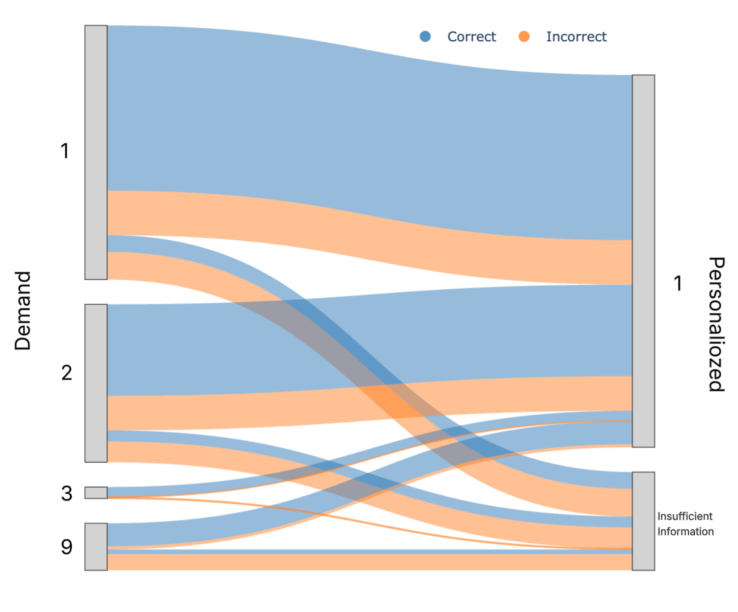
Figure 2: Historical-query-based personalization reduces the candidate category set and increases precision relative to demand-based category prediction for ambiguous queries.
Further, historical queries enable effective refinement of coarse or ambiguous category prediction output, frequently reducing the candidate set to a single—manually validated—category in more than two-thirds of evaluated cases.
Practical and Theoretical Implications
IntentTune’s integration of historical user behavior at the core of the intent inference pipeline introduces a shift from traditional post-hoc personalization applied only at the ranking stage. By resolving intent ambiguity before document retrieval, the system fundamentally increases recall and ranking precision for user-aligned items. The findings confirm that temporal local behavioral signals are significantly more indicative of latent intent than static or aggregate signals, especially for impulsive and highly personalized shopping behaviors.
Theoretically, the approach strengthens the case for multi-source context modeling—merging population-level priors and user-conditioned signals—as essential for robust query understanding in dynamic, high-cardinality domains. It also reveals the practical limits of relying solely on profile metadata and global activity in scenarios where query ambiguity is intrinsic and context-dependent.
Limitations and Directions for Future Work
Despite persuasive improvements, IntentTune’s design faces central challenges. Disparate or even contradictory signals across demand, profile, and historical activity can complicate intent reconciliation, particularly for users exhibiting diverse behaviors (e.g., shopping for both children’s and adult items). The cold-start problem persists for users with insufficient behavioral history or when general demand signals are sparse. These edge cases motivate further research into richer context modeling—including clickstream, user-item interaction history, and short-term session context—potentially using memory-augmented LLMs and hybrid explainer modules.
Addressing the scalability of manual annotation, generalization to broader product domains, and longitudinal validation through online A/B testing with user engagement metrics remain open areas for extension. The approach is also amenable to integration with more advanced commonsense knowledge extraction systems and persona modeling techniques (e.g., (Jiang et al., 7 Dec 2025, Chhikara et al., 28 Apr 2025)).
Conclusion
IntentTune advances the state of e-commerce search by directly integrating user-specific temporal behavioral data with population-level signals to resolve under-specified query intents. The empirical results demonstrate that behavioral personalization at the query-understanding phase enables sharp gains in intent disambiguation accuracy, particularly for key dimensions such as gender, age, and category. The theoretical insights elucidate the necessity of fine-grained, context-aware frameworks for intent modeling, with broad applicability for retrieval, recommendation, and conversational systems in commercial AI deployments.