- The paper refines planetary and stellar parameters using multi-sector TESS photometry and over 100 spectra, precisely measuring TOI-2134 c's eccentricity at 0.31±0.01.
- The paper employs advanced Gaussian Process modeling and spectral-domain post-processing to effectively mitigate stellar activity and isolate planetary signals.
- The paper reports a robust 4.7σ detection of a 59° obliquity for TOI-2134 c, challenging standard migration paradigms and underscoring the system's prime JWST targeting potential.
In-Depth Characterization of the Eccentric Temperate Giants in the TOI-2134 System
Introduction and Motivation
The TOI-2134 system provides a rare benchmark for dissecting the formation and dynamical evolution of multi-planet systems hosting both an inner mini-Neptune and an outer, eccentric, temperate sub-Saturn analog. This work delivers a comprehensive photometric and spectroscopic analysis of the TOI-2134 planetary system, combining high-cadence photometry from eight TESS sectors and an extensive trove of radial velocity (RV) measurements from HARPS-N, SOPHIE, EXPRES, and PARAS-2. The core objectives are to refine planetary and stellar properties, break long-standing degeneracies in the orbital architecture—specifically the eccentricity of the outer planet—and probe the spin-orbit alignment through the Rossiter-McLaughlin (RM) effect. Additionally, the paper explores formation scenarios, system completeness, and atmospheric characterization prospects for both planets (2607.01027).
Observational Data and Transit Analysis
The authors augment earlier datasets with three new, high-cadence TESS sectors and nearly 100 new spectra, providing dense phase coverage for both planets. The resulting photometric dataset encompasses eight TESS sectors with systematics-corrected light curves, enabling the identification of 23 transits for TOI-2134 b and two for TOI-2134 c.
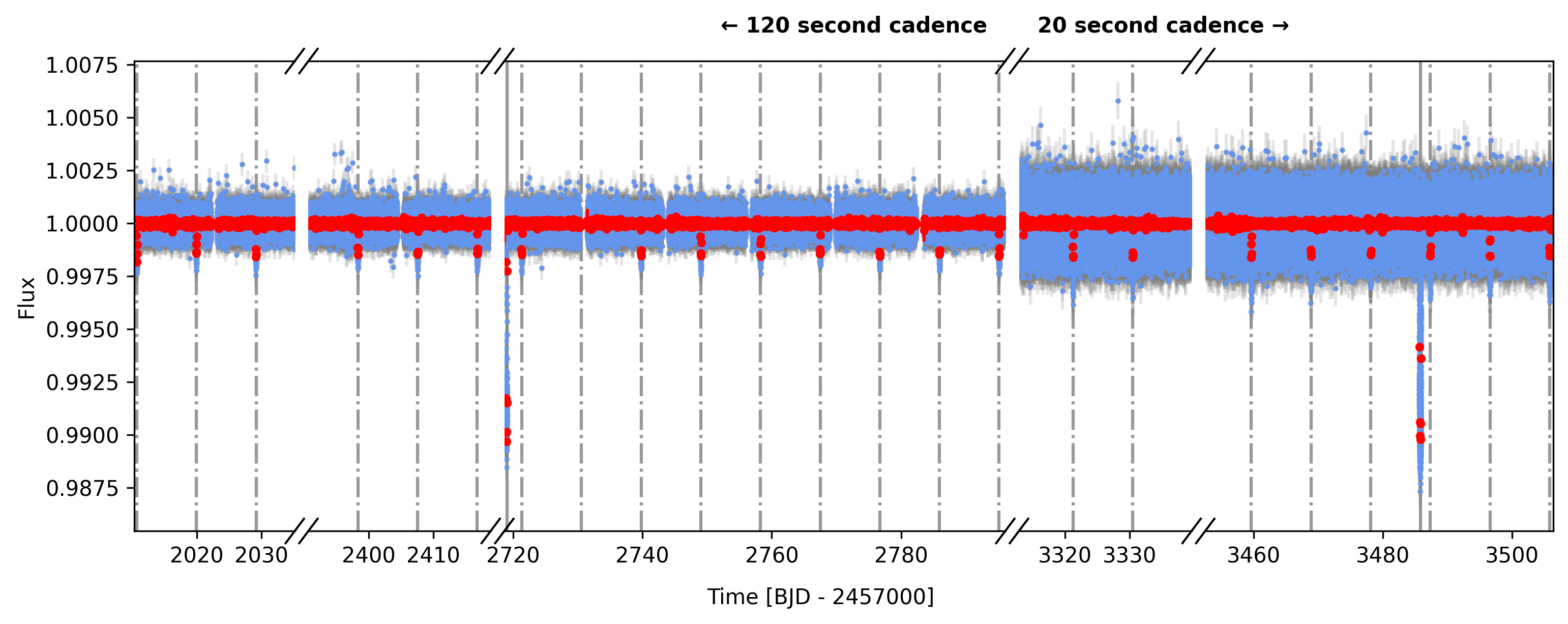
Figure 1: TESS systematics-corrected light curve over eight sectors, with transits of TOI-2134~b and c highlighted, and sector-dependent cadence evident.
The photometric analysis employs joint transit fitting with nested sampling, yielding robust constraints on period, radius, inclination, and impact parameter for both planets. The period of the outer planet, previously reliant on a mono-transit, is now sharply defined at $95.85$ days. All orbital timings and depths are determined at high significance, with photometric radius ratios measured at >80σ.
Transit timing variation (TTV) analysis of planet b, leveraging the dense multi-sector coverage, finds no significant deviations from a linear ephemeris. The absence of TTVs further disfavors high-eccentricity solutions for TOI-2134 c that had been previously consistent with mono-transit constraints.
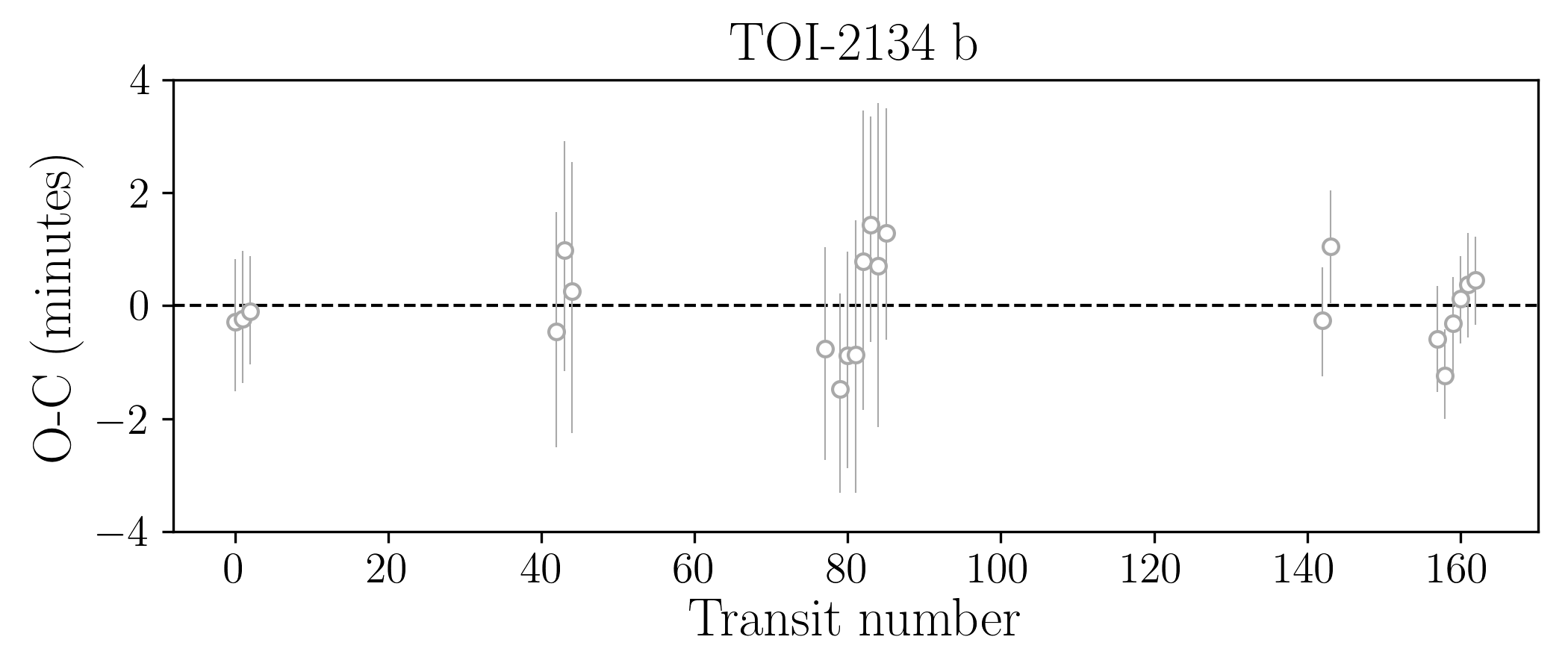
Figure 2: Observed-minus-calculated diagram of transit times for planet b shows no significant TTVs—constraining perturbations from the outer planet.
Radial Velocity Modeling, Activity Mitigation, and Model Selection
The RV dataset comprises 160 HARPS-N, 120 SOPHIE, and additional high-cadence points from EXPRES and PARAS-2, with state-of-the-art activity diagnostics derived in parallel. Periodogram analysis of the RVs and stellar activity indicators reveals a dominant planetary signal at 95.85 days and a considerable power excess at ∼48 days, consistent with the stellar rotation period, thus complicating unambiguous planetary characterization.
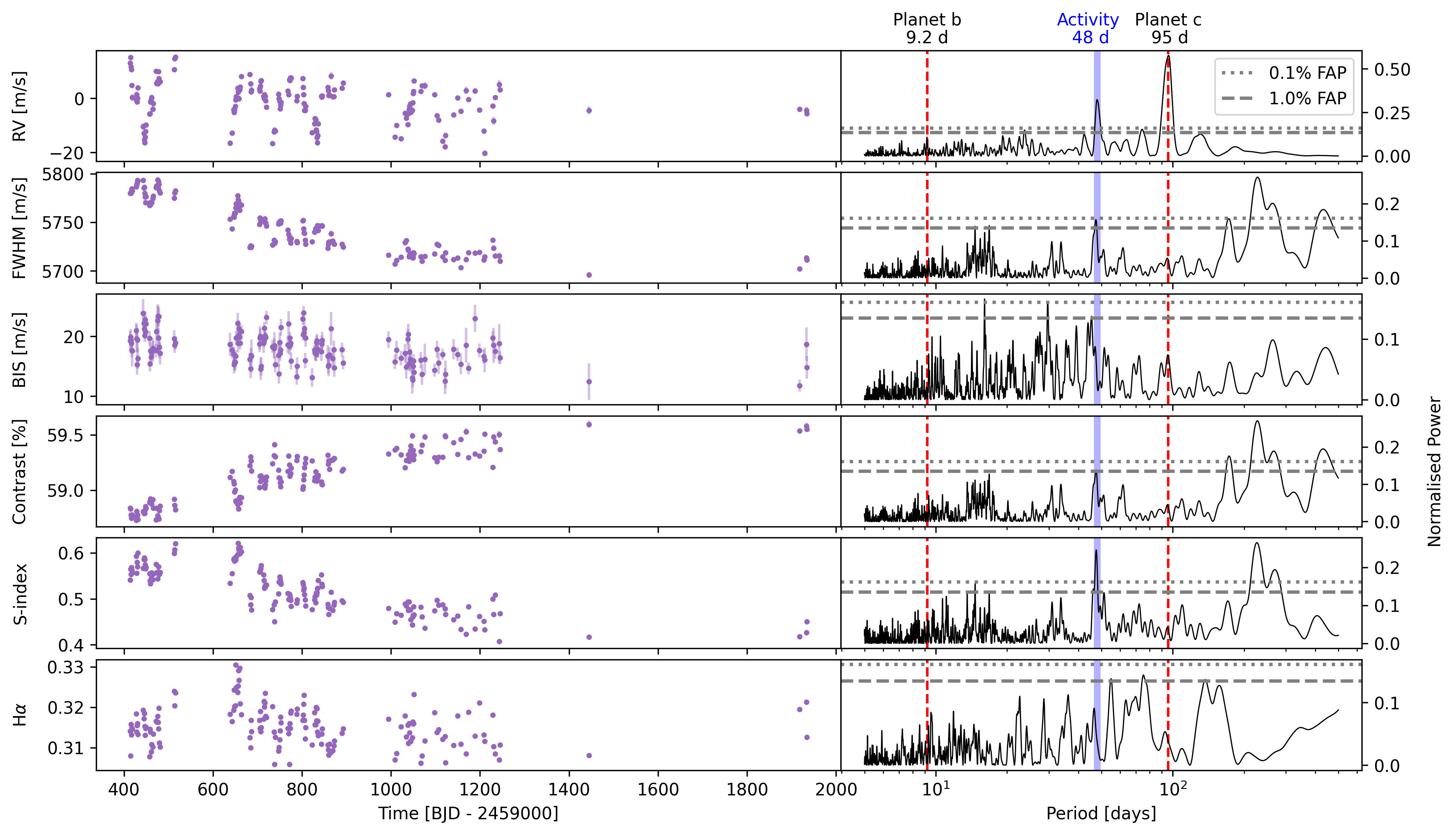
Figure 3: HARPS-N DRS data, including RV, line-profile, and activity indicators, with accompanying periodograms highlighting the star's rotational signature.
Direct, multi-technique mitigation of stellar activity is critical due to the confounding near-resonance between the outer planet's orbital period and the stellar rotation period or its harmonics. The authors employ parallel approaches:
- 1D and multi-dimensional Quasi-Periodic Gaussian Processes (GPs) jointly fit to the RVs and activity indicators,
- Spectral domain post-processing with YARARA to empirically suppress activity features,
- Doppler and shape separation via tweaks/scalpels, which independently extract activity-induced and planetary RVs,
- Keplerian models with linear and polynomial trends to test for long-term RV components.
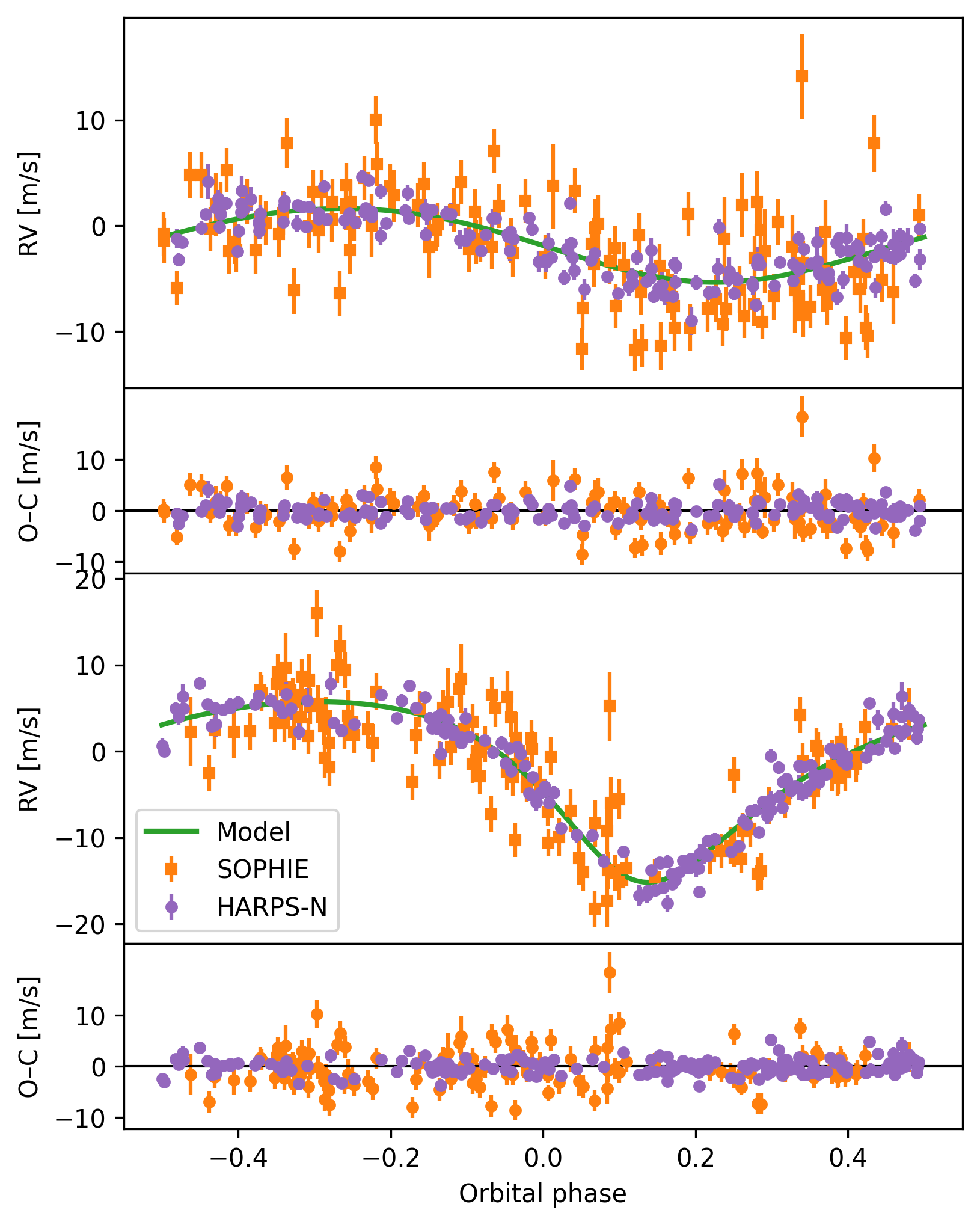
Figure 4: Phase-folded RVs for both planets and best-fit eccentric Keplerian models, demonstrating the improved signal discrimination and residuals.
All activity-mitigation methods consistently yield a unimodal eccentricity distribution for TOI-2134 c, with the joint RV plus activity-indicator GP analysis yielding ec=0.31±0.01 and Kc=10.45±0.24 m/s for the sub-Saturn, and Kb=3.49±0.18 m/s for the mini-Neptune. The previous high-eccentricity (e > 0.6) solutions are statistically rejected.
Detection limits analysis, using injection-recovery and dynamical stability constraints, excludes inner companions of >3 M⊕ and bodies between b and c above >5 M⊕, and excludes any stable orbits with P=50–185 days due to the strong eccentricity of the outer planet.
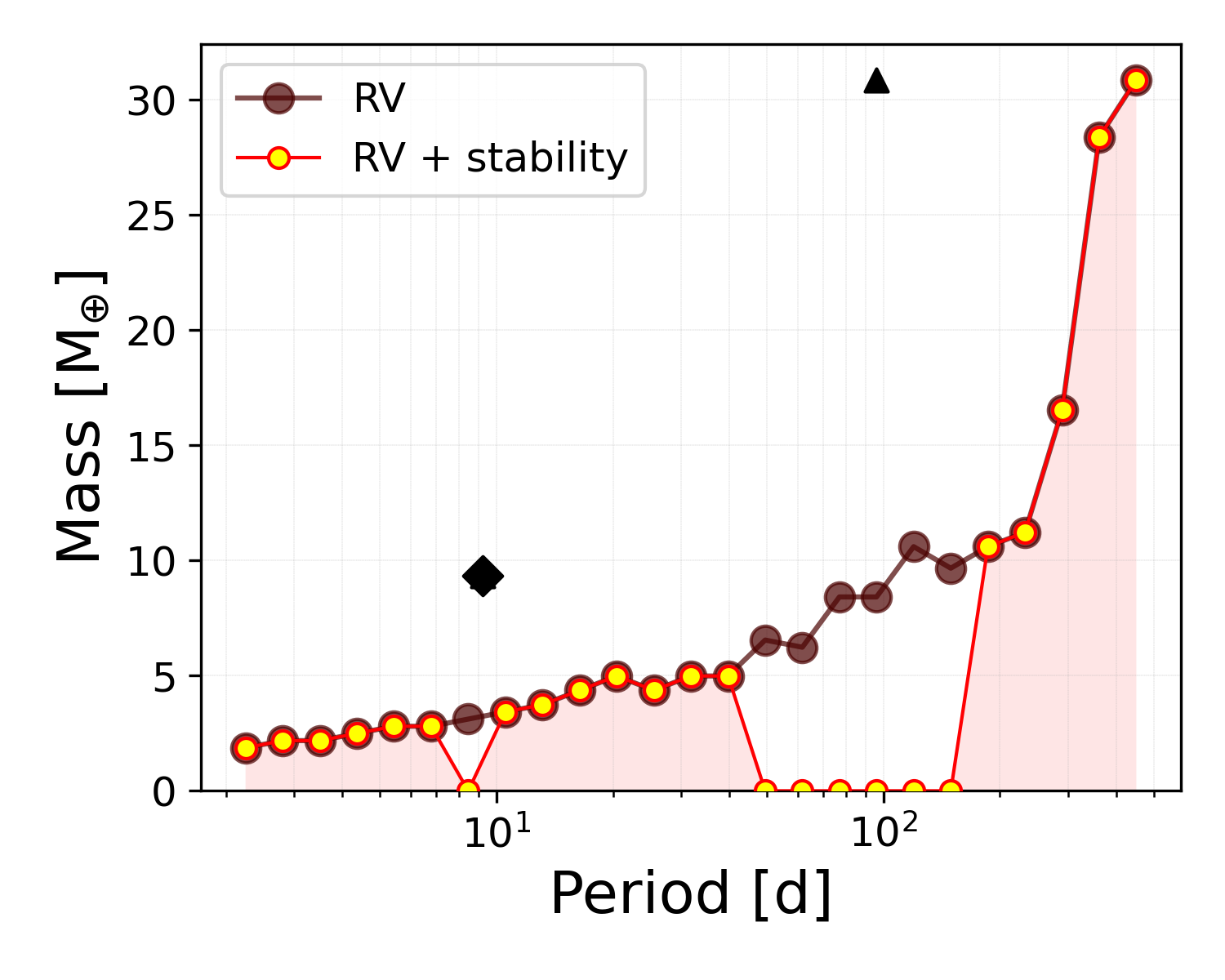
Figure 5: Planet mass-period detection limits incorporating RV, dynamical stability, and Gaia astrometric constraints, with broad exclusion of undetectable parameter space.
Spin-Orbit Alignment and Rossiter-McLaughlin Effect
The RM effect is probed for both planets using dedicated simultaneous spectroscopy. For the inner planet, no RM signal is detected at the achievable S/N. For TOI-2134 c, a 4.7σ detection of the RM effect is reported, measuring an obliquity of >80σ0. This result is notable: in contrast to the apparent alignment found for most long-period gas giants, TOI-2134 c exhibits a significant projected misalignment, suggesting a dynamical excitation rather than a quiescent disk migration history.
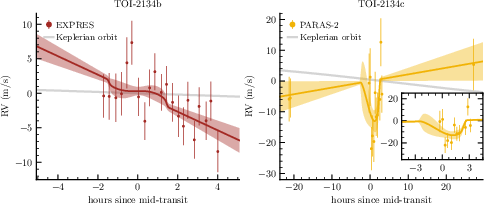
Figure 6: Rossiter-McLaughlin observations for TOI-2134 b (no detection) and c (significant misalignment; right panel), with model and uncertainties.
Interior Structure and Atmospheric Characterization
Detailed interior structure modeling is conducted for both planets. TOI-2134 b is found to be a low-density mini-Neptune with bulk density >80σ1 g/cm>80σ2, requiring a significant volatile envelope, with water-rich and water-poor formation scenarios allowed.
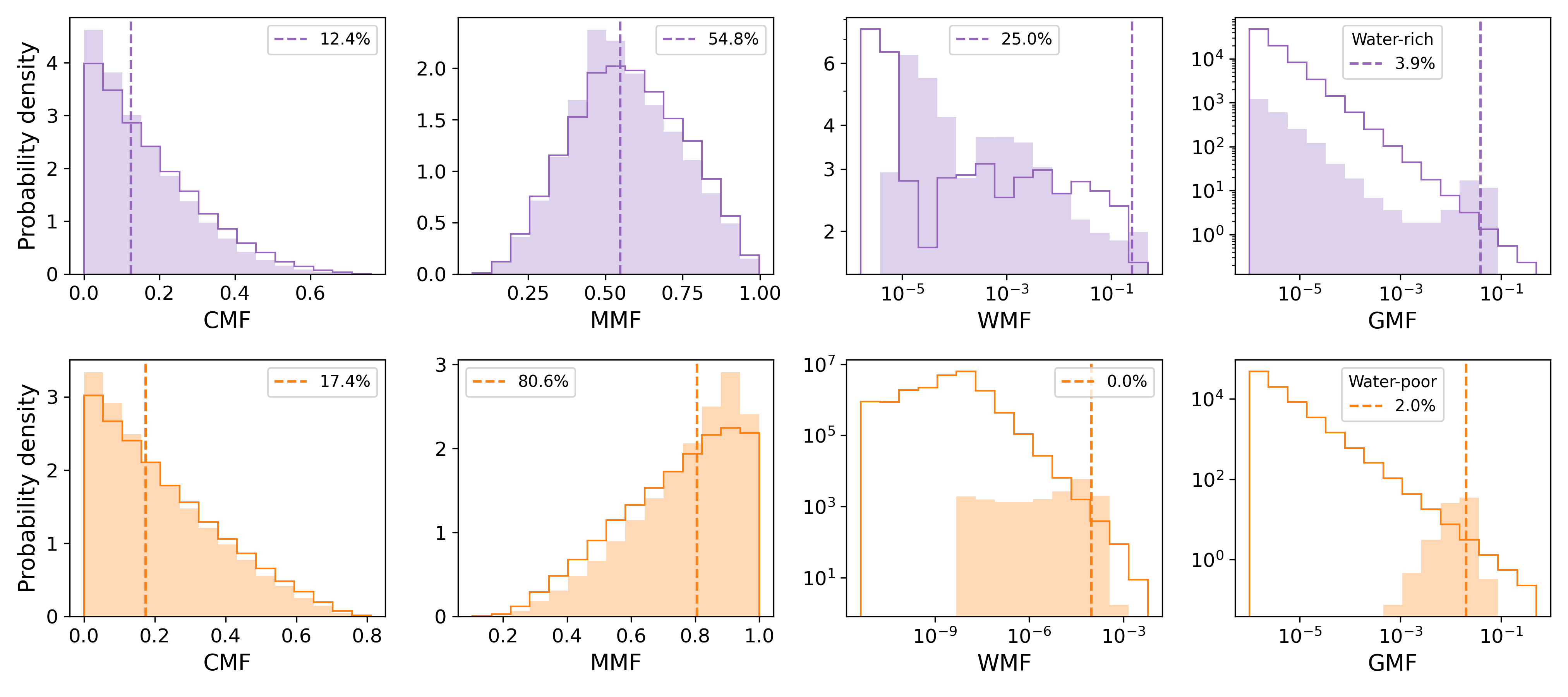
Figure 7: PlaNETic interior composition posteriors for TOI-2134~b in water-rich (top) and water-poor (bottom) scenarios, highlighting envelope and core/mantle contributions.
TOI-2134 c, with >80σ3 and >80σ4, is consistent with a sub-Saturn CMF of 0.5–0.6, and an atmospheric metallicity between >80σ5–>80σ6 solar, in line with observed trends for cold giants. A density of >80σ7 g/cm>80σ8 necessitates a substantial H/He envelope.
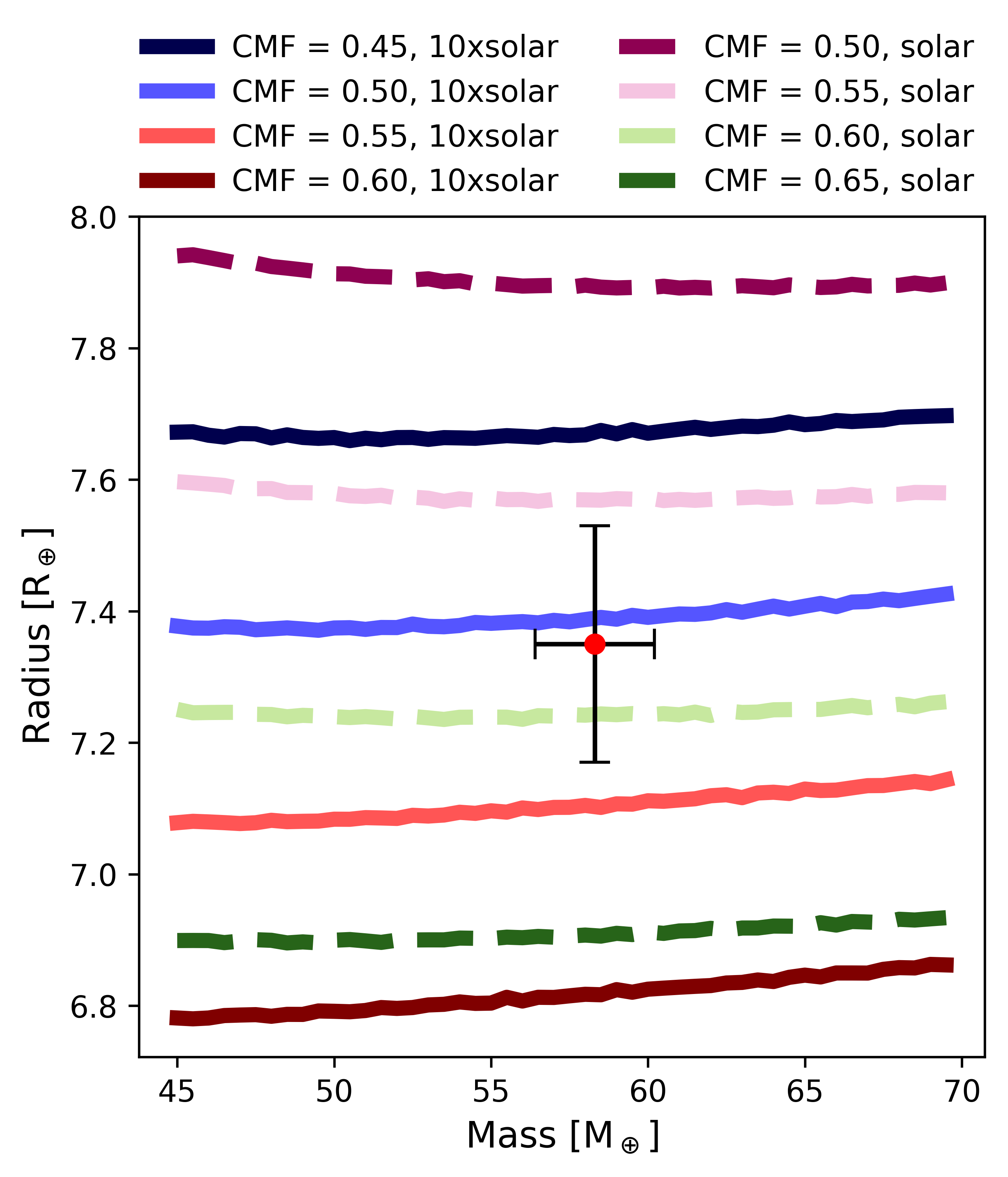
Figure 8: Mass-radius tracks for TOI-2134~c for varying core mass fractions and metallicities; observed parameters are consistent with a core-heavy, sub-Saturn profile.
Atmospheric transmission models show that both planets are among the best current temperate targets for JWST spectroscopy, with TOI-2134 c especially favorable for nitrogen chemistry at low equilibrium temperatures (>80σ9 K). Simulated spectra indicate prominent H∼0O, CH∼1, and for the outer planet, NH∼2 features, all accessible to NIRSpec and MIRI.
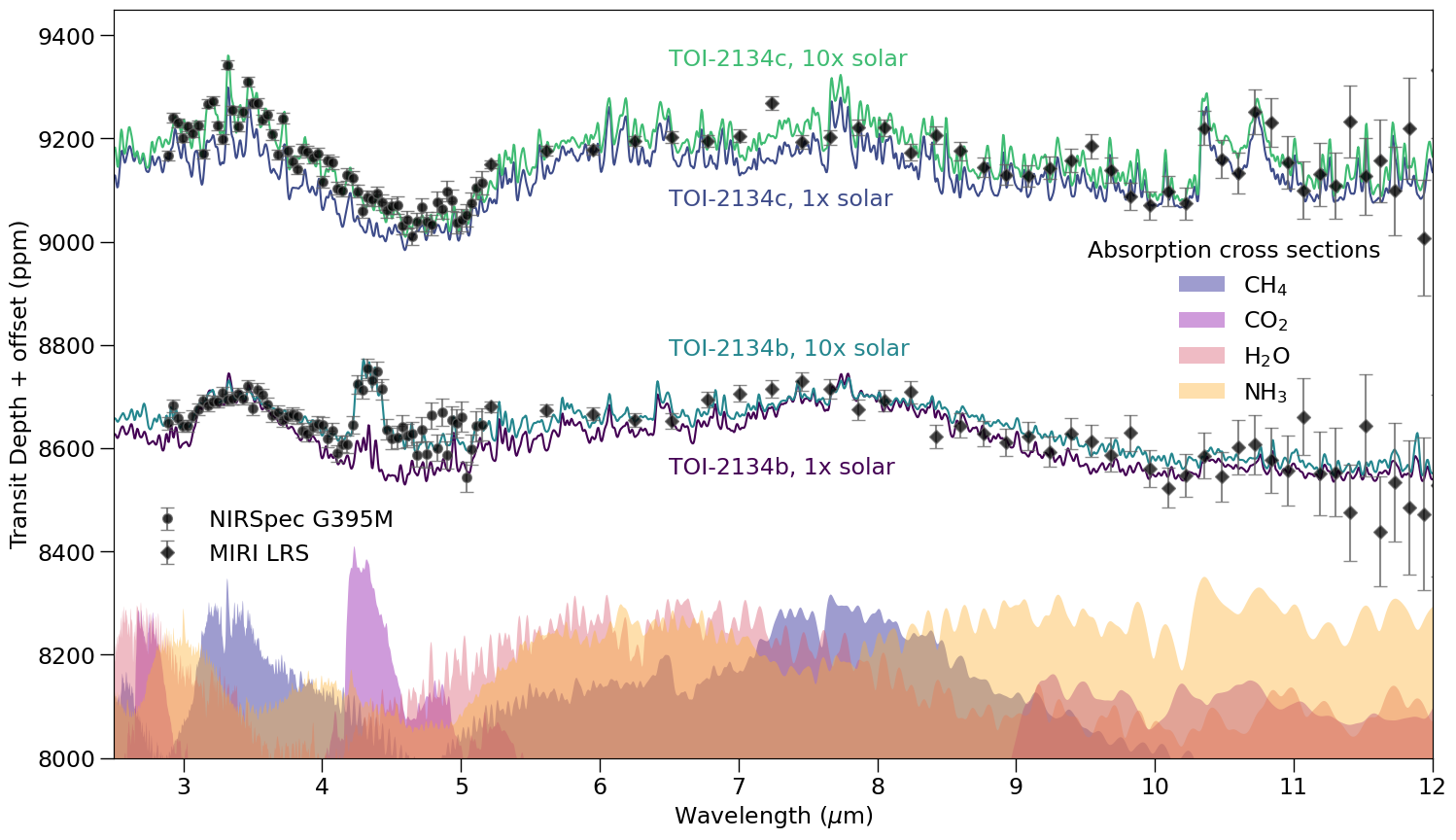
Figure 9: Model transmission spectra, including instrument simulations, with predictions for major molecular features at multiple metallicities and instrument bands for JWST.
Dynamical Context and Formation Scenarios
The orbital configuration—an inner mini-Neptune near-circular, and an outer eccentric temperate sub-Saturn with a large mutual inclination to the stellar spin—poses formation constraints that exclude simple disk-driven migration. No evidence is found for massive additional perturbers within detection limits. The remaining pathways are:
- Coplanar high-eccentricity migration mediated by a yet undetected, eccentric outer massive companion, though parameter space for such an object is severely constrained by RVs, stability, and Gaia astrometry.
- Secular dynamical instabilities and subsequent damping, which are less likely given the observed coplanarity and limited mutual inclination inferred from transits, but are not excluded.
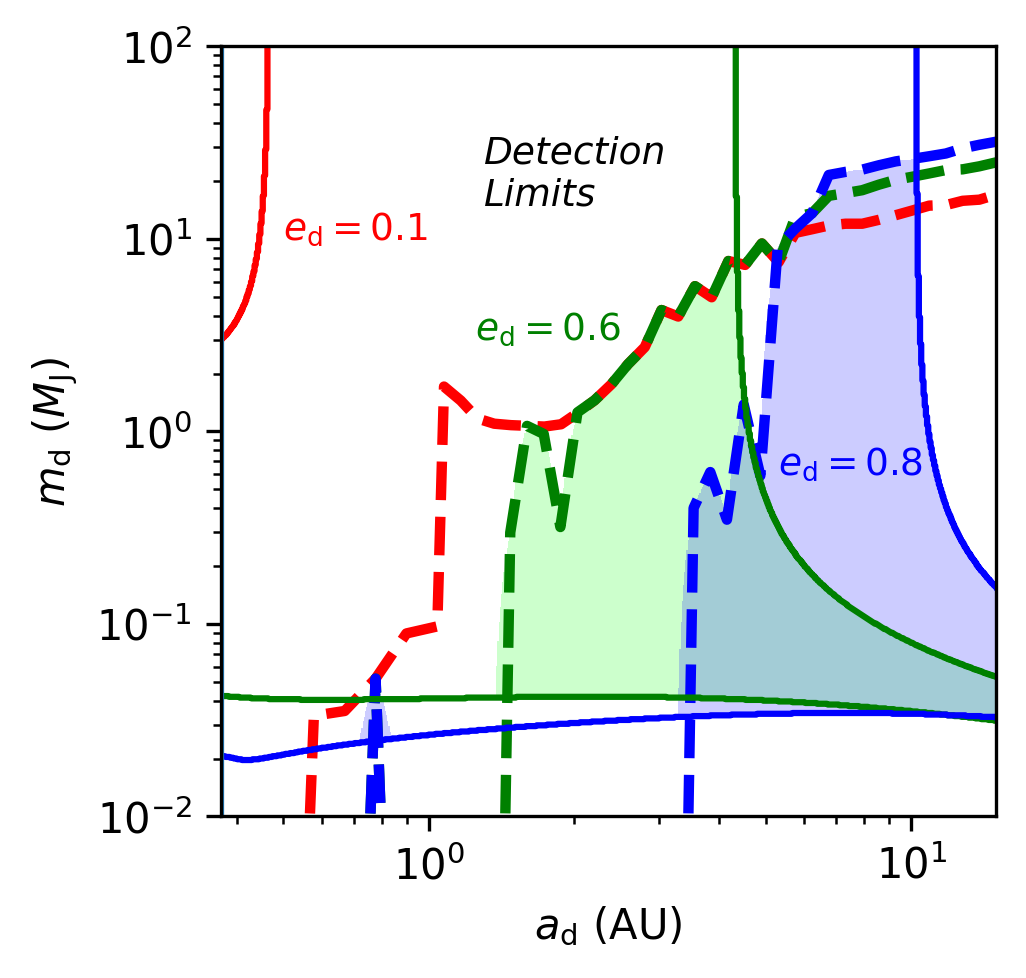
Figure 10: Parameter space of potential undetected companions capable of driving eccentricity excitation in TOI-2134 c, with constraints illustrated for different perturber eccentricities and detection limits.
The measured obliquity and eccentricity of TOI-2134 c compared to population-level distributions underscore an atypical reservoir for this class of planets, with implications for migration channels, planet-planet scattering efficiency, and coplanarity maintenance.
System Architecture and Context
The mass-radius relation for both planets places TOI-2134 b just above the 100% water line, and TOI-2134 c in a sparsely populated transition between sub-Neptunes and Saturn analogs, consistent with current probabilistic forecasts and interior models.
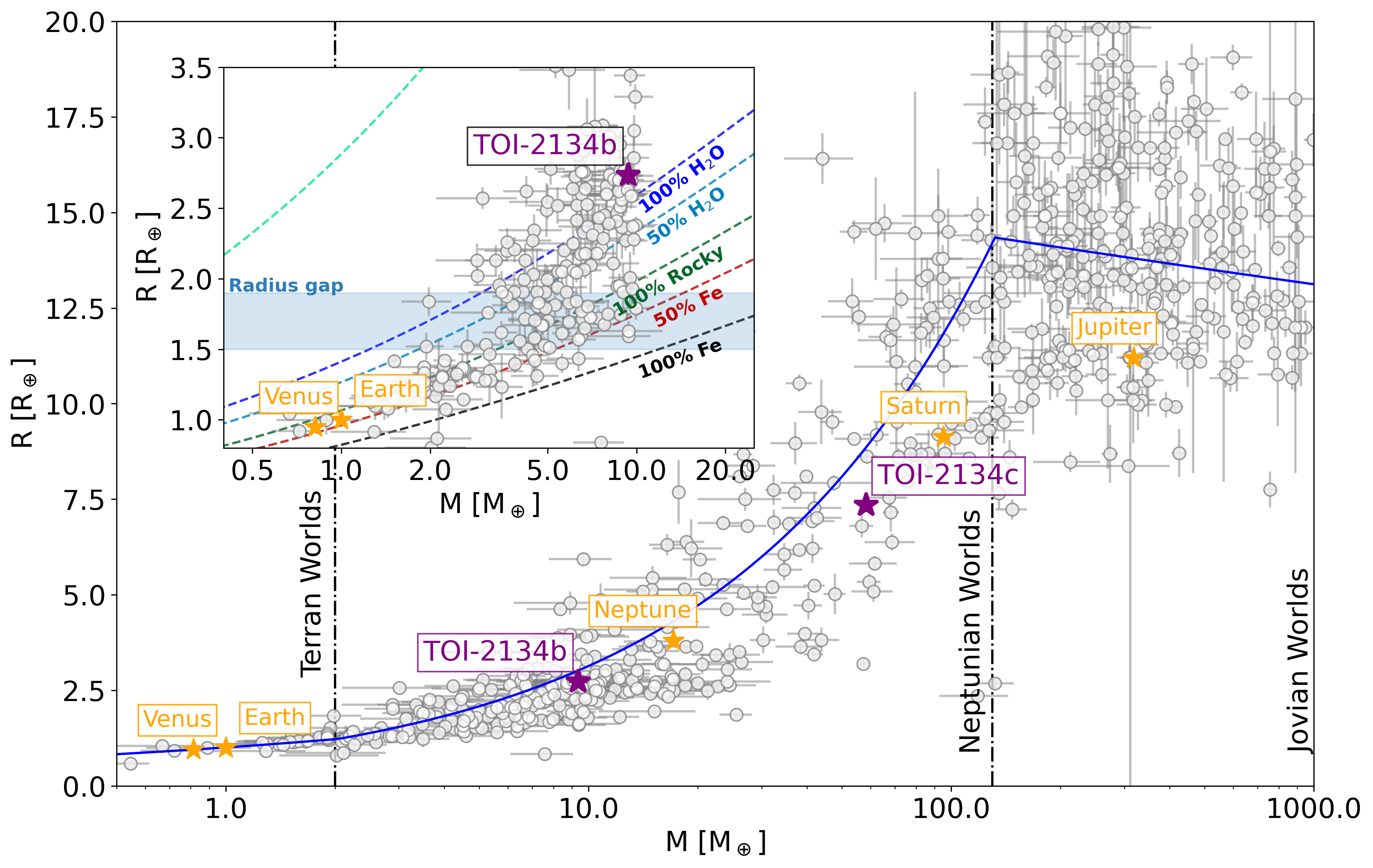
Figure 11: Mass-radius diagram for confirmed exoplanets, with TOI-2134 planets as purple stars and compositional regimes indicated; both planets reside in key transitional regions.
System architecture visualizations place TOI-2134 c partially within the habitable zone during periastron, raising the potential for habitable exomoons should they exist.
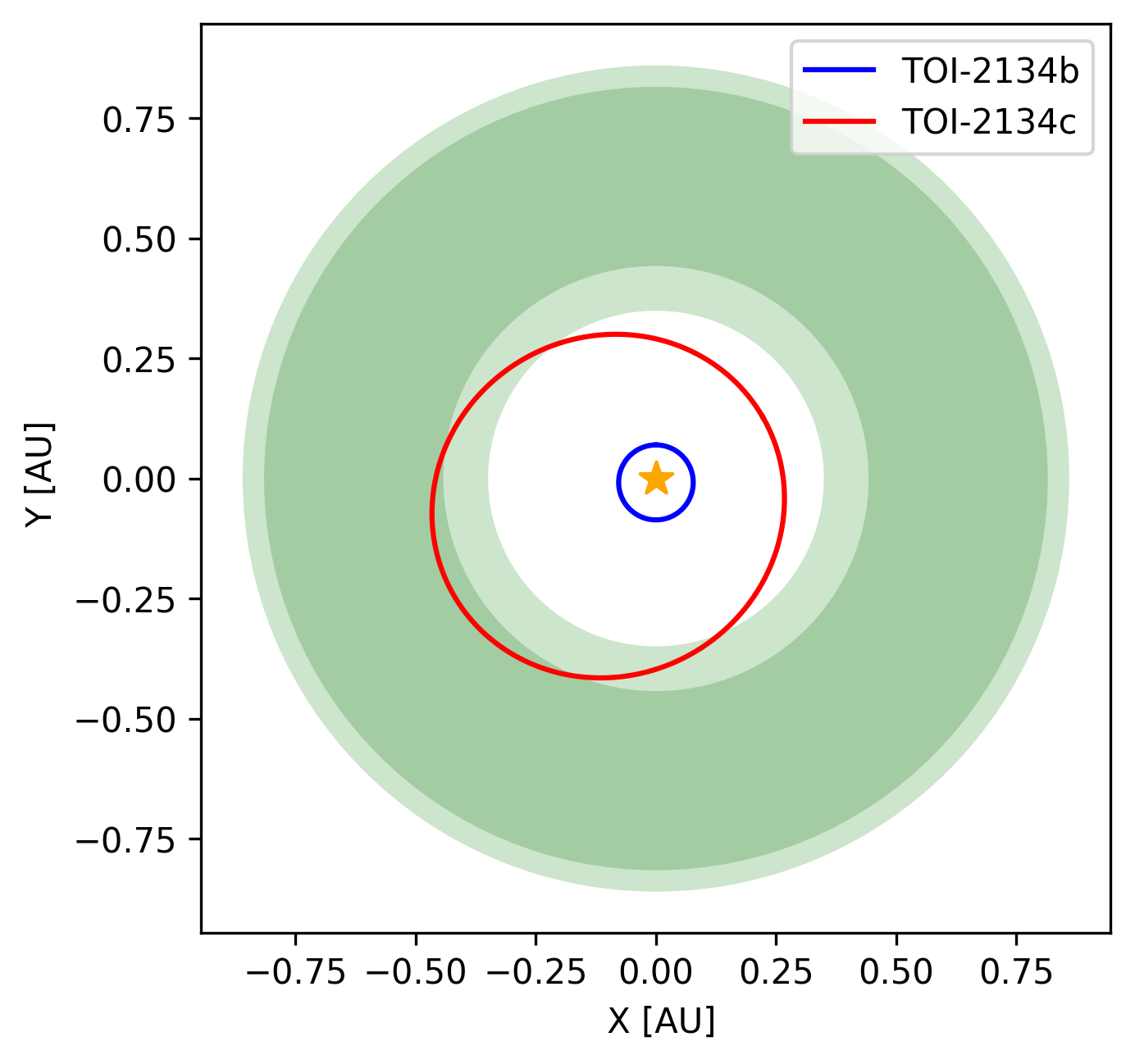
Figure 12: System structure with orbits, habitable zones, and planetary phases, illustrating TOI-2134 c's traversal through habitable insolation levels.
Conclusion
This analysis establishes TOI-2134 as a high-precision, multi-sector, multi-instrument benchmark for the evolution of temperate gas giants with inner companions. The rigorous application of joint photometric and RV modeling, advanced stellar activity mitigation, and interior/atmospheric modeling produces decisive advances:
- TOI-2134~c's eccentricity is measured as ∼3 with high statistical significance, definitively ruling out earlier high-eccentricity hypotheses.
- A robust, ∼4 detection of an obliquity of ∼5 for the outer giant sharply contrasts with the typically aligned longer-period transiting giants, challenging dominant migration paradigms.
- System completeness analysis excludes any massive, dynamically-stable companions between known planets.
- Both planets, especially TOI-2134~c, are identified as prime JWST targets in the temperate, sub-Saturn mass regime, permitting unprecedented atmospheric characterization—including the prospect of constraining nitrogen chemistry and water clouds.
Future theoretical and observational work, including further astrometric and RV campaigns and high-SNR space-based spectroscopy, will expand on these results to test migration scenarios, refine obliquity population statistics, and probe exoplanet atmospheric processes in critical but sparsely sampled parameter space.