- The paper introduces a novel lookahead context engineering method that decomposes transformations to significantly reduce TTFT spikes.
- It integrates asynchronous precomputation of KV caches for strategies like summarization, truncation, offloading, and isolation to minimize latency.
- Empirical results demonstrate up to 11.9× TTFT reduction, ensuring robust, efficient performance in long-horizon, multi-turn LLM workflows.
SmoothAgent: Efficient Long-Horizon LLM-Based Agent Serving with Lookahead Context Engineering
Introduction and Motivation
LLM-based agents have become central for executing multi-turn, complex workflows by integrating LLM inference with tool usage and interactive feedback. However, as agent interactions accumulate, so does the context, leading to sharp increases in GPU memory usage and computation. Critically, these growing contexts can induce “context rot,” a phenomenon where model reliability degrades even within supported context lengths. This dynamic motivates aggressive context engineering—strategies for reducing, summarizing, or externalizing segments of the agent context—but these strategies are themselves a source of substantial overhead, particularly due to repeated invalidation and reconstruction of key-value (KV) caches.
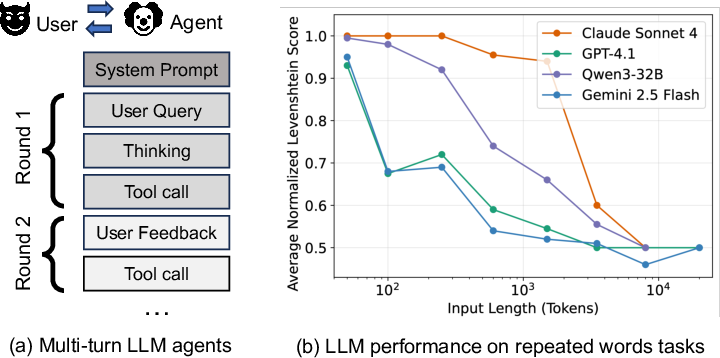
Figure 1: Without context engineering, contexts grow rapidly, causing context rot and degrading LLM agent performance.
Techniques such as context truncation, summarization, and offloading directly address context rot but require transformation-induced cache recomputation, considerably increasing time-to-first-token (TTFT) and tail latency. These TTFT spikes (see Figure 2 and Figure 3) are especially detrimental in latency-sensitive agentic applications.
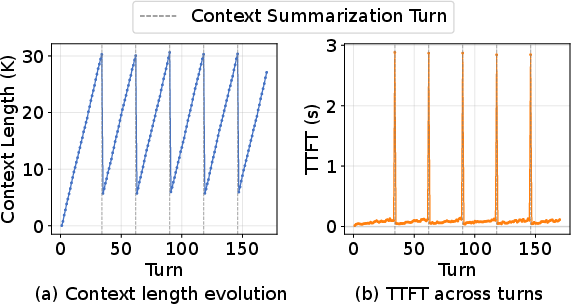
Figure 2: Summarization controls context but incurs significant TTFT at transformation points.
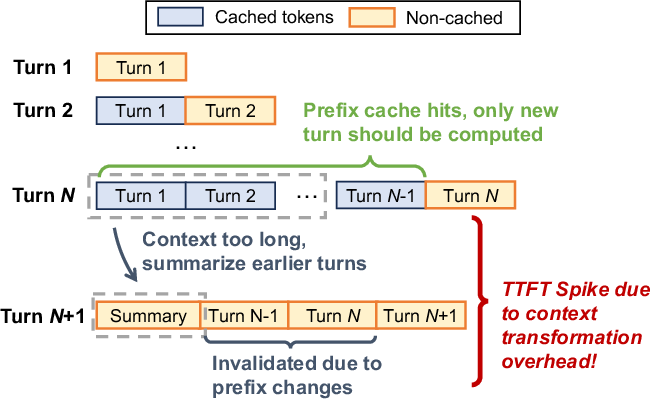
Figure 3: Cache invalidation and transformation costs together cause pronounced TTFT spikes.
Lookahead Programming Model and Segment-Decomposability
The core insight of SmoothAgent is that context transformations—when appropriately formulated—are segment-decomposable: the transformation over a context is decomposable into independent transformations of its constituent segments. Formally, for a context C partitioned as S1,S2,...,Sn, if T(C)=T(S1)∥T(S2)∥...∥T(Sn), then T is segment-decomposable, and each segment’s transformation is independent of future tokens.
By recognizing segment-decomposability, SmoothAgent proposes a lookahead programming model: agent frameworks express context engineering strategies as asynchronous lookahead transformations. The runtime then maintains both a working context and a lookahead context, scheduling computation of transformed prefixes and KV caches ahead of the actual commit point. This decouples transformation from latency-critical paths, amortizing the overhead and enabling direct KV cache reuse.
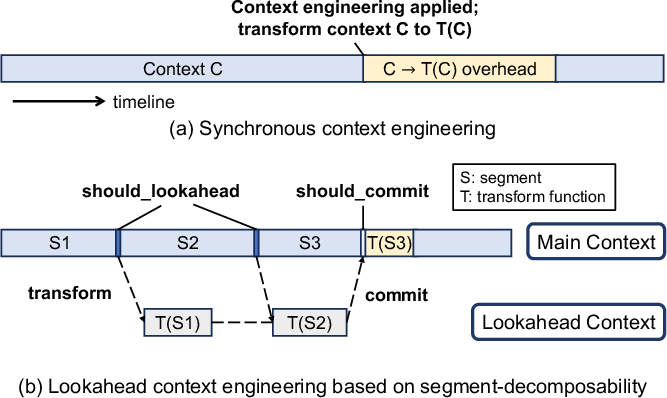
Figure 4: Lookahead execution: normal agent logic proceeds; lookahead asynchronously precomputes transformed cache segments, spliced in upon commit.
Instantiating Segment-Decomposability
Offloading
In offloading, bulky observations are replaced with references to external storage as soon as the corresponding segment is complete. The decision and transformation for each segment are independent, making it straightforward to precompute the transformed context in the background.
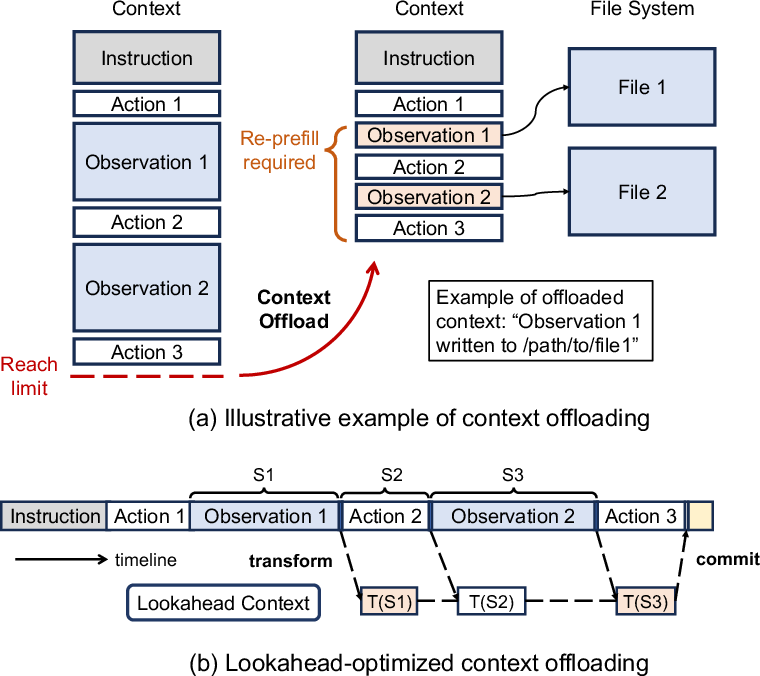
Figure 5: Offloading replaces in-context data with references, allowing advance preparation of transformed KV cache.
Reduction: Truncation and Summarization
- Keep-Recent-K Truncation: Only the most recent K segments are kept. Transformation is limited to the context window boundary, and history removal is locally determined, supporting asynchronous reduction.
- Summarization: Older spans are summarized into a short synopsis. By leveraging soft trigger thresholds, the summarization can be initiated in advance, further amortizing the transformation cost.
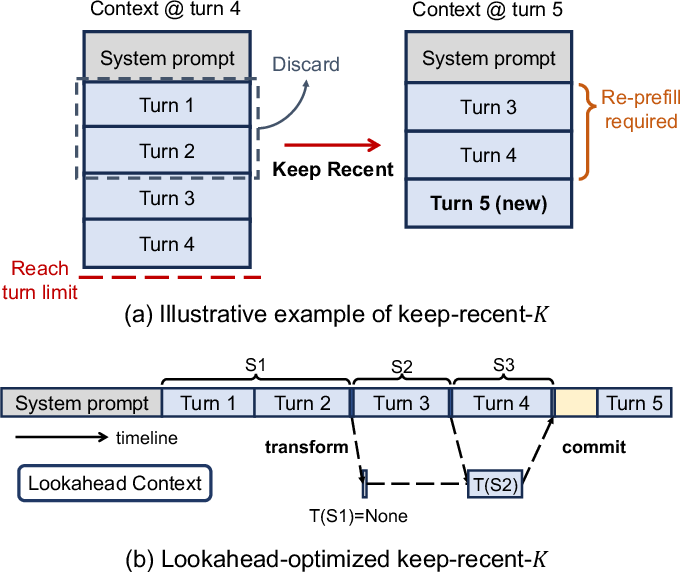
Figure 6: Keep-Recent-K truncation drops old context segments, supporting segment-decomposability.
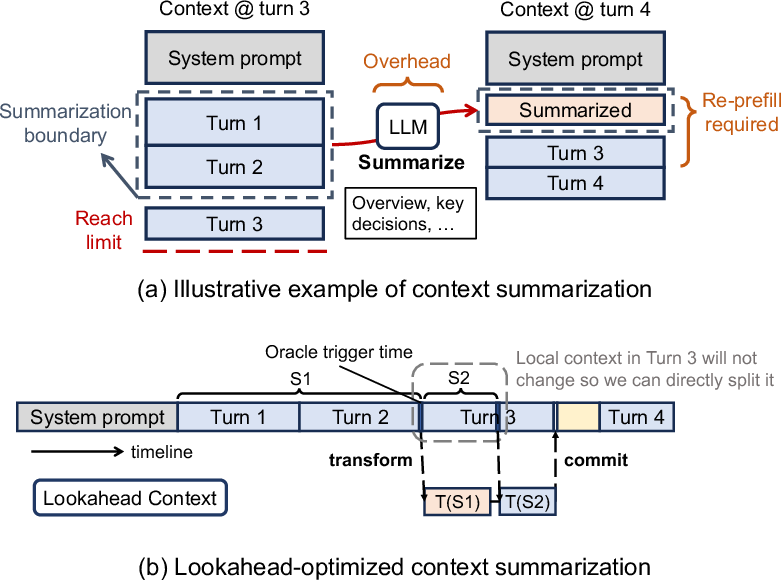
Figure 7: Summarization reduces context by generating synopses, enabling lookahead execution since summary creation depends only on past completions.
Isolation
When agents spawn sub-agents with specialized contexts and prompts, segment boundaries align with delegation points. By decomposing instruction generation into streamable segments, KV cache construction for sub-agents can largely overlap with ongoing generation, minimizing prefill overhead at context switches.
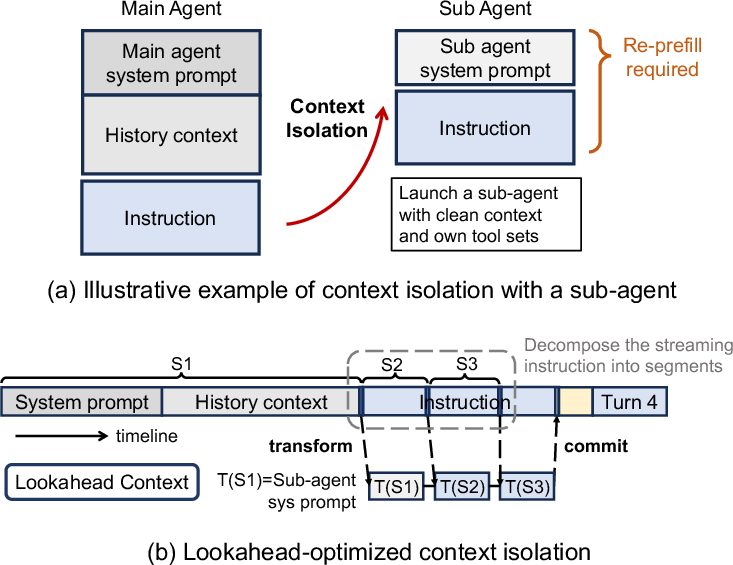
Figure 8: Sub-agent isolation decomposes new instructions, enabling prefilling of sub-agent contexts incrementally during generation.
Lookahead-Aware Scheduling in LLM Serving Systems
Precomputing transformed KV caches via lookahead can interfere with latency-critical requests in shared serving environments. SmoothAgent addresses this using a lookahead-aware scheduler, treating lookahead requests as best-effort (BE) and strictly prioritizing latency-critical (LC) requests. The scheduler admits BE chunks opportunistically, only when they fit within the available SLO budget, using an analytic context-aware batch latency model that incorporates both forward token count and cached context lengths.
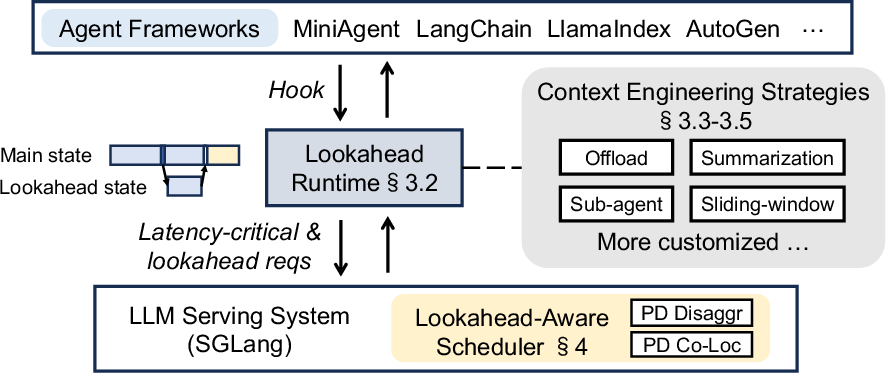
Figure 9: System architecture: SmoothAgent sits between the agent and serving system, orchestrating main and lookahead request flows.
Evaluation
Elimination of TTFT Spikes
Empirical results demonstrate that SmoothAgent achieves up to 11.9× reduction in TTFT at transformation points, substantially outperforming synchronous baselines. The reduction is most pronounced in summarization-heavy strategies due to their composite overhead (summarization plus re-prefilling), but is robust across offloading, truncation, and sub-agent isolation as well.
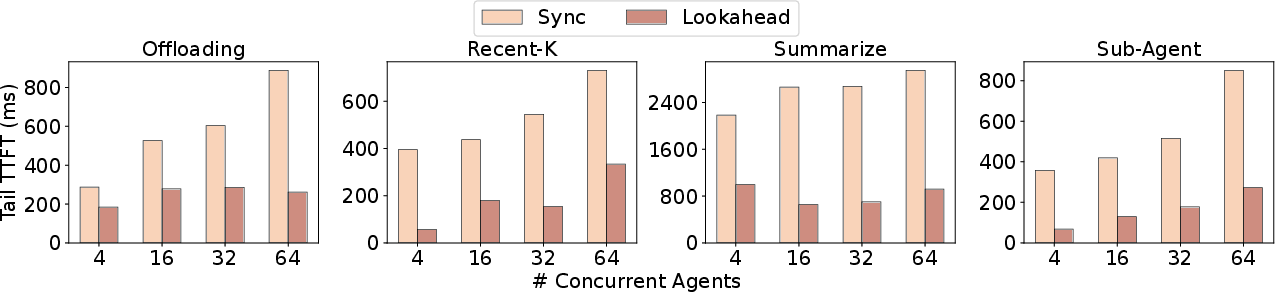
Figure 10: On Qwen3-8B, SmoothAgent removes transformation TTFT spikes under varying concurrency.
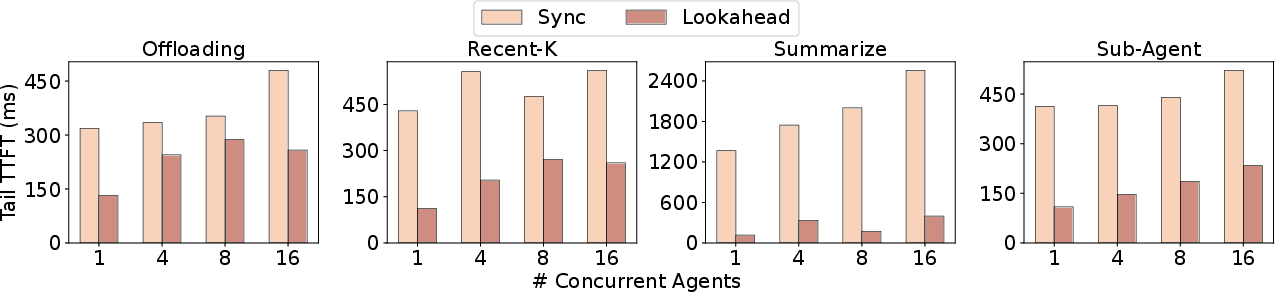
Figure 11: On Qwen3-32B, lookahead model eliminates TTFT spikes at transformation points.
SmoothAgent provides a smooth TTFT profile across turns, fully absorbing transformation costs ahead of time (Figure 12).
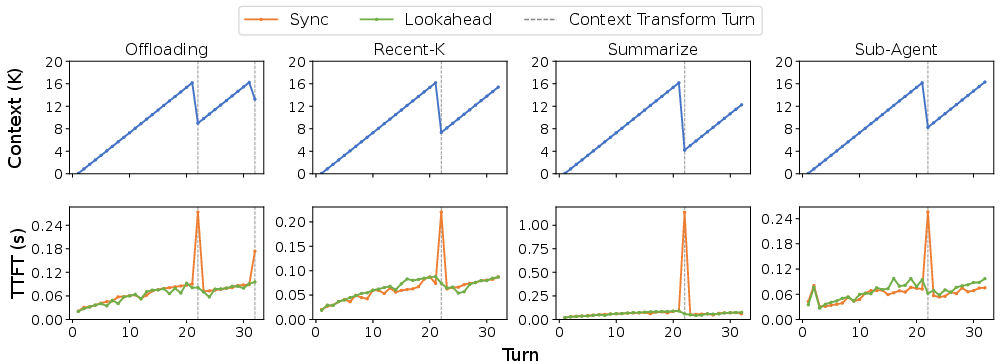
Figure 12: Context length and TTFT progression for Qwen3-8B: Synchronous strategies cause TTFT spikes; lookahead yields uninterrupted latency.
Performance is consistent under prefill-decode disaggregated architectures, despite the added cost of KV cache transfer between instances (Figure 13).
Figure 13: SmoothAgent reduces transform-time TTFT even under prefill-decode disaggregated deployment.
Scheduler Robustness
As background lookahead load increases, the lookahead-aware scheduler preserves tail latencies for LC requests, admitting BE work only when slack is available. This property is empirically verified in both co-located and disaggregated configurations (Figure 14).
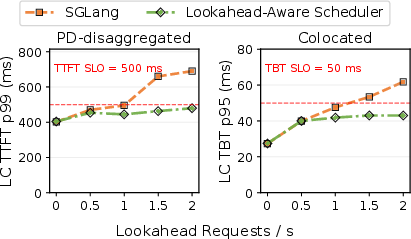
Figure 14: Lookahead-aware scheduling prevents LC latency inflation as BE lookahead traffic intensifies.
The proposed batch latency estimation (accounting for context lengths) is much more accurate than previous token-budget models, yielding reliable admission decisions (Figure 15).
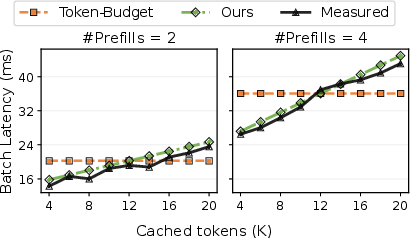
Figure 15: Context-aware scheduler’s model for batch latency delivers tighter prediction than token-only heuristics as cached-context grows.
Implications and Future Work
SmoothAgent’s lookahead programming model generalizes across multiple, widely-used context engineering strategies in agentic LLM applications. By moving transformation and KV cache construction off the critical path, it enables scaling of long-horizon agents without TTFT penalties previously imposed by context management. Integration into established frameworks (LangChain, LlamaIndex, AutoGen, OpenClaw) demonstrates broad compatibility and deployment practicality.
Practically, this unlocks large-scale, high-throughput deployment of agents requiring persistent memory and advanced context operations. Theoretically, the segment-decomposability property formalizes the class of context transformations suitable for lookahead, suggesting future research into more expressive context management strategies meeting this criterion. Additionally, best-effort, SLO-driven scheduling of non-critical computation—demonstrated here for agent serving—has broader applicability across multi-tenant, resource-constrained LLM infrastructure.
Potential future directions include research into:
- Dynamically adaptive segment partitioning to further optimize lookahead overlap.
- Expanded support for non-segment-decomposable transformations via speculative execution and rewinding.
- Deeper integration with memory and scheduling systems to handle heterogeneous multi-agent workloads.
Conclusion
SmoothAgent identifies and resolves a fundamental bottleneck in agentic LLM serving: transformation-induced TTFT spikes from context management. By exploiting the segment-decomposability of common context engineering strategies and introducing a lookahead execution model with SLO-aware scheduling, SmoothAgent eliminates these spikes, supporting efficient, robust long-horizon LLM-based agent execution (2607.00151). The approach is widely applicable and forms a foundation for scaling complex agentic workflows in production settings.

