- The paper introduces a decide-first-then-think paradigm that improves LLM inference efficiency by selecting forking points based on token-level confidence.
- The method computes confidence using average log-probabilities of top-k tokens to identify pivot tokens, triggering diversified sampling at key junctures.
- Empirical results demonstrate token savings up to 30% and runtime reductions up to 57% without sacrificing answer accuracy across diverse benchmarks.
Fork-think with Confidence: Efficient Parallel Reasoning via Decide-First-Then-Think Paradigm
Paradigm Shift in Parallel Reasoning
"Fork-Think with Confidence" (2606.31484) introduces a decisive shift from the canonical think-first-then-decide parallel reasoning framework in LLM inference to a decide-first-then-think strategy. Prior parallel reasoning approaches generate multiple traces early, then prune or aggregate them, incurring substantial token and runtime overhead by default. The proposed Fork-think method first executes a single greedy seed path, then uses model confidence to identify task-relevant forking points, from which it triggers diversified continuation sampling. This paradigm is grounded in recent findings about the role of token-level uncertainty (pivot tokens) in determining reasoning path divergence.
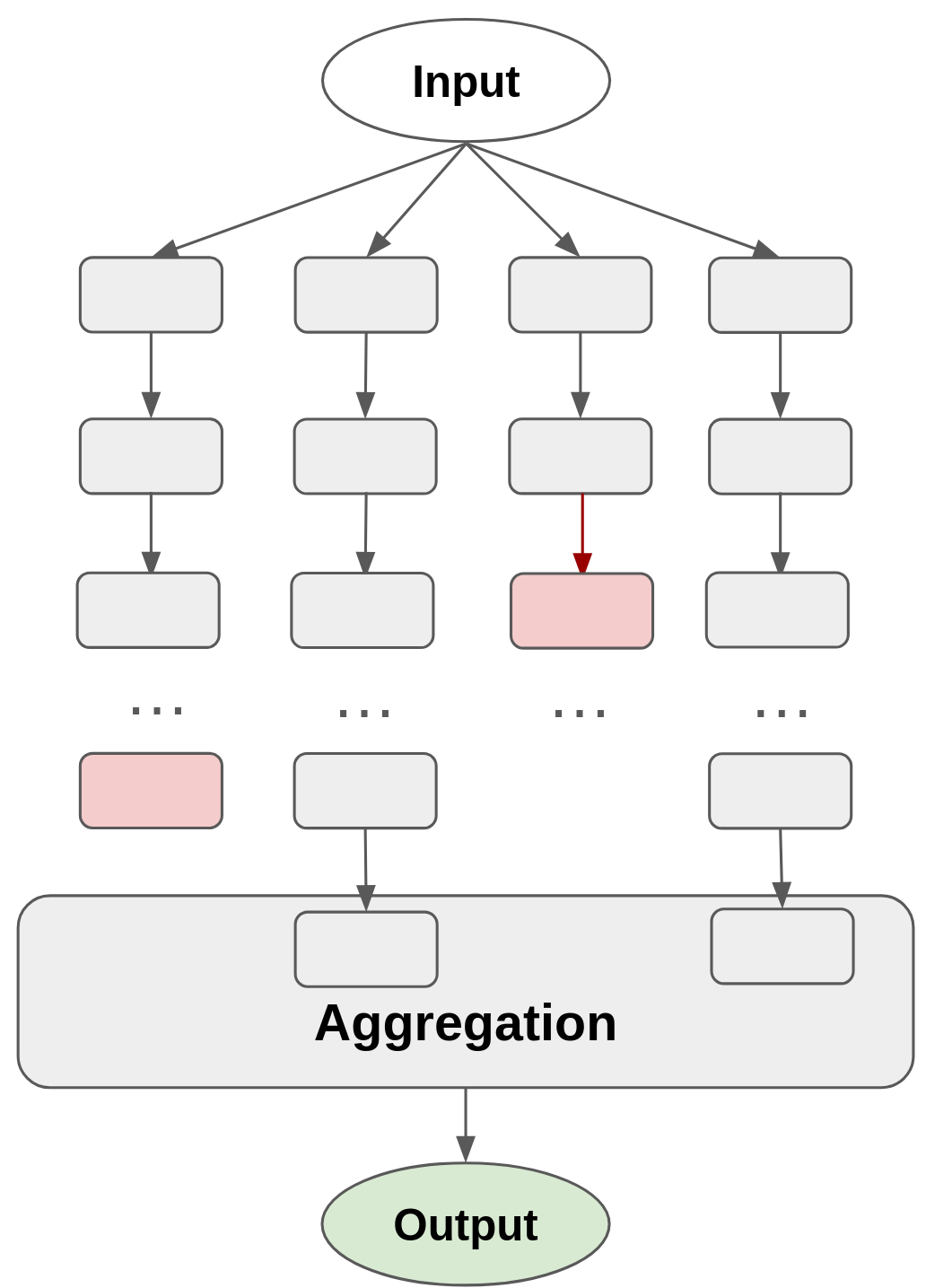
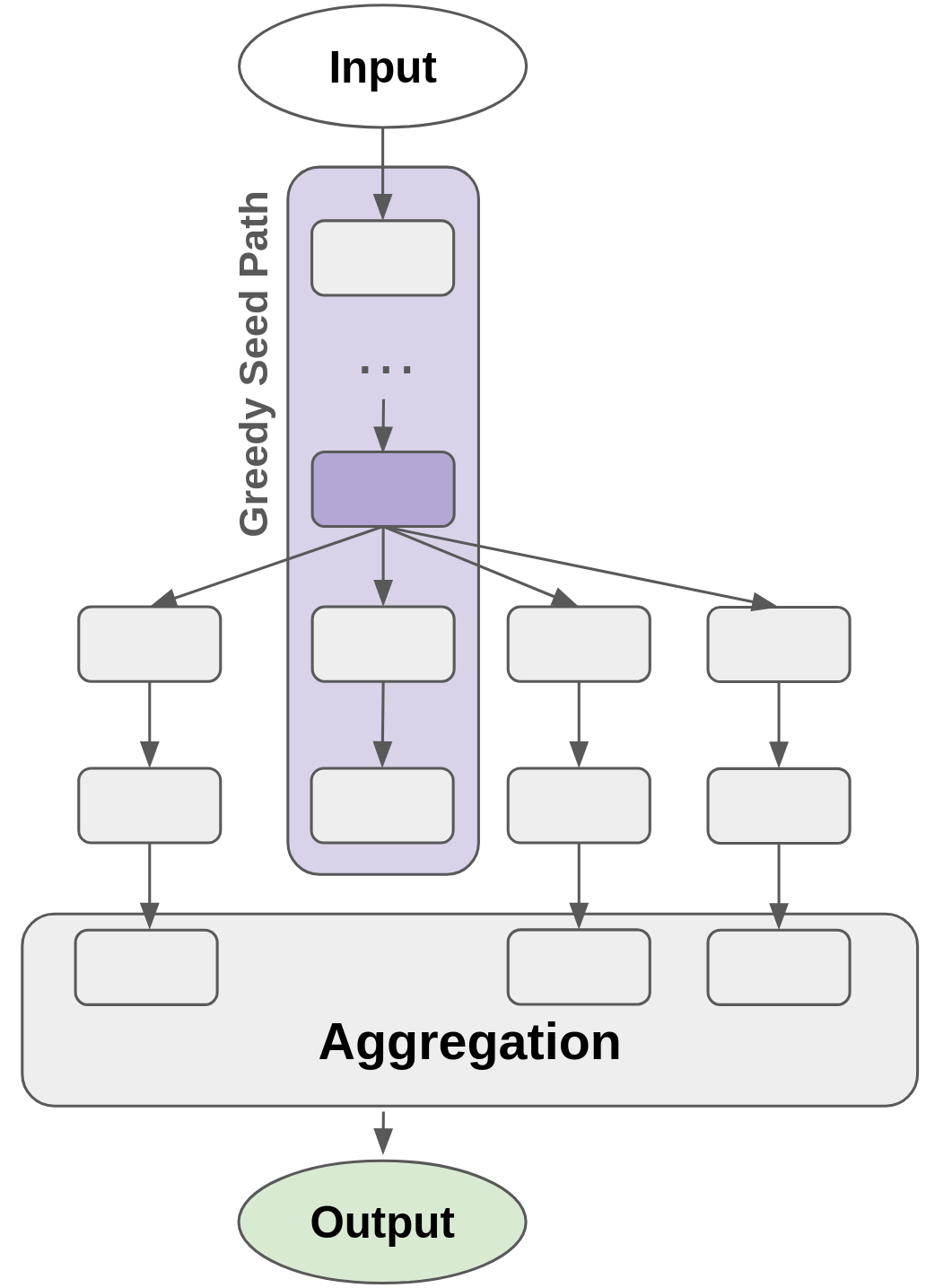
Figure 1: Schematic contrasting think-first-then-decide (left) with the decide-first-then-think approach (right) for parallel reasoning in LLMs.
Fork-think Algorithmic Foundation
Fork-think leverages confidence-based selection of forking points derived from a seed path, computed as averaged log-probability over the top-k tokens per position. The minimum-confidence locations (pivot tokens) serve as branch points, at which a branching factor n (e.g. 32) determines the number of continuations sampled at increased temperature. This enables aggregation of responses via voting schemes, capturing diversity without unnecessary computation.
Key technical details include:
- Seed path generation: Greedy decoding (zero temperature) for the initial sequence.
- Confidence estimation: Average log-probability or entropy over top-k tokens per seed path position.
- Forking point selection: Points with minimum confidence scores, optionally extended to multiple points.
- Branching/sampling: Temperature-controlled sampling for continuation at each fork.
- Aggregation: Majority or weighted voting.
This method does not require warm-up, offline training, or pre-computed thresholds, differentiating it from adaptive self-consistency (ASC) and pruning-based schemes.
Empirical Evaluation and Numerical Results
Extensive benchmarking was conducted using three LLMs (Qwen3-8B, DeepSeek-8B, Phi-4-RP-14B) across AIME24/25 (complex math olympiad benchmarks) and GPQA-diamond (graduate-level QA).
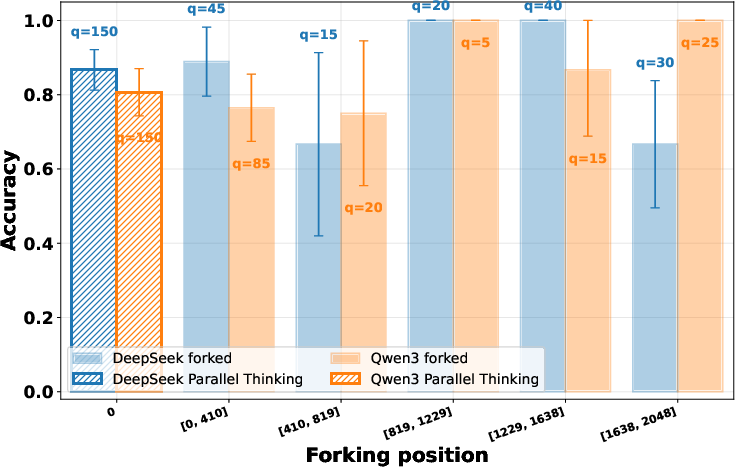
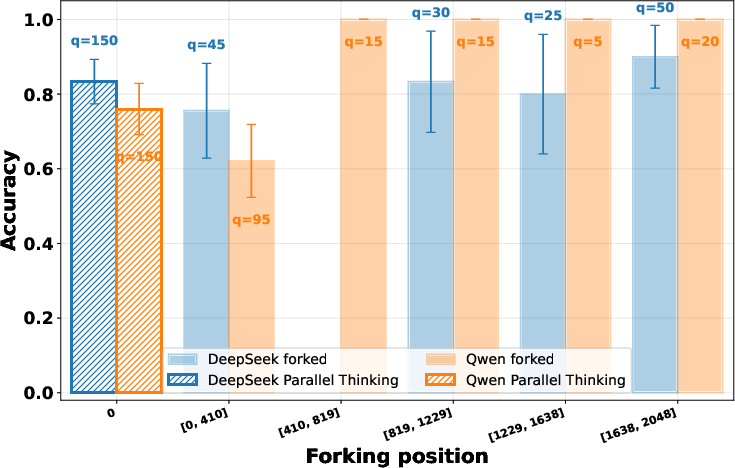
Figure 2: Fork-think performance on AIME24, illustrating majority-voting accuracy and token usage savings.
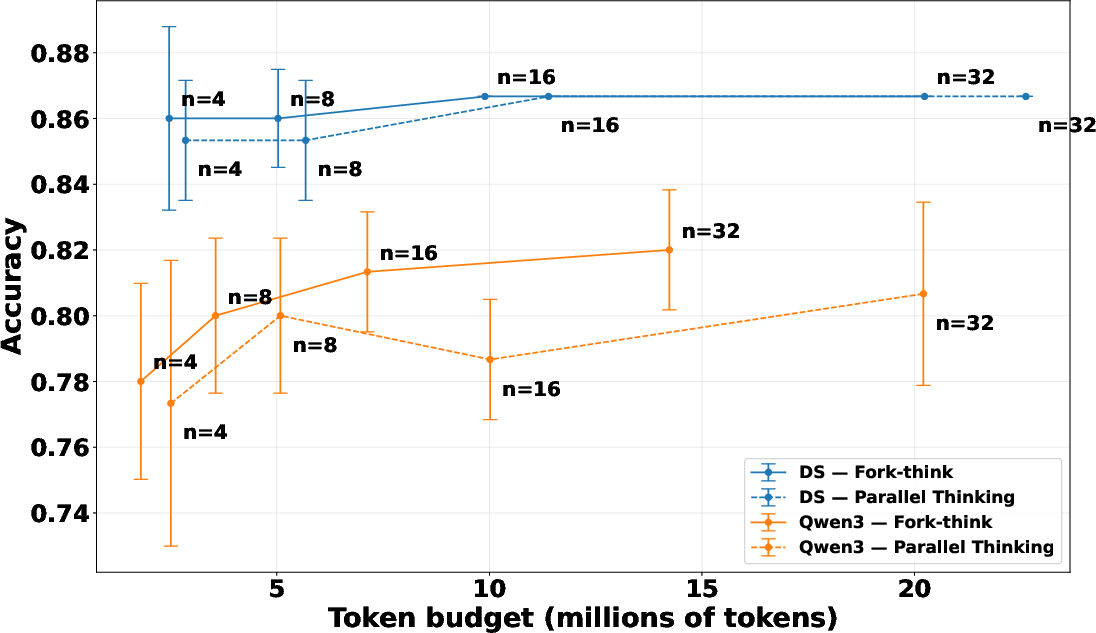
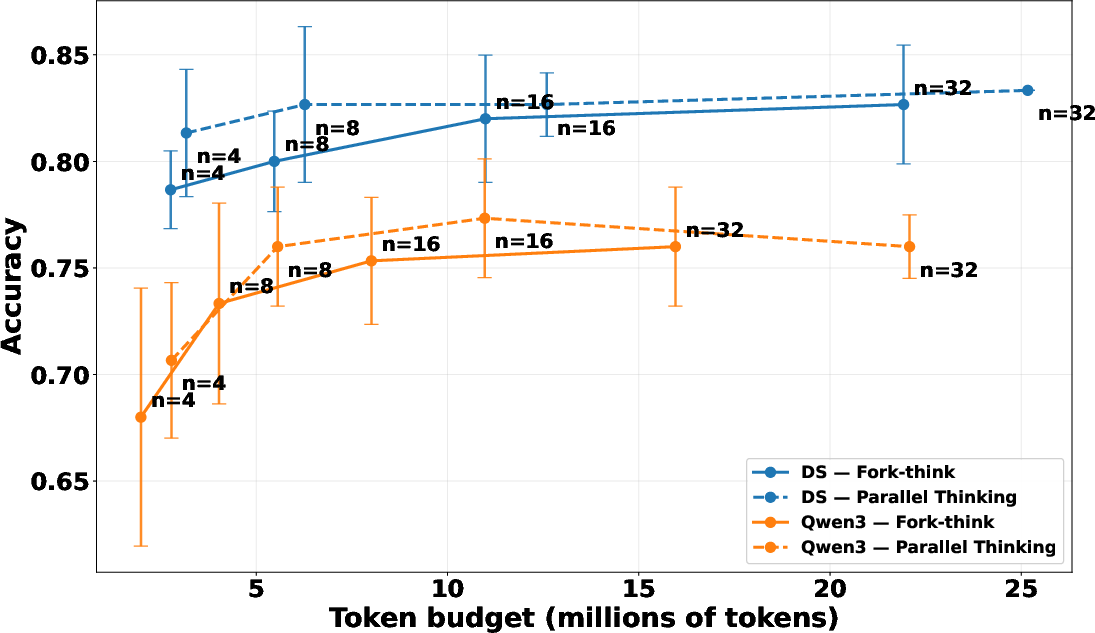
Figure 3: Fork-think performance on AIME24 for diverse model configurations.
Fork-think achieved 7–30% reduction in token consumption and up to 57% reduction in runtime versus parallel thinking, consistently maintaining or slightly improving answer accuracy (e.g., Qwen3-8B: 30% fewer tokens at +1.7% accuracy; DeepSeek-8B: 10% fewer tokens with identical accuracy; Phi-4-RP-14B: 8% savings with minimal accuracy changes). Incorporating early stopping and weighted voting yielded further efficiency gains without accuracy degradation.
Strong claims substantiated by empirical data:
- Later forking improves generations: Fork-think identifies forking points correlating with pivotal reasoning steps, generating more robust continuations than early branching.
- No retraining or warm-up required: Unlike pruning/threshold-based methods (e.g., DeepConf), Fork-think operates entirely training- and threshold-free.
- Token/runtimes savings are durable across models and datasets.
Analytical Insights and Ablations
An analysis of the distribution of forking points revealed that critical tokens (variables/operators) frequently coincide with solution steps on math benchmarks, underscoring the task-dependent nature of forking-point selection. Fork-think’s performance was robust across variable seed path lengths and branching factors. Forking too early reduces accuracy; optimal divergence often coincides with the core deduction phase.
Ablations on confidence estimation found that average log-probability is highly effective, though entropy-based methods yielded comparable performance and higher computational cost. Increasing the number of forking points or integrating budget-aware seed path lengths are promising future directions.
Theoretical and Practical Implications
Fork-think demonstrates that pre-determined forking based on confidence signals can substantially improve inference-time scaling efficiency for LLMs, without sacrificing answer quality. The results suggest that model uncertainty at the token level is a powerful indicator for branching, aligning with recent developments in reasoning diversity and test-time scaling.
Practically, Fork-think enables scalable deployment of high-performing LLMs in cost- or time-constrained settings, applicable to mathematical reasoning, scientific QA, and potentially code reasoning domains. Theoretically, the decide-first-then-think paradigm opens new lines of research for adaptive branching, budget-aware inference, and context-sensitive aggregation strategies.
Future Directions
Potential advancements include multi-forking strategies (multiple forking points per seed), dynamic adjustment of seed path lengths based on task complexity, and alternative uncertainty metrics for identifying optimal fork locations. Integration of Fork-think with programmatic constraints, alignment objectives, or test-time adaptation could drive further gains in controllable and aligned generation.
Conclusion
Fork-think with Confidence establishes a rigorous alternative to traditional parallel thinking in LLM inference by efficiently sampling diverse reasoning continuations at meaningful inflection points, guided by model confidence. It achieves state-of-the-art efficiency/accuracy trade-offs on complex reasoning benchmarks and is adaptable to more sophisticated aggregation and early stopping mechanisms. The decisive role of later forking positions and pivot tokens in reasoning generation sets a new research agenda for scalable, effective test-time inference in LLMs.