- The paper presents a novel coordinate-free, Hodge-de Rham decomposition that overcomes singularity and gauge issues in traditional Berry connection formulations.
- It leverages a globally smooth proxy potential to accurately separate quantized bulk contributions from Fermi surface effects in anomalous Hall transport.
- The framework demonstrates numerical stability with bounded errors and offers promising extensions to three-dimensional systems and chiral anomaly analyses.
Coordinate-Free Hodge Framework for Semiclassical Transport in Topological Bands
Introduction
The paper "Hodge Topology of Semiclassical Transport: A Coordinate-Free Geometric Framework for the Anomalous Hall Effect and Non-Linear Berry Dipole" (2606.31409) presents a fully coordinate-free, differential geometric approach to anomalous transport phenomena in crystalline solids, focusing on the Anomalous Hall Effect (AHE) and nonlinear Berry dipole responses. It systematically circumvents the topological obstructions that limit traditional formulations based on the Berry connection by directly leveraging the Hodge-de Rham decomposition on the Brillouin zone. This framework yields a globally smooth proxy potential that enables robust, singularity-free transport calculations—both linear and nonlinear—even for bands with nonzero Chern number.
Geometric Decomposition and Mathematical Framework
The core technical advance is the direct Hodge decomposition of the Berry curvature 2-form Ω on the 2D torus Brillouin zone: Ω=AT2πc1vol+dA
where c1 is the Chern number, AT is the area of the Brillouin zone, vol is the standard volume element, and A is a globally defined 1-form serving as a smooth proxy potential. This decomposition isolates the quantized topological monopole flux (harmonic sector) into the first term while ensuring the remainder is an exact form derivable from a globally smooth 1-form A.
Standard quantum mechanical descriptions define the Berry curvature as the exterior derivative of the Berry connection, a local quantity that cannot be made globally smooth in the presence of nontrivial topology. The explicit separation of the topological contribution via Hodge decomposition ensures that A is always globally smooth—even for c1=0—eliminating Dirac string singularities and providing a rigorous foundation for transport calculations.
Anomalous Hall Effect: Surface-Bulk Decomposition
Within this formalism, the macroscopic anomalous Hall current decomposes into a quantized topological bulk contribution and a geometric Fermi surface term: Janomi=−e2ϵijEj[2πc1ν+(2π)21∫TA∧df0]
with Ω=AT2πc1vol+dA0 the band filling and Ω=AT2πc1vol+dA1 the Fermi-Dirac distribution. At zero temperature, the wedge product Ω=AT2πc1vol+dA2 localizes on the Fermi surface, naturally recovering Haldane's result: that non-quantized geometric contributions to the AHE are 1D integrals over the Fermi surface.
Nonlinear Transport: Berry Dipole and Numerical Stability
Nonlinear anomalous Hall responses, notably the Berry dipole tensor relevant for the NLAHE, are typically susceptible to numerical artifacts when approximating derivatives of discretized Berry curvature data. The Hodge framework enables calculation of the dipole tensor Ω=AT2πc1vol+dA3 exclusively through smooth, global forms: Ω=AT2πc1vol+dA4
This formulation sidesteps the direct computation of derivatives of potentially noisy curvature, ensuring numerical robustness. The analytic equivalence between this geometric approach and the standard scalar integration-by-parts technique demonstrates that both methods yield identical results and noise rejection, even for arbitrary Chern number.
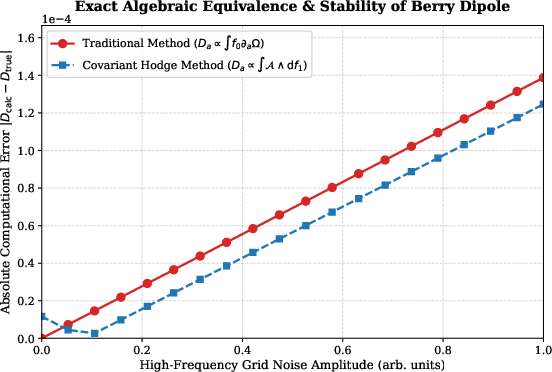
Figure 1: Numerical demonstration of the stability of extracting the non-linear Berry dipole (Ω=AT2πc1vol+dA5) for a generic 2D tilted massive Dirac cone under high-frequency grid discretization noise; both scalar and Hodge approaches exhibit bounded errors.
Empirical validation is shown in Figure 1, where both traditional scalar methods and the Hodge-based approach achieve error bounds of Ω=AT2πc1vol+dA6 despite artificial high-frequency noise in the Berry curvature.
Physical Interpretation of the Hodge Proxy Potential
The identity of Ω=AT2πc1vol+dA7 is established through gauge fixing: imposing the Coulomb-Hodge gauge (Ω=AT2πc1vol+dA8) and vanishing harmonic holonomies along Brillouin zone cycles. For topologically trivial bands (Ω=AT2πc1vol+dA9), c10 coincides with the globally smooth Berry connection in the maximally localized Wannier function (MLWF) gauge. For c11, where MLWFs are obstructed, c12 still exists as a globally smooth 1-form and captures all relevant geometric information for Fermi surface transport and nonlinear phenomena.
Algorithmic Implications and Covariant Stability
Imposing the Hodge gauge yields the Hodge Laplacian for c13 and resolves the uniform (c14) component ambiguity, fundamentally enforcing the macroscopic Brillouin zone average divergence to vanish. The momentum-space and real-space conjugate formulations guarantee no artificial filtering or amplification of physical observables due to the geometric construction, ensuring that all algorithmic steps with the Hodge geometric potential perfectly match the robustness of traditional, established methods.
Prospects for Higher Dimensions and Chiral Anomalies
While the present formalism is developed for 2D crystalline systems with c15 closed, the paper outlines concrete extensions to 3D Brillouin zones with Weyl nodes. In 3D, the Berry curvature generally fails to be closed due to the presence of monopole-like singularities (Weyl nodes), necessitating a full Hodge decomposition including a nontrivial co-exact sector. This opens new avenues for analyzing non-equilibrium chiral anomalies from a unified geometric perspective, with direct relevance for Weyl semimetals and related topological phases.
Conclusion
This paper rigorously formulates a coordinate-free, Hodge-theoretic approach to semiclassical transport in topological bands, resolving long-standing singularity and gauge ambiguity issues associated with the Berry connection in systems with nonzero Chern number. The differential-geometric methodology permits robust, globally valid evaluation of both linear and nonlinear transport phenomena, coinciding with and explaining the observed numerical stability of existing scalar computational techniques. The formalism is extensible to higher dimensions and topological phenomena characterized by singular Berry curvature distributions, providing a foundation for future theoretical and computational developments in topological transport theory.

