- The paper rigorously derives a gauge-invariant formulation for second-order DC conductivity in multiband systems employing the velocity-gauge Keldysh formalism.
- It decomposes the nonlinear current into distinct contributions—nonlinear Drude (ND), Berry curvature dipole (BCD), and quantum metric dipole (QMD) terms—each with unique lifetime scaling.
- The methodology offers clear diagnostics for separating geometric and topological effects in nonlinear transport, paving the way for both theoretical and experimental advances.
Introduction and Context
This work provides a comprehensive derivation of the second-order dc nonlinear conductivity in multiband tight-binding systems, employing the velocity-gauge Keldysh Green’s function formalism. Beyond offering gauge invariance, the approach yields a clean decomposition of the response into physically meaningful sectors: nonlinear Drude (ND), Berry curvature dipole (BCD), and two distinct quantum-metric-dipole (QMD) contributions—one intraband (intra-QMD) and one interband (inter-QMD). These contributions are organized according to their scaling with the electronic quasiparticle lifetime τ: respectively, O(τ2), O(τ), and O(τ0) for the ND, BCD, and QMD terms.
The paper situates its contribution within the ongoing development of geometric response theory, where both the Berry curvature and the quantum metric of Bloch bands act as geometric sources of transport phenomena. While the BCD mechanism has been established as a leading nonlinear source term, quantum metrics have more recently been recognized as distinct contributors to nonlinear responses, especially in systems with vanishing Berry curvature.
The model considers a multiband tight-binding Hamiltonian, coupled to uniform electromagnetic fields via the Peierls substitution, Hk→Hk+(e/ℏ)A(t), in the velocity gauge. Expanding the Hamiltonian in powers of the vector potential A, this yields first, second, and third order velocity-vertex operators (Vi, Vij, Vijk) that encode the system’s band structure via momentum derivatives.
The current operator derives from the functional derivative of the Hamiltonian with respect to A. Crucially, higher-order contact (diamagnetic) current vertices arising from the Peierls expansion (such as O(τ2)0 and O(τ2)1) are necessary to enforce gauge invariance and remove spurious divergences in the dc limit.
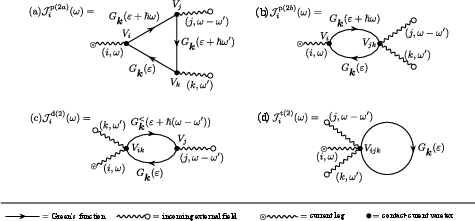
Figure 1: Diagrammatic representation of the four second-order current contributions in the Peierls velocity gauge: current vertices and Peierls contact vertices underpin distinct contributions.
All nonlinear response calculations are formulated within the Keldysh nonequilibrium Green’s function formalism, providing a systematic perturbative expansion in O(τ2)2.
Second-Order DC Conductivity: Lifetime Hierarchy and Geometric Decomposition
Within the constant-relaxation-time approximation, the second-order nonlinear current separates into diagrammatically distinct terms corresponding to different sequences of vertex insertions. After reducing to the DC limit and eliminating apparent O(τ2)3 singularities using gauge symmetry and the Ward–Takahashi identity, the response admits a universal decomposition: O(τ2)4
Each term is associated with distinct physical origins and O(τ2)5 dependences.
Nonlinear Drude (ND) Term (O(τ2)6):
Originates entirely from single-band intraband processes and depends only on band dispersion. It corresponds to the conventional semiclassical Drude picture, generalized to nonlinear order.
Berry Curvature Dipole (BCD) Term (O(τ2)7):
Arises from the imaginary part of the quantum geometric tensor (the Berry curvature), combined with a pinch singularity in the Keldysh kernel. This is the clean metal counterpart to the nonlinear Hall effect associated with Berry curvature dipoles [Sodemann & Fu PRL 2015, (2606.22359)].
Quantum Metric Dipole (QMD) Terms (O(τ2)8):
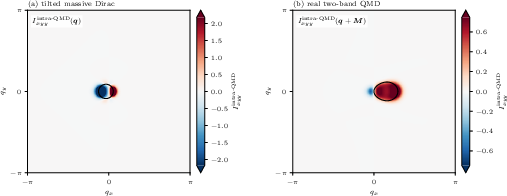
Intrinsic "geometric" contributions controlled by the quantum metric. The intra-QMD term is explicitly a Fermi-surface dipole of the quantum metric, while the inter-QMD is a Fermi-sea–weighted contribution involving derivatives of a band-normalized metric. They persist even if the BCD vanishes due to symmetries (e.g., in PT-symmetric systems or real two-band models).
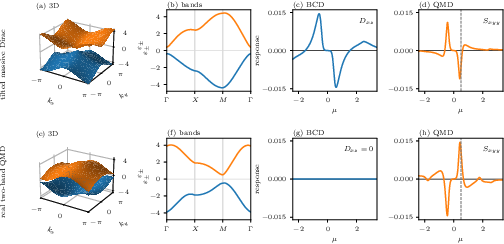
Figure 2: Two-model summary of band structures and nonlinear geometric diagnostics, contrasting BCD-dominated (Dirac) and QMD-dominated (real) two-band models.
The entire analysis is performed directly in the velocity gauge, making explicit how Peierls contact vertices ensure gauge invariance at each diagrammatic level.
Gauge Invariance and Cancellation of Connection-Dependent Terms
A central technical achievement is the explicit demonstration of cancellation of gauge-dependent "connection" terms (covariant derivatives of Berry connections and three-Berry-connection loops) in the final physical observable. Although such terms arise naturally in the band-basis expansion of the Keldysh-Kubo response (and have sometimes been individually attributed physical meaning), the physical current is shown to depend only on gauge-invariant band geometric quantities (Berry curvature for BCD, quantum metric for QMD), consistent with the projector calculus developed in [Mitscherling et al. 2025; Ulrich et al. 2026].
This cancellation reflects the broader geometric principle asserted in the literature: only projectors and their covariant derivatives enter true physical quantities, not arbitrary choices of Bloch-state phases or Berry connections.
Model Diagnostics: Distinguishing Geometric and Berry Contributions
Minimal two-band models are used to clarify the distinct origins of BCD and QMD responses:
These examples provide practical diagnostic tools for distinguishing between nonlinear responses of geometric (QMD) and topological (BCD) origin, and are relevant for experimental interpretation—such as in topological antiferromagnets where QMD signatures are isolated [Wang et al. Nature 2023].
Theoretical and Practical Implications
The explicit decomposition into ND, BCD, intra-QMD, and inter-QMD terms has several important implications:
- It provides a rigorous basis for interpreting nonlinear dc transport experiments in terms of band geometry, enabling extrication of quantum-metric contributions in the absence of Berry curvature.
- The lifetime scaling clarifies the roles of disorder and dissipation, distinguishing between extrinsic (disorder-dominated) and intrinsic (geometry-dominated) regimes.
- The gauge-invariant approach sidesteps ambiguities of connection-dependent quantities that have complicated prior analyses and poses a template for formulating observables in higher-order nonlinear response.
- The methods and decompositions here generalize naturally to the formulation of third-order and higher nonlinear responses in crystals, with expected analogs in the emergence of higher quantum-geometric tensors and multipoles [Mandal et al. PRB 2024, Zhang et al. PRB 2023].
Outlook and Prospects
This unified framework provides a foundation for future theoretical investigations and materials discovery targeting nonlinear geometric transport phenomena. Systematic inclusion of disorder, explicit vertex corrections, and generalization beyond nondegenerate bands are natural directions. The velocity-gauge approach also suggests numerical strategies for first-principles calculations of geometric response tensors in complex materials. Experimental efforts can leverage these diagnostics to design or identify materials—in particular PT-symmetric or antiferromagnetic compounds—where nonlinear quantum-metric responses can be isolated and maximized.
Conclusion
This work delivers a rigorous, gauge-invariant decomposition of the second-order dc conductivity for multiband tight-binding systems, articulated within the velocity-gauge Keldysh formalism. The transport response is shown to consist of nonlinear Drude, Berry-curvature-dipole, and both intraband and interband quantum-metric-dipole contributions, each with well-defined physical origin, gauge structure, and disorder scaling. The methodology provides both a conceptual and computational blueprint for dissecting and predicting nonlinear transport phenomena in topological and quantum-geometric materials.
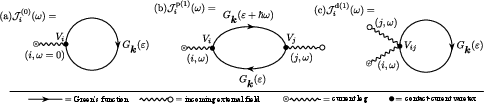
Figure 4: Diagrammatic representation of the zeroth- and first-order current contributions, emphasizing the necessity of Peierls contact vertices for gauge invariance.
Figure 5: Diagrammatic representation of the four second-order current contributions, further underscoring the interplay of paramagnetic and contact terms in DC response.
References:
The technical results and further discussion can be found in "Second-order dc conductivity in the velocity-gauge Keldysh formalism: gauge-invariant decomposition into nonlinear Drude, Berry-curvature-dipole, and quantum-metric responses" (2606.22359).