- The paper introduces an operator-level topological invariant for the integer QHE, reformulating Hall conductivity through noncommutative geometry.
- It employs the Wigner–Weyl formalism and cyclic cohomology to integrate disorder, inhomogeneity, and interaction effects beyond traditional band theory.
- The study rigorously demonstrates how finite lattices lead to vanishing quantization, with recovery in the thermodynamic limit aligning with experimental observations.
Topological Invariant for the Integer Quantum Hall Effect: Noncommutative Geometry Perspective
Introduction and Motivation
The integer quantum Hall effect (QHE) exemplifies a physical phenomenon fundamentally characterized by topology. While the original TKNN invariant provides a quantized topological formula in terms of Bloch bands for ideal, homogeneous, noninteracting systems, real quantum Hall platforms feature disorder, inhomogeneities, and electron-electron interactions, often precluding a straightforward band description. This work presents a systematic, operator-theoretic generalization of the QHE invariant, applicable to a broad class of two-dimensional (2D) tight-binding models (including non-homogeneous and interacting cases), and reformulates the topological invariant for Hall conductivity within the rigorous framework of noncommutative geometry and cyclic cohomology.
Operator Level Invariant: Green Functions and Phase Space Calculus
The principal result is the construction of an invariant N3 for the integer QHE expressed as a pairing of K−1-theory of a noncommutative (operator) algebra and a specific cyclic 3-cocycle. The observable Hall conductivity is succinctly captured as
σH=2πN3
where N3 is determined not by band projectors, but by the phase-space (Wigner-transformed) Matsubara Green function GW(x,p) and the corresponding inverse operator QW(x,p). The invariant is formulated as
N3=24π2∣V∣ϵlmkTr(GW⋆∂plQW⋆GW⋆∂pmQW⋆GW⋆∂pkQW)
accounting for spatial inhomogeneity, explicit disorder, and general pairing/interaction effects via the full, interacting Matsubara Green function. The ⋆ (Moyal) product encodes the noncommutativity of quantum phase space and is essential whenever translational symmetry is broken.
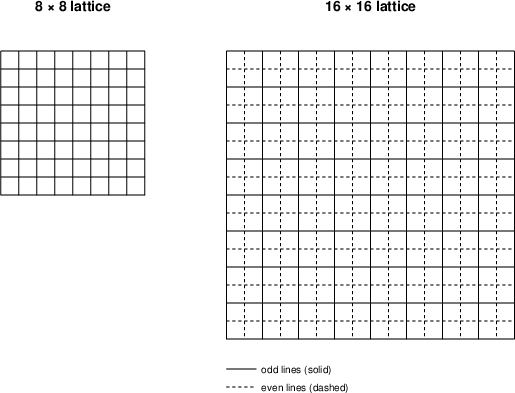
Figure 1: Schematic representation of the lattice phase space sets O and its refinement O′ underlying the Wigner–Weyl formalism.
The paper employs the K−10-algebraic structure of operators associated with the tight-binding lattice model (with or without a continuum limit). The Weyl symbol calculus maps operators to phase-space functions, inducing a noncommutative algebra with the Moyal product. In this framework:
- The K−11 group is generated by invertible elements in the operator algebra K−12, naturally encompassing the full Green function.
- The relevant cyclic cohomology K−13 provides the domain for the cocycle associated with the quantized Hall response.
- The topological invariant K−14 is given as a pairing K−15, where K−16 is the K−17-class of the Green function and K−18 the explicit cocycle.
The construction ensures gauge-covariant regularization and allows one to connect to known cohomological expressions for Chern characters in the smooth (continuum) limit.
Finite Lattice, Discretization, and Continuum Limit
A crucial, nontrivial claim rigorously demonstrated in the paper is that for strictly finite-size, discretized systems (finite spatial lattice and discretized Matsubara frequencies), both the K−19 group and σH=2πN30 vanish. Thus, the invariant σH=2πN31 is identically zero in such situations: no topological Hall effect can be observed as a bulk, integer quantized response. This is directly connected to the vanishing linear response in Hall conductivity in finite-size numerical lattice computations with strict periodic boundary conditions—a result supported by previous lattice simulations.
Conversely, when the lattice size becomes much larger than all physical correlation scales, or when disorder and inhomogeneity effectively smear out energy/momentum quantization, the sums over discrete momenta can be approximated by integrals. In this limit, the non-zero cyclic cohomology allows for a nontrivial, typically integer value for σH=2πN32. This recovery of quantized Hall conductance in the thermodynamic (or “effective continuum”) limit robustly aligns with experimental observations.
The Role of Inhomogeneities and Weak Index Theorems
The general formalism admits explicit σH=2πN33-dependence (e.g., spatially varying fields or disorder) and does not require translation invariance. The authors demonstrate that various weak index theorems apply:
- If σH=2πN34 is homotopic to a momentum-only function σH=2πN35 (i.e., the inhomogeneity is weak), the topological class is integer-quantized.
- If the system can be smoothly deformed to one with a uniform magnetic field, the invariant remains integer.
- The invariant is stable under homotopies deforming the star/Moyal product towards the pointwise product if the path avoids singularities.
However, in the strongly inhomogeneous regime, with significant spatial dependence that cannot be removed by a homotopy, σH=2πN36 can acquire non-integer values, implying a breakdown of strict quantization for the spatially averaged Hall response.
Technical Innovations
- The Wigner–Weyl operator calculus is extended and rigorously regularized for general tight-binding lattices, including precise techniques for handling boundary conditions and the toroidal phase space (as depicted in Figure 1).
- The pairing of Green function σH=2πN37-theory classes with cyclic cochains is explicitly constructed for phase space operator algebras, providing a powerful topological formula valid beyond the non-interacting, clean case.
- The work elucidates the exact mechanism underlying the restoration (or loss) of Hall quantization upon moving between finite and infinite systems, or clean and disordered regimes.
Numerical, Analytical, and Conceptual Implications
- Numerical simulation: Results imply that computations of quantized Hall plateaus demand system sizes significantly exceeding disorder and correlation lengths to observe integer quantization.
- Disorder and physical realization: Realistic experimental systems always possess some disorder, which ‘fills in’ discrete momentum space, justifying the practical relevance of the continuum limit result.
- Theoretical generality: The approach encompasses interacting systems, provides an operator-level understanding aligned with high-energy field theory (e.g., anomaly inflow and the index theorem paradigm), and lays the mathematical groundwork for generalizing Hall-like topological invariants to broader classes of physical systems.
Prospects for Future Research
This operator-cyclic pairing formalism is a flexible computational and conceptual tool. Potential future directions include:
- Constructing explicit models or materials where spatially varying Chern numbers drive fractional (non-integer) local Hall conductances.
- Elucidating “strong” index theorems for spatially complex cases, potentially uncovering new classes of topological responses in higher dimensions or in the presence of exotic order (e.g., in polycrystalline or inhomogeneously strained materials).
- Applying the developed machinery to noncommutative geometries relevant for recent developments in synthetic quantum matter and quantum simulation architectures.
Conclusion
This work provides a mathematically rigorous, conceptually unified framework for analyzing the integer quantum Hall effect in general (possibly non-homogeneous, disordered, or interacting) 2D tight-binding systems. The reformulation of the QHE invariant as a cyclic cocycle pairing bridges topological condensed matter and noncommutative geometry, clarifies the vanishing of quantization for finite lattices, and identifies the essential mechanism by which quantization emerges in the thermodynamic/disordered limit. This formalism sets the stage for new developments in topological classification, robust transport, and operator-level understanding of quantum materials.

