- The paper introduces the band-projected electric quadrupole as a key variable linking Berry curvature and quantum metric in lattice systems.
- It derives microscopic formulas for Hall viscosity and nonlocal Hall conductivity, highlighting lattice-specific corrections to the continuum model.
- The work establishes the nonlocal Hall ratio as an experimental diagnostic for assessing the ideal geometry of Bloch bands.
Quantum Geometric Origin of Hall Viscosity and Nonlocal Hall Conductivity in Lattice Bands
Introduction and Motivation
The interplay between quantum geometry and measurable transport phenomena has become a focal point in contemporary condensed matter theory, notably with the advent of flat Chern bands and moiré systems. The paper "Quantum Geometric Origin of Hall Viscosity and Nonlocal Hall Conductivity in Lattice Bands" (2605.27059) presents a rigorous reconstruction of Hall viscosity and nonlocal Hall conductivity in generic lattice systems, extending key concepts from the continuum Landau-level paradigm to topological Bloch bands. The underlying physical picture is reexamined through a quantum geometric lens, with emphasis on the joint roles of Berry curvature and the quantum metric, as defined within the quantum geometric tensor (QGT).
Band-Projected Quadrupole as the Geometric Variable
A central result is the identification of the band-projected electric quadrupole as the geometric variable that simultaneously encapsulates the kinematics (commutator algebra) mediated by Berry curvature and the spatial extent set by the quantum metric. In lattice systems, the canonical guiding-center decomposition central to the continuum quantum Hall effect (QHE) is replaced by a projection of the position operator onto an isolated Bloch band. The projected coordinate operators, X^μ, satisfy the noncommutative algebra
[X^μ,X^ν]=iΩμν(k),
mirroring the magnetic algebra in Landau levels but fundamentally set by the Berry curvature rather than an external field.
Beyond the center-of-mass motion, the intrinsic quadrupole moment of a semiclassical wave packet, defined as the (symmetrized) spatial fluctuation,
⟨Q^μν⟩=gμν(k),
directly links the band-projected quadrupole to the quantum metric. This establishes a formal and physical bridge between quantum geometry and the internal structure controlling viscous and electrodynamic responses.
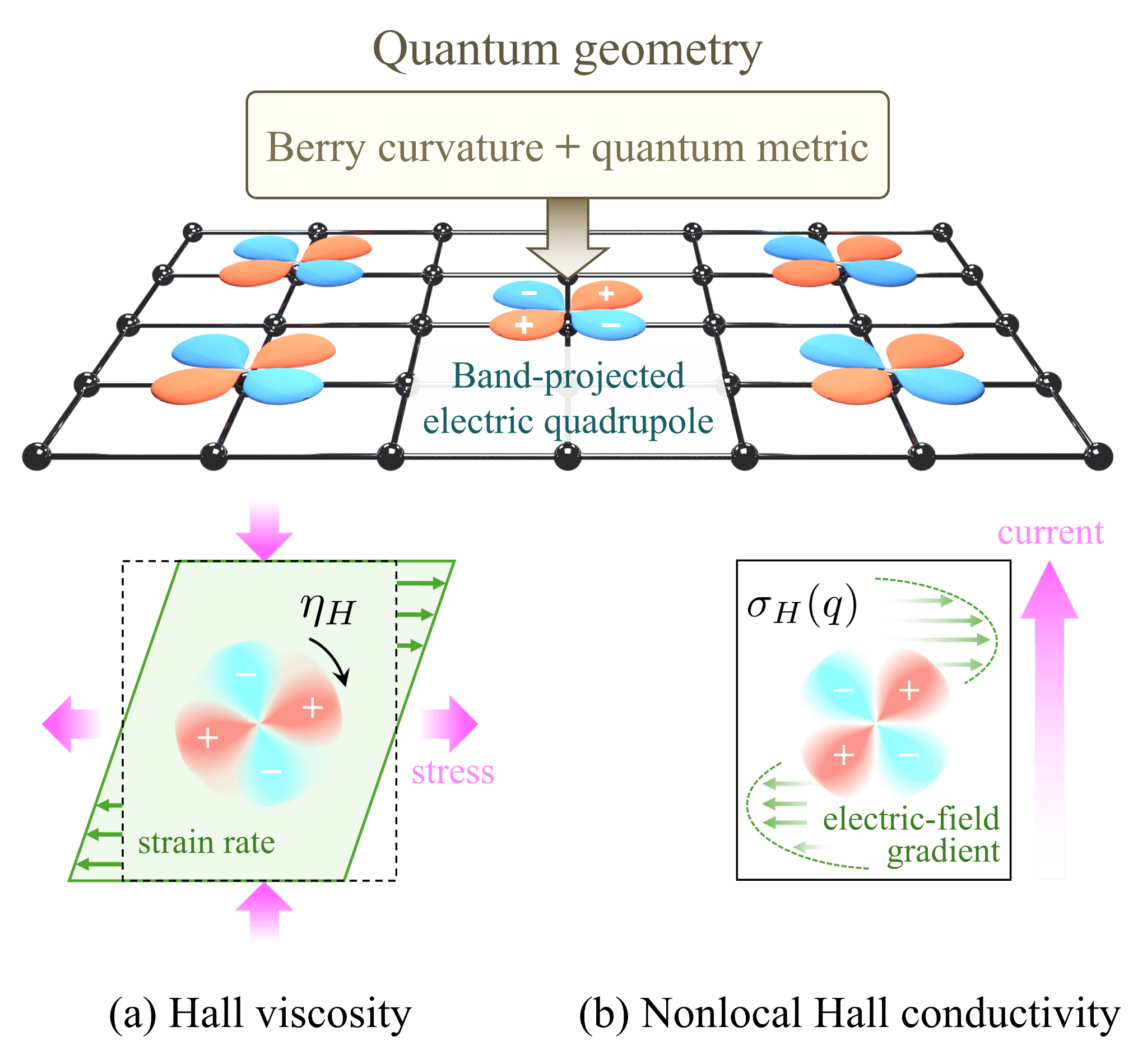
Figure 1: Conceptual schematic of the geometric quadrupole picture. The quantum metric and Berry curvature define the band-projected electric quadrupole, underlying (a) Hall viscous response to strain and (b) nonlocal Hall response to spatially inhomogeneous electric fields.
The Hall viscosity tensor is constructed through the equal-time commutator of band-projected strain generators, yielding a dissipationless response characteristic for time-reversal breaking systems. In the Bloch band context, the isotropic component of the Hall viscosity is given by
ηH=−4ℏ∫BZ4π2d2kΩ(k)tr[g(k)],
where tr[g] and Ω are, respectively, the trace of the local quantum metric and the Berry curvature. This formulation systematically generalizes the uniform, rotationally invariant Landau level case to non-uniform, lattice-specific band structures, encoding local geometric variations via explicit momentum dependence.
Under time-reversal symmetry, both gμν and Ωμν transform in such a way that all Hall viscosity tensor components cancel, consistent with the vanishing of dissipationless, time-reversal-odd responses in normal insulators.
Nonlocal Hall Conductivity and Viscosity-Conductivity Relation
The quadratic-in-wavevector (q2) term in the expansion of nonlocal Hall conductivity, crucial for probing geometric properties electrically, is governed by the same band-projected electric quadrupole. Within the adiabatic single-band approximation, the leading correction to the Hall conductivity in response to a spatially nonuniform electric field is
σH(2)(q)=ℏe2∫BZ4π2d2k21gαβ(k)Ω(k)qαqβ.
The relation between [X^μ,X^ν]=iΩμν(k),0 and [X^μ,X^ν]=iΩμν(k),1—well known to be universal in Galilean invariant systems such as the IQHE—acquires nontrivial lattice-specific corrections. These corrections can be cast as Berry-curvature and quantum-metric covariances across the Brillouin zone.
Key numerical results, as detailed in the paper, compare the nonlocal Hall ratio [X^μ,X^ν]=iΩμν(k),2 across different lattice Chern band models (Kapit–Mueller, chiral TBG, Qi–Wu–Zhang). For ideal geometries satisfying the trace condition (i.e., flat quantum metric equal to the modulus of Berry curvature), deviations from the Landau-level benchmark are strongly constrained and controlled by Berry-curvature fluctuations.
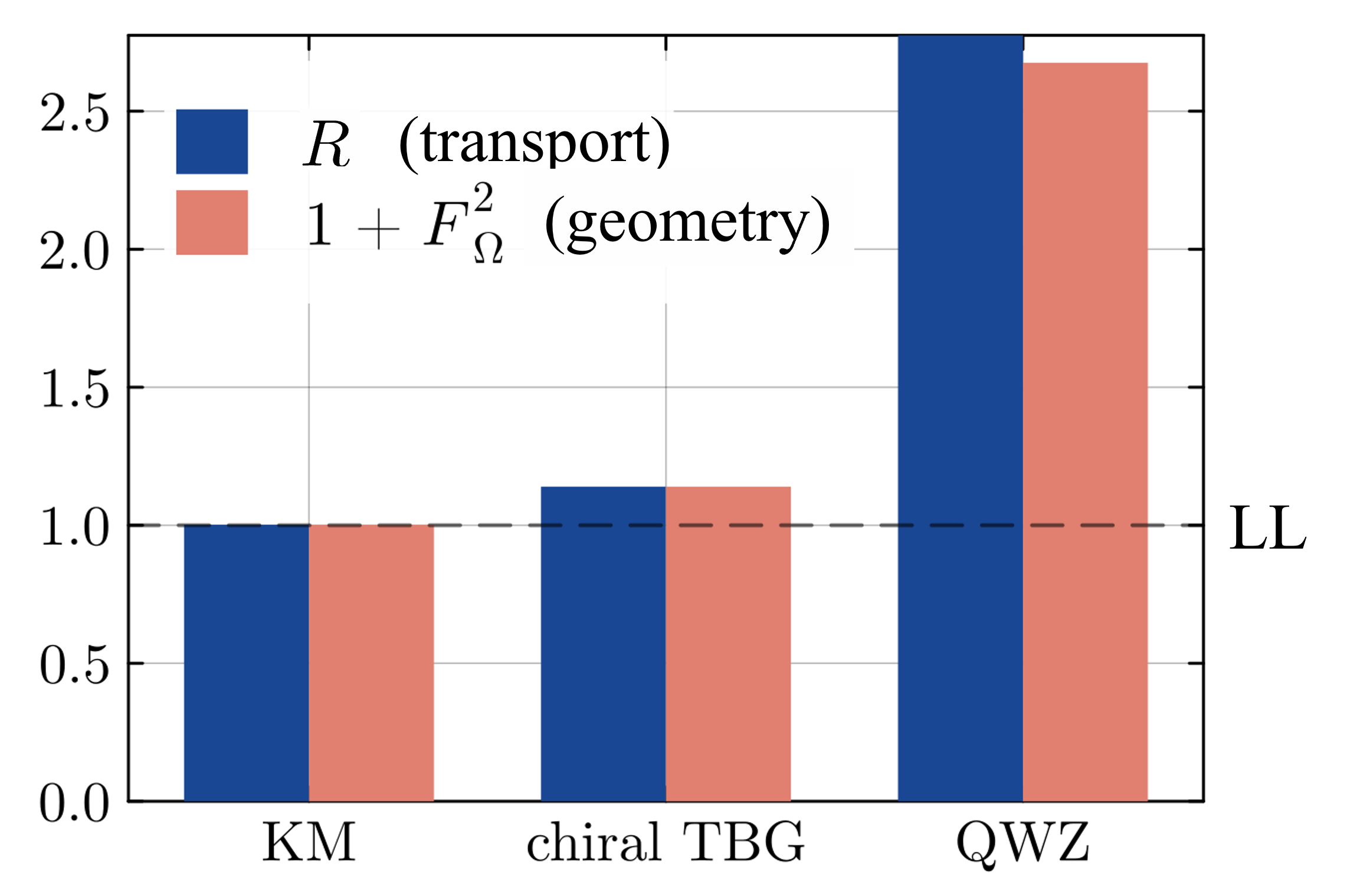
Figure 2: Nonlocal Hall ratio [X^μ,X^ν]=iΩμν(k),3 versus the ideal-band expression [X^μ,X^ν]=iΩμν(k),4 for distinct Chern bands; the dashed line denotes the Landau-level benchmark [X^μ,X^ν]=iΩμν(k),5.
Quantum Geometric Diagnostics and Implications
The nonlocal Hall ratio [X^μ,X^ν]=iΩμν(k),6, experimentally accessible without microscopic band structure knowledge, provides a direct electrical diagnostic of band geometric "idealness," a property strongly tied to the stability of fractional Chern insulator phases. The results establish that, in the ideal limit, [X^μ,X^ν]=iΩμν(k),7 is centered at unity, and any enhancement is quantitatively attributable to Berry-curvature fluctuations. The band-projected construction thus offers a principle for relating transport measurements to the underlying quantum geometry, providing a valuable tool for both design and diagnosis of correlated topological phases.
Theoretical and Experimental Outlook
This geometric formulation clarifies the microscopic underpinnings of nondissipative viscosity and nonlocal transverse responses in lattice systems, opening numerous directions for future research:
- Extension beyond single-band models: Multi-band projections, including interband coherence, are a natural next step for topologically nontrivial systems with small gaps or strong mixing.
- Role of interactions: While the analysis is grounded in single-particle band geometry, interaction-driven modifications may lead to new geometric bounds or emergent collective phenomena, especially in the context of fractional Chern insulator and other strongly correlated phases.
- Quantum metric engineering: The explicit role of the quantum metric, both in transport and collective mode stability, motivates direct efforts to engineer flat quantum metric distributions in artificial lattice systems.
- Experimental probes: The nonlocal Hall ratio connects naturally to measurable transport experiments and can guide exploration and optimization of candidate moiré materials and designer Chern bands.
Conclusion
The delineation of the band-projected quadrupole as the central quantum geometric object underpinning Hall viscosity and nonlocal Hall conductivity systematically extends the geometric paradigm of the continuum QHE to crystalline lattice bands. The quantum metric and Berry curvature, encapsulated within the QGT, are shown to control measurable transport properties and serve as diagnostics for ideal band geometry, with clear numerical and experimental signatures. This framework will likely serve as a foundation for further progress in the geometrization of quantum transport, the stabilization and detection of correlated topological states, and the rational design of topological materials with tailored geometric response functions.

