- The paper demonstrates a sharp, capacity-induced collapse in long-horizon agents, revealing a plateau-transition-floor performance structure.
- The controlled experiments in structured environments isolate state cardinality and dependency density as critical parameters defining the collapse boundary.
- The analysis shows that world-model representational failures precede erroneous actions, underlining the need for enhanced diagnostic and memory architectures.
World-Model Collapse in Long-Horizon Language Agents: Evidence for a Phase Transition
Introduction
The paper "World-Model Collapse as a Phase Transition" (2606.31399) investigates a non-gradual, phase-transition-like failure mode in long-horizon LLM agents. The central claim is that task difficulty, modulated via state cardinality (sc) and dependency density (dd), does not induce a smooth decline in agent performance as typically assumed. Instead, the empirical results indicate a plateau-transition-floor structure in performance, with abrupt collapse once world-model capacity is exceeded. The authors primarily utilize the controlled "StatefulPuzzle" environment, with a fully instrumented agent loop that enables per-step analysis of world-state fidelity and action validity.
The study frames long-horizon agent failures using statistical physics terminology, considering sc and dd as control parameters and final task success as the order parameter. The crucial mechanistic element is that the agent's world-state representation degrades before invalid actions manifest, exposing a temporal precursor to overall plan failure. This structure is formalized via operational grid bracketing and per-step diagnostics, allowing for precise localization of the transition boundary.
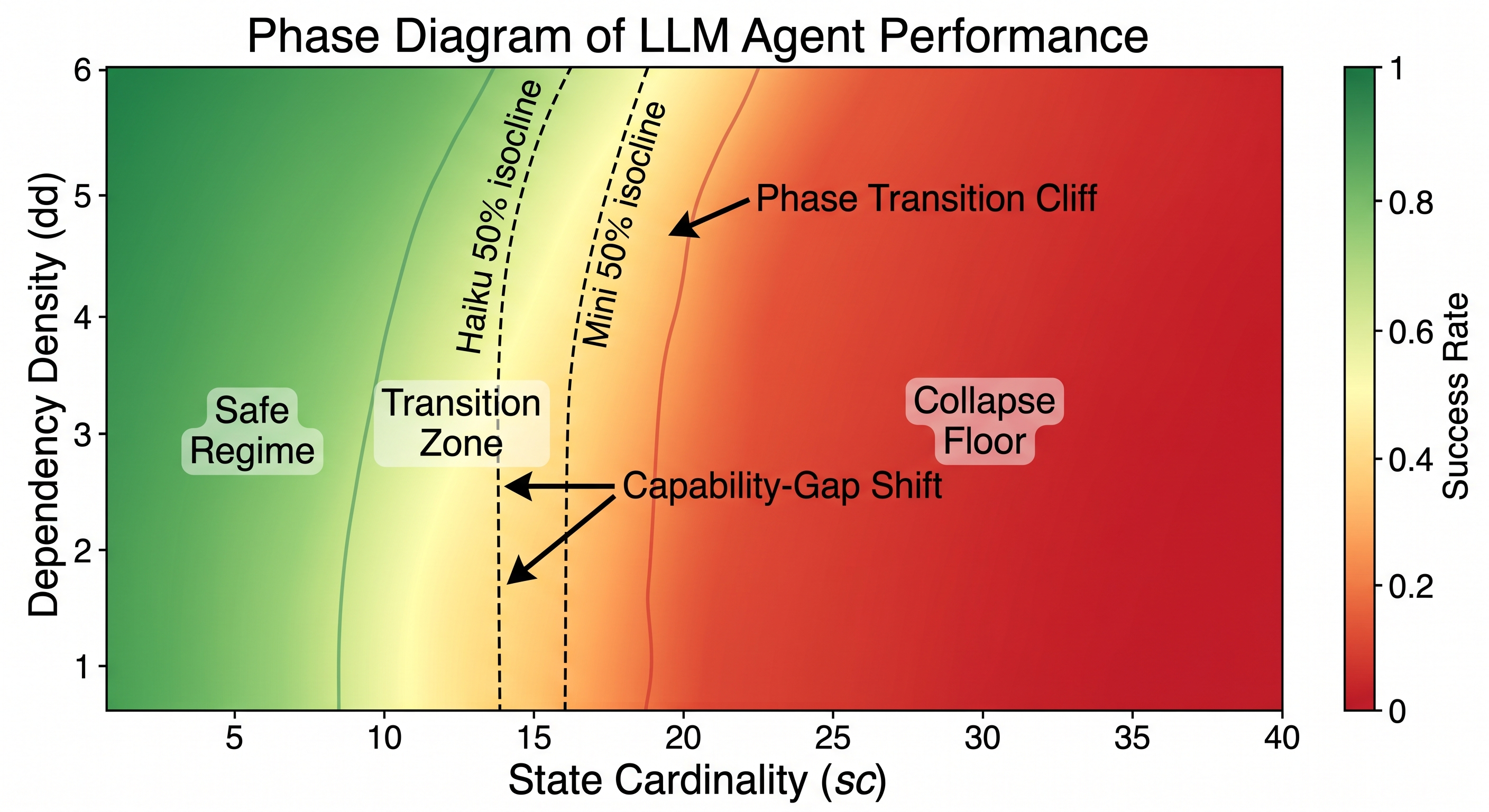
Figure 1: Conceptual phase diagram for world-model collapse in the (sc,dd) plane, separating solved, transition, and collapsed regimes.
Methodology
Controlled Environment Design
Three deterministic environments are constructed for isolating the effect of structural parameters:
- GraphNav: Navigation in graphs with keys/switches.
- ToolDAG: Tool-call sequencing under increasing variable namespace.
- StatefulPuzzle: The main environment, manipulating objects over rooms, containers, and items, allowing orthogonal control over sc and dd.
The key innovation is the explicit separation of world-state accuracy from action validity by exposing gold world states at each step.
Agent Architecture
A three-call Planner/Updater/Self-Diag loop maintains and updates a structured explicit world-state memory, which is critical for deconvolving representational failures from policy/execution errors.
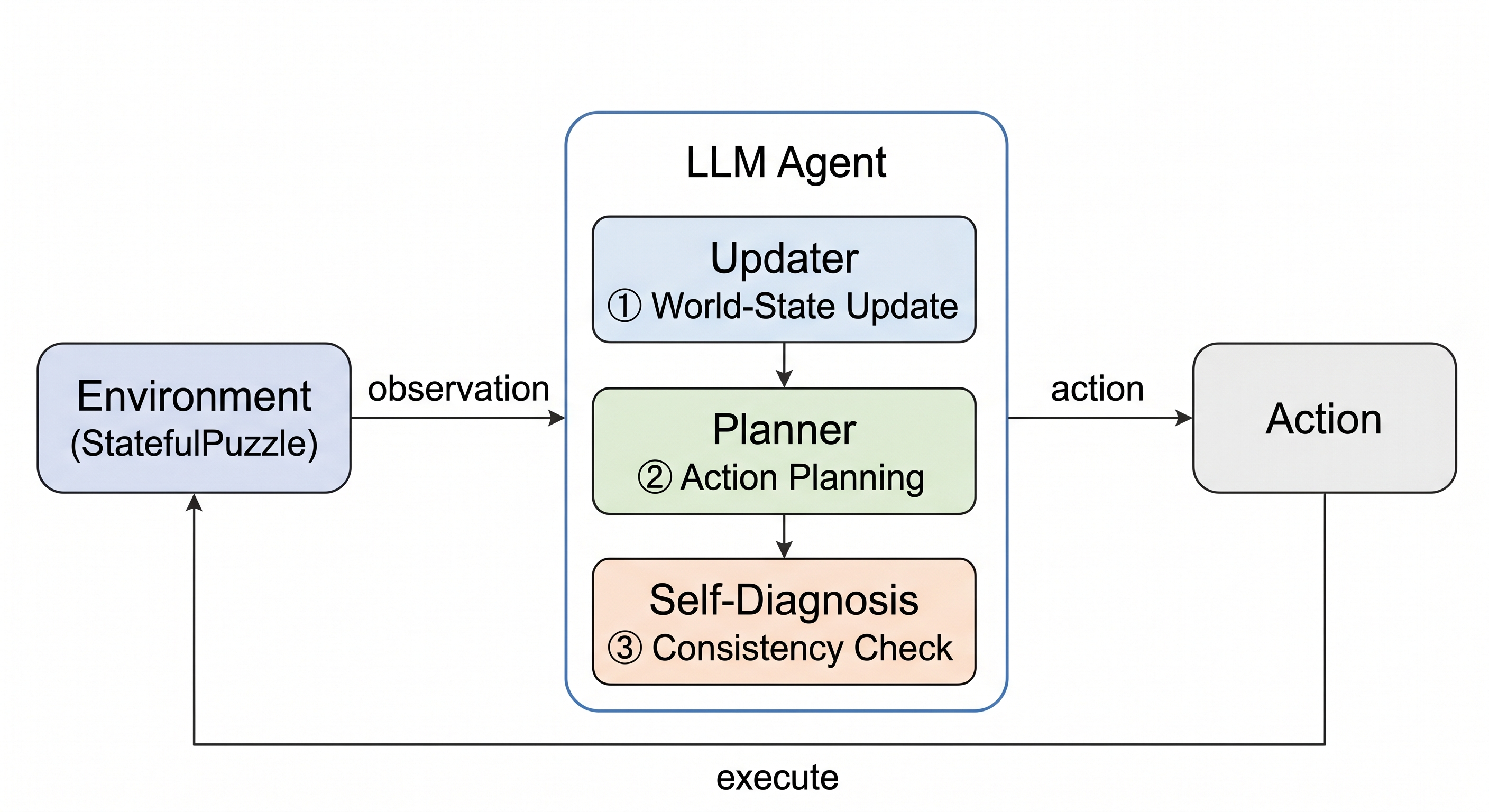
Figure 2: Stepwise agent loop separating planning, world-state updates, and self-diagnosis under fine-grained control of stressors.
Stress Grid and Evaluation Protocol
A 4×4 grid on (sc,dd) is evaluated, with n=100 episodes per cell, under fixed horizon and other nuisance parameters. The choice of axes and environment follows locked, preregistered pilot criteria ensuring monotonicity and diagnostic validity.
Numerical Results and Phase Structure
Empirical Phase Diagram
Task success heatmaps show that:
- At low sc and dd, the agent maintains near-perfect performance;
- Increasing sc, especially in conjunction with high dd, causes a sharply localized drop (transition band) to a regime of consistent failure (collapse floor);
- Increasing dd at fixed sc only induces collapse near the transition; away from the boundary, its effect is limited.
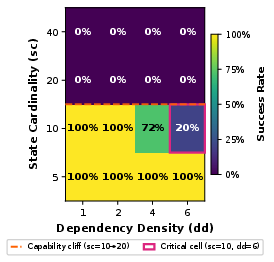
Figure 3: Success-rate heatmap demonstrates plateau, transition, and collapse under systematic variation of state and dependency size.
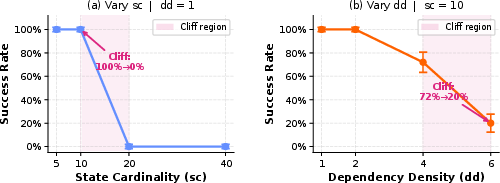
Figure 4: Cross-sectional profiles reveal the sharpness of the transition, localized to a narrow range on the sc axis.
World-model fidelity is empirically shown to decay before action validity, meaning the observed actions are made under an already inconsistent state, not simply as a result of transient planning noise.
Single-Axis Ablations
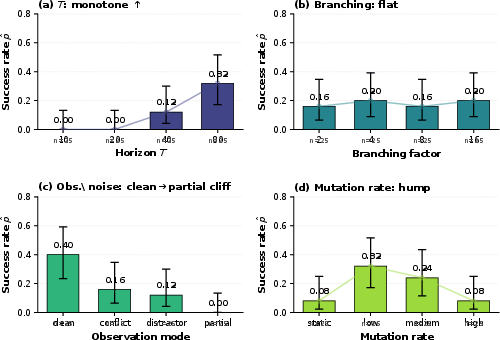
The role of secondary factors is systematically evaluated:
Cross-Model and Fine-Grained Analysis
Boundary Localization
Fine-grained scans along sc sharpen the critical point to sc⋆≈13.5 (claude-haiku-4-5). In contrast, no direct horizon analog is observed; T modifies feasibility but not the critical world-model load boundary.
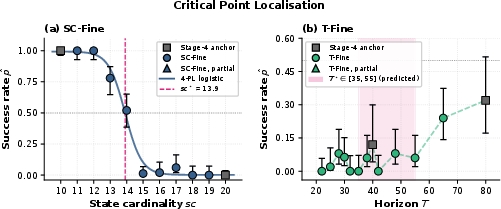
Figure 6: Critical-point analysis; the SC axis exposes a narrow transition, absent on the T axis, confirming structural, not horizon-driven, collapse.
Robustness Across Foundation Models
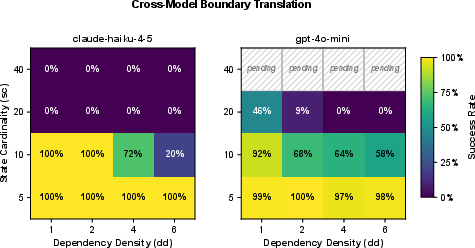
Comparative experiments with GPT-4o-mini, GPT-4o, and Llama-3 70B show:
Theoretical and Practical Implications
The results explicitly falsify gradual-drift models of agent failure, e.g., canonical path-deviation frameworks (Lee, 22 Feb 2026), and instead reveal a sharp capacity-induced cliff. This is analogous to statistical mechanics phase transitions but operationalized at finite grid resolution rather than in the thermodynamic limit.
The critical implication for agent-design and evaluation:
- Final step success is not diagnostic; failures are typically representational, not merely local action noise.
- Agent harnesses and memory architectures must be assessed not only for total score but for when (τW) the world model loses coherence.
- Structured and externalized memory mechanisms, planner/memory hybrids, and explicit causal state tracking are the most direct targets for extending world-model capacity.
Future research should integrate per-step instrumentation of world-state fidelity, avoid conflating structural and horizon/branching stressors, and employ controlled grids to complement ecological benchmarks. Scaling or scaffolding that merely increases context length without state support is insufficient for reliable long-horizon operation.
Conclusion
"World-Model Collapse as a Phase Transition" demonstrates that LLM-agent failures in long-horizon tasks are governed by an abrupt, quantifiable capacity boundary in their implicit world-models, not by smooth drift or local error accumulation (2606.31399). Empirical analysis in controlled settings, with multiple model families, exposes a plateau-transition-floor structure in task success with collapse first manifesting as a representational failure. Capability increases shift the boundary but do not remove it. These findings direct methodological attention toward explicit diagnostics of world-model fidelity, agent design with externalized or structured state representations, and evaluation protocols sensitive to the existence and location of structural collapse boundaries.