UnfoldArt: Zero-Shot Recovery of Full Articulated 3D Objects from Text or Image
Abstract: Articulated 3D objects are essential for interactive environments in embodied AI, robotics, and virtual reality, but reconstructing their structure and motion from sparse observations remains challenging. Existing approaches remain largely constrained by lack of supervised data or lack the priors needed to reliably recover articulation, hidden geometry, and internal object structure. We present the first debate-driven agentic approach to articulated 3D object reconstruction from text or image inputs that both grounds articulation reasoning in concrete motion and exposes the occluded geometry revealed under articulation. High-level agents reason about object semantics and motion using knowledge from vision-language and video models, while low-level agents estimate articulation parameters and interaction points; together, they engage in a two-round structured debate that first exploits global--local disagreement and then grounds the agents in freely generated video. The same video prior, conditioned on the agreed articulation, then drives each part through its motion to expose occluded interiors and geometry that cannot be inferred from a single static view. By combining agentic reasoning with a video generative prior, our approach jointly infers articulation and reconstructs complete 3D articulated objects, producing high-fidelity geometry, internal structure, and motion-consistent states beyond directly observed surfaces.
Paper Prompts
Sign up for free to create and run prompts on this paper using GPT-5.
Top Community Prompts
Explain it Like I'm 14
What this paper is about
This paper introduces UnfoldArt, a system that can create a complete 3D model of a moving object—like a door, drawer, or robot arm—from just one image or a short text description. It doesn’t only model the outside; it also figures out how the parts move and what hidden parts inside look like when you open or slide things. This is useful for robots, games, and virtual reality where objects need to move realistically.
What questions the researchers asked
The team focused on three simple questions:
- From a single picture or short text, can we figure out how an object is made of parts and how those parts move?
- Can we make a full 3D model that includes not just the outside, but also the inside that you’d only see when something is opened?
- Can we do this without special training on lots of examples of moving objects, by using general AI models already available?
How the system works, in everyday terms
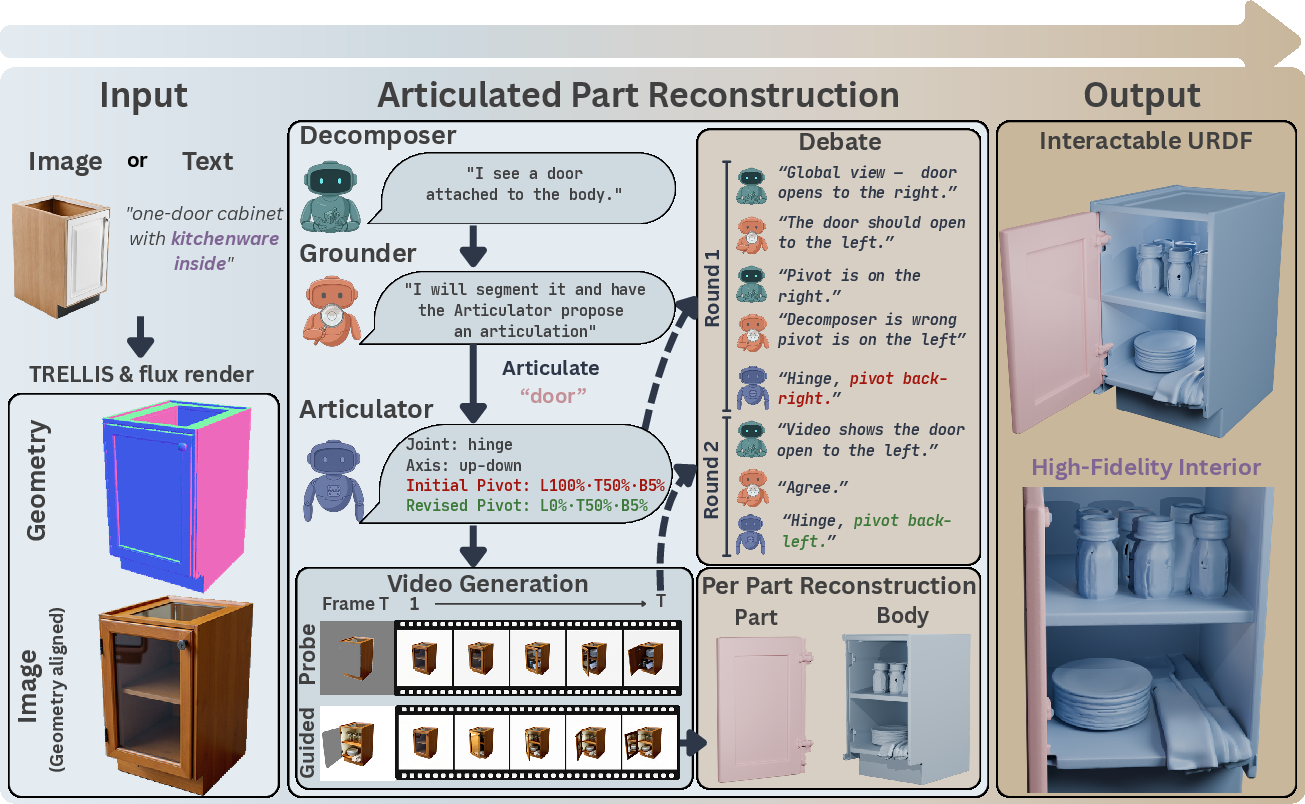
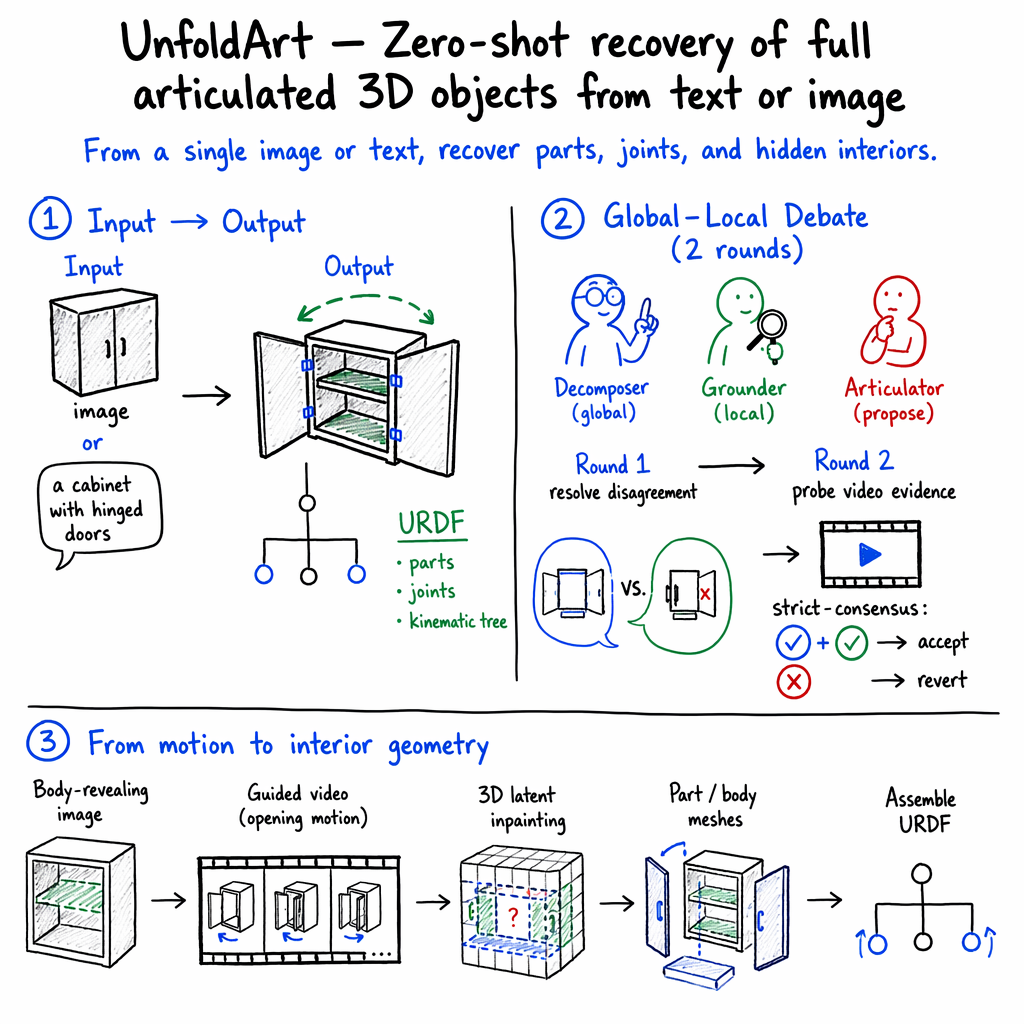
Think of UnfoldArt as a small team of smart helpers that look at an object from different angles—big picture and close-up—and then argue (politely!) until they agree on how the object moves. Then they “imagine” a short video of the object moving to double-check their guesses and to reveal hidden parts. Finally, they build a detailed 3D model you can interact with.
Here’s the process, step by step:
- Starting point: From your image or text, UnfoldArt makes a first rough 3D shape and a realistic picture of the object. This gives the system something concrete to think about.
- Three “agents” (like teammates) look at the object:
- Decomposer: looks at the whole object and suggests what the parts are (like “this is a door” or “this is a drawer”) and how they probably move (swing or slide).
- Grounder: finds the exact areas of those parts in the picture (like drawing a mask around a door panel).
- Articulator: guesses the joint details—what type of joint it is (hinge or slider), the direction it moves, and where it rotates or slides from.
- A two-round “debate” to reduce mistakes:
- Round 1 (global vs. local check): The whole-object view and the close-up view often disagree in helpful ways. For example, if you crop just the door panel without context, you might choose the wrong hinge side. The team compares notes and fixes these errors.
- Round 2 (video evidence): The system uses a general video generator to create a short “probe” video of how the object would move. The agents watch this video to see if their guess looks natural. If the video clearly shows movement that contradicts their guess, they adjust things like the hinge side or the movement direction.
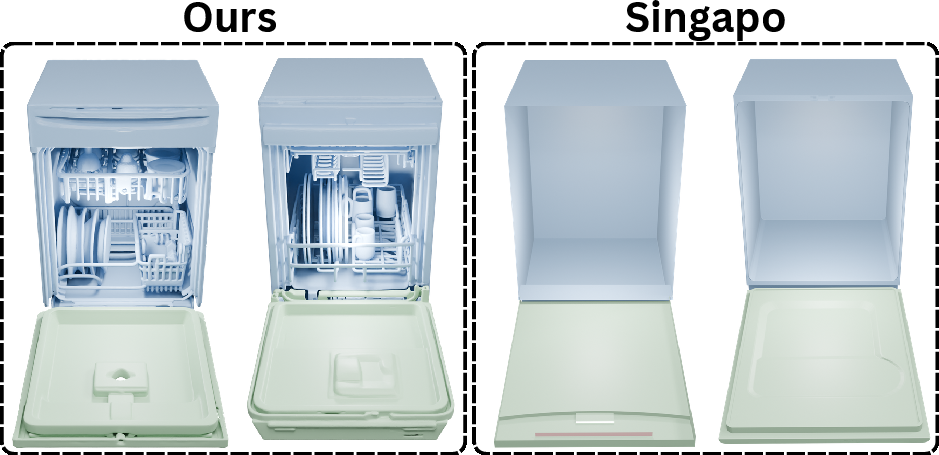
- Using motion to reveal the inside: Once the motion is agreed on, the system makes another short, guided video that shows the part moving fully open. This exposes hidden areas inside, like the cavity behind a cabinet door or the slot behind a drawer.
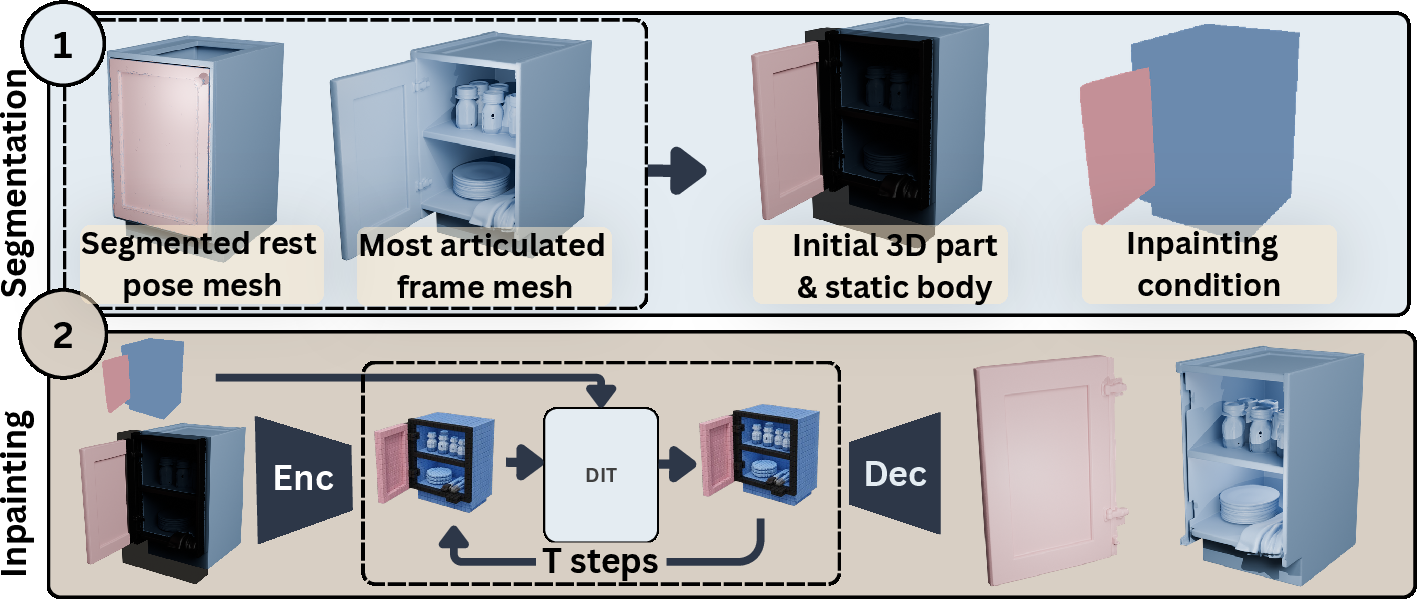
- Filling in missing geometry (“inpainting”): Imagine you have a 3D puzzle with some pieces missing along the edge where the part and body meet. The system knows which parts are definitely the door and which parts are definitely the body, but the boundary is fuzzy. It “inpaints” the uncertain boundary in 3D—like carefully coloring in the missing pieces—using the motion and the video frames as clues. This produces clean, separate 3D meshes for moving parts and the main body, including the once-hidden interior.
- Final output: The model is saved with standard joint info (a URDF file), so you can open, close, and animate it in simulators or games.
What they found and why it matters
The authors tested UnfoldArt against other advanced methods on several datasets:
- Objects seen in typical training sets (like household cabinets and drawers).
- Harder “out-of-distribution” objects, like helicopters, robot arms, and human-like figures with chained movements.
Key takeaways:
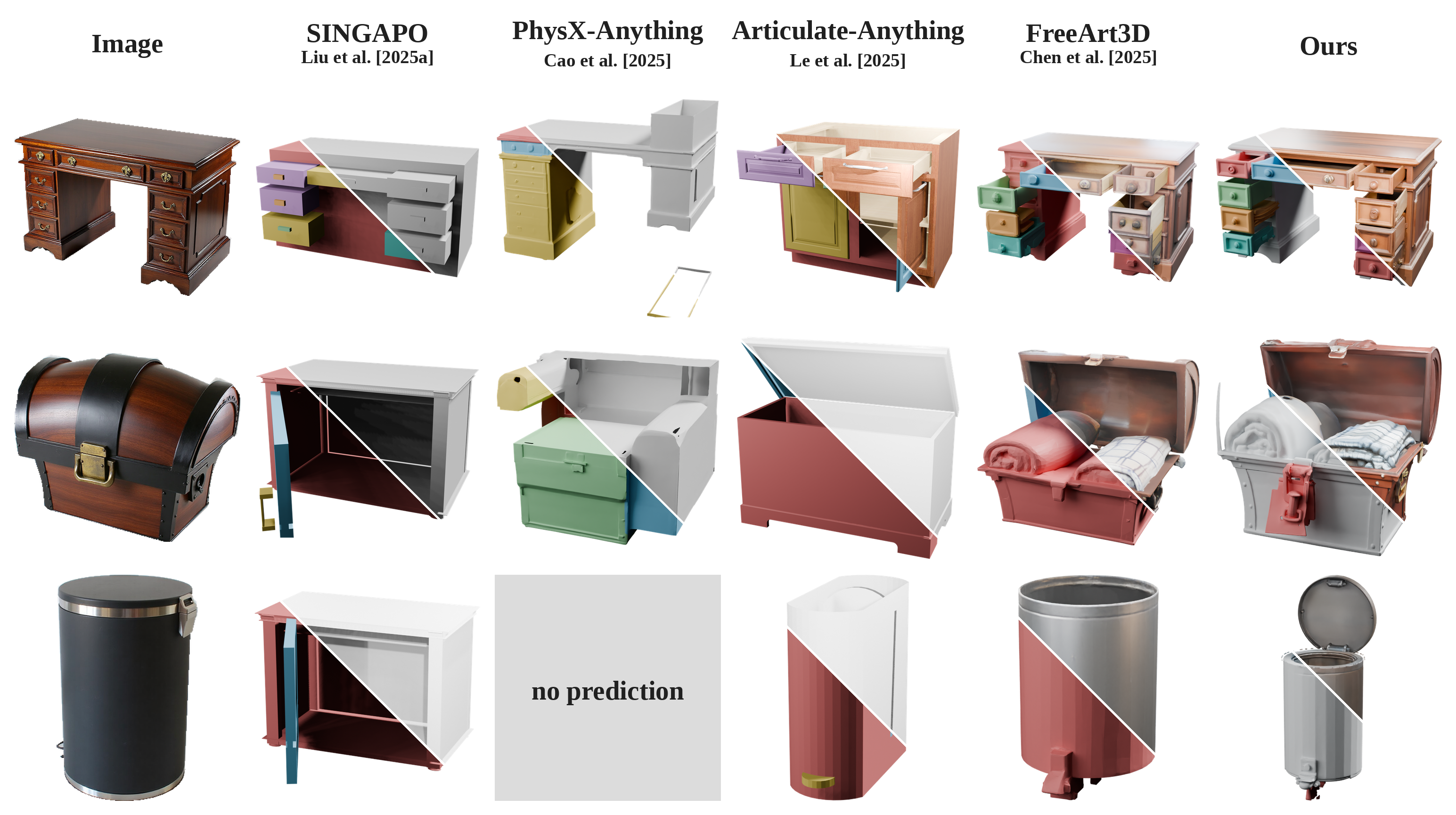
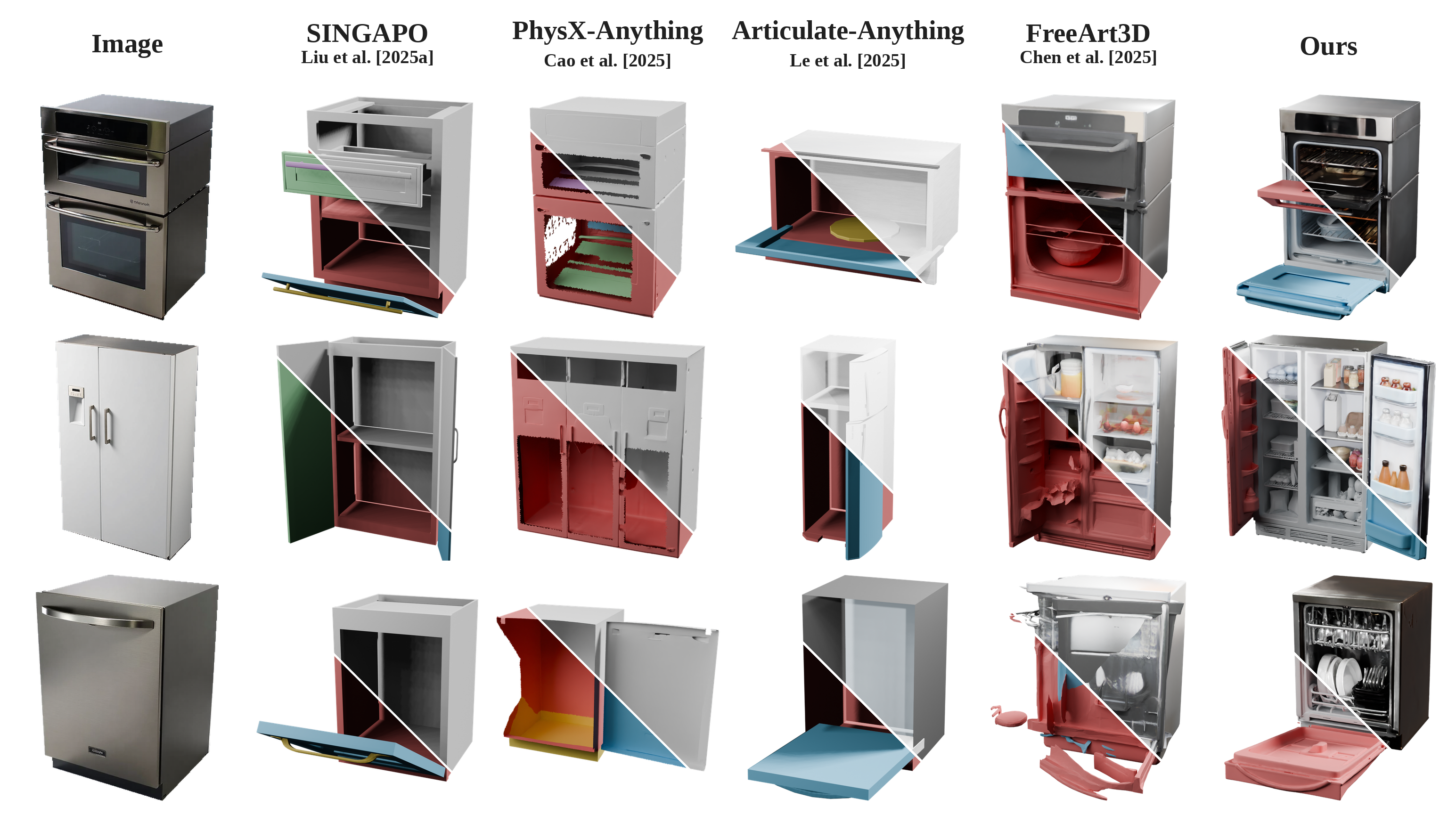
- Strong joint prediction: UnfoldArt more accurately figured out how parts move—especially the direction of hinges and sliders—on many challenging objects.
- Better geometry with details: It made more detailed 3D shapes and cleaner part separations, especially when revealing interiors.
- Works without special training on moving objects: While some systems rely on lots of examples of moving objects to learn from, UnfoldArt leans on general-purpose models plus its debate-and-video strategy. It still performed well even on objects very different from the usual training data.
- Competitive on standard benchmarks: On common datasets, it stays close to or matches top systems trained specifically for those categories, while often doing better at getting the joint types and directions right.
Why this research is important
- For robotics and embodied AI: Robots need to know how things open, slide, or rotate to interact safely and effectively. UnfoldArt can create realistic, moveable models from just a photo, helping robots practice in simulations without needing expensive 3D scans.
- For games and VR: Designers can quickly turn simple references into interactive objects that open and reveal interiors, making worlds feel more alive.
- Less data dependency: Instead of requiring huge, carefully labeled datasets of moving objects, UnfoldArt shows how to combine general AI knowledge, a structured “debate” between agents, and imagined videos to recover motion and hidden geometry.
- A new way to reason: The “debate-driven” approach is a fresh idea—using disagreements between a global view and a close-up view, plus video evidence, to fix tricky mistakes and make smarter decisions.
In short, UnfoldArt is a tool that can “see” how things are built and how they move, even when starting from very little information, and it can “unfold” objects to reveal their insides—opening doors for better virtual worlds, smarter robots, and faster content creation.
Collections
Sign up for free to add this paper to one or more collections.