- The paper introduces a novel MD-3k benchmark and Laplacian Visual Prompting method to quantify geometric ambiguities in monocular depth estimation.
- The methodology measures depth-layer preference via alternating RGB and spectral inputs, achieving improved ML-SRA on ambiguous cases.
- Empirical results indicate that input modifications reveal complementary depth hypotheses, paving the way for ambiguity-aware 3D scene understanding.
Probing Geometric Ambiguity in Monocular Foundation Models with Multi-Layer Depth Evaluation
Introduction and Motivation
Monocular depth estimation serves as a foundational interface between 2D images and 3D scene understanding, typically outputting a single scalar depth per pixel. However, this single-layer paradigm is fundamentally inadequate in scenarios where layered geometry exists along an optical ray, most notably in the presence of transparent materials. In such cases, multiple valid geometrical surfaces can be present; sensor or rendering conventions collapse this ambiguity into a single value according to biases inherent in the data or annotation protocol.
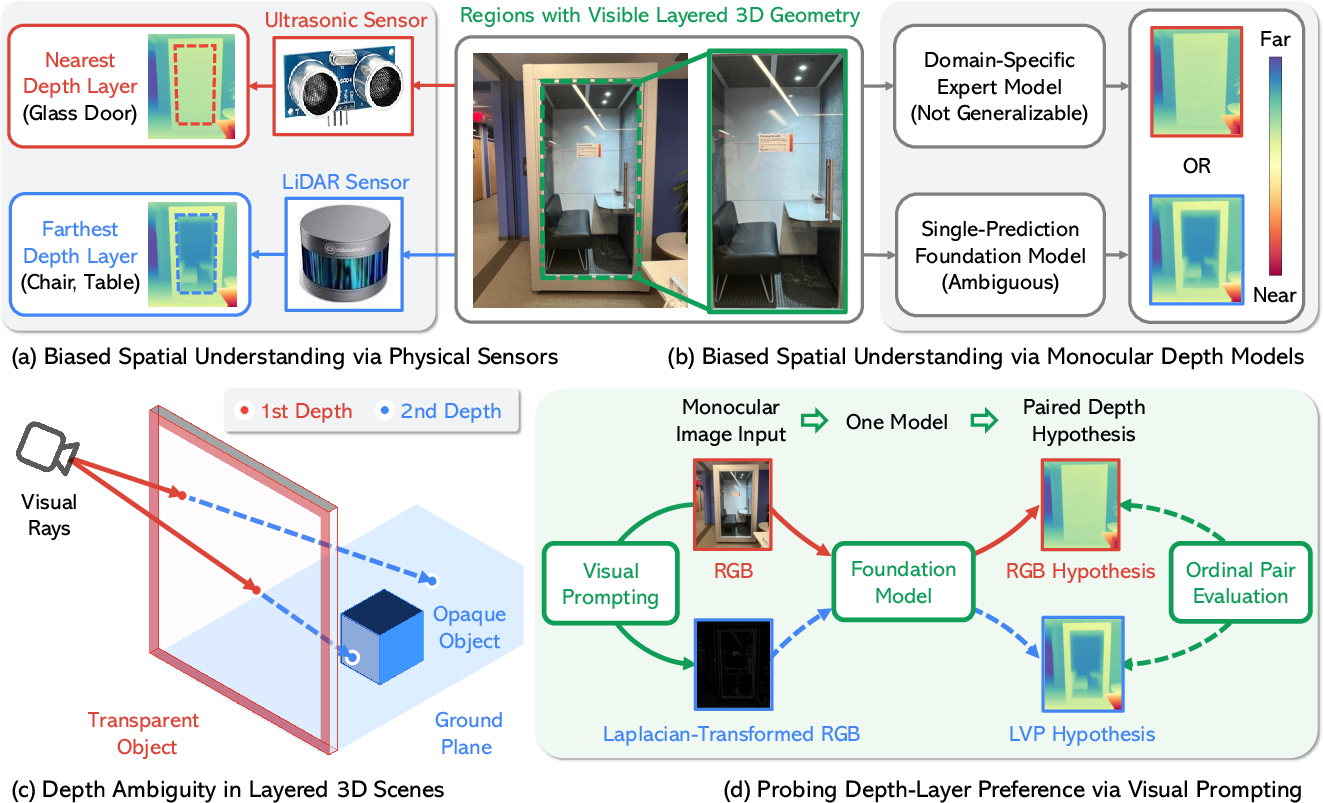
Figure 1: Geometric ambiguity in transparent scenes, where single-layer depth collapses multiple valid surfaces into one dataset-driven scalar target.
This paper exposes and formalizes the issue of collapsed geometric ambiguity within state-of-the-art monocular depth foundation models by introducing a novel measurement framework and evaluating the capacity of current models to express or modulate multiple plausible depth hypotheses.
MD-3k Benchmark: Measuring Layered Geometric Ambiguity
A primary contribution is the introduction of the MultiDepth-3k (MD-3k) benchmark, a real-world dataset constructed to diagnose layer preference in transparent scenes. MD-3k provides sparse ordinal labels for each image, specifying relative spatial relationships for both the transparent foreground and the visible background layers. This formulation circumvents the absence of practical, dense, sensor-neutral multi-layer ground truth for transparency and enables precise measurement of which layer models tend to report under annotation- and hardware-driven biases.
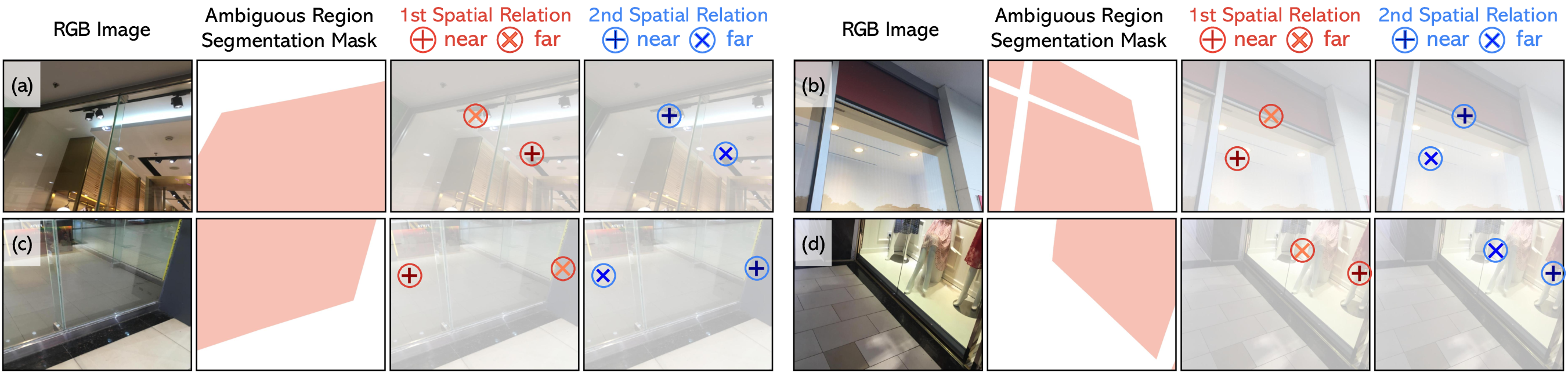
Figure 2: MD-3k: Images annotated with ambiguous region masks and sparse point pairs; relative spatial relationships reverse between layers in (a-c) and agree in (d).
The dataset is partitioned into a "Reverse" subset, where ordinal relations are conflicting between layers (only one can be satisfied per depth map), and a "Same" subset, where relations are consistent. This partition is crucial for disentangling inherent ambiguities in monocular depth inference from general ordinal ranking difficulty.
Depth-Layer Preference and Evaluation Framework
For each frozen depth foundation model, the authors propose to measure depth-layer preference α(fθ), the empirical tendency to align with foreground or background ordinal relations in ambiguous regions. Furthermore, the study assesses whether changing the input representation alone—without any parameter updating—can modulate this preference or produce geometrically complementary outputs.
A central evaluation metric is Multi-Layer Spatial Relationship Accuracy (ML-SRA), which quantifies the proportion of cases where a model's paired hypotheses (e.g., standard RGB input and a modulated variant) collectively satisfy the two annotated ordinal relations—foreground and background—across the MD-3k dataset.
Laplacian Visual Prompting: Spectral Probing of Frozen Models
A key methodological innovation is Laplacian Visual Prompting (LVP). LVP is a deterministic, high-frequency image-space transform applied channel-wise using a standard Laplacian kernel; the transformed image is rescaled to the standard input range and fed to the frozen model as an alternative query.
The goal of LVP is to probe the latent geometric information within the model that might be preferentially expressed depending on the spectral emphasis of the input. Unlike learned visual prompting or feature-space interventions, LVP is entirely training-free, operationally simple, and provides a physically interpretable spectral perturbation.
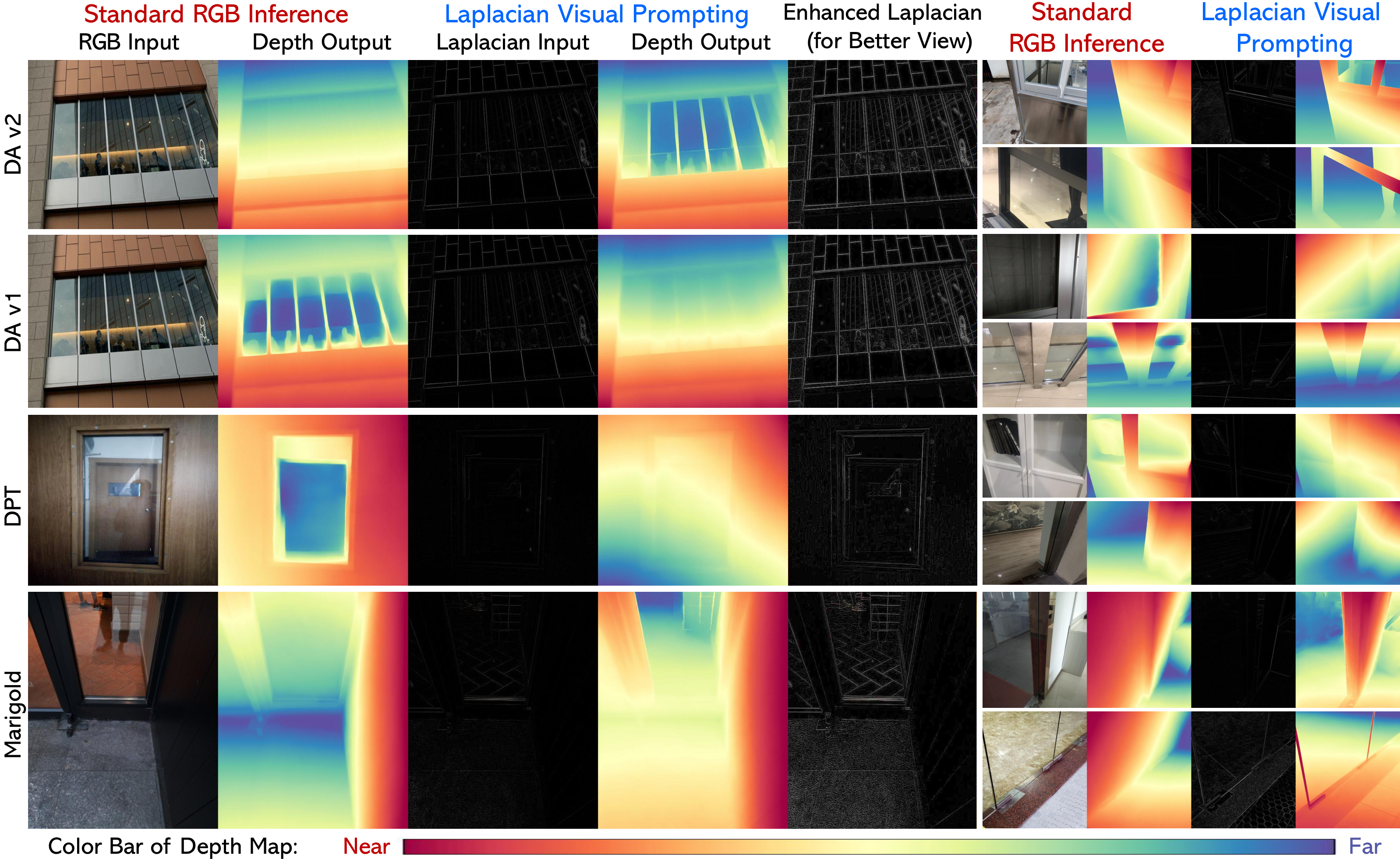
Figure 3: LVP modulates depth-layer preference in certain models, producing complementary depth hypotheses in ambiguous regions.
Layer Preference Diversity and Modulation
Empirical evaluation across a large suite of foundation models demonstrates extensive diversity in depth-layer preference under standard RGB input. For instance, models tuned to indoor environments favor the foreground (proximal transparent surface), whereas models exposed to predominantly outdoor data, or influenced by synthetic rendering conventions, often favor the background (distal scene). This heterogeneity is dataset- and domain-dependent, confirming that trained models inherit supervision- and annotation-induced conventions rather than intrinsic geometric truth.
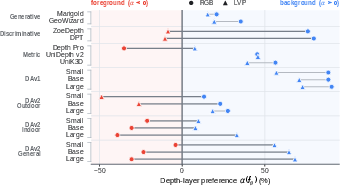
Figure 4: Depth-layer preference and LVP response: each row tracks the transition in layer bias from RGB (circle) to LVP (diamond); color encodes layer preference (red: foreground, blue: background).
Most notably, the LVP transformation shifts depth-layer preference in several models, especially DPT, Depth Pro, and the Depth Anything v2 (DAv2) family, enabling a candidate complementary hypothesis in response to an otherwise ambiguous input. The modulation is model-dependent and non-universal; several architectures (e.g., DAv1, certain diffusion-based estimators) exhibit minimal sensitivity to LVP, revealing boundary conditions for the technique.
Strong Numerical Results and Contradictory Claims
On the MD-3k Reverse subset, where single-output models fundamentally cannot satisfy both layers' spatial constraints, paired RGB/LVP inference using DAv2-L achieves 75.5% overall ML-SRA and 52.2% on ambiguous cases—significantly above the 56.4% strict ceiling for any duplicated (non-complementary) single-output map. This result substantiates the contradictory claim that a frozen, single-output model can jointly realize both foreground and background ordinal relations—by input prompting alone—thereby exposing otherwise hidden geometric hypotheses.
Scaling, Ablation, and Spectral Specificity
Analysis of model scaling indicates that increased model capacity enhances ML-SRA only when RGB and LVP biases diverge (i.e., the candidate pair offers complementary hypotheses). When biases converge, performance can degrade as model commitment increases to a single hypothesis. LVP's effect is robust to ablation on kernel configuration, spectral sign, and grayscale input, confirming that efficacy is governed by the spectral content of the prompt rather than fine-grained architectural or preprocessing details.
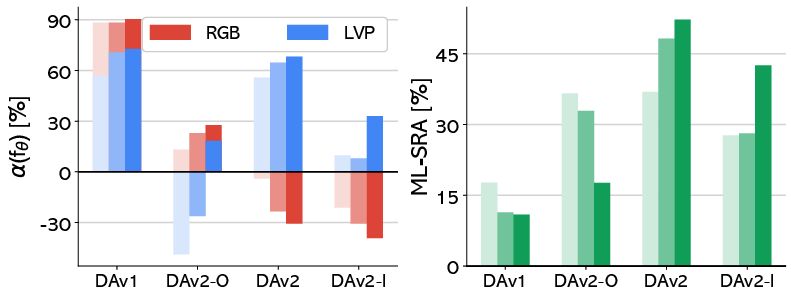
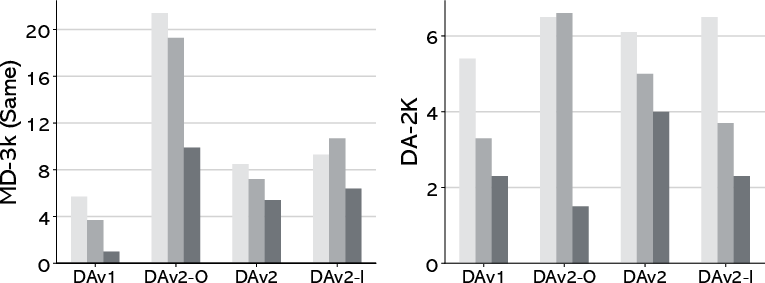
Figure 5: Scaling analysis highlights improvements in ambiguous cases only when model biases diverge across RGB/LVP; consistent spatial relations lead to stable generalization.
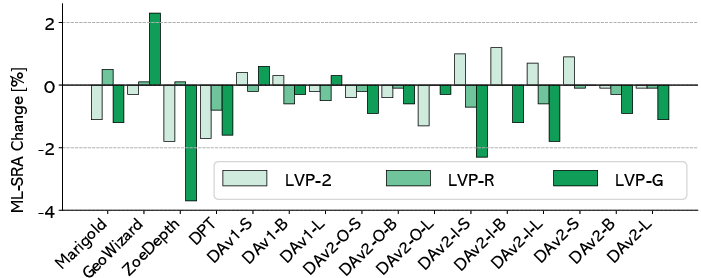
Figure 6: LVP design ablation: ML-SRA remains stable across kernel shape, sign, and input color space variants.
Downstream Applications and Qualitative Interpretation
The complementary depth hypotheses induced by RGB/LVP prompting are applicable in geometry-conditioned image generation and video, providing richer scene hypotheses for tasks such as conditional rendering and enabling temporally coherent exploration of spatial ambiguity.
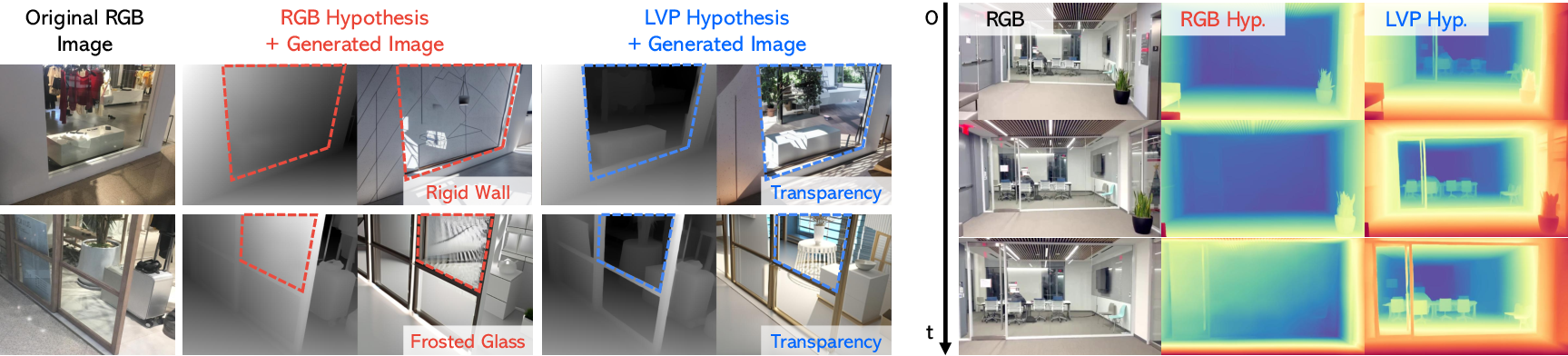
Figure 7: Candidate depth hypotheses from RGB/LVP pairs serve as distinct ControlNet conditions and animated depth streams for geometric content manipulation.
Limitations and Implications
While LVP unlocks distinct latent geometric predictions in several strong monocular models, its effectiveness is not universal—limitations occur in frequency-entangled semi-transparent surfaces and architectures less responsive to spectral input manipulation. MD-3k annotates only sparse point pairs per image and is specifically tailored to transparency; comprehensive dense annotation and semantic layer selection remain open directions.
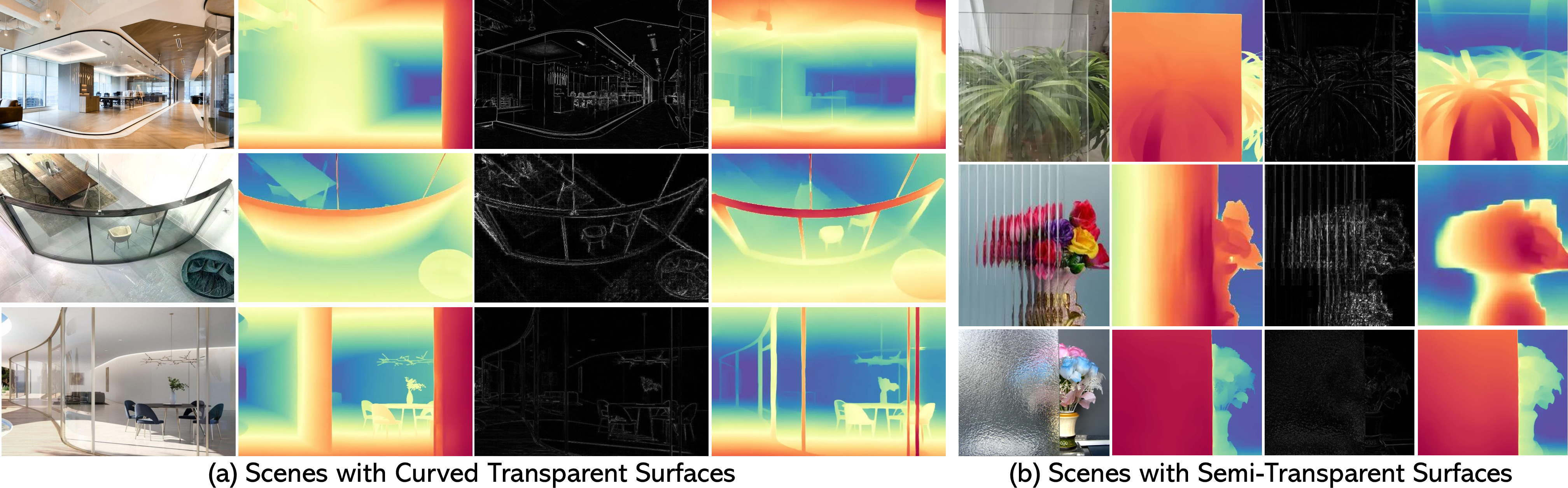
Figure 8: Generalization boundaries for LVP: success in curved-glass scenarios and failure in frequency-entangled semi-transparency.
The theoretical implication is clear: the conventional single-depth paradigm collapses a geometric posterior into a dataset-shaped deterministic target, obscuring multiple valid physical interpretations. Practically, system designers are urged to both measure and express such ambiguity rather than treating it as noise—enabling multi-hypothesis reasoning, application-aligned bias tuning, and ambiguity-resilient robotic perception.
Conclusion
This work systematically quantifies geometric ambiguity in monocular depth foundation models and demonstrates—via the MD-3k benchmark and training-free spectral prompting—that frozen models can be induced to express complementary geometric hypotheses corresponding to layered scene structure. These findings call for a conceptual shift in depth model supervision, evaluation, and application toward explicit ambiguity-awareness and multi-hypothesis representation. Extension to broader scene types, generalized ambiguity classes, and the integration of auxiliary semantic information represent promising directions for future research in multi-modal 3D scene understanding.
Reference: "One Scene, Two Depths: Probing Geometric Ambiguity in Monocular Foundation Models" (2606.29600)