- The paper introduces a novel internal debate framework that leverages dual-routing, momentum switching, and expert pools to enhance multi-agent reasoning.
- The paper demonstrates significant improvements in accuracy and efficiency, achieving 3.7× lower latency and 87% token reduction compared to external debate methods.
- The paper employs viewpoint-shift supervision to ensure robust error correction and sustained reasoning across diverse text and multimodal benchmarks.
Mixture of Debaters: Architectural-Level Debate for Multi-Agent Reasoning
Motivation and Limitations of Current Debate Frameworks
Multi-agent debate has become a prominent mechanism for enhancing the reasoning abilities of LLMs, capitalizing on adversarial critique and consensus among diverse agents to reduce hallucinations and improve answer fidelity. Conventional approaches, however, are constrained by two structural drawbacks: (1) fixed, static pipeline architectures with inflexible role assignments, and (2) substantial computational overhead stemming from deployment of multiple model instances and inter-agent communication requirements.
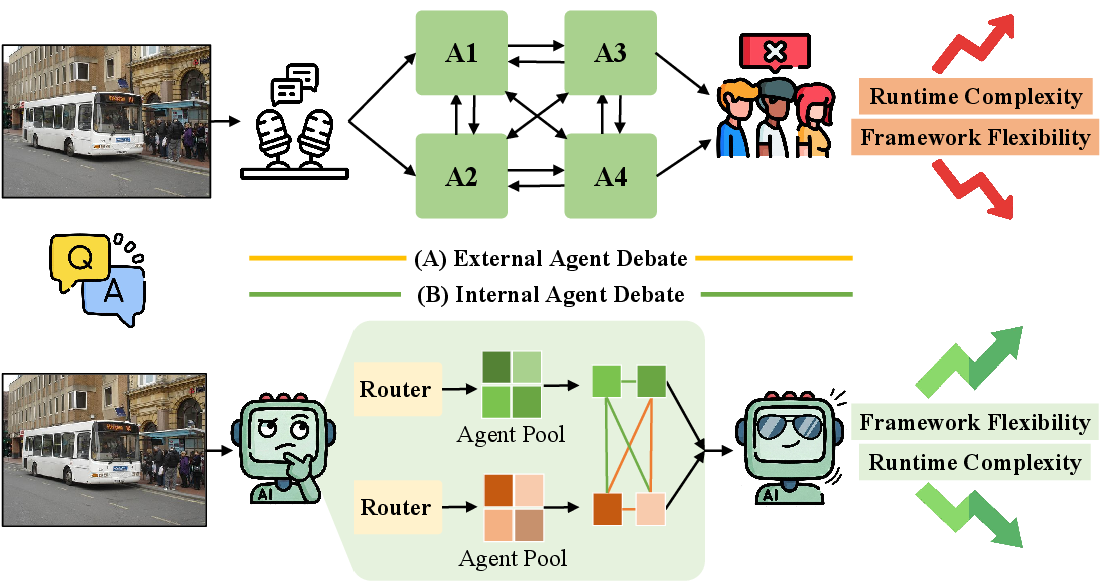
Figure 1: Traditional external debate versus internalized Mixture-of-Debaters—a single model with internal expert routing eliminates communication costs and adapts fluidly.
MoE architectures serve as a foundational avenue for parameter-efficient, conditional computation, but generic MoE lacks the alignment required for dynamic, dialectical reasoning and exhibits instability under token-level expert routing.
Mixture-of-Debaters (MoD): Core Contributions
The Mixture-of-Debaters (MoD) framework internalizes the debate process within a single model instantiation by leveraging three architectural innovations:
- Dual-Routing Mechanism: Two independent routers decouple role assignment (proposer, critic, synthesizer) from process-stage allocation (debate, synthesis, completion). This mechanism supports asymmetric, context-sensitive pathways between interpretation and synthesis experts, enabling fluid reasoning modes in response to shifting epistemic demands.
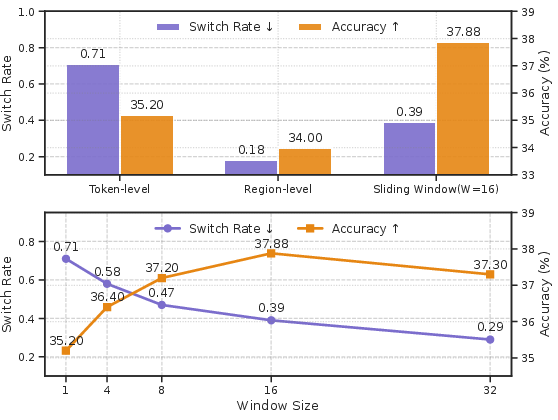
- Momentum Switching: Routing stability is enhanced by a causal sliding window over recent tokens, imposing persistence on expert utilization and suppressing high-frequency stance jitter. The result is increased local coherence and improved argumentative consistency without loss of adaptability.
- Unified Self-Debate via MoE: Diverse debating behaviors are encoded as lightweight, parameter-efficient expert modules within disjoint interpretation (A-side) and synthesis (B-side) expert pools. Dynamic combinations, realized via independent Top-K selection, enable N×N reasoning profiles without communication overhead.
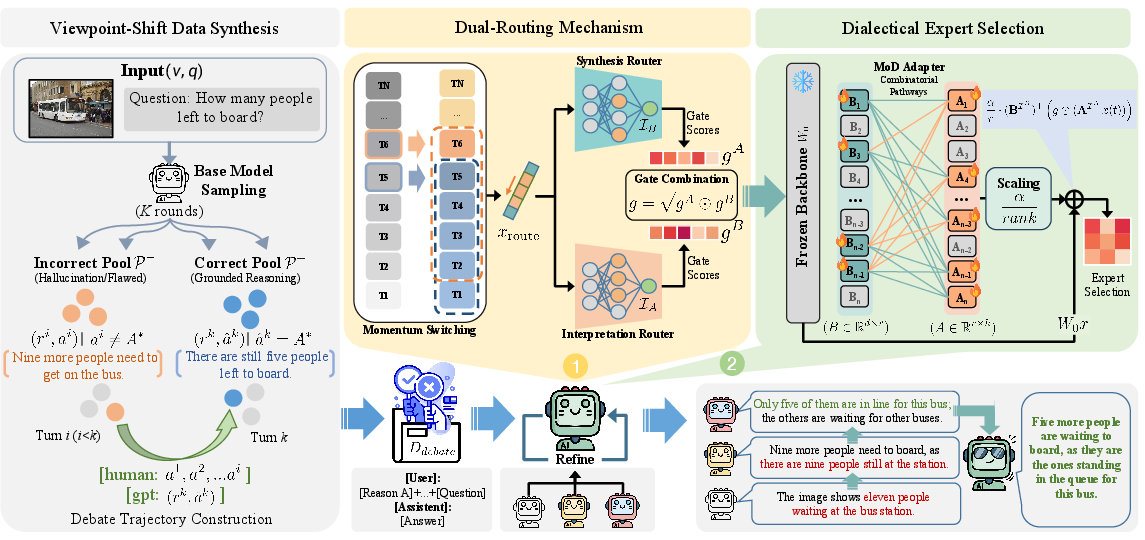
Figure 2: Architectural overview—MoD combines viewpoint-shift data synthesis, dual-routing, momentum switching, and independent expert pools.
Training with Viewpoint-Shift Supervision
Adapted instruction-tuning data is synthesized to supervise explicit stance-shifting, robust belief revision, and error recognition. For each visual-linguistic input, multiple responses are sampled and partitioned into correct and incorrect pools. Training trajectories expose the model to (a) consistent reasoning, (b) error correction episodes, and (c) robustness scenarios where correct reasoning must be sustained amid misleading alternatives. Autoregressive language modeling loss is combined with a layer-wise auxiliary term to enforce balanced expert utilization and mitigate expert collapse.
Experimental Results: Efficacy and Efficiency
MoD achieves dominant performance over both single-model and multi-model debate baselines across a diverse suite of text and multimodal benchmarks, including ScienceQA, MMMU, MMStar, and POPE. On LLaVA-v1.6-13B, MoD-Multi delivers 75.21% on ScienceQA-TEST and 44.40% on MMStar, exceeding conventional parameter-efficient MoE-LoRA variants. The multi-round, self-debate inference mode further improves outcomes by exploiting internal re-evaluation pathways.
Crucially, MoD attains these gains with 3.7× lower latency and 87% reduction in token consumption relative to external debate protocols, despite utilizing only 12M additional parameters.
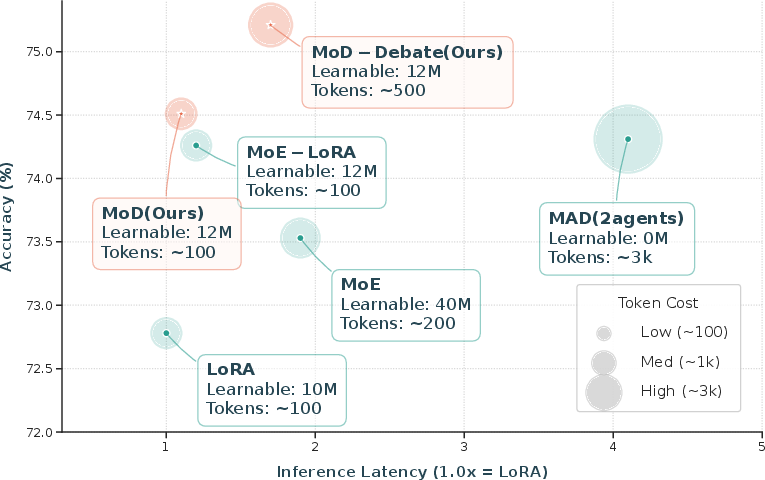
Figure 3: MoD achieves higher accuracy at significantly reduced latency and token usage compared to parameter-efficient baselines and external multi-agent debate.
Analysis and Ablations: Routing, Stability, Expert Specialization
Systematic ablation studies clarify the contribution of each major design:
Visualizations of activation distributions reveal consistent load-balancing and topic-sensitive specialization. Router-A (interpretation) and Router-B (synthesis) exhibit distinct, non-overlapping preferences, reinforcing the importance of dual, decoupled pathway design.

Figure 5: Layer-wise expert activation analysis confirms differentiated and stable expertise for Router-A (interpretation) and Router-B (synthesis).
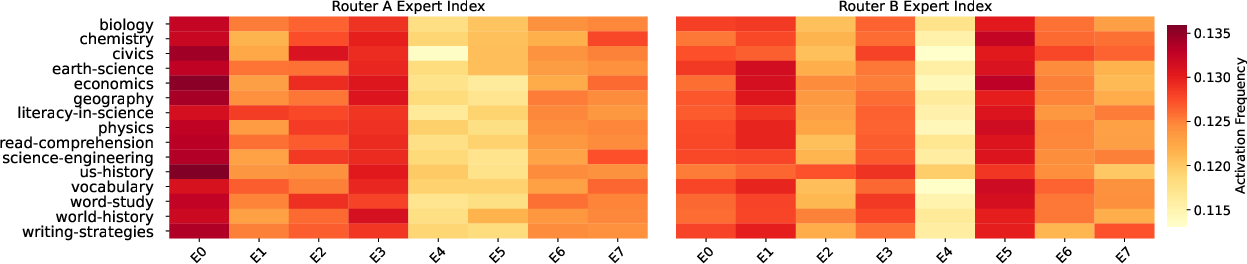
Figure 6: Expert activation frequencies by topic show subtle, useful specialization in both routers.
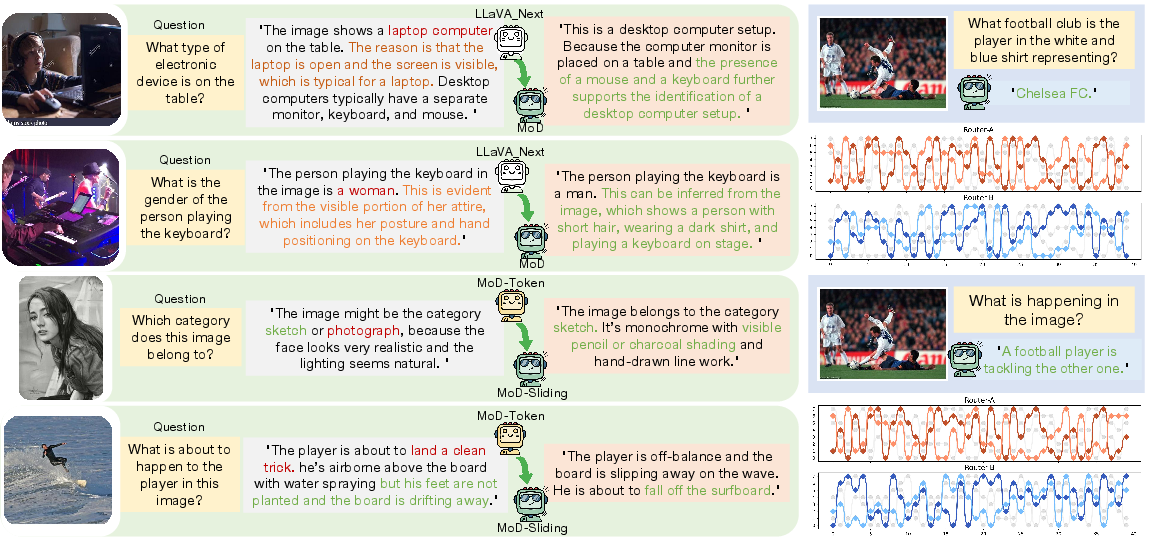
Figure 7: MoD yields more grounded, detail-oriented reasoning and internally coherent stance sequences, informed by context-aware expert selection.
Practical and Theoretical Implications
MoD refines the multi-agent debate paradigm by demonstrating that structured, compositional reasoning behaviors—previously associated chiefly with explicit agent ensembles—can be architecturally internalized within a single LLM backbone. The approach addresses the prohibitive costs and synchronization bottlenecks typical of external agent deployments, producing significant efficiency gains.
On the theoretical front, the demonstrated specialization and dynamic coordination between distinct expert pathways provide insights for future efforts seeking more interpretable, modular, and controllable reasoning within parameter-efficient architectures. The explicit separation of interpretation and synthesis roles represents a shift toward fine-grained, distributed cognition in large-scale models.
Anticipated future trends include generalized internal debate controllers for unsupervised role induction, self-optimizing routing policies under reinforcement objectives, and broader application of MoD architectures to high-stakes, cross-modal reasoning domains.
Conclusion
Mixture-of-Debaters (MoD) establishes a framework for dynamic, architectural-level debate within a single model by integrating dual-routing, momentum switching, and modular expert pools. The result is superior reasoning capability, improved accuracy-efficiency profiles, and strong expert specialization for multimodal and textual tasks. These findings suggest parameter-efficient internal debates are a viable and scalable direction for advancing multi-agent reasoning paradigms in LLMs (2606.29425).