- The paper introduces a physics-guided conditional graph diffusion framework that achieves a mean field error of 0.835% in TCAD device simulations.
- The methodology leverages a native graph representation and iterative diffusion to separate global field construction from localized corrections while maintaining physical fidelity.
- Implications include rapid convergence in hybrid AI-TCAD workflows, improved simulation efficiency, and parameter-efficient adaptability across various device types.
Physics-Guided Conditional Graph Diffusion for TCAD Device Simulation: Expert Summary and Analysis
Introduction and Motivation
Traditional TCAD (Technology Computer-Aided Design) simulation of semiconductor devices relies on explicit solving of coupled drift-diffusion PDEs across spatially complex, irregular meshes, offering high-fidelity field-level insight at very high computational cost. Existing ML surrogates, including PINNs and graph neural operators, target either terminal device metrics or attempt mesh-based field prediction through single-step regressions, but consistently encounter difficulties capturing stiff multiphysics couplings and sharp spatial transitions—especially at junctions and material interfaces. Over-smoothing and poor local conservation fundamentally limit their efficacy.
PCGD (Physics-Guided Conditional Graph Diffusion) directly addresses these failings through a generative, diffusion-based paradigm, bridging the gap between computational efficiency of modern ML surrogates and the physical rigor of direct PDE-based methods. By targeting field-level prediction as a mesh-native generative task, enforced and guided by explicit physics-based objectives and hybrid cross-attention global conditioning, PCGD provides a route to highly scalable, physically faithful device simulation on the native structures encountered in advanced TCAD workflows.
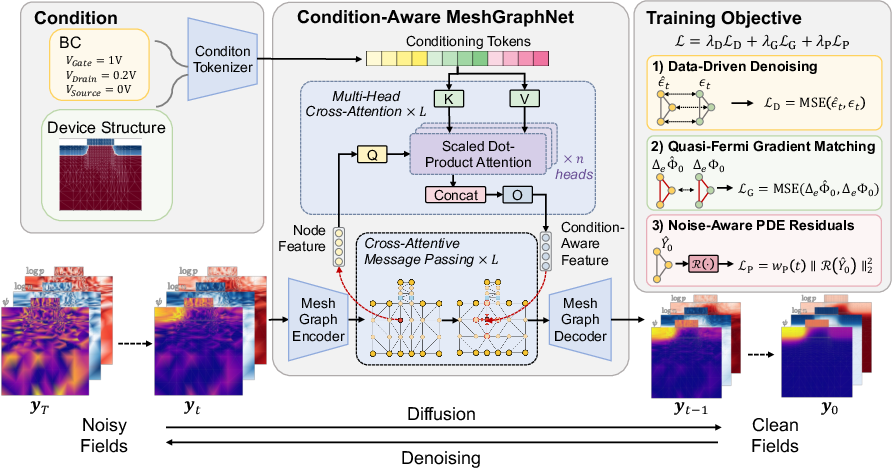
Figure 1: Overview of the PCGD framework: A condition-aware MeshGraphNet denoiser maps noisy physical fields, mesh features, and conditioning tokens to accurate device fields, training with a hybrid denoising-physics objective.
Mesh-Native Graph Diffusion: Methodological Framework
Native Graph Representation
PCGD eschews rasterization and directly operates on the irregular, unstructured TCAD finite-volume mesh, formalized as a spatial graph with node and edge features capturing all relevant physical, geometric, and boundary contexts. Fields to predict—electrostatic potential (ψ), and logarithmic carrier densities (logn, logp)—are defined per node, comprising the global state matrix.
Diffusion-Based Field Generation
Instead of deterministic regression, PCGD learns a conditional distribution pθ(Y0∣G,XV,XE,c) via denoising diffusion (2606.29272). The forward process applies noise to ground-truth fields; the reverse employs a neural denoiser (MeshGraphNet variant) to progressively reconstruct the clean physical state in an iterative chain, separating macroscopic topology establishment from micro-scale correction of sharp features—a crucial design for resolving stiff drift-diffusion physics.
Condition-Aware MeshGraphNet and Global Conditioning
PCGD introduces condition tokens that encode terminal boundary constraints and global structural context, injected globally via cross-attention at every message passing block, enabling each node direct access to device-level information independent of graph-topological path length. This mechanism is essential for robustness across device classes and operation regimes with complex, multi-terminal layouts.
Physics-Guided Hybrid Objective
Classic denoising objectives fail to enforce strict conservation or physical law. PCGD interleaves three complementary losses:
- Denoising MSE: Matches predicted noise to injected noise at all diffusion times.
- Exponent-Free Quasi-Fermi Gradient Matching (LG): Provides a physical transport prior while avoiding numerical instability by comparing quasi-Fermi gradients instead of stiff exponential fluxes.
- Noise-Aware PDE Residuals (LP): Directly evaluates the discrete PDE residuals (Poisson and continuity equations) on the predicted fields, but dynamically gates their contribution by signal-to-noise ratio, ensuring only physically plausible field states induce strong residual regularization, thereby avoiding instability during early diffusion.
The total objective robustly balances data alignment and strict physics adherence, producing models with both high accuracy and physical fidelity.
Quantitative Evaluation and Model Ablations
Main Results: Accuracy and Physics Consistency
On a highly heterogeneous validation set spanning 6,763 device field graphs (PN diodes, planar MOSFETs), PCGD achieves a mean relative field error of 0.835%, notably outperforming direct regression (1.207%) and unconditioned diffusion (1.585%). Condition-aware diffusion alone achieves the lowest mean error (0.720%), confirming the necessity of global information injection for field-level accuracy. Incorporation of physics-guided objectives suppresses the aggregate physics residual error by 17.5% over pure, data-driven diffusion, and reduces maxima by nearly three orders of magnitude compared to non-physics-aware baselines.
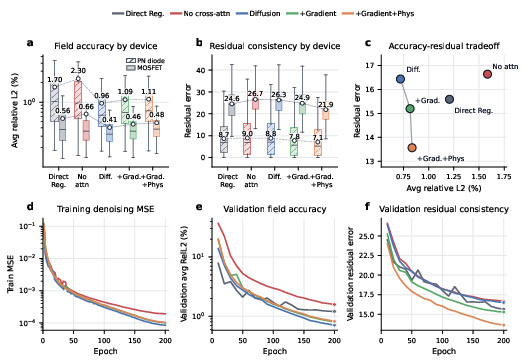
Figure 2: Validation accuracy and aggregate residuals for different model variants across device families, and convergence curves for loss/validation error; hybridization of denoising and physics objectives yields superior trade-offs.
Field Visualization and Residual Localization
High-resolution field visualizations show that PCGD faithfully reconstructs both global and highly localized electrical structures—such as depletion regions and inversion channels—while maintaining suppressed PDE residuals at challenging spatial boundaries.
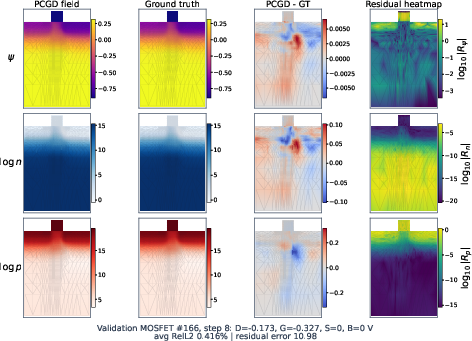
Figure 3: Coupled-field reconstruction and residual heatmaps for a MOSFET using PCGD: left-to-right—predicted field, ground truth, error, and logarithmic residual intensity.
The mesh-native PyG representation supports edge-typed message passing and topological masking, handling complex multi-material interfaces and efficiently encoding all finite-volume simulation outputs on graph primitives.
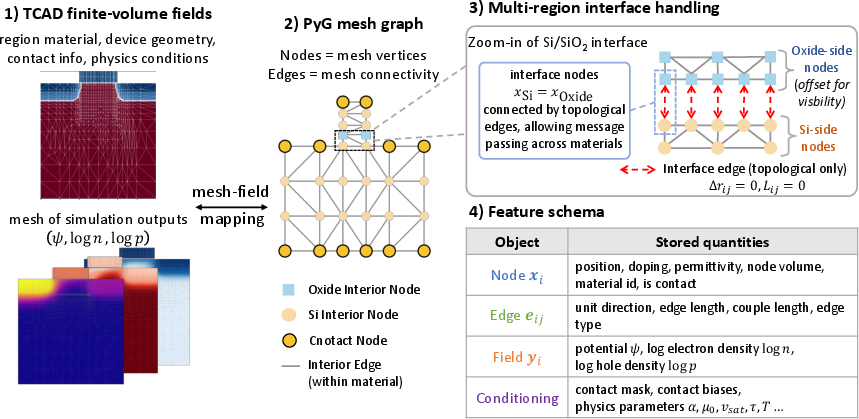
Figure 4: PyG graph encoding for TCAD meshes: Fields, geometry, contacts, and material information stored natively, enabling seamless message passing and residual computation.
Coupled Field Prediction for PN Diodes
PCGD demonstrates similarly strong fidelity and physical constraint in diodes, with spatially localized residual errors only at sharp junctions, again correlating closely to regions of highest physical challenge.
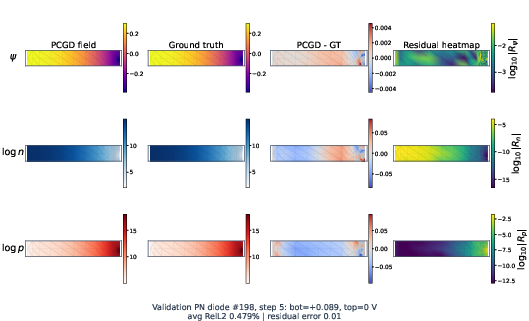
Figure 5: Field-level reconstruction and residual localization for PN-diode; spatial structure and error profiles align with known physical challenges.
Out-of-Distribution Generalization and Adaptation
PCGD's mesh-native and physics-guided conditioning enables robust, parameter-efficient transfer to previously unseen device classes. On SOI-MOSFETs, a topology absent from pretraining, zero-shot transfer is poor, but rank-8 LoRA adapter fine-tuning with a modest target set yields a mean error of 0.815%—close to the 0.723% reference mean for full fine-tuning, but requiring 14.34× fewer trainable parameters and 5.30× less data.
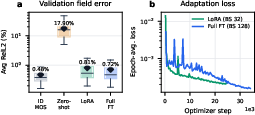
Figure 6: SOI-MOSFET fine-tuning: LoRA adaptation achieves near-parity with full retraining using one-tenth the capacity; training dynamics indicate rapid convergence.
Discussion: Theoretical and Practical Implications
Decoupling of Physical Scales via Iterative Generation
PCGD provides strong evidence that separating global field construction from local conservation correction, through diffusion-based generation and progressive physics regularization, is key for stable, generalizable, and physically meaningful surrogate modeling of stiff, exponentially coupled PDE systems on irregular meshes—a result with clear implications for both scientific ML and computational device engineering.
Practical Utility in Hybrid Workflows
Given its ability to rapidly generate physically plausible, field-level device states, PCGD is positioned as a foundational component of hybrid AI-TCAD workflows—enabling fast initializations for conventional solvers, accelerating sweep convergence, and providing a robust fallback at bias points where traditional Newton-Raphson iterations diverge. Its O(N) scaling and mesh-native representation promise tractability for 3D device families beyond planar structures, including FinFETs and GAA.
Limitations and Future Directions
Major OOD geometric shifts require domain adaptation, indicating current limitations in direct extrapolation; future directions include expanding pretraining data diversity, scaling to 3D, and constructing universal mesh-native surrogates capable of handling arbitrary topology and multiphysics regimes (e.g., breakdown, minority carrier injection, quantum effects). Methodologically, extensions could integrate further physical constraints (e.g., interface trap models), and advance transfer protocols for data-efficient adaptation.
Conclusion
PCGD sets a new standard in mesh-native, field-level, physically consistent surrogate simulation for semiconductor devices. By combining generative graph diffusion over unstructured meshes with explicit hybrid physics guidance and parameter-efficient conditioning, it offers strong accuracy and rapid adaptability, addresses critical limitations of one-step and black-box surrogates, and provides a clear path toward robust, scalable integration within automated device design and AI-driven TCAD workflows. Its formalism and results serve as a blueprint for future surrogates in computational science domains demanding both speed and physical integrity.

