
- The paper presents P-K-GCN, integrating geometry-aware graph convolutions, Koopman operator dynamics, and physics-based regularization for deep spatiotemporal super-resolution.
- The model minimizes HR reconstruction error by leveraging adaptive spatial encoding, linearized latent temporal propagation, and physics-driven PDE residual penalties.
- Experimental evaluations on 3D cardiac electrodynamics demonstrate its ability to preserve fine spatial details and temporal coherence, even with sparse, noisy inputs.
Physics-Augmented Koopman-Enhanced GCN for Deep Spatiotemporal Super-Resolution
Motivation and Problem Definition
High-resolution spatiotemporal modeling is imperative for elucidating mechanisms in scientific and engineering systems, yet the acquisition of such data is constrained by sensor density, cost, and computational overhead. Standard super-resolution (SR) frameworks predominantly rely on purely data-driven approaches or physics-constrained learning. The former often lack physical fidelity and robustness, while the latter struggle with irregular geometries inherent in real-world domains, such as anatomical structures. Addressing these inadequacies, the paper introduces the Physics-augmented Koopman-enhanced Graph Convolutional Network (P-K-GCN), designed for spatiotemporal SR on arbitrary domains.
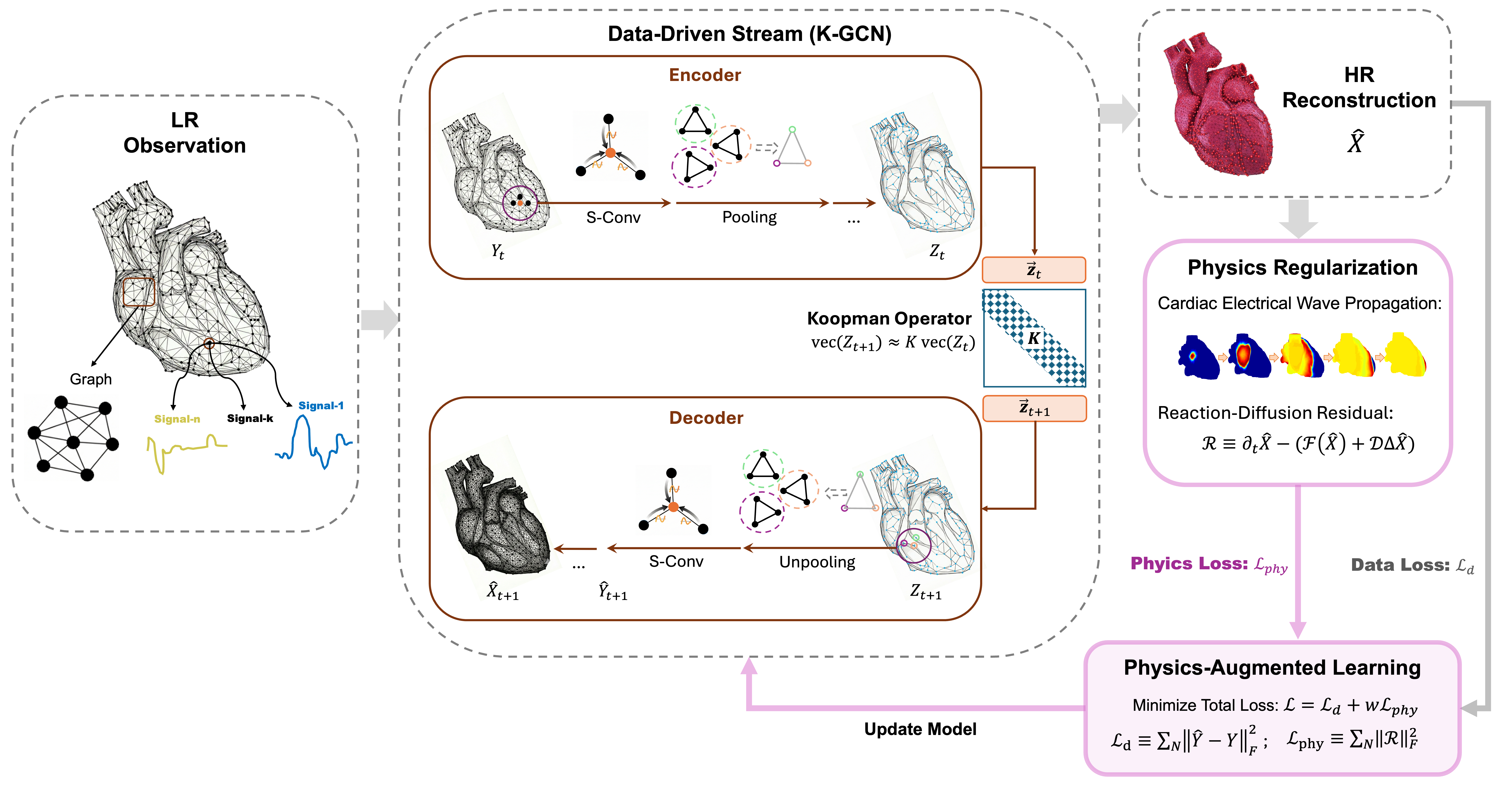
Figure 1: Flowchart of the hybrid methodology integrating graph encoding, Koopman temporal modeling, and physics-based regularization.
Model Architecture and Core Components
P-K-GCN unifies three foundational elements:
Theoretical Error Analysis
The paper provides rigorous generalization guarantees. By constraining the hypothesis space with physics priors, the functional capacity (as measured by empirical Rademacher complexity) is strictly reduced. This tightens uniform convergence bounds for LR and HR reconstruction errors:
- Error Bound: The HR error EHR is bounded in terms of LR empirical risk, complexity terms, and the physics residual tolerance ϵ, as formalized in the main theorem.
- Koopman Regularization: Frobenius norm regularization on the Koopman matrix yields a capped expansion rate, suppressing temporal error accumulation to O(γn), compared to O(Ln) for unconstrained RNNs.
This theoretical framework demonstrates that even when data-driven models achieve identical empirical losses, the physics-augmented model achieves a strictly lower—and provably bounded—SR error.
Experimental Evaluation
P-K-GCN is evaluated on the SR of 3D cardiac electrodynamics, reconstructing high-resolution transmembrane potentials and recovery dynamics from sparse, noisy LR measurements. The domain is discretized to 4,370 nodes, and cardiac activity is modeled via the Aliev-Panfilov PDE system.
- Baselines:
- NN: Standard deep network without geometry or physics priors.
- K-GCN: Graph-based SR without physics constraints.
- PINN: Physics-informed neural networks without geometry-aware encoding or stable temporal modeling.
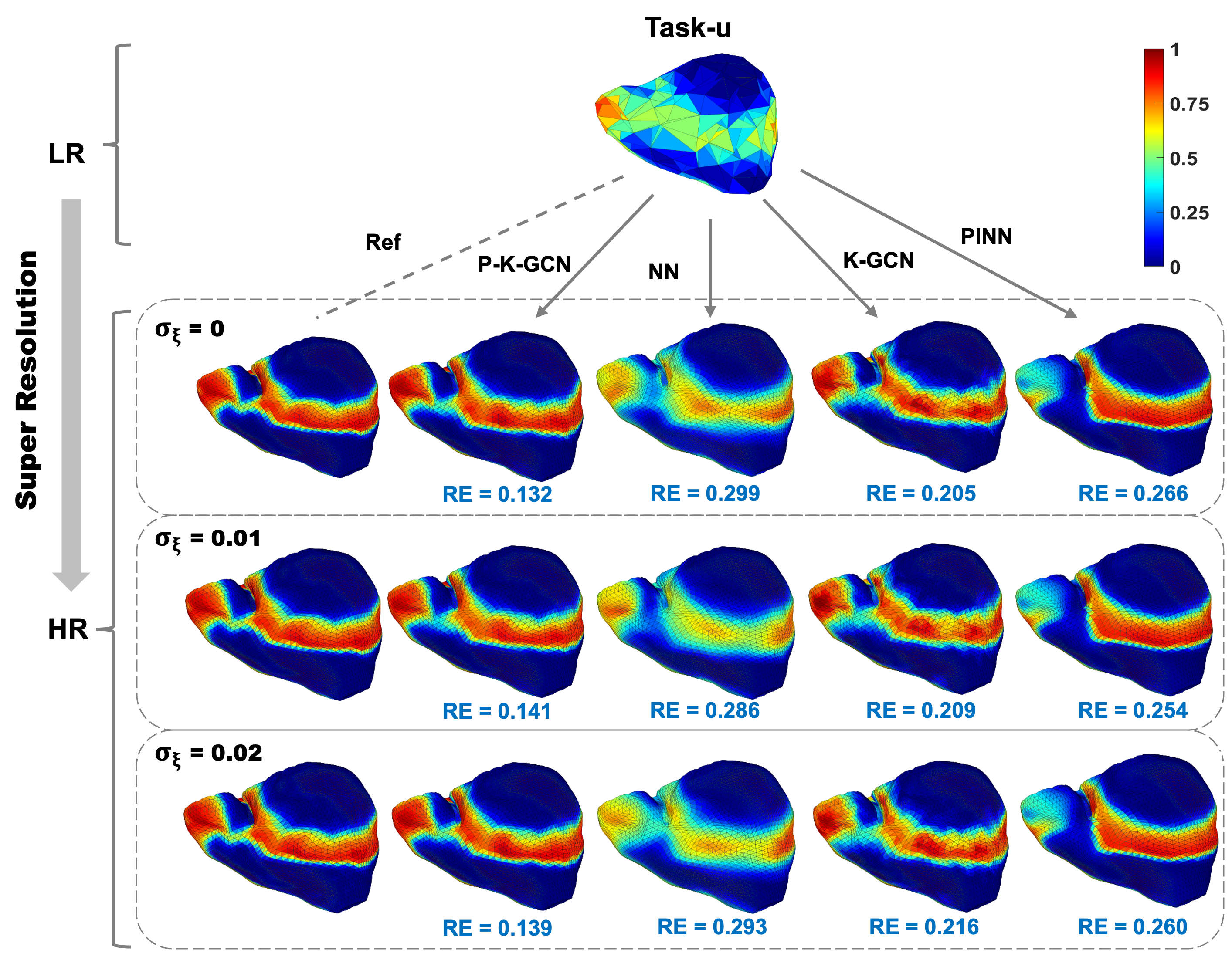
Figure 3: Reconstructed transmembrane potential (u) at time step 35 under varied noise levels, comparing all methods against ground truth.
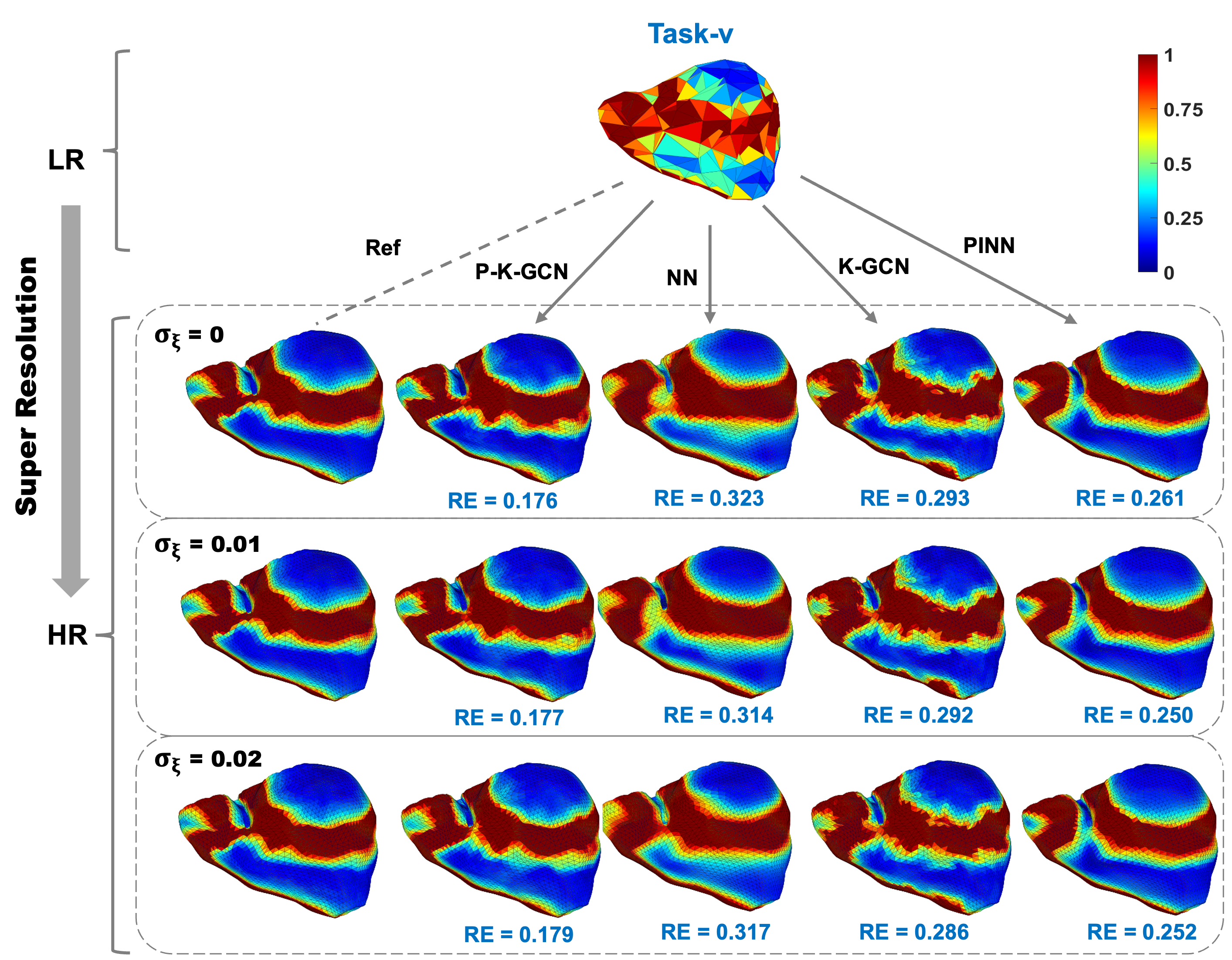
Figure 4: Reconstruction of the recovery variable (v) at time step 35, exhibiting similar trends across noise regimes.
Visual results indicate that P-K-GCN consistently yields highest fidelity reconstructions, with both spatial detail and temporal coherence preserved under all noise levels. NN fails to recover local structure; PINN returns smoothed, physically plausible outputs but lacks fine detail; K-GCN preserves geometry but exhibits artifacts and instability without physics constraints.
Quantitative results confirm the supremacy of P-K-GCN: with no added noise (σξ=0), the aggregated relative error REtotal achieves 0.154±1.5×10⁻⁴, reflecting a 50.48% reduction relative to NN and significant gains against all baselines.
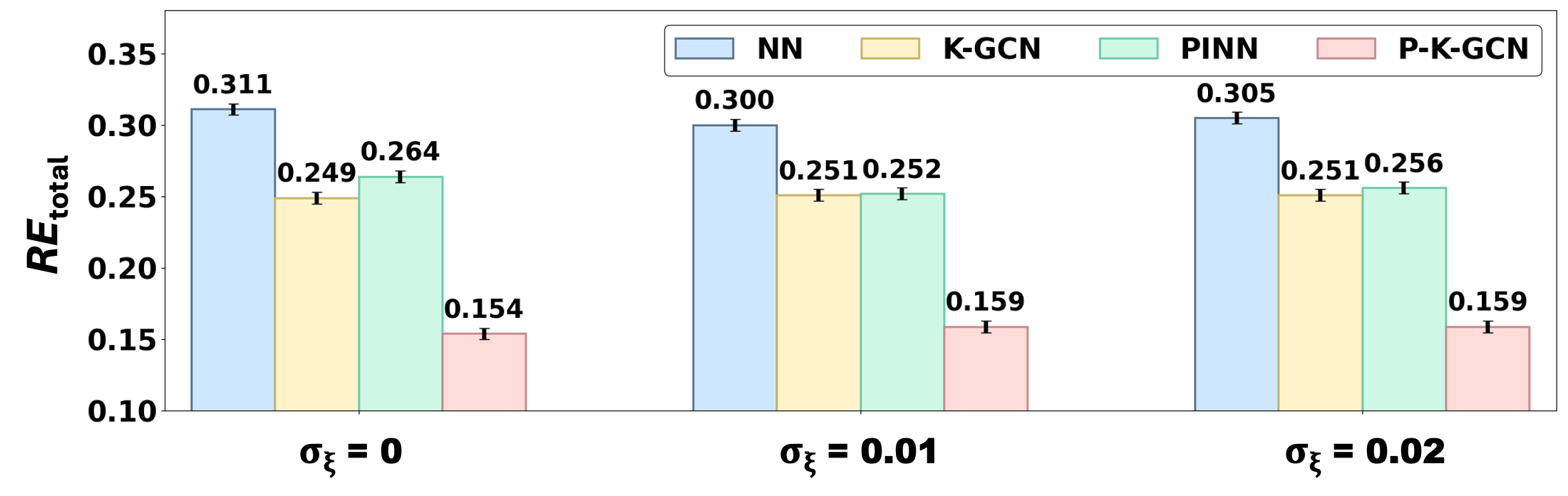
Figure 5: Bar chart of total relative error across all models and noise levels, demonstrating the robust advantage of P-K-GCN.
Implementation and Practical Implications
The blend of geometry-aware graph encoding, linearized temporal propagation, and domain physics constraints enables P-K-GCN to:
- Operate robustly on non-Euclidean, irregular domains;
- Generalize to out-of-distribution regimes under sparse, noisy input;
- Suppress spurious artifacts and instability in temporal sequence prediction;
- Guarantee physical consistency and sharpness of SR reconstructions.
The combination is particularly impactful for biomedical modeling (cardiac systems, brain imaging), environmental sensing, and any spatiotemporal inverse problem requiring super-resolution and physical fidelity.
Future Directions
The theoretical bounds established for physics-augmented GCNs and Koopman-based temporal modeling open pathways for further research:
- Extending to broader classes of physical systems (e.g., thermodynamics, fluid mechanics);
- Joint learning of projection operators and physics priors for domains with evolving topologies;
- Integration with probabilistic inference for uncertainty quantification in scientific machine learning;
- Automated selection of physical constraints via differentiable programming and domain adaptation.
Conclusion
P-K-GCN introduces a rigorously designed, physically consistent deep super-resolution model for spatiotemporal dynamics on arbitrary graphs (2606.19303). By synergizing geometric graph convolutions, Koopman-enhanced latent linear dynamics, and manifold-aware physics regularization, it achieves provably tight generalization bounds and robust numerical performance across regimes. The framework is widely applicable to scientific, engineering, and biomedical inverse problems, setting a new benchmark for physically constrained spatiotemporal SR.