- The paper shows that latent-space drifting models can match the predictive fidelity of diffusion models with a two-order magnitude reduction in inference time.
- It introduces both label-based and spatial conditioning paradigms, where label-based conditioning offers higher quantitative accuracy while spatial conditioning supports generalization to unseen geometries.
- Quantitative results indicate that the drifting models achieve an nRMSE of 0.0684 and R² of 0.80, making them viable for real-time indoor CFD surrogate deployment.
Drifting Models for Surrogate Flow Modeling: An Expert Analysis
Introduction
"Drifting Models for Surrogate Flow Modeling" (2606.07481) presents a systematic adaptation of generative drifting networks to the task of surrogate modeling in computational fluid dynamics (CFD), particularly for indoor airflow simulation. The motivation is anchored in the prohibitive cost of high-fidelity CFD necessary for design, optimization, and real-time control of indoor environments. Generative surrogates based on deep learning have been established as a promising strategy, but current state-of-the-art diffusion-based surrogates incur high inference latency due to their iterative nature. This work demonstrates that a single-pass, latent-space drifting model can approach the predictive fidelity of diffusion baselines while operating with two orders of magnitude faster inference, and further introduces spatially conditioned variants with potential for enhanced generalization beyond discrete configuration catalogs.
Drifting Model Architecture and Conditioning Paradigms
The core methodological contribution is the application of drifting models—originally conceived for image generation—to the domain of CFD surrogates. The approach leverages a learned VAE to encode velocity fields into a compact latent space, within which the drifting mechanism is operationalized. This drift, instead of learning a noise-to-data sequence as in diffusion models, evolves the generated sample distribution toward the data manifold in latent space via a kernel-based attraction/repulsion field. The inference is thus single-pass, sidestepping the need for ODE integration or iterative denoising.
Two distinct conditioning schemas are developed:
- Label-based conditioning: Each sample is indexed by discrete inlet/outlet positions and room configuration labels, embedded to inform the generative process. This regime limits scope to the training set’s enumerated geometries but achieves higher quantitative accuracy.
- Spatial conditioning: Here, geometry and boundary conditions are encoded as binary masks of the domain, subsequently embedded through a convolutional encoder. This approach supports generalization to unseen spatial layouts, a critical advantage for practical deployment, but currently yields lower fidelity due to representational and encoder limitations.
Both architectures incorporate scalar inlet velocity embeddings, merged with configuration vectors to fully specify the physical conditions.
Quantitative and Qualitative Results
The study benchmarks three models—latent diffusion, label-based drifting, and spatially conditioned drifting—on 2D, steady-state indoor airflow problems. Evaluation metrics include nRMSE, R2, cosine similarity, divergence, and vorticity errors, measuring not only field-wise agreement but also structural fidelity fundamental to fluid dynamics.
Numerical performance highlights include:
- Label-based drifting achieves nRMSE of 0.0684 and R2=0.80 against the baseline diffusion nRMSE of 0.0592 and R2=0.85.
- Per-sample inference latency is drastically reduced from ∼1870 ms (diffusion, NFE = 1000) to ∼6.7 ms (drifting, NFE = 1).
- Flow-structure metrics such as divergence and vorticity errors show the label-based drifting model matches or slightly surpasses diffusion in some aspects, despite its single-pass nature.
- The spatial conditioning variant shows substantially inferior nRMSE (0.108), attributed to the preliminary nature of its encoder, but retains correct qualitative flow topology, including jet formation, recirculation, and wake structures.
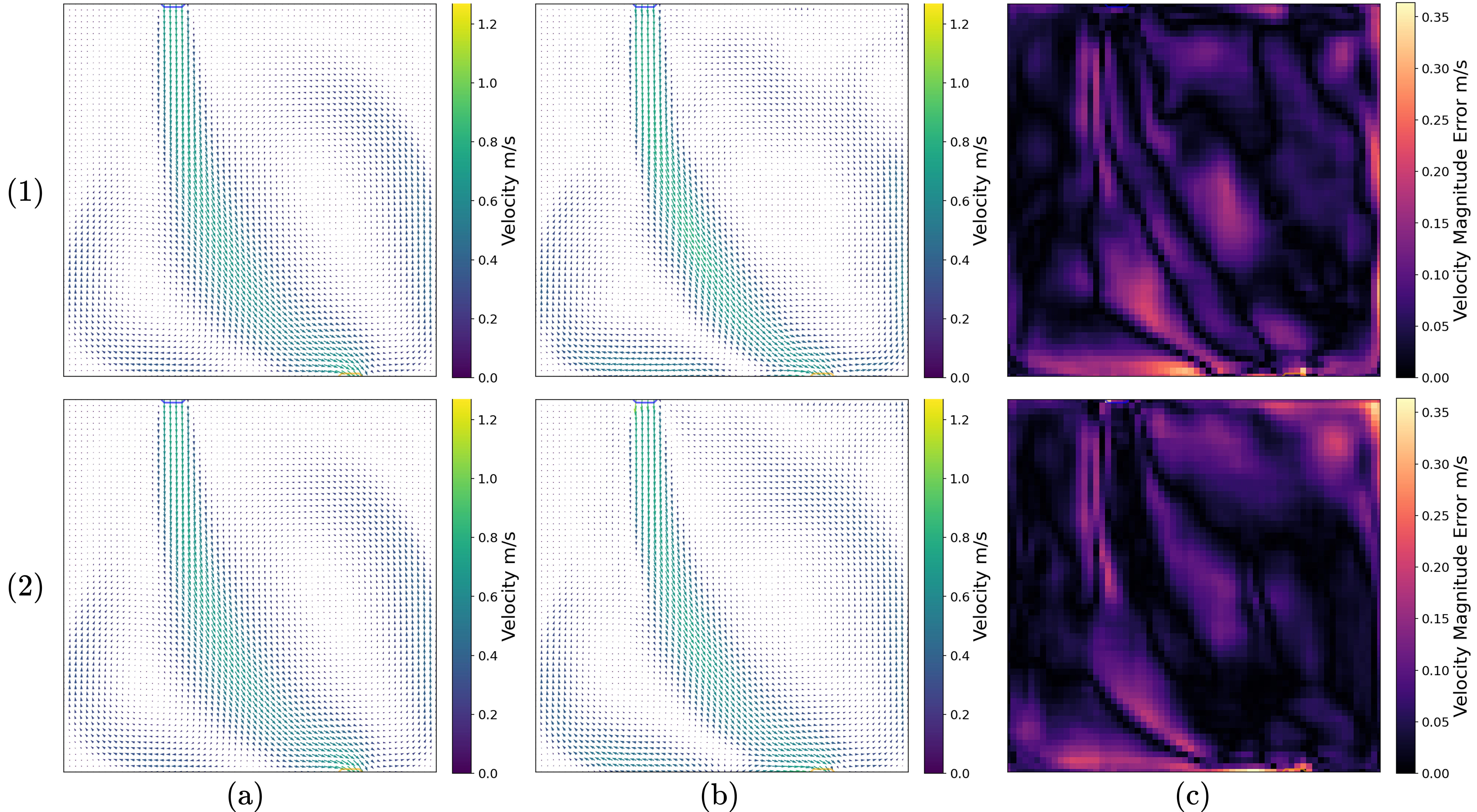
Figure 1: Comparison of single-pass drifting and diffusion surrogates in velocity field prediction, demonstrating similar flow structure recovery and error localization in the empty-room configuration.
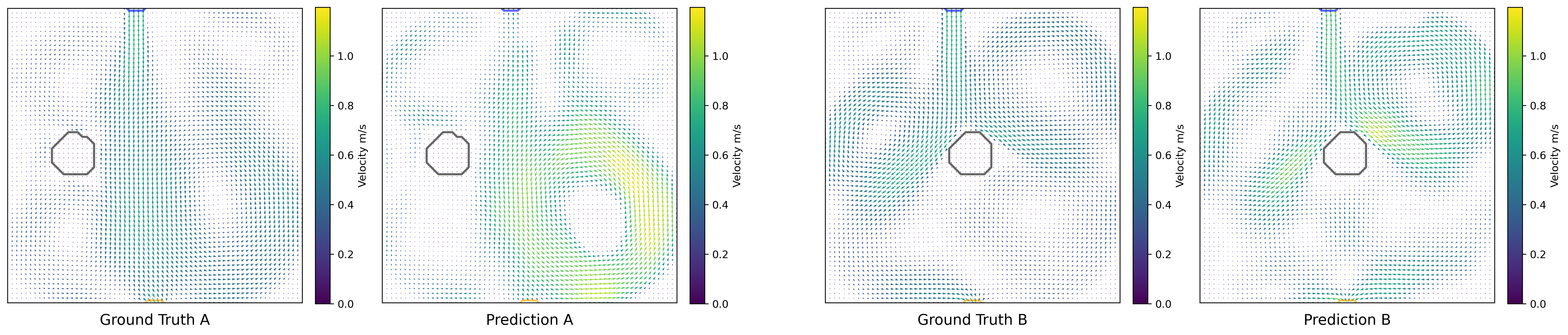
Figure 2: Visualization of spatially conditioned drifting model predictions for flows past obstacles, indicating capability to recover essential flow features across unseen geometric conditions.
Methodological Advances and Implementation Details
Critical architectural innovations introduced are:
- Latent-space drifting via a domain-trained VAE, as opposed to an off-the-shelf encoder, preserving semantically meaningful and compact representations amenable to efficient generative sampling.
- Label-aware attraction masking in the drifting update, ensuring generation is conditioned only towards physically compatible ground-truth samples. This prevents degenerate averaging across fundamentally different flow regimes—essential due to the combinatorial boundary and geometry variability in CFD datasets.
- Spatial conditioning through binary mask encodings, designed to support open-world deployment by allowing explicit, fine-grained physical boundary description rather than limiting generalization to catalogued cases.
The diffusion baseline is carefully controlled, leveraging modern latent diffusion models with DiT backbones and accurate integration of boundary conditions; inference is performed with DDIM and a 1000-step cosine schedule, reflecting current best practices in generative surrogates for fluid flow.
Theoretical and Practical Implications
The results robustly establish that NFE=1 drifting models can nearly close the fidelity gap to state-of-the-art generative surrogates in CFD, while providing at least two orders of magnitude boost in inference speed. This is a significant advance over iterative diffusion or flow-matching strategies, which, despite improvements, remain bottlenecked by the need for multiple neural evaluations or ODE solves.
Practically, this opens the pathway for real-time CFD surrogate deployment in design-loop optimization, ventilation control, or interactive engineering settings—contexts where both predictive fidelity and low latency are essential. The spatially conditioned variant, though currently less accurate, provides a crucial step toward universal surrogacy by supporting arbitrary, user-specified spatial boundary input.
Limitations and Future Directions
Several limitations are acknowledged. The experiments are confined to steady-state 2D flows and moderate dataset sizes, with heavy reliance on spatial compression in the VAE impacting fidelity. The spatial conditioning interface, still immature, constrains generalization performance. Further, the present architecture does not yet realize the full potential of drifting with richer, higher-resolution latent representations, nor does it address temporally evolving or 3D flows.
Future research directions must include:
- Refinement of spatial encoders, potentially cross-attention based, for greater geometric expressivity.
- Scaling to 3D and timedependent CFD regimes, leveraging the high-speed advantage for simulation acceleration across larger, more complex domains.
- Direct comparison against strong deterministic surrogates (e.g., FNOs) in the high-dimensional regime where probabilistic, multimodal prediction is critical.
- Exploration of hybrid architectures integrating physics-informed constraints directly into the drifting update.
Conclusion
This paper systematically demonstrates that generative drifting, executed in latent space and appropriately conditioned, can serve as a high-speed, high-fidelity surrogate for indoor airflow CFD, almost matching diffusion models but at orders of magnitude lower computational cost. The methodological advances—latent domain-adaptive encoders, label-aware kernel masking, and spatial conditioning—establish a strong foundation for further research. Rapid, structure-preserving, and physically informed surrogate modeling enabled by such architectures will be instrumental in scalable scientific computing, model-based control, and virtually instantaneous design iteration for engineered environments.

