- The paper proposes TILR, a training-free method that isolates invariant reasoning directions in latent trajectories.
- It enhances reasoning reliability by projecting updates onto a low-dimensional subspace, reducing variance from paraphrasing and reference choices.
- Empirical evaluations show accuracy improvements of up to 5.5% and significant robustness gains with minimal computational overhead.
Geometric Structure and Invariant Directions in Latent Reasoning Trajectories
Introduction
The paper "Invariant Reasoning Directions in Latent Trajectories of LLMs" (2606.29164) presents a comprehensive study on the geometric structure of latent reasoning within LLMs. The authors hypothesize and demonstrate that meaningful differences between strong and weak latent reasoning trajectories—arising from multi-step, hidden-state reasoning—are highly concentrated in a low-dimensional subspace, distinct from generic embedding variance. They further introduce Trajectory-Invariant Latent Refinement (TILR): a training-free, inference-time intervention that isolates and leverages these invariant latent directions to enhance reasoning reliability and robustness without retraining or parameter updates.
Motivation: Fragility in Latent Refinement
Despite advances in latent reasoning and post-training refinement techniques, existing methods often apply contrastive updates derived from strong and weak models directly in the full hidden space. Empirically, this approach is fragile, exhibiting sensitivity to input paraphrases, reference checkpoint choices, and hyperparameters. These instabilities stem from unconstrained updates that indiscriminately propagate both stable (reasoning-associated) and unstable (instance-specific) latent components.
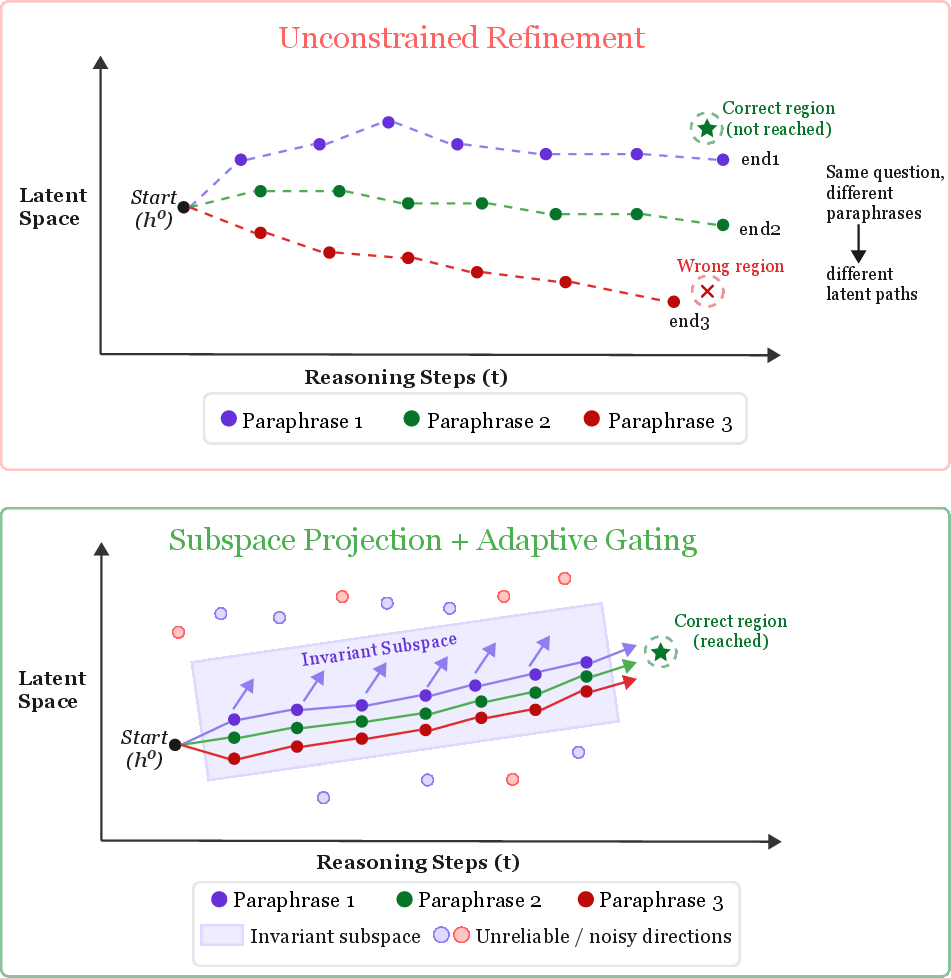
Figure 1: Stable, invariant directions in latent space are critical to robust reasoning; naive refinement mixes both stable and unstable components, leading to fragility.
The TILR Framework: Isolating Invariant Latent Directions
TILR systematically addresses the aforementioned fragility by decomposing the contrastive correction signal into stable and unstable components and constraining updates to a calibrated, low-rank reasoning subspace. TILR defines a five-stage intervention process:
- Contrastive Feedback Search: Compute the difference dt between strong and weak reference trajectories for the current step.
- Invariant Subspace Projection: Project dt onto a subspace Ur constructed via truncated SVD over contrastive differences across a calibration set, capturing consistent reasoning variation.
- Adaptive Stability Gating: Compute an alignment score γt, measuring how well dt aligns with Ur, and scale the update accordingly.
- Residual Blending: Maintain trajectory stability by blending the refined state with the unrefined baseline.
- State Update: Produce the new latent state by applying the projected and gated update.
This design ensures that refinement acts only along directions empirically associated with invariant, task-relevant reasoning behavior, while suppressing erratic, input-dependent updates.
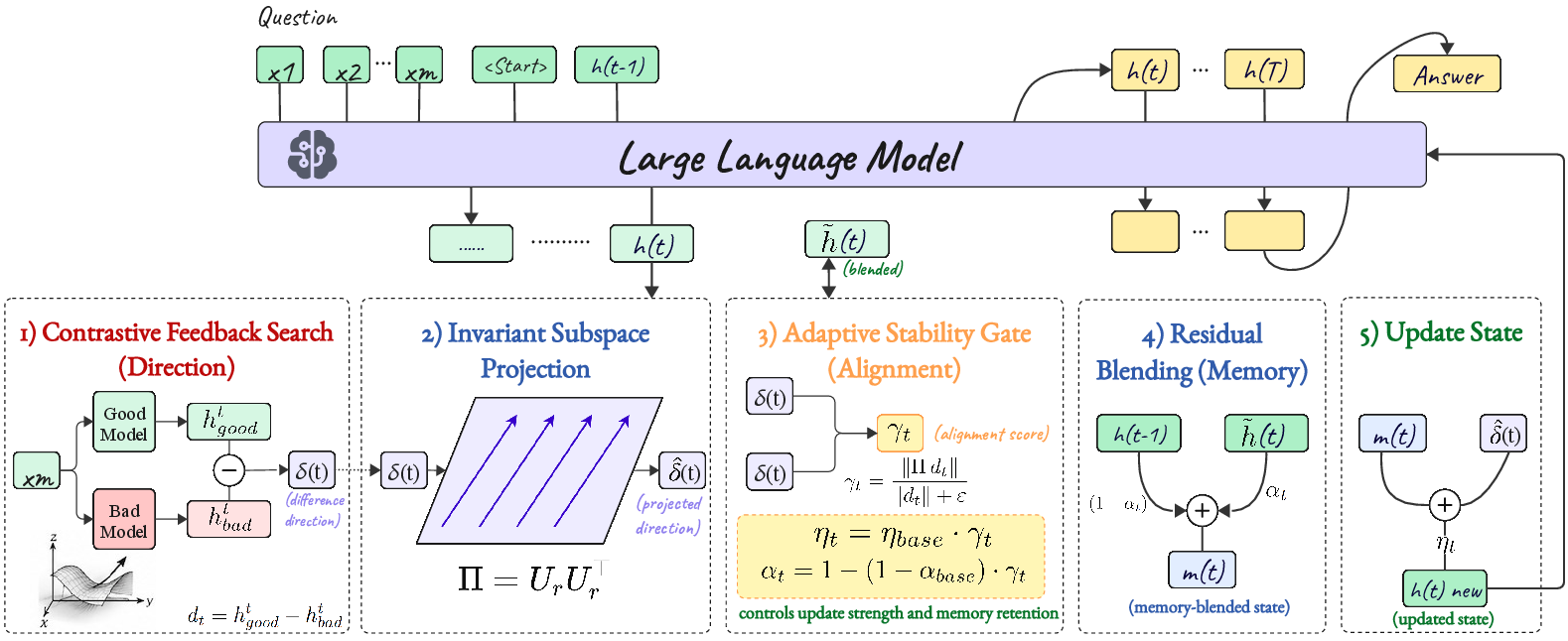
Figure 2: TILR enhances latent reasoning by projecting corrections onto a stable subspace and modulating update strength via an alignment gate.
Empirical Analysis of Latent Subspace Structure
The authors empirically demonstrate that contrastive differences between strong and weak trajectories exhibit strong low-rank structure across six reasoning benchmarks. For several datasets, a single direction explains over 90% of the refinement variance, while others require only a handful of principal components. Crucially, these directions are largely orthogonal to generic input variance, supporting the hypothesis that latent reasoning quality is encoded in distinct subspaces.
Causal intervention experiments verify the functional necessity of these invariant directions: interventions restricted to the TILR subspace yield superior accuracy and robustness compared to interventions along random or input/trajectory principal directions.
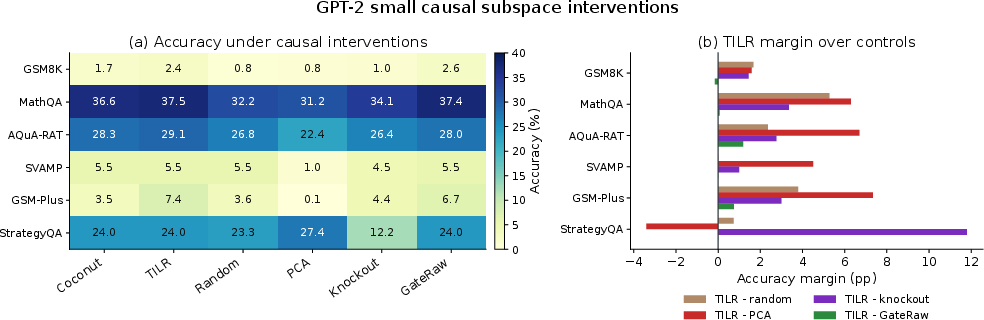
Figure 3: Accuracy and margin analysis show the functional importance of the learned invariant subspace for causal reasoning interventions.
Robustness to Paraphrasing and Reference Choices
TILR reduces both the variance of latent trajectories under paraphrased inputs and the sensitivity of outputs to the particular reference checkpoint pair. Experiments with five paraphrase variants per input reveal that TILR achieves up to a 53% reduction in latent trajectory variance and a 10% boost in answer agreement relative to unconstrained refinement, consistently across all tasks. Additionally, TILR sharpens the alignment of hidden trajectories to the reasoning subspace, attenuating superficial input variation.
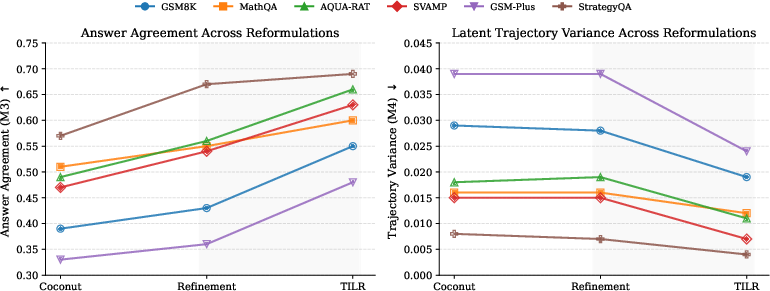
Figure 4: TILR improves answer consistency and suppresses paraphrase-induced hidden-state variance compared to unconstrained refinement.
TILR consistently matches or outperforms both token-level (Chain-of-Thought) and latent-level reasoning baselines in exact-match accuracy across mathematical and commonsense reasoning tasks, particularly excelling on robustness benchmarks. Accuracy improvements over unconstrained refinement average 2 percentage points, with gains as high as 5.5 points for some datasets. Ablation studies confirm that both subspace projection and adaptive gating are necessary and complementary: projection provides the majority of improvements by filtering unstable directions, while gating further stabilizes updates on low-confidence inputs.
Numerical results highlight:
- Mean accuracy improvements of 2–5.5% versus unconstrained refinement, with no increase in inference tokens.
- 39% average reduction in latent trajectory variance under paraphrase stress.
- Up to 74% reduction in checkpoint-pair sensitivity on robustness-oriented datasets.
- Near-zero additional computational cost compared to standard refinement.
Theoretical and Practical Implications
The findings establish that stable, low-dimensional structure underlies effective latent reasoning in LLMs. TILR operationalizes a geometric perspective: reliable reasoning emerges from a restricted, transferable subspace within the high-dimensional hidden state, amenable to efficient post-training intervention. These insights link empirical advances in activation steering and contrastive decoding with theoretical work on invariance and subspace learning.
For practice, this enables deployment of more robust, interpretable, and consistent inference-time reasoning without costly retraining, as TILR requires only forward passes and a truncated SVD per reference family. These interventions are compatible across architectures and scale, as evidenced by strong results on GPT-2 and Qwen2.5-Math-1.5B backbones.
Limitations and Future Directions
While TILR offers substantial improvements in stability and robustness, it does not guarantee accuracy or rectify biases inherited from the base or reference models. The invariant subspace is empirical and may fail to generalize to arbitrary distributions or larger-scale models. Maintaining up-to-date subspace calibrations under distribution shift and further mechanistic dissection of subspace directions—relating them to interpretable reasoning circuits—are open research avenues.
Extension to other architectures, tasks (planning, tool-use, agentic reasoning), and real-world LLM systems, as well as integration with verification and uncertainty estimation, are promising directions for future work.
Conclusion
The TILR framework substantiates that stable, invariant directions in latent trajectory space encode much of the transferable reasoning power in LLMs. By constraining refinement to these empirically derived subspaces, TILR achieves significant improvements in reasoning consistency and robustness at no training cost. These results motivate a geometric paradigm for future mechanistic interpretability and robust reasoning interventions in LLMs.