- The paper presents a novel non-generative methodology to extract Thought Graphs for detailed, multi-dimensional profiling of LLM reasoning traces.
- It employs a deterministic, rule-based and embedding-driven segmentation pipeline to compute 19 metrics across Breadth, Depth, Structure, Metacognition, and Efficiency.
- Empirical results reveal significant inter-model variation and underline the importance of cyclic graph representations in capturing complex reasoning processes.
Structural Profiling of Open-Ended LLM Reasoning: The ThinkProbe Framework
Introduction and Motivation
Current evaluation paradigms for LLMs primarily emphasize scalar accuracy on closed tasks under the presumption of a ground truth reference. This paradigm is inadequate in open-ended domains—ethical reasoning, philosophical discourse, creative ideation—where correctness is inherently ill-defined and the process of reasoning itself becomes the critical observable. To address this gap, the ThinkProbe framework (2606.29067) proposes a fully non-generative, graph-based structural profiling methodology for LLM reasoning traces, eschewing LLM-as-analyzer circularity and enabling quantitative, multi-faceted assessment of reasoning patterns independent of answer correctness.
The ThinkProbe Framework
ThinkProbe operationalizes reasoning trace analysis via extraction of a Thought Graph, a directed cyclic graph whose nodes (Thought Units, TUs) represent discrete cognitive operations, and edges encode six types of semantic relations. The trace is segmented and classified using a deterministic, rule-based and embedding-driven pipeline, without recourse to a generative analyzer. From this representation, a five-dimensional cognitive profile (5D-CP) comprising 19 behavioral metrics is computed, partitioned along Breadth, Depth, Structure, Metacognitive, and Efficiency axes.
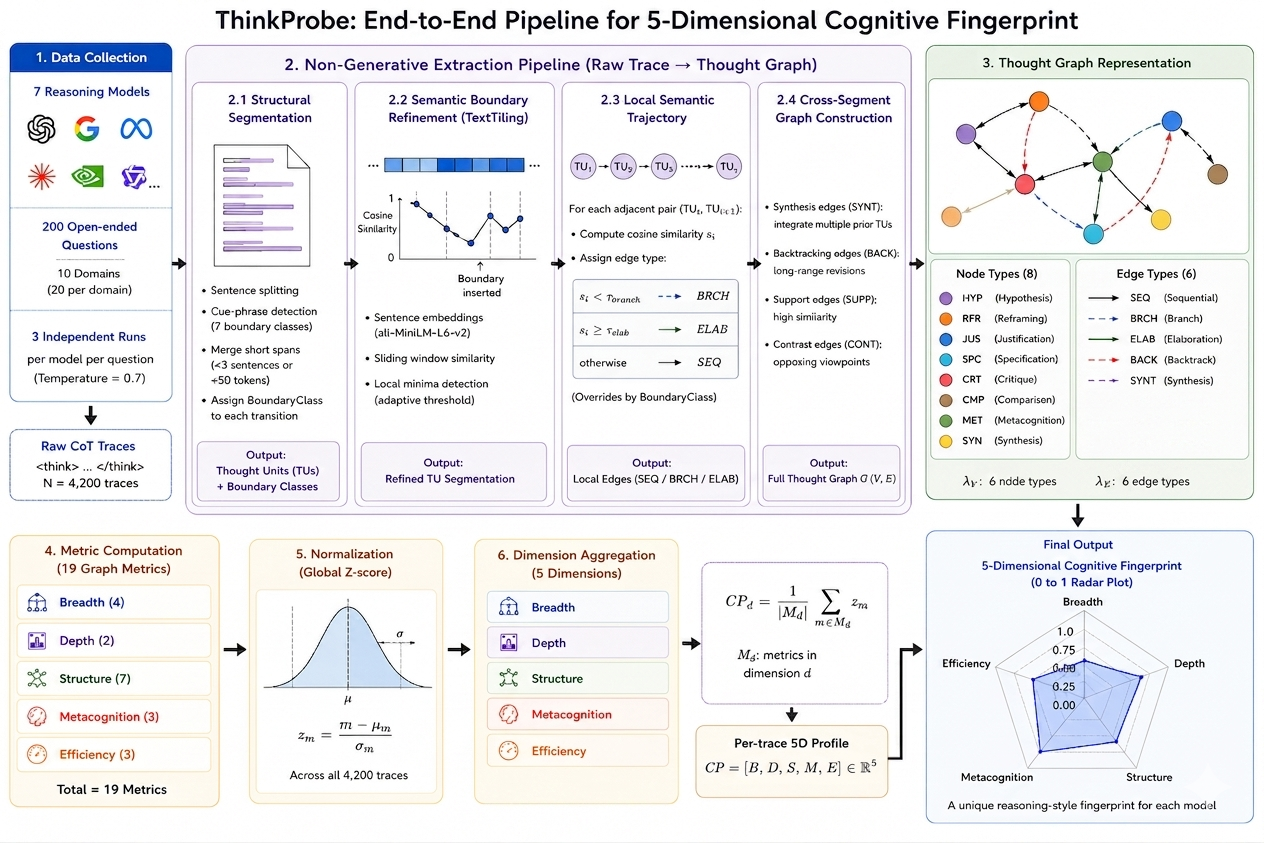
Figure 1: The ThinkProbe pipeline, illustrating non-generative extraction of graph structure and metric computation from raw reasoning traces.
Thought Graph Representation
A Thought Graph G=(V,E,λV,λE) encodes the fine-grained sequential and non-sequential reasoning steps, capturing cycles and cross-thread synthesis via recursive backtracking arcs and synthesis nodes—structures unrepresentable in traditional DAG/tree-based frameworks.
- Node taxonomy: 8 types (HYP, RFR, JUS, SPC, CRT, CMP, MET, SYN), grouped in four cognitive families.
- Edge taxonomy: 6 types (SEQ, BRCH, ELAB, BACK, SYNT, CRIT), capturing fine distinctions such as semantic branching, elaboration, revision, synthesis, and critique.
The node and edge types are assigned deterministically using surface cues, embedding-based TextTiling, and predefined lexical and structural heuristics.
Metric Suite and Multi-Dimensional Profiling
The 19 metrics used to construct the 5D-CP quantitatively characterize:
- Breadth: e.g., branching factor, unique perspectives, semantic spread.
- Depth: e.g., maximum chain length, mean branch depth.
- Structure: e.g., exploration/exploitation ratio, backtracking rate, cross-branch connectivity.
- Metacognition: e.g., critique/hypothesis ratio, hedging density.
- Efficiency: e.g., tokens per idea, redundancy ratio.
Scores are global z-normalized, and aggregated per dimension for each trace and at the model level.
Experimental Protocol
The protocol encompasses 7 native reasoning models, 200 hand-curated open-ended questions, and 10 cognitive domains, yielding 4,200 reasoning traces (3 runs per model-question pair, with per-trace temperature sampling to probe intra-model stochasticity). All models produce extensive pre-answer thinking traces, enabling the capture of internal synthetic reasoning trajectories rather than output-formatted rationales.
Results
Inter-Model Cognitive Profile Divergence
Analysis across the full trace set unambiguously demonstrates substantial, reproducible, and statistically significant (all 19 metrics, p<0.001) variation in cognitive profile geometry between models, with no pair occupying the same region of the 5D-CP space.
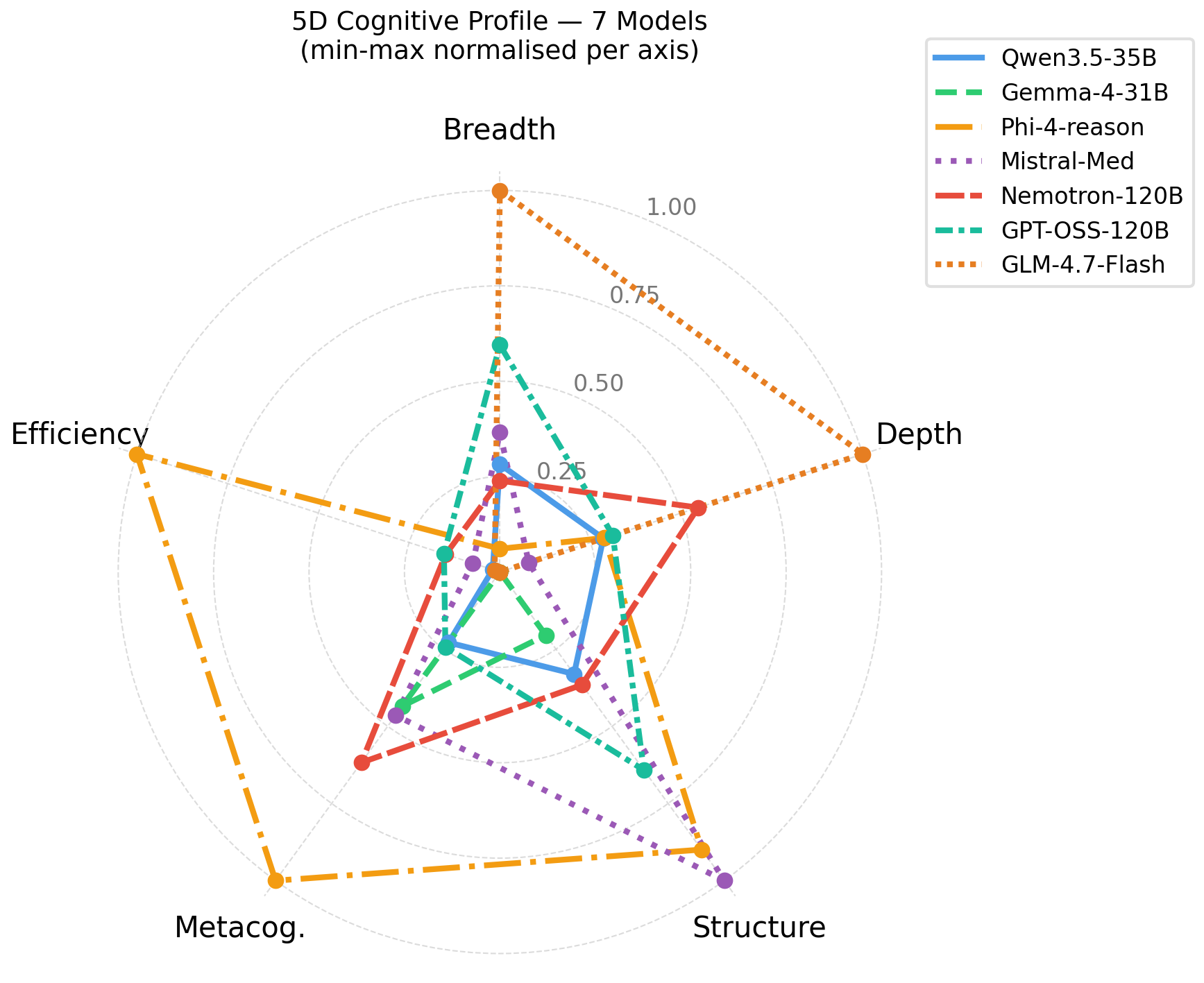
Figure 2: 5D Cognitive Radar: per-model mean profile polygons, min–max normalized to visualize reasoning style diversity across Breadth, Depth, Structure, Metacognitive, and Efficiency dimensions.
Distinct behavioral regimes emerge:
- High-efficiency, high-structure thinkers (e.g., Phi-4-reasoning): Maximally concise, structurally dense traces (zEfficiency=+1.27), depth-centric, breadth-limited.
- Broad-and-deep generalists (e.g., GLM-4.7-Flash): Simultaneous maxima in Breadth (z=+0.66) and Depth (z=+0.59), at the expense of Efficiency.
- Compact, low-variance models (e.g., Gemma-4-31B): Lowest on Breadth, Depth, and Efficiency, producing the shortest and simplest traces.
Cosine similarity between model 5D-CP vectors ranges from −0.91 (near-orthogonal strategies) to +0.77 (profile convergence).
Metric Discriminability
All 19 metrics exhibit robust model-level effects (ε2=0.10–$0.75$), with verbosity and structural-revision measures (Avg. Tokens, Backtracking Rate) dominating, but structure-independent metrics (Perspective Taking, Critique/Hypothesis Ratio) also achieving large discriminative effect.
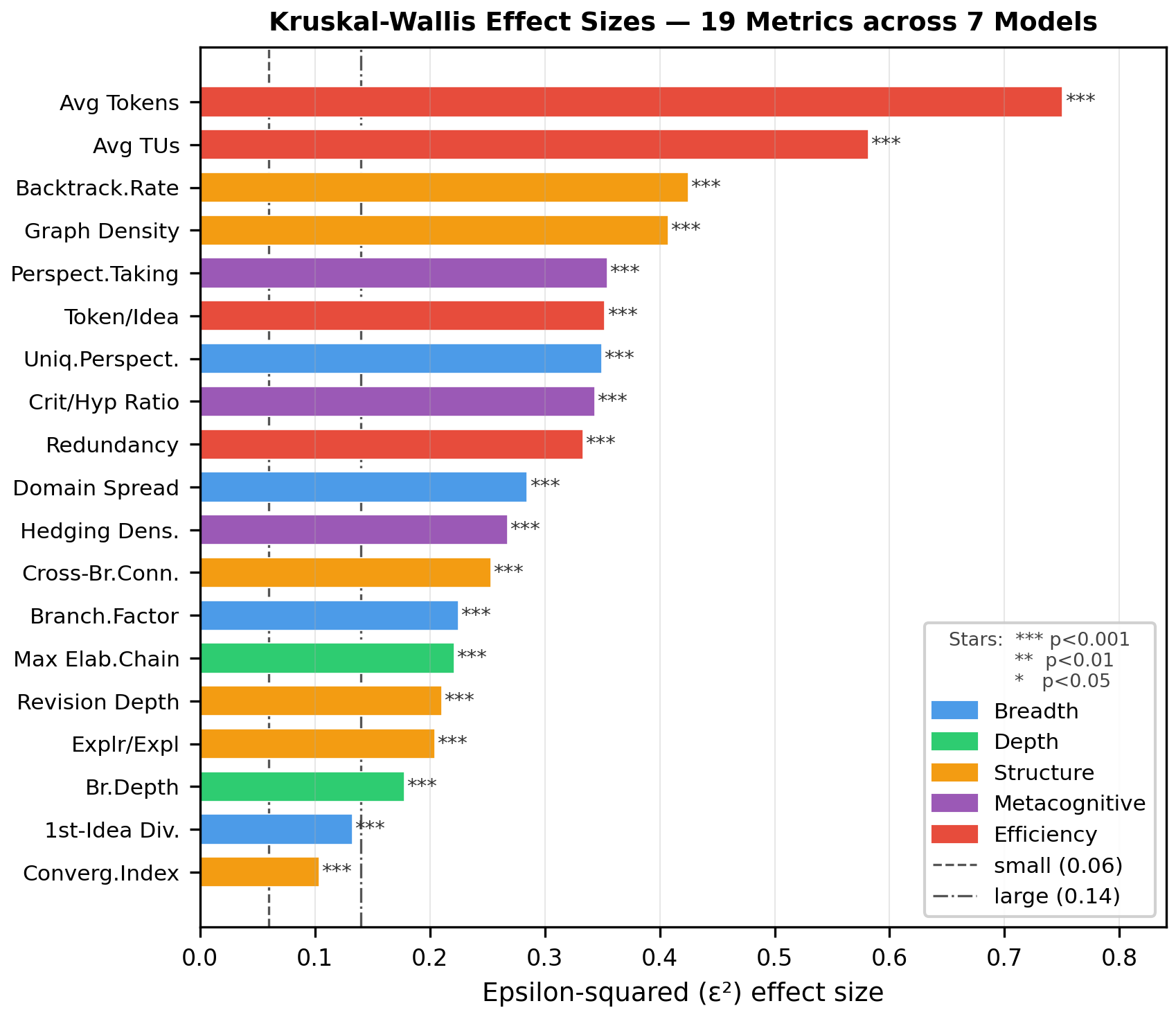
Figure 3: Kruskal–Wallis ε2 effect sizes for all 19 active metrics, sorted and color-coded by 5D dimension; all p<0.0010.
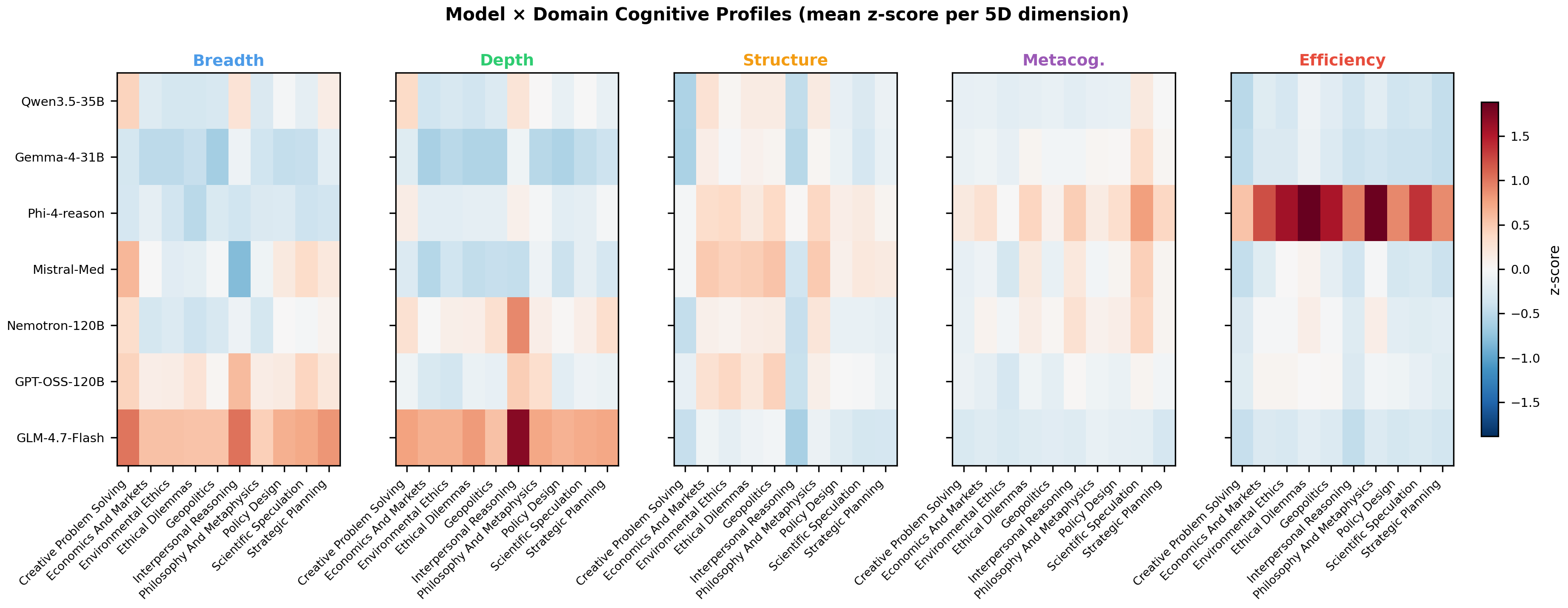
Domain-driven variance is markedly lower (max p<0.0011), confirming that reasoning structure is a stable, model-level property. The exception is the Structure dimension, where convergence and cross-branch integration metrics are genuinely domain-sensitive.
Necessity of Cyclic Graph Representation
Iterative refinement, synthesis, and cross-branch integration manifest empirically as cycles in Thought Graphs—present in 95.6% of traces, with median 32 cycles per trace and median cycle length of 14 TUs.
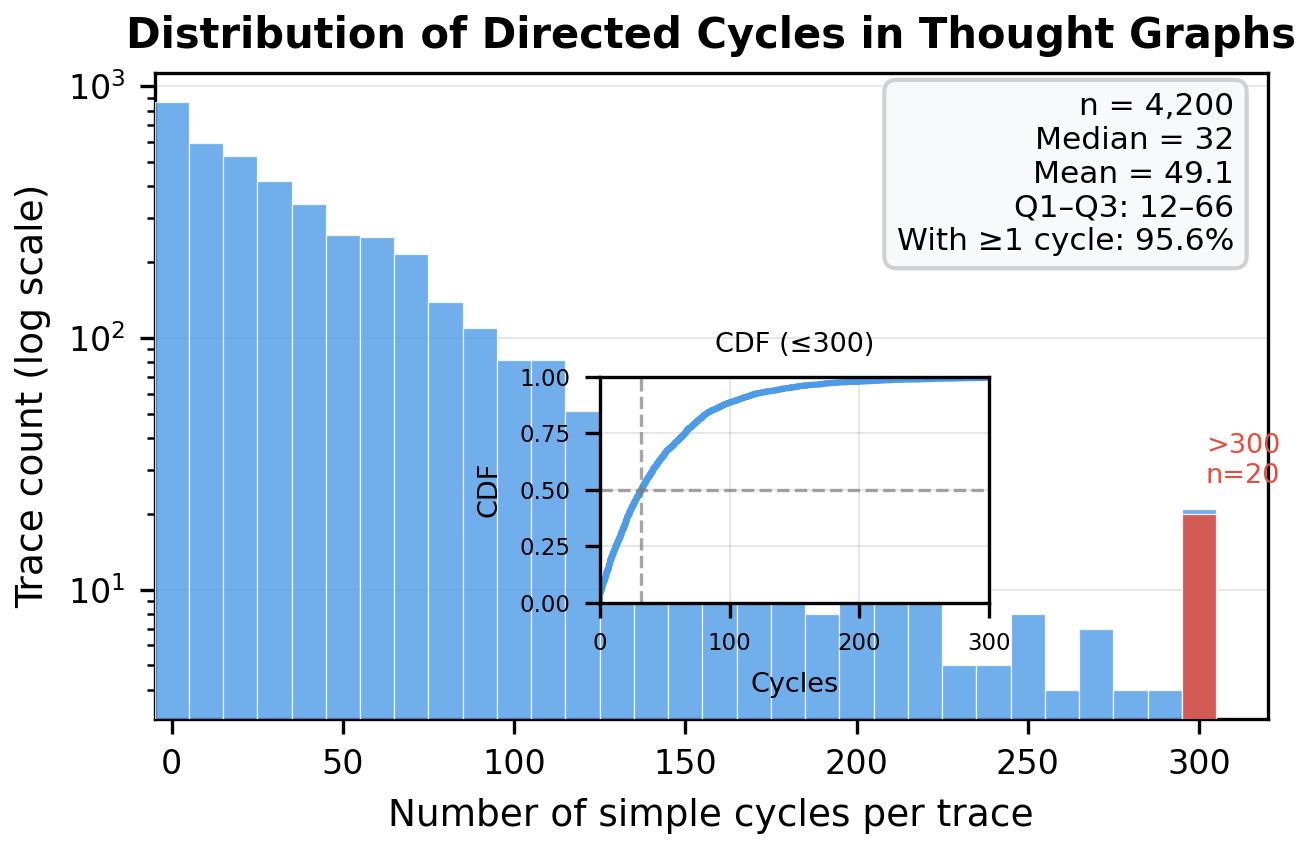
Figure 4: Distribution of simple directed cycle counts per trace (n=4,200), log-scale; confirms cycles are a nearly universal property of LLM reasoning traces.
Model-level variation in cycle count mirrors Depth/Structure distinctions.
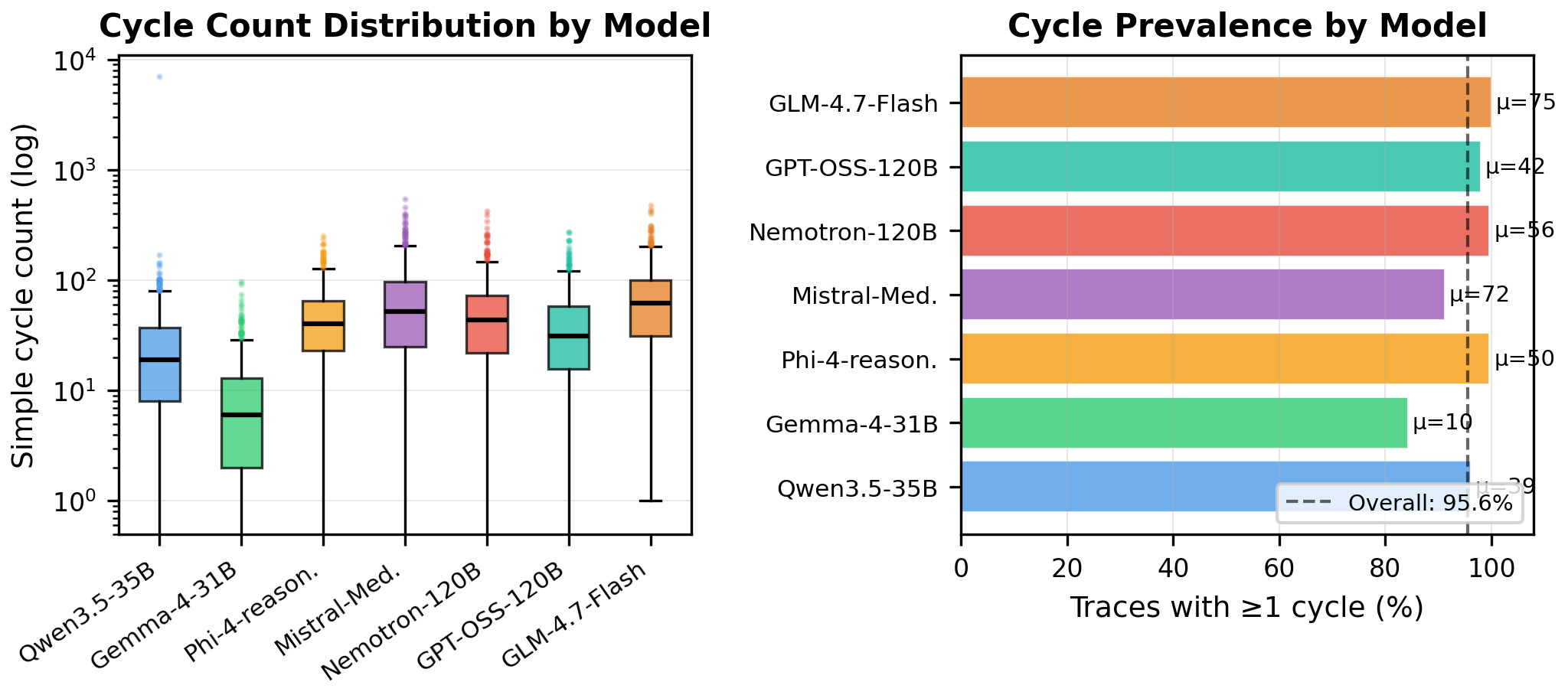
Figure 5: Left: per-model cycle count distributions; Right: fraction of traces containing at least one directed cycle (dashed line: 95.6% overall).
Graph cycle statistics are not artifacts of trace length; cycles arise fundamentally due to synthesis and backtracking behaviors, justifying the choice of a cyclic directed graph scheme over tree/DAG representations.
Pipeline Robustness and Human Validity
Ablation studies confirm non-redundancy across extraction layers (segmentation, semantic trajectory, cross-segment analysis), with each layer contributing uniquely to complex structural metrics. Annotation studies reveal that pipeline segmentations (boundary F1=0.705) match or exceed inter-annotator agreement (F1=0.582) for major cognitive transitions, supporting the practical functional validity of the extracted graph structures.
Implications and Future Directions
ThinkProbe shifts the evaluation paradigm towards process-centric, structure-aware profiling in open-ended reasoning—formalizing model-specific cognitive styles that are invariant to prompt, question, or domain. This enables:
Future research directions include correlating 5D profiles with human expert judgments, extending extraction to instruct-based chain-of-thought traces, and leveraging structural signals for calibrated, profile-aware deployments.
Conclusion
ThinkProbe provides a scalable, non-generative, structurally rich framework for dissecting LLM reasoning traces, offering a suite of metrics that collectively capture nuanced, stable, and model-specific reasoning styles, even in the absence of any reference answer. The empirical stability of these structural profiles points to the emergence of distinct cognitive regimes across LLM architectures and training, with consequences for the theoretical understanding of LLM reasoning processes and the design of future evaluation methodologies.