- The paper introduces a qudit-based IQP framework that processes integer data directly, eliminating distortions from binary encoding.
- It employs QFT layers and diagonal rotations, achieving low mean errors (~2%) and high correlation (r>0.96) in calorimeter image recovery.
- The study outlines scalable strategies via optimized circuit synthesis and Monte Carlo expectation estimation, paving the way for hardware-efficient deployments.
Qudit Extension of Parameterized IQP Circuits for Quantum Generative Modeling of Integer Data
Overview and Motivation
The presented work addresses the fundamental limitation of qubit-based parameterized Instantaneous Quantum Polynomial (IQP) circuits in handling non-binary datasets for quantum generative modeling. Traditional IQP approaches require binarization of integer data, leading to distortion of metric and structural relationships inherent in the dataset—particularly problematic for high-dimensional distributions with complex correlations. This paper establishes an IQP framework operating natively in the qudit space, allowing integer-valued features to be encoded and processed directly, thus preserving the metric structure and leading to improved generative fidelity for physical datasets (e.g., energy deposition in high-energy physics calorimeters).
Methodological Foundations
The quantum generative model is parameterized via IQP circuits comprised of initial and final Quantum Fourier Transform (QFT) layers adapted for qudits, sandwiching a diagonal central layer containing trainable integer-based rotations. Classical trainability is maintained by leveraging efficient Monte Carlo estimation of expectation values for diagonal operators, exploiting analytical decompositions of observables into Pauli-Z polynomials within the qudit formalism. The Maximum Mean Discrepancy (MMD) loss is redefined to operate on cyclic qudit distances, ensuring that statistical discrepancies are evaluated with respect to true metric relationships between integer states.
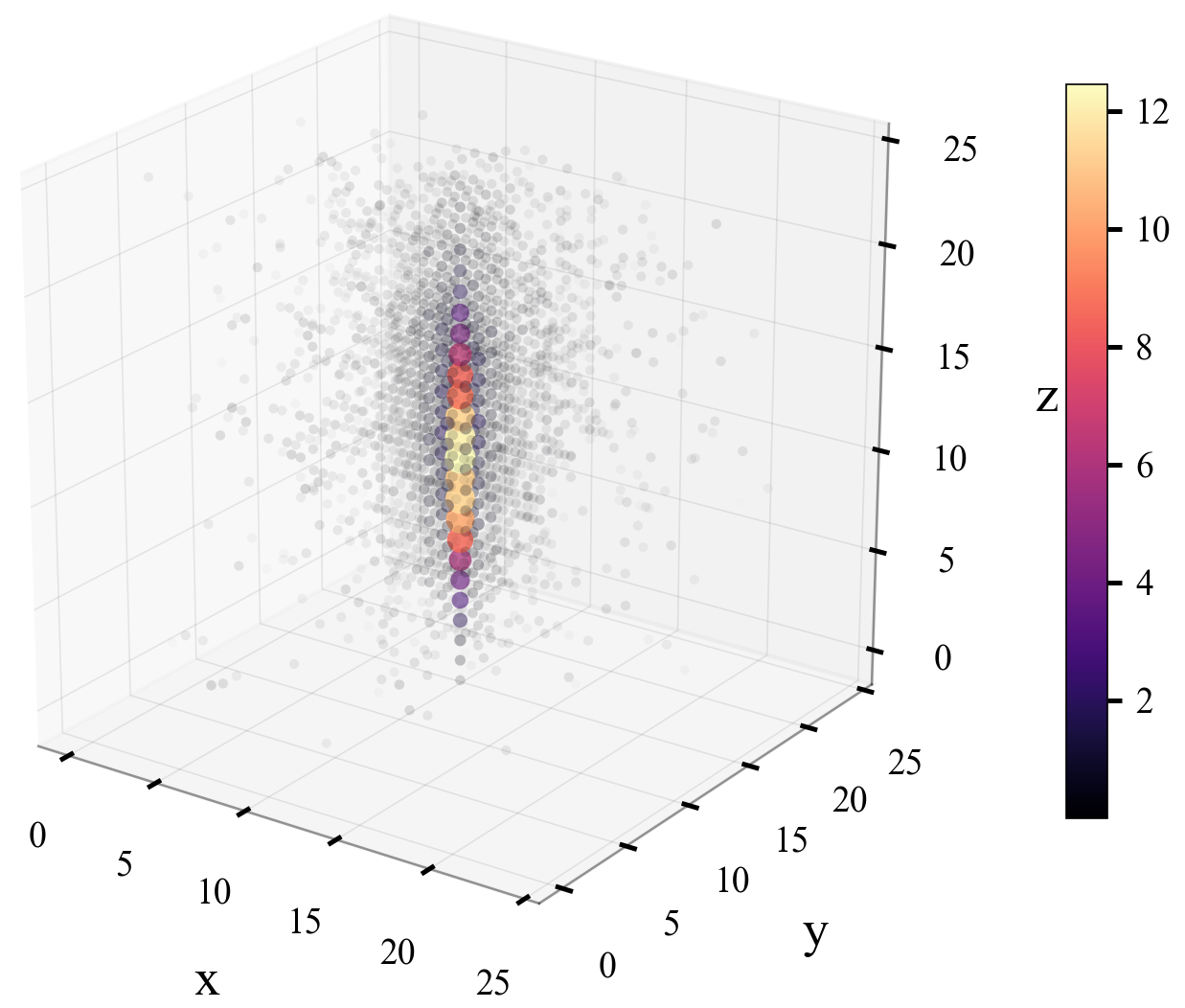
Figure 1: Extraction protocol for calorimeter images, highlighting data windowing centered on the barycenter, yielding integer-valued energy depositions suitable for qudit-based representation.
Data Encoding and Integer Mapping
Integer energy deposition data from three-dimensional calorimeter images is encoded via standardization followed by discretization onto an integer lattice [0,d−1] using controlled mapping procedures. Mean relative error analysis confirms the efficacy and precision trade-offs (Figures 4). Selection of qudit dimension d is guided by a balance between computational tractability (qubit resource requirements) and fidelity to original data metrics. For small-scale studies (n=6), d=16 gives mean errors below 15% per pixel, while more extensive cases (n=12) employ d=32 for errors below 10%.
Circuit Architecture and Classical Optimization
The qudit IQP circuit architecture generalizes qubit-based Hadamards to QFTs, maintaining the commutativity and diagonality of central parameterized layers. Expectation values for observables are calculated stochastically using uniform sampling over the qudit register space, enabling scalable classical optimization via automatic differentiation. Initialization strategies for gate parameters incorporate data-dependent schemes based on empirical covariance, yielding improved convergence rates compared to agnostic uniform initializations.
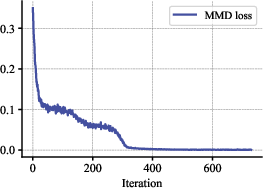
Figure 2: MMD loss function profile for 6-pixel images (qudit dimension d=16) during training, demonstrating smooth descent.
Numerical Results: Generative Fidelity and Covariance Recovery
6-Pixel Case ([0,d−1]0, 24 Qubits)
The trained IQP circuit is sampled classically, reconstructing mean energy depositions and covariance/correlation matrices for withheld validation data. The model achieves relative mean errors below [0,d−1]1 and exhibits high correlation coefficients ([0,d−1]2 off-diagonal), with element-wise residual errors averaging [0,d−1]3. KL divergence between generated and validation distributions is [0,d−1]4, indicating statistically minor deviations.
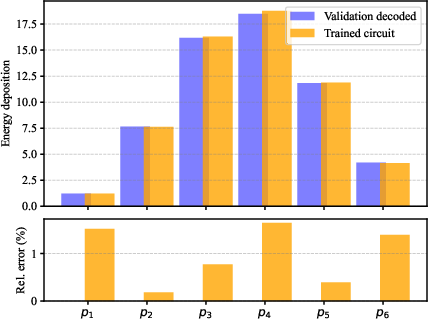
Figure 3: Comparison of mean energy deposition per pixel between validation and IQP-generated samples for 6-pixel, [0,d−1]5 images. Relative error [0,d−1]6.
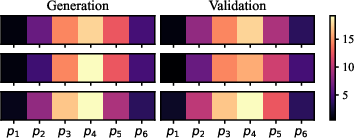
Figure 4: Illustrative samples from IQP circuit versus validation dataset, confirming qualitative agreement at the image level.
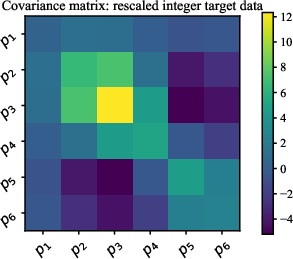
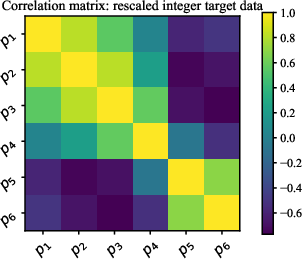
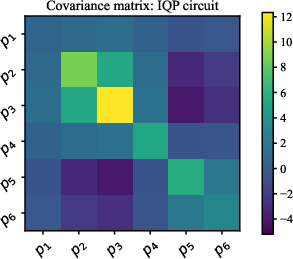
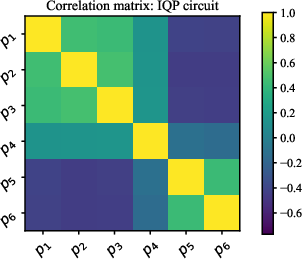
Figure 5: Covariance and correlation matrices—top: validation data; bottom: IQP-generated data—demonstrate accurate structure capture and correlation recovery.
12-Pixel Case ([0,d−1]7, 60 Qubits)
Owing to computational limitations, direct sampling is replaced by expectation value estimations. The IQP circuit achieves relative errors around [0,d−1]8 in mean energy deposition across pixels, with off-diagonal correlation coefficient [0,d−1]9 and average element-wise residual d0. Degradation is observed in higher-dimensional settings, indicating expressivity limitations of current diagonal ansatz.
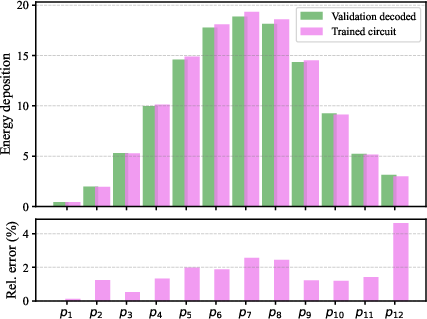
Figure 6: Mean energy deposition comparisons for 12-pixel, d1 data; relative error remains d2.
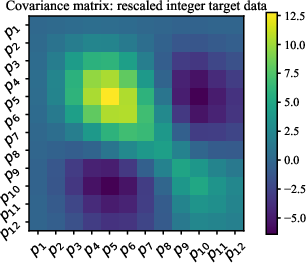
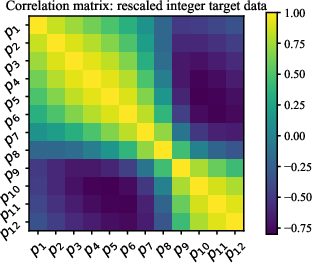
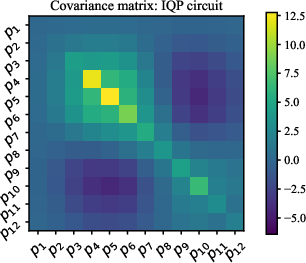
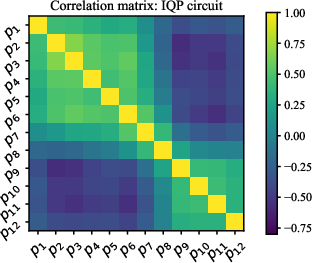
Figure 7: Validation vs generated covariances and correlations, capturing overall structure but with attenuated pairwise relationships.
Scaling: Preliminary Results on 25-Pixel, d3 Systems
The manuscript includes supplementary analyses on 25-pixel images (d4 qubits). MMD loss converges, but correlations and covariances degrade further, with residual error d5 and d6. Extended optimization and more expressive ansatz architectures are implicated as future requirements for reasonable scaling.
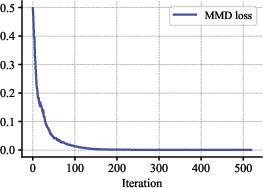
Figure 8: MMD loss evolution for 25-pixel systems, confirming learnability in high-qubit regime.
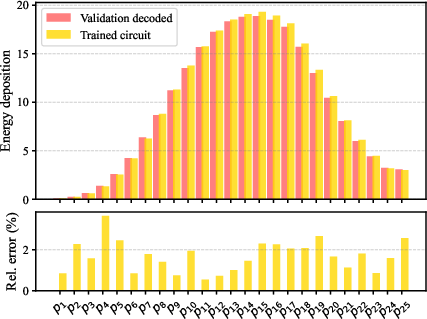
Figure 9: Mean energy deposition recovery for 25-pixel dataset; sizable alignment but with increased residual error.
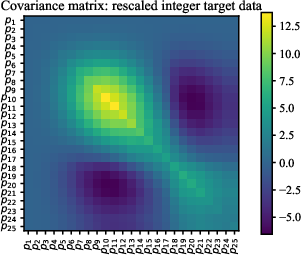
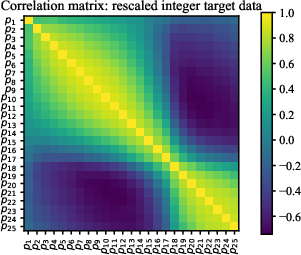
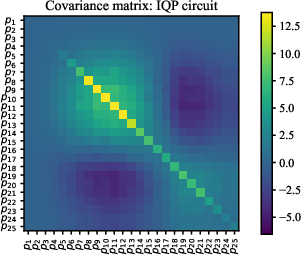
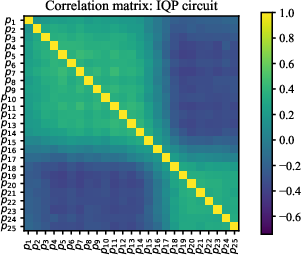
Figure 10: Covariance/correlation matrices at 25-pixel scale; IQP circuit captures broad structure but fails to recover fine-grained dependencies.
Circuit Deployability and Hardware Considerations
Deployment strategies on quantum hardware are discussed, including connectivity-aware compilation via Parity Twine and mid-circuit measurement schemes—both enabling reduction in circuit depth (logarithmic in qudit dimensionality) and improving hardware compatibility. The QFT layers are efficiently synthesized, and diagonal layers maintain polynomial scaling in pixel number. The impact of noise, error correction (hypercube architectures [hangleiter2025fault]), and potential for classically efficient simulation under non-idealities (amplitude damping [shravan2026efficientsimulationnoisyiqp]) are reviewed.
Comparison with Prior Approaches and Theoretical Implications
The paper's qudit-generalized IQP framework is contrasted with amplitude-encoding and quantum angle generator techniques used in prior calorimeter image modeling, both suffering exponential decay in accessible moment ranges and covariance expressivity due to latent variable encoding and binary circuit constraints. Previous sparse binary IQP circuits [slim2026iqpbornmachinecalorimeter] are highlighted for structural deficits in correlation recovery. Notably, universality enhancements via auxiliary qubits and kernel-adaptive training [kurkin2025universality] are suggested as promising avenues to transcend current expressivity limitations.
Conclusion
The qudit extension of parameterized IQP circuits provides a rigorous and physically motivated generative modeling paradigm for integer-valued data, overcoming distortions inherent in qubit binarization. Classical trainability is preserved via analytical expectation decompositions and kernel-based loss functions tailored to cyclic integer metrics. Empirical results on calorimeter data demonstrate high-fidelity mean and covariance recovery at moderate pixel counts, with observed limitations in correlation strength at larger scales implicating the need for more expressive circuit designs or advanced kernel schemes. The method is poised for deployment on contemporary quantum hardware, contingent on advancements in circuit compilation, error correction, and noise mitigation. Theoretical implications for scaling quantum generative models and hardware-efficient architectures suggest rich opportunities for further research in quantum machine learning and simulation of complex physical systems.

