- The paper presents a reproducible pipeline that rigorously benchmarks excited-state simulations by addressing symmetry contamination, trainability failures, and resource constraints on H2O/STO-3G.
- It employs symmetry projection and validated ansatz choices like UCCSD and ADAPT-VQE to accurately recover the neutral excited-state ladder while diagnosing critical algorithmic issues.
- The study introduces matrix-aware shot allocation and error mitigation strategies that achieve chemical accuracy, providing a comprehensive reference for near-term quantum hardware applications.
Symmetry-Respecting Excited-State Simulation Pipeline for H2O/STO-3G on Near-Term Quantum Hardware
Integration of Pathologies in Excited-State Quantum Algorithms
The paper "A Reproducible Pipeline for Symmetry-Respecting Excited States on Near-Term Quantum Computers: The H2O/STO-3G Case" (2606.28130) presents a meticulously constructed end-to-end workflow to simulate excited states of the water molecule (H2O) in the minimal STO-3G basis. The study systematically characterizes and integrates fundamental obstacles encountered in variational excited-state quantum algorithms, including symmetry contamination, trainability failures, finite-sampling instability, and resource assessment. The methodology leverages exact diagonalization to ground all quantum results, making the system a rigorous benchmark for pipeline reproducibility and algorithmic pathology diagnosis.
By focusing on a small, fully diagonalizable molecular system with the Jordan–Wigner transformation (12 qubits), the authors enable exhaustive validation against classical references, ensuring all quantum claims are numerically substantiated. The paper's contributions reside in integration, verification, and transparency: it exposes limitations and failure modes typically omitted in isolated algorithm demonstrations, providing a teaching and benchmarking reference for the quantum chemistry community.
Spectral Contamination and Symmetry Projection
The bare qubit Hamiltonian for H2O/STO-3G interleaves neutral and cationic states in its spectrum due to the presence of all particle-number sectors in the mapped Hilbert space. Several low-lying eigenstates originate from the H2O+ cation (N=7), contaminating the excited-state manifold targeted for the neutral species. This spectral pathology is addressed via symmetry projection, enforcing particle-number and spin constraints through penalty terms in the Hamiltonian:
H^μ=H^+μ(N^−8)2+μS^z2
The penalty approach recovers the correct neutral excited-state ladder, revealing the necessity for symmetry-respecting techniques in quantum excited-state calculations.
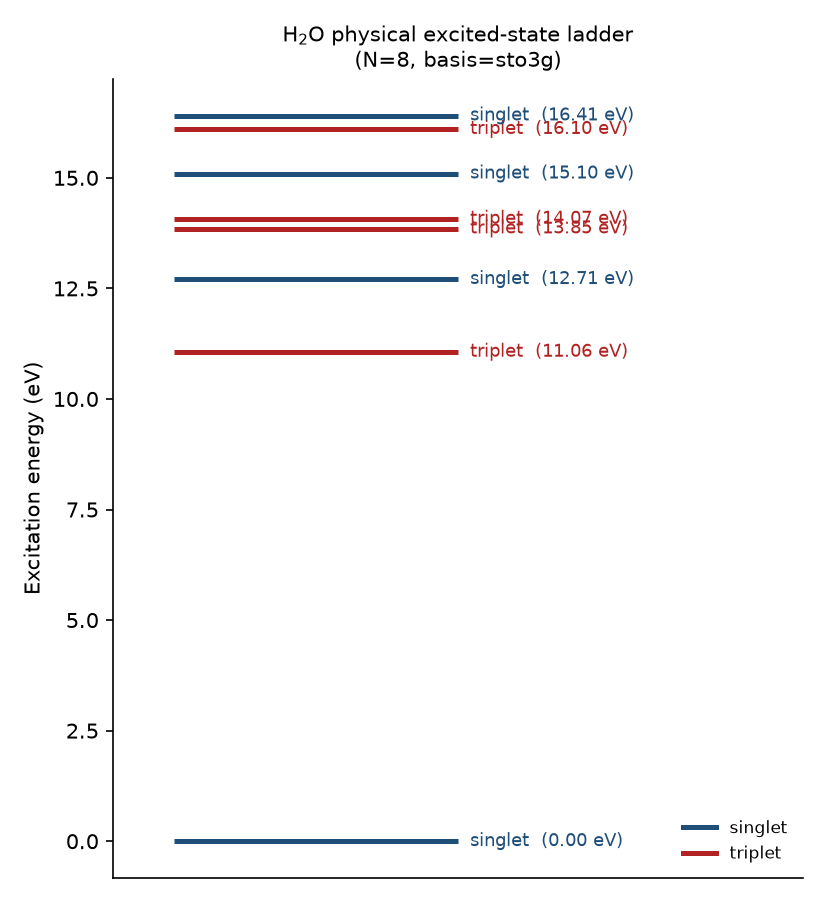
Figure 1: Neutral excited-state ladder of H2O/STO-3G obtained by symmetry-penalty projection, exposing cation contamination in the bare spectrum.
Ground-State Trainability: Brillouin’s Theorem and Ansatz Selection
Ground-state optimization under various ansatz constructions exhibits sharp bifurcation in trainability:
- Chemically motivated ansatz (UCCSD): Achieves chemical accuracy, preserving particle number and spin.
- Hardware-efficient and number-conserving ansätze: Stagnate at the Hartree–Fock energy due to vanishing gradients, a direct consequence of Brillouin’s theorem; singles excitations do not couple to the reference determinant.
ADAPT-VQE circumvents this trainability bottleneck by selecting double excitations based on energy gradient, descending below Hartree–Fock and achieving the target accuracy with ansatz compactness.
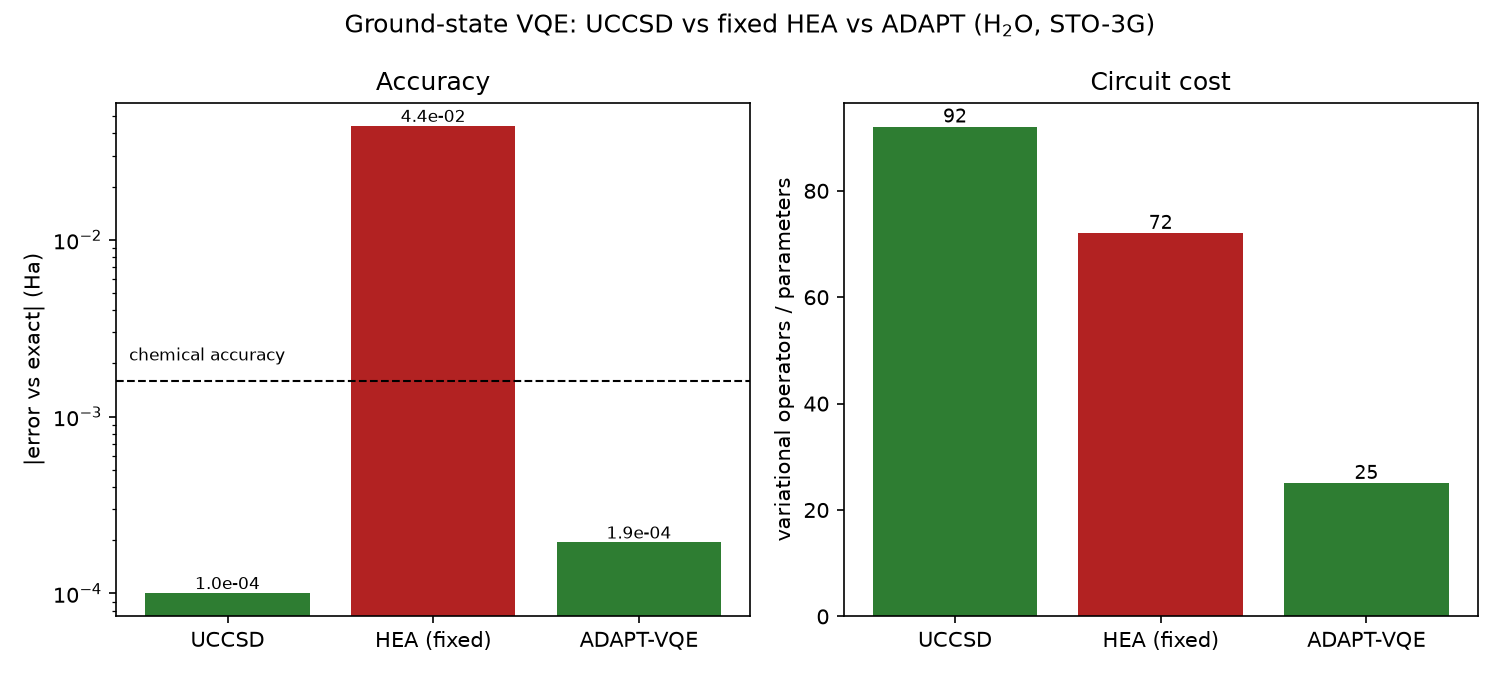
Figure 2: Ground-state convergence for three ansätze; only UCCSD and ADAPT-VQE reach chemical accuracy.
Excited-State Algorithms: Failures of Deflation, Robustness of qEOM
Variational Deflation (VQD)
VQD applied with hardware-efficient ansatz collapses onto spurious cationic states, misordering the excited-state ladder and inheriting contamination from the unconstrained Hilbert space.
Penalty Methods
While symmetry penalties diagnostically remove contaminant states, their aggressive use degrades trainability and energies, resulting in trade-offs that preclude robust solution.
Quantum Equation-of-Motion (qEOM)
qEOM, constructed with number-conserving excitation operators, solves the generalized eigenvalue problem in a structurally symmetry-protected subspace. The method reproduces the exact neutral excited-state ladder and is robust to ground-state errors. Structural protection ensures conservation of particle number in all realizations, even under shot noise.
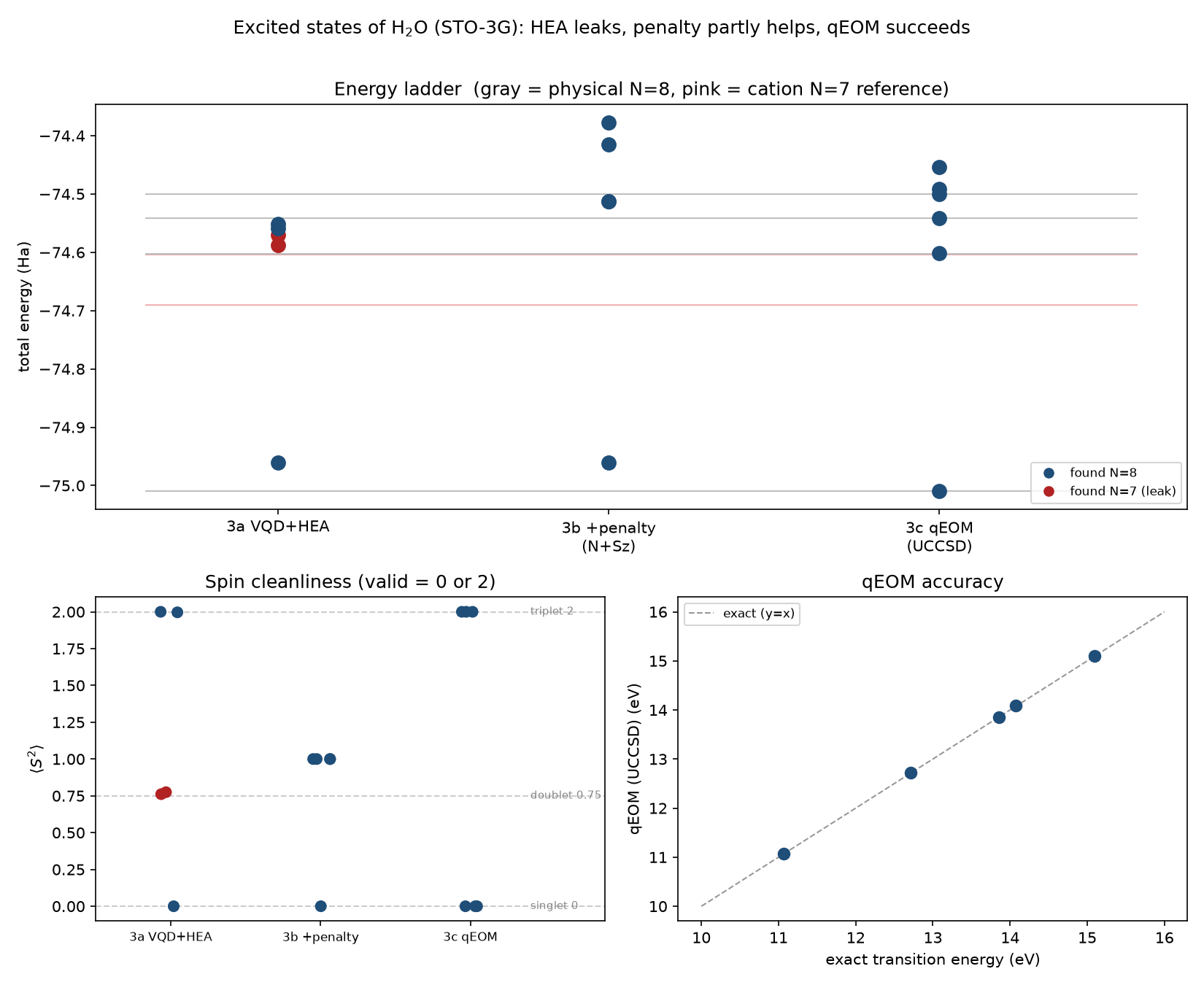
Figure 3: Comparison of VQD (symmetry-contaminated) and qEOM (number-conserving, robust) excited-state spectra.
Measurement Strategies and Shot Allocation
Measurement of subspace matrix elements for qEOM/QSE inherits a daunting apparent complexity: millions of Pauli strings. However, global deduplication and commute-grouping compress the measurement bases by an order of magnitude. The critical innovation is matrix-aware shot allocation, which prioritizes variance minimization across matrix entries. Gap-sensitivity allocators, successful in linear-response screening, fail in nonlinear eigenvalue solves by neglecting Ritz-root identity preservation.
The structured measurement budget achieves chemical accuracy on all excitation gaps with ∼3×10⁹ total shots, vastly outperforming naive per-element multiplication estimates.
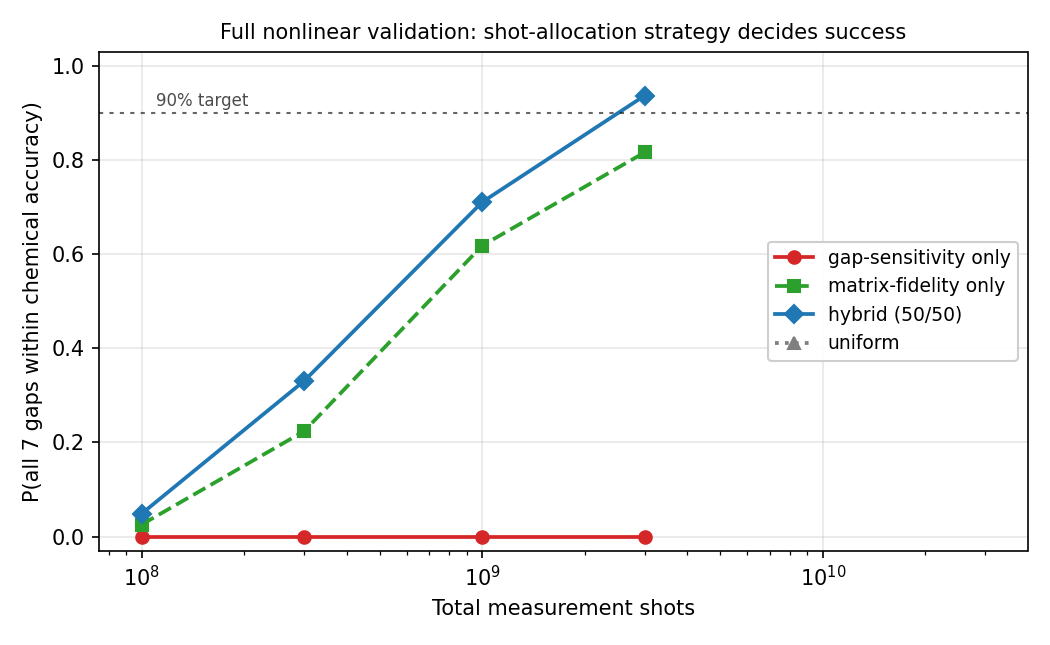
Figure 4: Matrix-aware shot allocation outperforms gap-sensitivity and uniform strategies, reaching 20 chemical accuracy success in 21 shots.
Finite Sampling Noise and Overlap Conditioning
Monte Carlo analysis under pessimistic independent Gaussian noise models reveals:
- Structural protection of particle number in qEOM basis, even under noise.
- Low shot counts produce overlap matrix ill-conditioning; canonical-orthogonalization regularization mitigates bias–variance trade-offs.
- Realistic measurement models are inherently well-conditioned; regularization acts as insurance, not a fundamental correction.
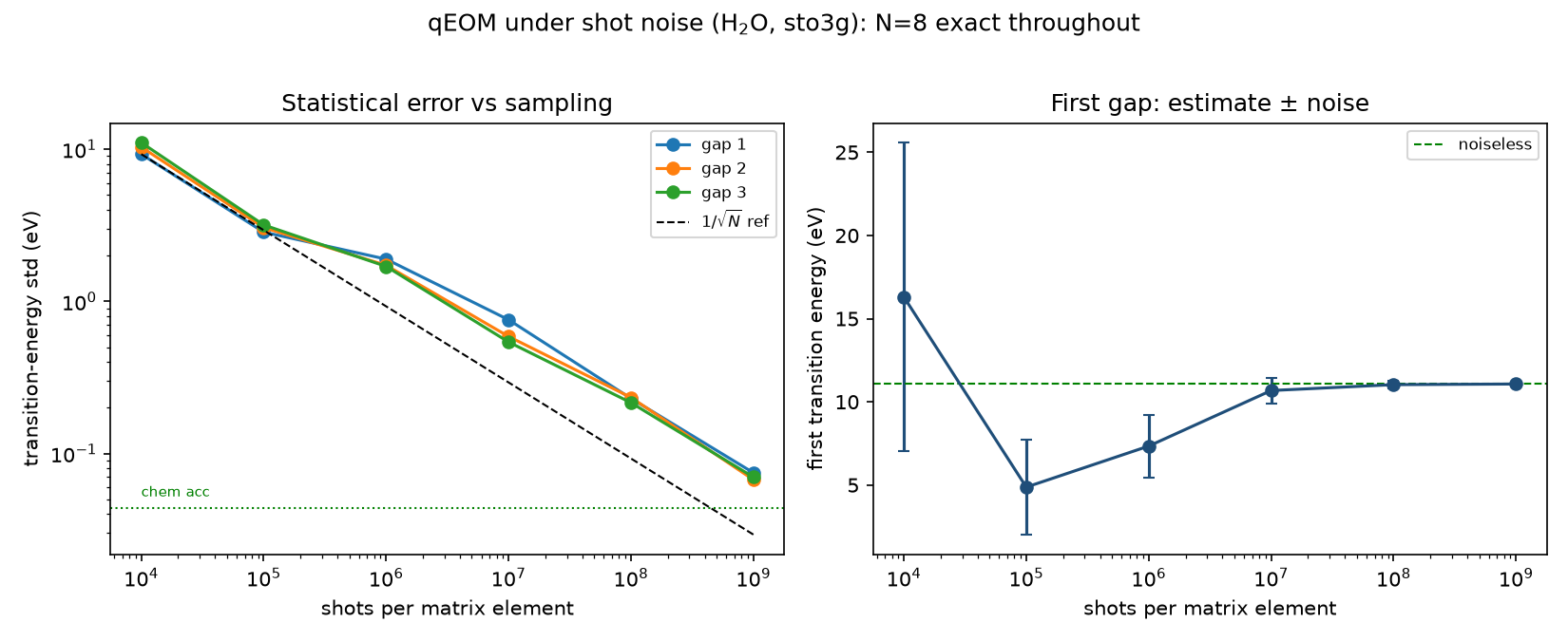
Figure 5: qEOM under shot noise; particle number remains exactly 22, while statistical error in transition energies diminishes with increased sampling.
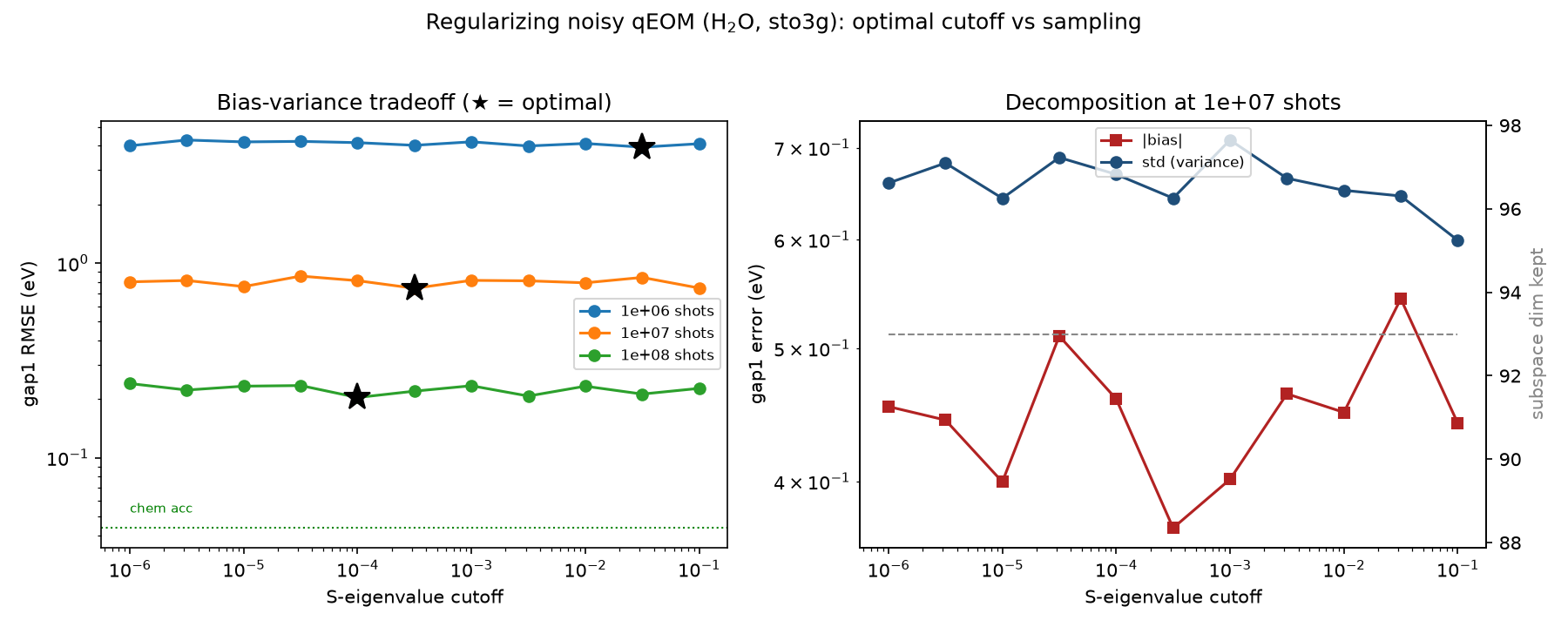
Figure 6: Regularization of the overlap matrix, showing RMSE-optimal eigenvalue cutoffs adapting to available shots.
Hardware Resource Assessment: Gate Fidelity as the True Constraint
Resource evaluation on superconducting, trapped-ion, and neutral-atom hardware modalities reveals:
- ADAPT-VQE circuits require substantially fewer two-qubit gates than UCCSD, enhancing compactness and feasibility.
- Wall-clock time for measurement budgets is attainable (days) on current hardware; per-circuit fidelity is the principal limiting factor for practical deployment.
- Routing overheads and gate infidelity across platforms decidedly constrain single-circuit performance, motivating ongoing error mitigation and eventual fault tolerance.
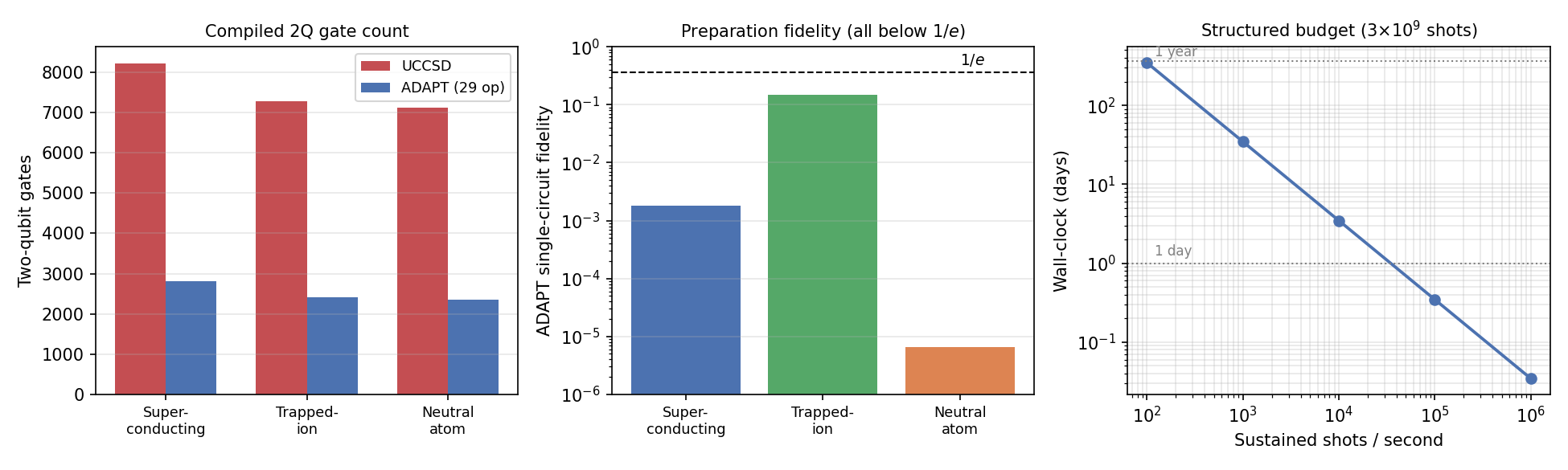
Figure 7: Hardware resource breakdown; ADAPT-VQE offers improved gate counts, but single-circuit fidelity is the practical bottleneck.
Conclusion
The reproducible pipeline for H23O/STO-3G excited-state simulation consolidates variational algorithm pathologies and robust solutions within a single benchmark system. Symmetry contamination, trainability failures, measurement complexity, and finite-sampling instability are individually diagnosed and collectively resolved through symmetry-respecting, matrix-aware approaches. Structural protection of particle number, realistic measurement compression, and resource assessment all converge to a scenario where algorithmic correctness and measurement budgets are not limiting; instead, gate fidelity is the binding obstacle for near-term quantum hardware.
Practically, this pipeline provides a rigorous reference for benchmarking and teaching, and points toward symmetry-protected algorithms (including q-sc-EOM) and error-mitigated/fault-tolerant hardware as focal points for future development. The explicit transparency in failure modes offers strategic guidance for improvement and refinement of excited-state simulation methodologies in quantum chemistry.
References
- H. Song, "A Reproducible Pipeline for Symmetry-Respecting Excited States on Near-Term Quantum Computers: The H24O/STO-3G Case" (2606.28130).