- The paper presents a novel orbital-optimized, spin-adapted MC-VQE framework that reliably predicts excited states while conserving spin symmetry.
- It integrates orbital rotations, state-averaged energy minimization, and hardware-aware error mitigation to optimize circuit complexity and measurement efficiency.
- Benchmark results on polyatomic molecules demonstrate linear scaling and robust error reduction, advancing practical quantum spectroscopic simulations.
Orbital-Optimized Spin-Adapted Multistate Contracted VQE for Excited States and Properties on Quantum Hardware
Introduction and Motivation
Accurate quantum chemical prediction of excited states and their transition properties is essential for modeling spectroscopy, photochemistry, and the design of photoactive materials. Classical approaches employing either linear-response (LR) or variational/multistate formulations exhibit limitations, especially for states with strong multiconfigurational character or near-degeneracies, such as conical intersections, where LR approaches become unreliable [Ziems2024-ew, (2606.15489)]. Quantum computers, in principle, offer polynomial or exponential speedups for quantum many-body problems, but the current NISQ devices are limited in circuit depth and subject to substantial noise.
This paper presents an orbital-optimized, spin-adapted multistate contracted variational quantum eigensolver (oo-MC-VQE) framework targeting ground and excited states on quantum hardware. The approach enforces spin symmetry, balances ansatz expressivity and circuit complexity across multiple states, integrates quantum error mitigation, and demonstrates electronic spectrum calculations for polyatomic molecules on both emulated and real quantum devices.
Theoretical Framework
Multistate Contracted VQE and Spin Adaptation
The MC-VQE paradigm assigns each targeted state a unique reference, followed by a shared parameterized unitary ansatz for electron correlation. State-averaged energy minimization leads to the construction and diagonalization of a multistate Hamiltonian subspace. A key innovation is the explicit use of spin-adapted operators for the unitary ansatz, guaranteeing the conservation of spin symmetry throughout VQE optimization. Instead of introducing spin penalty terms, the operator pool is tailored to well-defined spin sectors, which is advantageous for both simulation fidelity and hardware efficiency [Kjellgren2025-pb, Magoulas2025-wb].
When orbital optimization is incorporated, orbital rotations are included as additional variational parameters, ensuring optimal active-space representations and further reducing correlator circuit complexity. The total optimization is performed jointly over unitary and orbital rotation parameters, with gradients obtained efficiently via the parameter-shift rule and analytical derivatives.
Reduced Matrix Elements and Hardware-Efficient Evaluations
Property and state transition matrix elements are efficiently built from expectation values between determinantal basis states and their symmetry-adapted linear combinations, using measurement-reducing superposition tricks that exploit hardware commutativity and reference state structure. This trades an increased number of measurements for shallower circuits, which is critical for NISQ-era devices.
Error Mitigation Strategies
The work extends ansatz-based readout and gate error mitigation (M0), correcting for both classical readout and a subspace of gate errors by constructing confusion matrices tailored to the specific ansatz and reference preparation circuits. A more granular variant, M0+, is developed for complex multi-determinantal state preparation at the cost of exponential scaling, but mostly the standard M0 approach suffices for the studied benchmarks.
Numerical Results and Demonstrations
Circuit Scaling and Ansätze Expressibility
The scaling of ansatz parameters with the number of state-averaged targets is analyzed via ADAPT-VQE and oo-ADAPT-VQE protocols for archetypal small molecules (LiH, H₂O, NH₃). The number of circuit parameters required to maintain chemical accuracy increases nearly linearly with the number of targeted states in all systems considered.
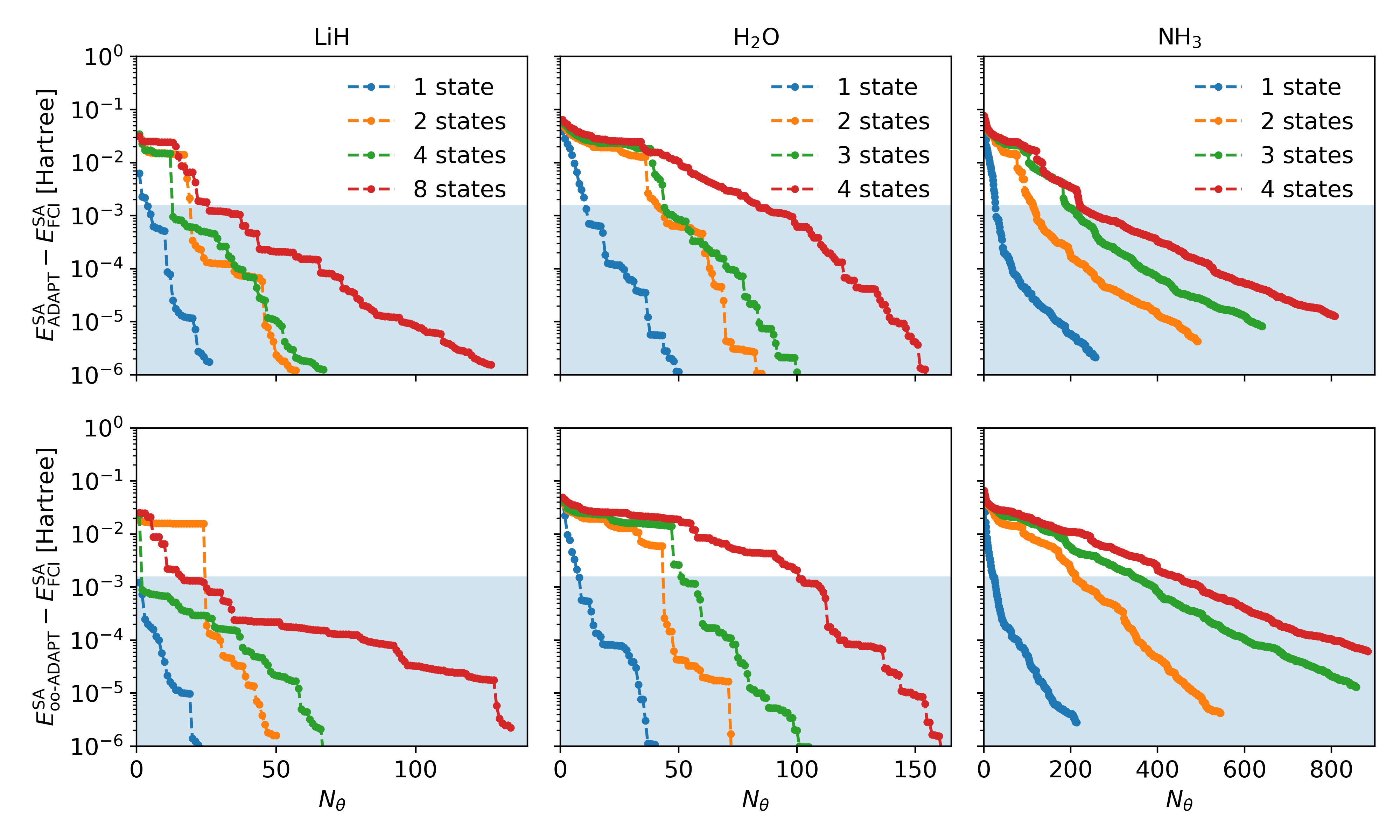
Figure 1: State-averaged ADAPT (top) and oo-ADAPT (bottom) convergence and error distribution for LiH, H₂O, and NH₃ as a function of the number of states included; blue region denotes chemical accuracy.
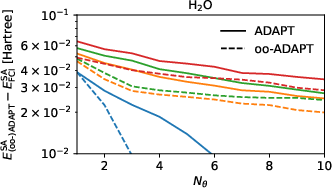
Figure 2: Convergence behavior for the first ten ADAPT iterations in H₂O for increasing state-averaging; orbital optimization provides an initial advantage but saturates rapidly.
Notably, the inclusion of orbital optimization has a significant impact only in early iterations. For tightly converged solutions, its effect on parameter count is minor or system-dependent.
Calculation of Excitation Properties on Quantum Hardware
The quantum circuit implementation is subjected to realistic noise models (IBM's noise models) and deployed on the IBM quantum backend for two molecules: formaldehyde and H₃⁺. Spectral properties are extracted by evaluating excitation energies and oscillator strengths across multiple VQE-optimized states.
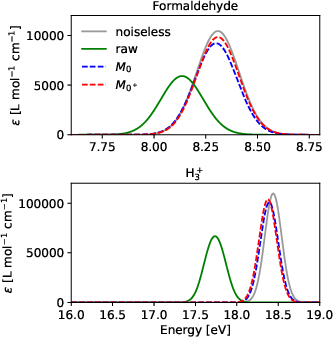
Figure 3: Electronic spectra of formaldehyde (top) and H₃⁺ (bottom) under simulated device noise; error-mitigated spectra (dashed) closely match noiseless results, with noise resilience varying by system.
Error mitigation (M0 and M0+) is essential for reducing spectral shifts introduced by device noise, and the efficacy of mitigation is correlated with the condition number of the subspace Hamiltonian. Systems with higher condition numbers exhibit greater susceptibility to noise, resulting in larger spectral shifts in the absence of mitigation.
Experimental runs on IBM quantum hardware reveal larger deviations than their noise-simulated counterparts, underscoring the limitations of current error models, which do not fully capture hardware-specific error channels such as crosstalk and temporal drifts.
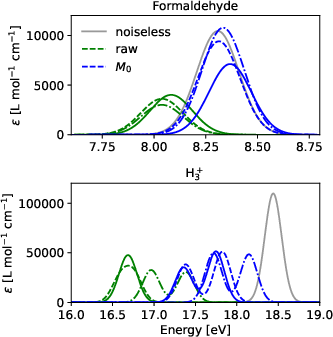
Figure 4: Experimental electronic spectra of formaldehyde (top) and H₃⁺ (bottom) on quantum hardware (ibm_marrakesh and ibm_aachen); results across independent runs indicate noise-induced variability, with qualitative features preserved.
Nevertheless, the main features and qualitative trends in the absorption spectra are retained, and the methodology demonstrates robustness under realistic NISQ conditions.
Implications and Future Directions
The proposed oo-spin-adapted MC-VQE protocol enables scalable, balanced targeting of many-electron excited states with quantum circuits whose depth and complexity scale linearly with the number of states. The design enforces spin symmetry by construction—critical for accessing physically relevant states and reducing the risk of unphysical solutions. The work provides evidence that variational quantum algorithms with quantum error mitigation, coupled with hardware-aware reference preparation and measurement schemes, can already deliver meaningful spectroscopic predictions on current hardware for carefully chosen systems.
These findings suggest several avenues for future research:
- Ansätze and circuit design: Exploration of more hardware-efficient, scalable ansatz families and state-preparation techniques.
- Robust error mitigation and error correction: Development of scalable mitigation and verification protocols, moving towards full utilization of multi-reference states and larger active spaces.
- Application to strongly correlated and nonadiabatic phenomena: Extension to conical intersections, charge-transfer systems, and nonadiabatic dynamics, leveraging the balanced treatment offered by the multistate variational protocol.
- Integration with quantum embedding or hybrid approaches: Embedding quantum-classical or quantum-quantum hybrid schemes for simulating reactive environments or condensed-phase phenomena.
Conclusion
The orbital-optimized, spin-adapted MC-VQE framework constitutes an important advance in the use of quantum algorithms for excited-state quantum chemistry. It provides a systematic route for balanced, symmetry-respecting, and measurement-efficient calculations of ground and excited state properties on both simulated and real quantum hardware. The empirical scaling with the number of targeted states, circuit constructions, and error mitigation practices are validated across test cases, establishing a technical baseline for future quantum computational spectroscopy. While current quantum hardware still poses significant challenges in terms of quantitative accuracy, the presented methodology demonstrates that, with sufficient mitigation and circuit co-design, meaningful chemical insight is already attainable.