- The paper demonstrates that ergotropy in capacitively coupled DQD quantum batteries is mainly due to non-passive population distributions rather than coherence.
- It employs resonant microwave modulation to selectively drive E0↔E3 transitions using experimentally relevant parameters from Si/SiGe DQDs.
- It shows that 1/f detuning noise critically degrades charging dynamics by suppressing population ordering, reducing the battery's extractable work.
Ergotropy Dynamics in Capacitively Coupled Double-Quantum-Dot Batteries Under 1/f Charge Noise
System Architecture and Noise Model
The study investigates a two-qubit quantum battery (QB) architecture realized by capacitively coupled double quantum dots (DQDs), each operating in the charge qubit regime. The static battery Hamiltonian comprises local detuning (ϵ0,i), tunnel splitting (Δ0,i), and a capacitive Ising-type coupling (J) representing the interaction. Static parameters are derived from experimentally relevant Si/SiGe DQDs: Δ0,1/h=8.4 GHz, Δ0,2/h=6.6 GHz, and J/h=15.3 GHz at the symmetric detuning sweet spot (ϵ0,1=ϵ0,2=0).
The external environment is modeled by band-limited $1/f$ stochastic detuning fluctuations, dominant in Si/SiGe platforms, with a spectral amplitude cϵ and frequency cutoffs (ωl,ωh). For each noise realization, detuning enters longitudinally as Δ0,i0, affecting both the resonance condition and dynamical channel. Ensemble averaging over many stochastic traces captures the realistic decoherence and loss of contrast.
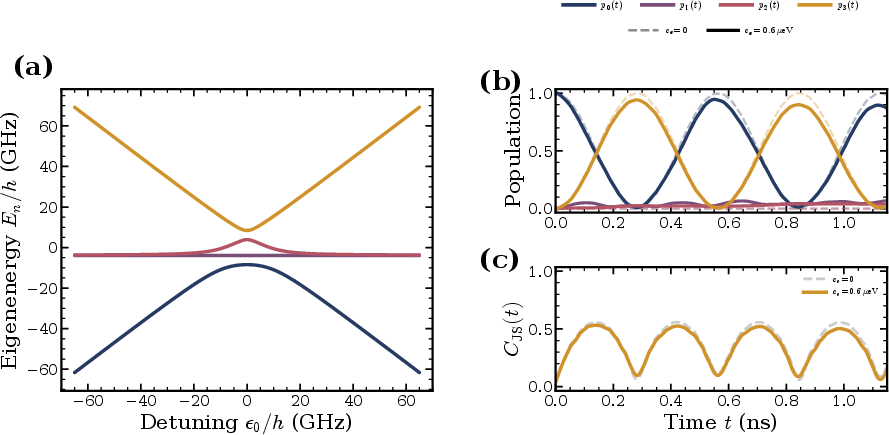
Figure 1: The static coupled DQD energy spectrum and noise-averaged charging dynamics reveal dominant Δ0,i1 population transfer and coherence generation, degraded under detuning charge noise.
Resonant Charging and Channel Selection
Charging occurs via resonant microwave modulation of the tunnel couplings, transverse in the localized charge basis. The drive frequency is tuned to Δ0,i2 GHz, directly addressing the highest-lowest energy transition. This choice enables selective population transfer and superposition generation, with the charging branch predominantly governed by the Δ0,i3 channel.
Dynamic evolution shows oscillatory population exchange between Δ0,i4, with intermediate levels (Δ0,i5, Δ0,i6) weakly involved during the first charging branch. The system thus acts as an effectively two-level QB embedded in a four-level manifold. Jensen–Shannon quantum coherence (Δ0,i7) remains finite, serving as a quantitative measure of dynamical superposition in the energy basis.
Noise-induced detuning shifts and fluctuations degrade both population transfer and coherence amplitude, manifesting as reduced oscillation contrast and suppressed Δ0,i8 upon ensemble averaging.
Ergotropy Decomposition and Population Ordering
Ergotropy (Δ0,i9), defined as the maximum extractable work via unitary operations with respect to J0, is decomposed into population (J1) and coherent (J2) contributions using energy-basis dephasing. The key finding is that, in this microwave-driven protocol, J3 is dominated by J4, with J5 comparatively minor.
Parametric analysis with coherence (J6) and J7-J8 population imbalance (J9) shows that passive ordering violations (diagnosed by the indicator Δ0,1/h=8.40) occur before the stronger Δ0,1/h=8.41 inversion. The onset of non-passivity in the diagonal energy-basis population distribution is the relevant threshold for positive population ergotropy, consistent with passivity theory.
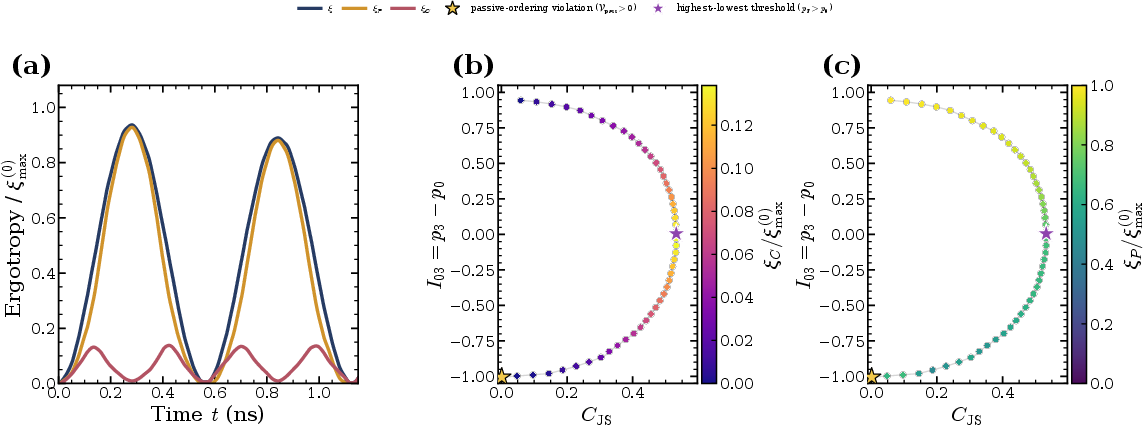
Figure 2: Ergotropy channel decomposition highlights population-dominated storage and passive ordering violations, with noise reducing both total ergotropy and coherence.
Trajectories reveal that most extractable work is stored in non-passive populations, even as the drive generates transient coherence. This underscores the role of coherence as a dynamical resource supporting population redistribution, and not necessarily as the main repository of ergotropy in this protocol.
Noise-Induced Degradation: Channel Maps
Two-dimensional maps of ergotropy channels over time and Δ0,1/h=8.42 visualize the degradation mechanism under Δ0,1/h=8.43 detuning noise. Total ergotropy (Δ0,1/h=8.44) and population ergotropy (Δ0,1/h=8.45) show closely aligned structures, confirming the population-dominated character.
The region with large passive ordering violation (Δ0,1/h=8.46) diminishes as detuning noise amplitude increases, signaling weakened population transfer pathways and reduced capacity to generate non-passive distributions. Coherent ergotropy (Δ0,1/h=8.47) remains finite but subdominant throughout.
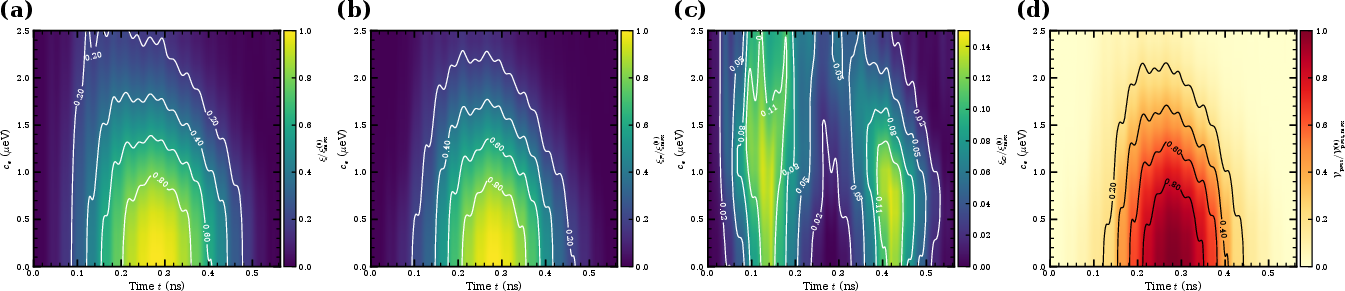
Figure 3: Channel-resolved ergotropy maps elucidate noise-induced suppression of passive ordering violation, driving loss of extractable work in the QB.
This establishes that detuning noise primarily impairs QB performance by disrupting the population transfer mechanisms underlying non-passive ordering, rather than simply by coherence decay. The physical origin is realization-dependent detuning shifts, which perturb selective resonant dynamics and reduce transfer efficiency.
Implications and Prospects
From a practical standpoint, the results imply that materials engineering to minimize detuning noise (e.g., using thin quantum wells [PaqueletWuetz2023]) will critically enhance QB robustness, not only by protecting energy basis coherence but more importantly by preserving population ordering pathways vital for ergotropy.
Theoretically, this population-centric ergotropy interpretation aligns with recent multichannel QB frameworks [Francica2020, Wang2026Ergotropy] and motivates the refinement of charging protocols that combine coherent driving with robust population transfer. It also suggests extensions—incorporation of relaxation, phonon interaction, correlated noise, or larger DQD arrays—to probe collective charge modes and scalable charging strategies.
Future directions include optimization of tunnel coupling drives for maximal population ergotropy with minimal detuning sensitivity and generalization of ergotropy channel analysis to multi-qubit and many-body QB systems.
Conclusion
The study presents a detailed stochastic Hamiltonian analysis of a capacitively coupled DQD quantum battery subjected to realistic Δ0,1/h=8.48 detuning noise, with charging implemented via resonant tunnel coupling modulation. The extractable work is shown to be predominantly carried by non-passive population distributions in the energy eigenbasis, with coherence acting as a transient mediator. Detuning noise degrades battery performance chiefly by suppressing population ordering violations underlying ergotropy. This establishes a direct practical and theoretical connection between ergotropy-based battery metrics, charge qubit control protocols, and low-frequency noise physics in solid-state platforms.

