- The paper demonstrates a phase-driven ABS quantum battery that uses interaction-induced hybridization to amplify extractable work.
- It employs nonadiabatic Landau-Zener transitions and full quantum simulations to map ergotropy dynamics and identify optimal charging windows.
- The study reveals that phase-resolved charging in high-transparency SNS junctions can outperform full-cycle extraction protocols for efficient energy storage.
Interaction-Enhanced Ergotropy in Phase-Driven Andreev Bound State Quantum Batteries
Overview
This work introduces and analyzes a phase-driven quantum battery comprised of two coherently coupled Andreev Bound State (ABS) units, the minimal superconducting architecture capable of supporting programmable quantum energy storage via interaction-augmented coherent processes. The study systematically investigates ergotropy dynamics as a function of phase drive, ABS-ABS interaction, and junction transparency, focusing on nonadiabatic Landau-Zener excitation and interaction-induced hybridization. The regime most relevant for high-transparency graphene-based SNS Josephson junctions is thoroughly explored, revealing that interactions can amplify the extractable work and induce pronounced coherent oscillations in the charging process, establishing a mechanism for phase-resolved, programmable energy extraction. The theoretical framework employs effective two-level system models for the ABS, with full quantum simulations.
Model and Methodology
The minimal battery is composed of two short SNS Josephson junctions, each supporting a pair of ABS at energies ±EA(ϕ), where ϕ is the superconducting phase difference. The effective Hamiltonian incorporates both the time-dependent (phase-controlled) ABS sector and an X-type inter-unit coupling, Hint=Jσx(1)σx(2). The protocol realizes charging through a linear phase ramp ϕ(t), driving the system across an avoided crossing at ϕ=π—the locus of minimal ABS gap and maximal mixing.
The ergotropy, quantifying the maximally extractable work that can be harvested by unitary operations, is evaluated with respect to the instantaneous ABS energy basis, taking as reference the passive rearrangement of the quantum state. This operational approach distinguishes stored “useful” energy from total injected energy, revealing how nonpassivity is generated and subsequently manipulated.
Interaction-Assisted Charging and Ergotropy Amplification
The final ergotropy as a function of interaction is shown to exhibit three distinct regimes, especially in the high-transparency (graphene-relevant) case. There is a monotonic enhancement for small J due to hybridization-facilitated energy redistribution, followed by a region of broad optimality, and finally a strong oscillatory pattern for J/Δ≳1 set by coherent interference between interaction-driven redistribution and phase-initiated excitation.
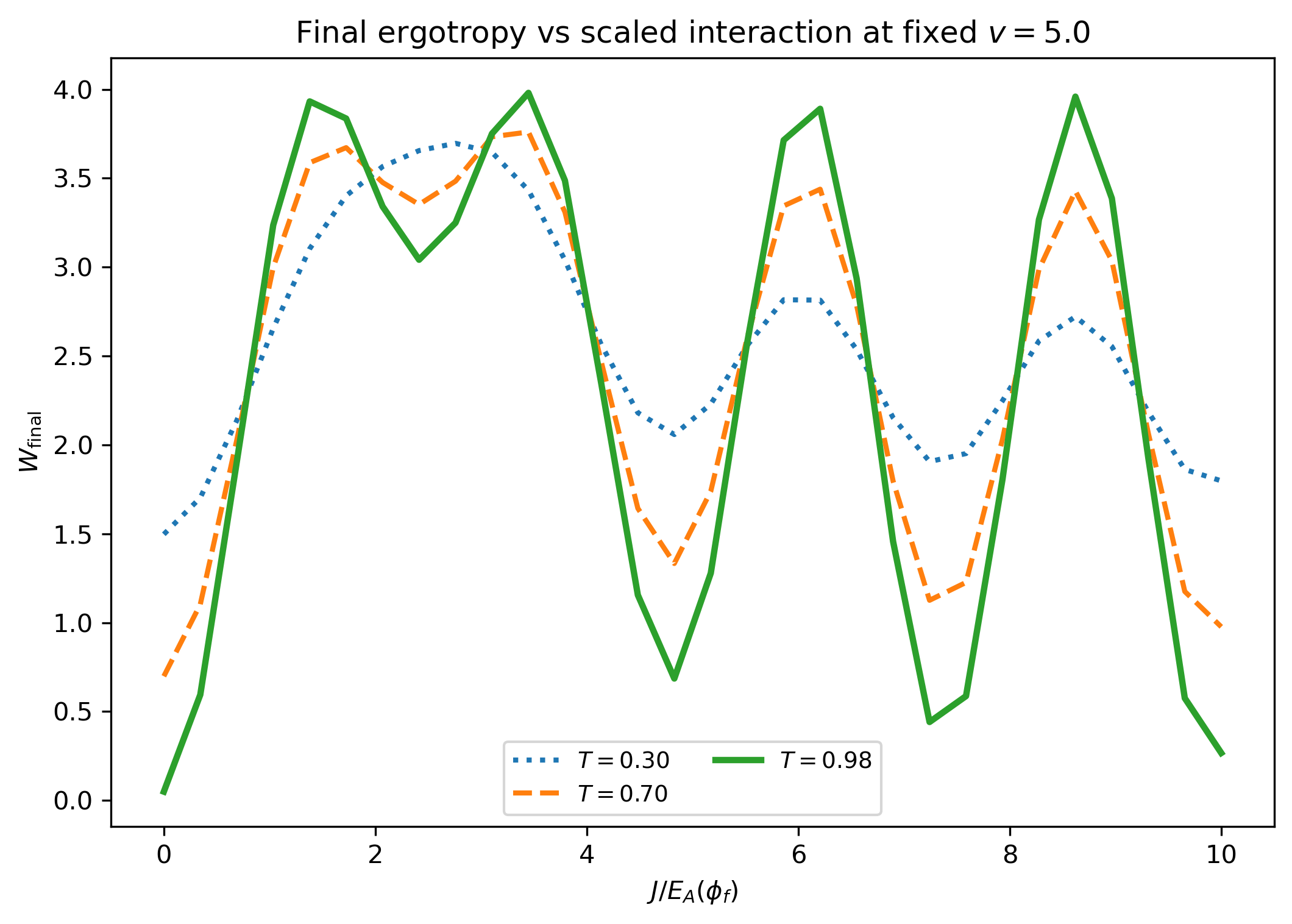
Figure 1: Final ergotropy Wfinal as a function of normalized interaction strength, for different transparencies, highlights constructive enhancement and the onset of pronounced coherent oscillations for high-transparency graphene-like devices.
This non-monotonic dependency of ergotropy on J is especially pronounced in the ballistic regime (ϕ0), demonstrating that the interplay between step-like ABS spectra and inter-unit coupling fundamentally reshapes the quantum work landscape. The avoided-crossing at ϕ1 injects nonadiabatic excitations, while interaction mediates their hybridized redistribution into sectors of the combined Hilbert space that drastically lift passivity.
Phase-Resolved Charging Dynamics and Partial-Cycle Work Extraction
Extending beyond single-point (end-of-protocol) analysis, the ergotropy is mapped as a function of the superconducting phase across the Josephson cycle. For weak coupling, ergotropy increases predominantly post-crossing, saturating at the phase-cycle endpoint. Critical deviations emerge for strong interactions: the ergotropy profile develops multi-modal oscillations; local maxima arise well before the end of the phase cycle, indicating that optimal extractable work is reached—and can be harvested—by interrupting the drive at a specific phase.
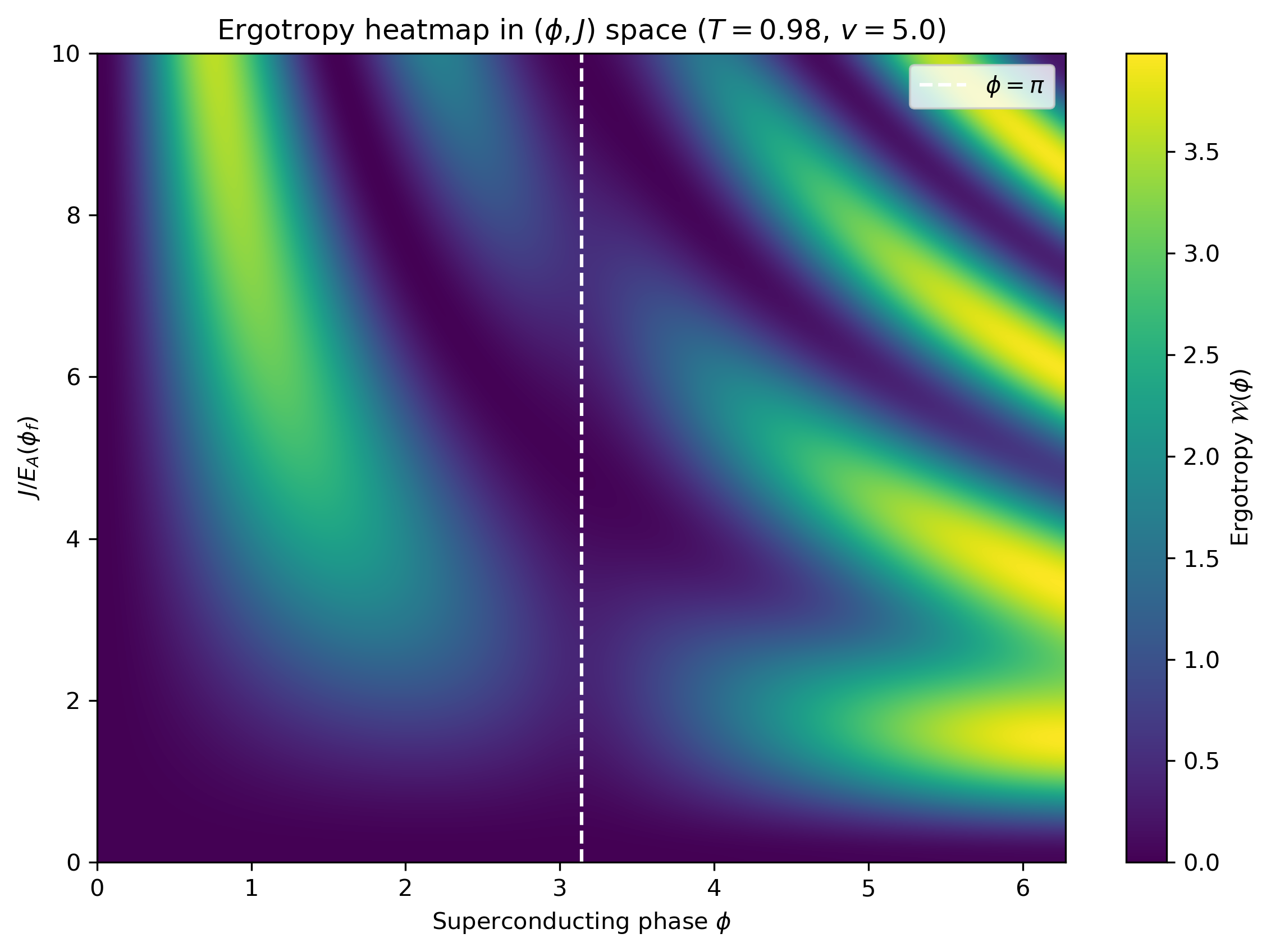
Figure 2: Phase-resolved ergotropy landscape ϕ2, showing excitation generation after the avoided crossing, interaction-enhanced redistribution, and the emergence of pronounced optimal windows for partial-cycle extraction.
Quantitative analysis reveals that the gap between optimal partial-cycle extractable ergotropy and conventional full-cycle values grows substantially at large ϕ3. The practical implication is that, for strongly interacting ABS batteries, full Josephson phase sweeps are suboptimal: coherent backflow during the latter part of the cycle can actually reduce the usable stored work, while interrupted protocols maximize power and operational flexibility.
Global Landscape and Microscopic Mechanism
The two-parameter ergotropy landscape ϕ4 demonstrates intricate phase- and interaction-dependent high-ergotropy ridges, diagonally structured due to the interplay between Landau-Zener transition probabilities (set by the minimum ABS gap and ramp velocity) and oscillatory hybridization dynamics. The positioning of maxima shifts with ϕ5, yielding dynamically reconfigurable charging windows, programmable by adjusting the superconducting phase (external bias) and the interaction (circuit engineering).
These observations collectively pinpoint interaction-assisted avoided-crossing excitation and coherent hybridization as the key microscopic charging mechanisms, enabling energy storage and extraction in regimes forbidden to non-interacting ABS batteries or those driven only by conventional fields.
Implications and Outlook
The findings establish that coherent quantum interactions—both intrinsic (via ABS wavefunction overlap) and engineered (via superconducting circuits or couplers)—are not only secondary perturbations, but can be harnessed as central resources for energy storage and optimization in next-generation quantum batteries. High-transparency SNS devices, particularly with graphene weak links, are highlighted as experimentally accessible platforms where such physics is maximally manifest. The demonstrated phase-resolved programmability offers new handles for extracting work in synchrony with qubit or circuit operation, and the explicit linkage to ABS physics opens routes to compatibility with superconducting quantum information architectures.
Future research may generalize the model to extended ABS arrays, probe open-system effects (dissipation, dephasing, environmental coherence), and explore the integration of phase-driven quantum batteries as on-demand power sources or coherence reservoirs for quantum processors. The demonstrated architectures provide clear benchmarking targets for engineered many-body enhancement of quantum thermodynamic tasks.
Conclusion
This work delivers a comprehensive analysis of phase-driven, interaction-assisted ergotropy generation and extraction in coupled ABS quantum batteries, mapping the detailed dependency on junction transparency, interaction, and phase drive. In the high-transparency regime, strong interactions catalyze large, phase-localized enhancements in extractable work, enabling partial-cycle programmable operation and revealing a coherent quantum charging mechanism. These results provide both theoretical foundations and experimentally testable predictions for the design and optimization of hybrid quantum batteries in superconducting platforms (2606.24456).