Ergotropy Protection via Cavity Detuning in Collective Open Quantum Batteries
Published 5 May 2026 in quant-ph | (2605.04042v1)
Abstract: This study investigates the performance and ergotropy protection of open collective quantum batteries subject to superradiant decay. By employing a passive spectral detuning strategy within an intermediate cavity, an optimal detuning value ($Δ*$) is analytically derived and numerically verified to spectrally isolate the system and protect quantum coherence, achieving up to 1088% ergotropy improvement for single qubits and superextensive collective advantage for $N \ge 3$. Our analysis resolves a "non-Markovian paradox," revealing that maximizing ergotropy does not strictly require non-Markovian memory; rather, suppressing environmental memory via detuning optimally preserves coherence, which serves as the fundamental resource. Survival maps across different environments demonstrate that thermal noise dissipates coherence more severely than telegraph noise. Finally, we establish that collective amplification of the effective coupling ($g_{\rm eff} = g\sqrt{N})$ inevitably drives large qubit arrays into the ultra-strong coupling regime, providing a quantitative ceiling $N_{\rm max}$ on the validity of the Tavis-Cummings description and the current ergotropy protection protocol.
The paper proposes a passive spectral detuning protocol to retain ergotropy in collective quantum batteries by filtering system–environment interactions.
It derives an optimal detuning scaling law, Δ*(N)=g√(N/2γ₀), confirming up to 1088% ergotropy improvement under both RTN and thermal noise.
The study challenges the need for non-Markovian effects by demonstrating that maximum ergotropy protection is reached even with reduced trace distance backflow.
Ergotropy Protection via Cavity Detuning in Collective Open Quantum Batteries
Introduction and Motivation
The manuscript "Ergotropy Protection via Cavity Detuning in Collective Open Quantum Batteries" (2605.04042) rigorously investigates the preservation of ergotropy in collective quantum batteries (QBs) subjected to superradiant decay and environmental noise. The central challenge addressed is suppressing irreversible ergotropy loss due to decoherence, especially in regimes with collective enhancement of emission rates. The study proposes and analytically justifies a passive spectral detuning protocol between the collective QB array and an intermediate cavity, thus enabling robust protection of quantum coherence. The implications are twofold: the protocol achieves dramatic ergotropy retention and re-examines the necessity of non-Markovian effects for peak QB performance.
The quantum battery model consists of an array of N identical two-level systems (qubits) with frequency ωb collectively interacting with a single cavity mode (ωc), itself coupled to a structured environment. The key system Hamiltonian extends the standard Tavis-Cummings form to include detuning, open dynamics, and environment interactions. The Hamiltonian preserves the collective symmetry structure, allowing efficient representation of the dynamics in terms of Dicke states.
The pivotal control parameter is the detuning Δ=ωc−ωb, which is shown to spectrally filter system–environment interactions. Analytical treatment using projection operator techniques (Nakajima-Zwanzig formalism) and time-convolutionless (TCL2) expansion yields an effective master equation with a collective, detuning-dependent dissipator. The key collective decay scaling γ→Nγ is balanced against a detuning-induced suppression, leading to the identification of an optimal detuning Δ∗(N).
Analytical Strategy and Scaling Laws
Maximizing residual ergotropy requires competition between the collective dispersive shift χ=g2N/Δ and dissipative loss 2γ0Δ. This balance determines the optimal filter detuning as
Δ∗(N)=gN/2γ0
where g is the cavity–battery coupling and ωb0 the base decay rate. This scaling law is verified analytically and numerically for system sizes up to ωb1. The framework also quantifies ergotropy via the passive state approach and tracks information backflow using the Breuer–Laine–Piilo (BLP) non-Markovianity measure.
Ergotropy Dynamics and Detuning-Based Protection
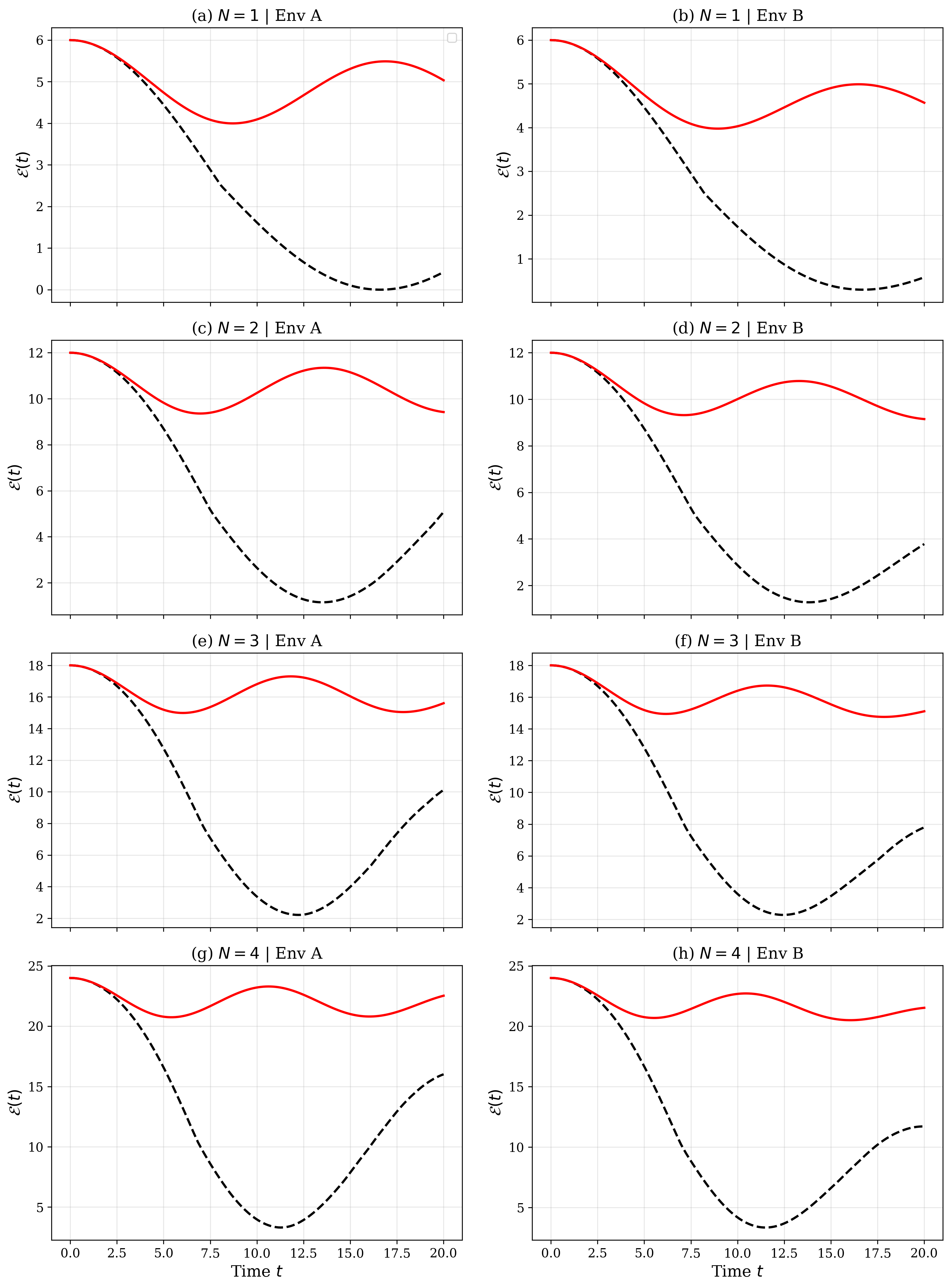
Passive detuning enables quasi-spectral isolation, dramatically suppressing superradiant decay. Comparison between unfiltered and spectrally optimized scenarios reveals up to ωb2 ergotropy improvement for single qubits, with substantial non-extensive gains for larger arrays.
Figure 1: Joint time evolution of residual ergotropy and trace distance (BLP measure) for increasing ωb3, under both RTN and thermal environments, with/without optimal detuning.
Notably, the improvement ratio decreases with ωb4 due to the rapid growth of collective decay rates outpacing filter bandwidth, yet the residual ergotropy remains superextensive. Importantly, suppression of ergotropy loss via passive detuning does not require strong non-Markovian memory effects; indeed, maximal protection occurs concomitantly with a reduction in BLP non-Markovianity—a clear contradiction to prior assumptions about the necessity of environment-induced memory for optimal QB operation.
Survival Maps and Parameter Landscape
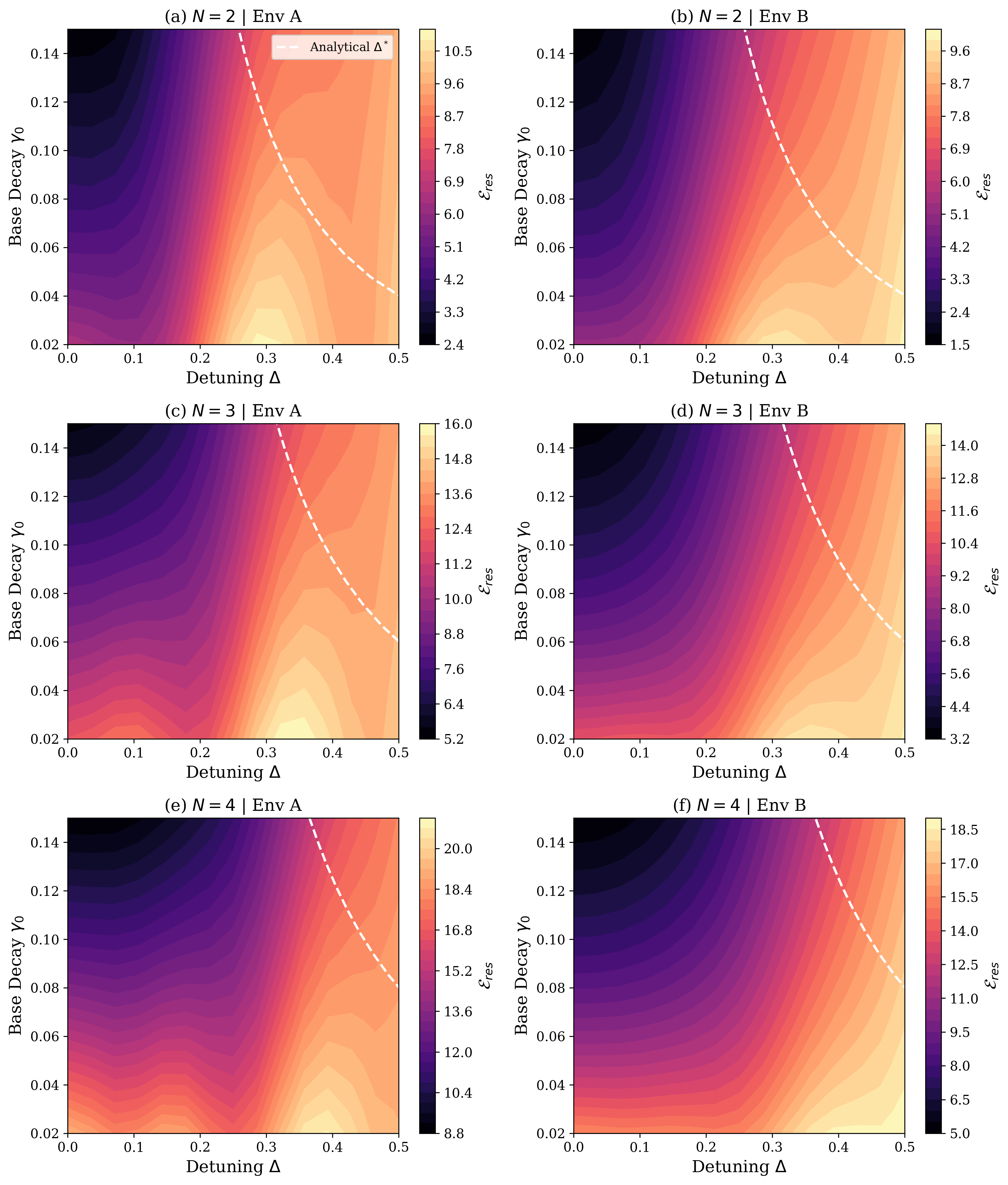
Ergotropy survival maps are constructed as a function of detuning and decay rate, elucidating the sharp optimality and sensitivity of the protocol.
Figure 2: Ergotropy survival maps in ωb5 space for increasing ωb6, contrasting RTN and thermal environments. The analytical detuning optimum ωb7 tracks the region of maximal ergotropy.
As ωb8 increases, the region of effective ergotropy protection narrows, reflecting the limitation of filter bandwidth relative to collective decay scaling. The optimal detuning must be more precisely tuned for larger systems, highlighting a practical constraint on scaling up QB arrays under this protocol.
The Non-Markovian Paradox
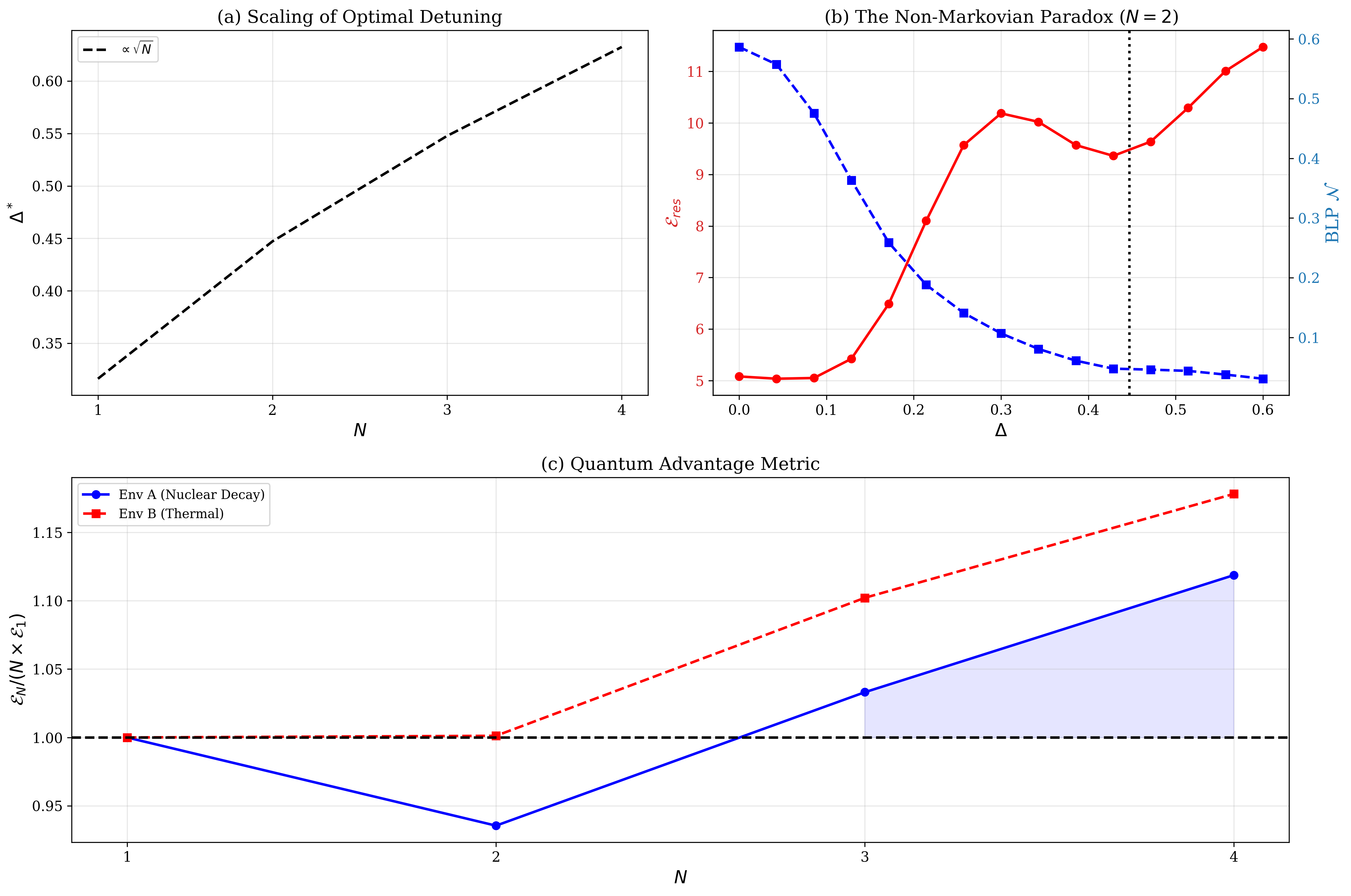
A central contribution is the elucidation of the "non-Markovian paradox": while non-Markovian dynamics (as measured by BLP trace distance backflow) have been widely regarded as essential for energy recovery and coherence protection, passive detuning demonstrates the reverse—the strongest ergotropy protection is achieved when the signature of non-Markovianity is minimized. This result is robust across both random telegraph noise (RTN) and thermal noise environments.
Figure 3: (a) Scaling of optimal detuning with ωb9 (analytical vs. numerical, with fitted exponents ωc0); (b) Anti-correlation of filtered ergotropy and BLP measure as a function of detuning; (c) Collective quantum advantage ωc1 versus ωc2 showing superextensive gains.
This empirical anti-correlation challenges the established focus on engineering system–environment memory effects for QB design and instead centers quantum coherence preservation as the dominant resource.
Environmental Dependence and Quantum Advantage
Comparison between RTN and thermal reservoirs shows that thermal noise is a much more severe dissipator of coherence than classical telegraph noise, reducing ergotropy survival areas and decreasing the effective power-law scaling exponent for optimal detuning (ωc3). The protocol preserves a collective quantum advantage (ωc4) for ωc5 in both environments, indicating that collective interactions, when spectrally isolated, surpass independent operation even under realistic open system conditions.
Limitations Imposed by the Rotating Wave Approximation
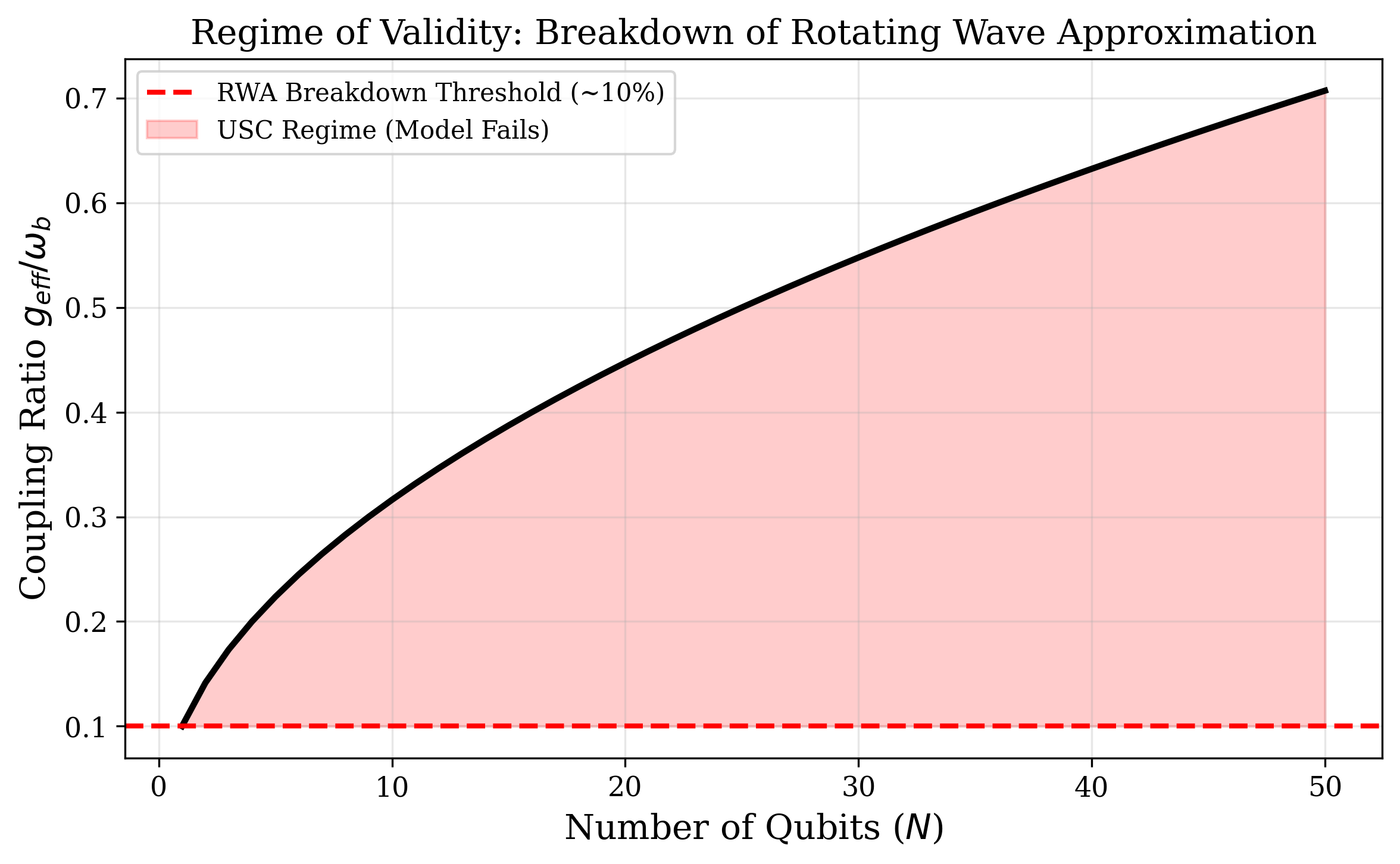
The protocol's scalability is fundamentally constrained by the onset of the ultra-strong coupling (USC) regime. The Tavis-Cummings description breaks down when ωc6 exceeds a threshold (typically 0.1), at which point energy non-conserving terms must be incorporated (i.e., transition to a full Dicke Hamiltonian regime).
Figure 4: Effective coupling ratio ωc7 vs ωc8, demarcating the boundary beyond which the rotating wave approximation (RWA) fails and ultra-strong coupling effects dominate.
This finding yields a quantitative upper bound on feasible QB size for this detuning-based ergotropy protection protocol.
Implications and Future Directions
This work makes several substantial contributions:
It establishes a robust, passive, and energetically efficient mechanism for ergotropy protection scalable to small/medium-sized QB arrays.
It revises the prevailing understanding of the relationship between non-Markovianity and energetic performance in open QBs.
It identifies collective quantum advantage thresholds and environmental constraints for near-term QB realizations.
It provides an explicit ceiling for parameter regimes where this approach remains valid.
Practically, these results will inform design and control strategies for quantum batteries and other collective open quantum devices. Theoretically, they motivate deeper examination of coherence as a central quantum thermodynamic resource, decoupled from entanglement and environmental memory. A clear next step is the extension of analytical and numerical models to higher TCL order, inclusion of strong coupling and USC effects, and eventual experimental translation in cavity or circuit QED platforms.
Conclusion
Passive cavity detuning enables substantial and scalable ergotropy retention in collective quantum batteries, challenging assumptions about the necessity of non-Markovianity and entanglement in work extraction. The observed non-Markovian paradox and quantification of practical scaling and breakdown regimes collectively demarcate both the strengths and limits of this approach for quantum energy storage technologies.
“Emergent Mind helps me see which AI papers have caught fire online.”
Philip
Creator, AI Explained on YouTube
Sign up for free to explore the frontiers of research
Discover trending papers, chat with arXiv, and track the latest research shaping the future of science and technology.Discover trending papers, chat with arXiv, and more.