- The paper introduces ChunkGroupSHAP, a method that uses semantic chunk grouping to generate more faithful explanations for embedding-based rankers.
- It employs a listwise Shapley-value approach with KernelSHAP sampling and an NDCG-based utility, outperforming traditional word-level methods.
- Experimental results on multiple datasets show that adaptive chunk grouping improves user interpretability and model transparency in dense retrieval systems.
Listwise Explanation of Embedding-Based Rankings via Semantic Chunk Grouping
Problem Motivation and Background
Interpretability in information retrieval (IR), particularly for neural dense embedding rankers, is fundamentally challenged by the mismatch between model representations and conventional feature-units used for explanations. Lexical models such as BM25 are often explained through word-level attributions, which aligns well with their scoring mechanics. In contrast, dense retrievers operate over contextualized sentence- or passage-level embeddings, making word-attribution both technically misaligned and practically fragmentary for faithful explanations. Listwise ranking explainers, notably RankSHAP and RankingSHAP, retain this lexical bias, operating over isolated words while dense rankers aggregate semantically fused signals. This critical disconnect impedes both model auditing and user-facing transparency.
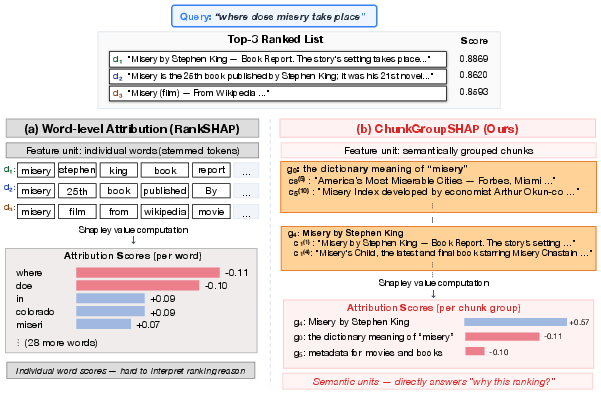
Figure 1: Word-level (RankSHAP) vs. ChunkGroupSHAP explanation for embedding-based ranking.
The ChunkGroupSHAP Approach
Semantic Chunk Grouping Pipeline
ChunkGroupSHAP is introduced as a listwise Shapley-value-based feature attribution technique that resolves the feature-unit mismatch for dense retrievers. The approach involves three key components:
- Semantic Chunking: Each document is tokenized into overlapping text windows (chunks) using a fixed window size and stride.
- Embedding and Clustering: Chunks are embedded (using, e.g., E5-small) and then clustered into k semantic groups via k-means, either at the corpus-level or within the query's candidate set.
- Listwise Perturbation for Attribution: A group mask is then applied across all documents in the ranked list, so that perturbing a group perturbs all associated evidence in all candidate documents. The marginal impact of each semantic group is estimated listwise via KernelSHAP sampling and an NDCG-based utility function.
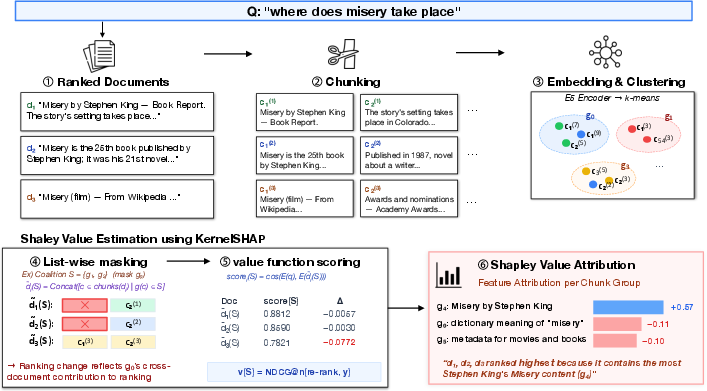
Figure 2: Overview of the ChunkGroupSHAP pipeline for a query; chunking, embedding, clustering, and listwise Shapley computation are illustrated.
This construction yields explanation units that are closer in granularity to the dense ranker’s true evidence aggregation process, supporting attribution analysis that can meaningfully be interpreted as supporting the observed list ordering.
Experimental Design
Datasets and Rankers
Evaluations span MS MARCO, FinanceBench, AILACaseDocs, and FinQA, contrasting both BM25 and various E5-family dense rankers. For explainers, comparisons involve RankSHAP (word-level, NDCG), RankingSHAP (word-level, Kendall's τ), and ChunkGroupSHAP under varying chunk/group scopes. Quantitative evaluation employs the Fidelityb metric (Kendall's τb) measuring agreement between the observed ranking and one reconstructed from the explanation features most highly attributed by SHAP.
Main Results and Observations
- Setting-Dependent Optimal Feature Unit: For lexical BM25, word features yield highest explanation fidelity, whereas ChunkGroupSHAP chunk groups significantly improve fidelity for dense rankers, especially on structured domain-specific corpora (e.g., FinanceBench, AILACaseDocs, FinQA).
- Impact of Grouping Granularity: Both the number of semantic groups and the chunk size critically affect fidelity; larger k generally increases attribution quality up to a saturation point, and optimal chunk/window size is corpus and model-dependent.
- Scope Selection: Corpus-level groupings give strong results on smaller, homogeneous corpora, while query-local groupings are necessary in highly heterogeneous retrieval settings like MS MARCO.
- Human Evaluation: In reranking studies, chunk-group explanations yield higher user fidelity in reconstructing model rankings compared to word-level explanations or randomly clustered chunk groups.
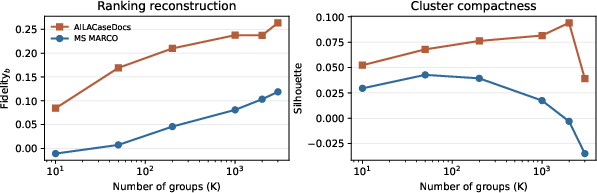
Figure 3: Effect of the number of semantic groups k for E5-small ChunkGroupSHAP. Fidelityb and cluster compactness (silhouette) are presented.
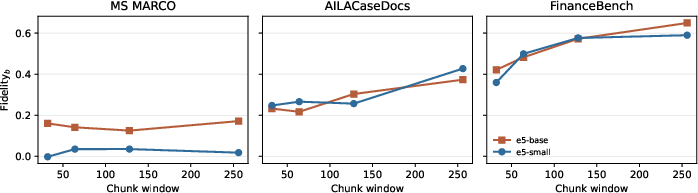
Figure 4: Fidelityb as a function of chunk window size, supporting the analysis of optimal contextual granularity.
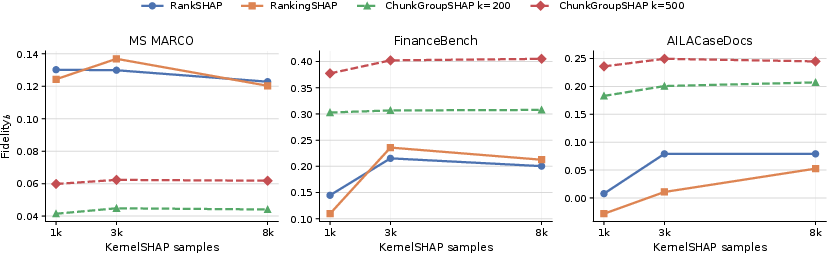
Figure 5: Influence of KernelSHAP sampling budget and granularity on Faithfulness for various explainers.

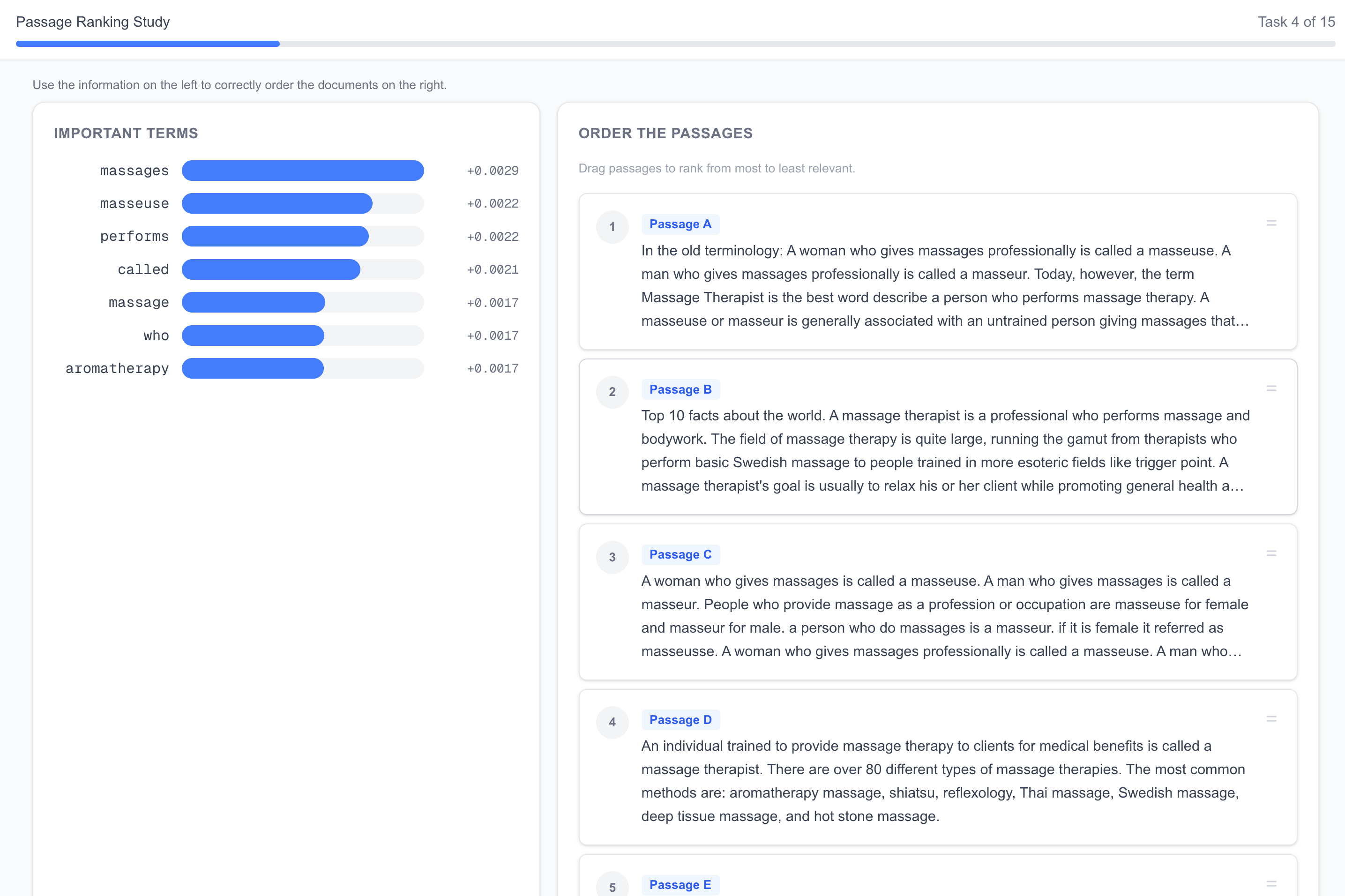
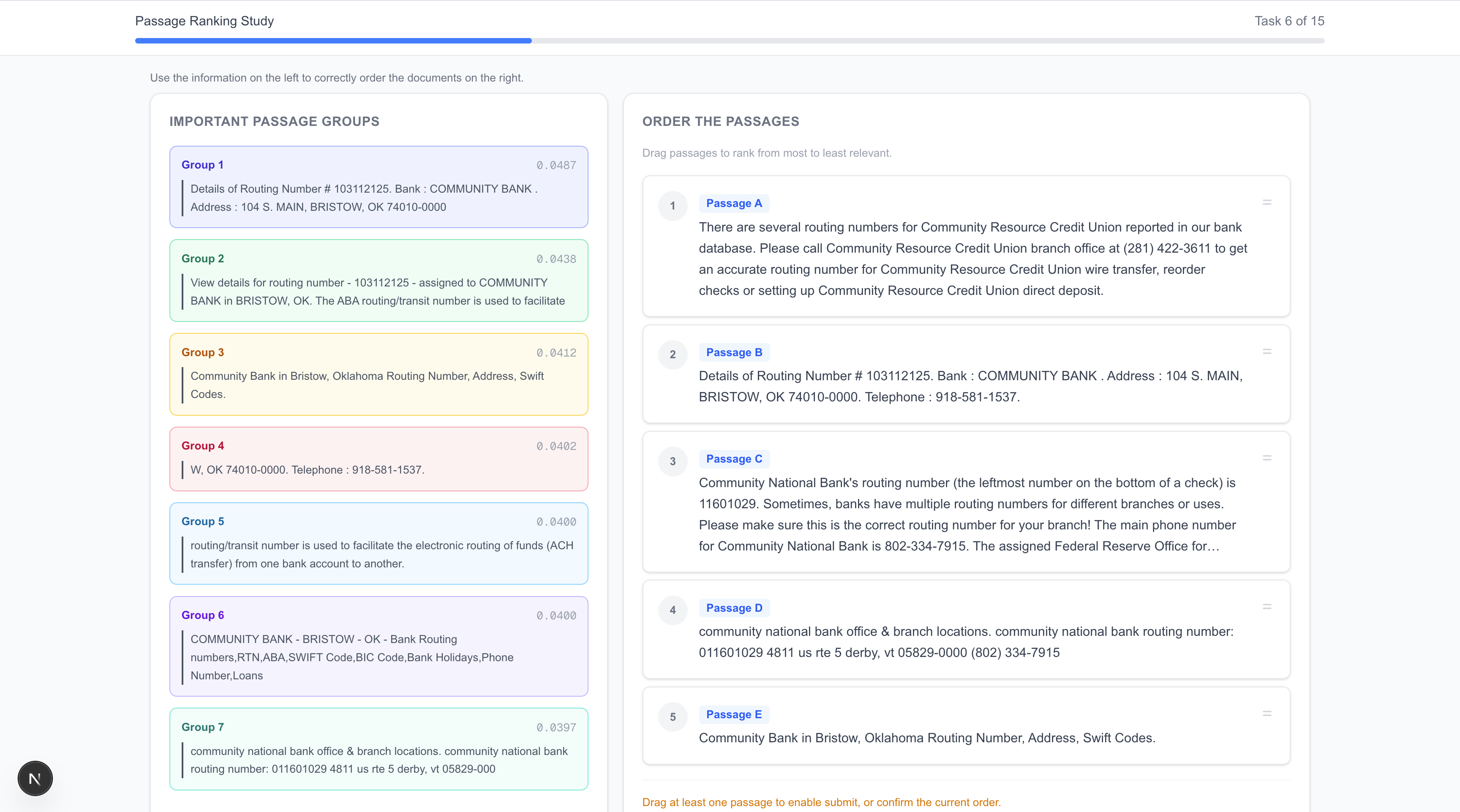
Figure 6: Human evaluation interface; comparison of reranking study UI between chunk-group and word-based explanations.
Theoretical and Practical Implications
ChunkGroupSHAP concretely demonstrates that the choice of feature-unit in explanation is tightly bound to the representational topology of the underlying ranker and the statistical-structural pattern of the corpus. Semantic chunk grouping enables coherent, reusable, and interpretable units of explantion while maintaining the technical requirement of cross-document perturbation required for listwise explanation—surmounting the severe fragmentation of word-level approaches for dense semantic models.
Pragmatically, this expands the toolkit for IR system developers, auditors, and end-users by yielding explanations that are more inspectable and actionable in real-world semantic retrieval and RAG pipelines, while remaining technically rigorous with respect to the faithfulness constraint. The human evaluation results underscore the user-facing consequences of explanation granularity, particularly in mixed or open-domain settings.
Future Directions
There are several clear avenues for further development:
- Automatic Granularity Selection: The optimal grouping granularity and scope are empirically shown to be setting-dependent. Deriving adaptive, corpus-sensitive and ranker-aware grouping strategies, either via meta-learning or auxiliary signals (e.g., retrieval entropy, corpus clustering structure), would generalize this framework.
- End-to-End Pipeline Attribution: Current attributions cover only fixed candidate lists; extending to the effects on initial first-stage retrieval choices and pipeline composition remains an open challenge.
- Efficient Estimation: KernelSHAP sampling costs scale with the number of groups; more efficient, possibly model-specific estimators, could improve feasibility for web-scale or real-time interpretability purposes.
- Semantic Sanity: High numerical attribution fidelity can be achieved by non-semantic groupings (random group partitions), indicating the need for hybrid metrics that combine ranking faithfulness with human-meaningful interpretability.
Conclusion
ChunkGroupSHAP transitions listwise explanation of embedding-based ranking models from a lexical, word-centric paradigm to one that semantically matches the evidence aggregation of dense retrieval models. The methodology robustly enhances faithfulness of explanations for neural rankers on structured corpora, but also precisely delineates the cases where lexical word features, chunk-level representations, or query-local adaptation are needed. The feature-unit must fit the representational structure of both the ranker and data—explanation design cannot be decoupled from retrieval modeling assumptions. This work provides both a technical foundation and empirical basis for the systematic study and deployment of interpretable, faithful, and practical explanations in dense semantic retrieval.

