Grounded Iterative Language Planning: How Parameterized World Models Reduce Hallucination Propagation in LLM Agents
Published 26 Jun 2026 in cs.AI | (2606.27806v1)
Abstract: World models for language agents come in two useful forms. An agent-based world model calls an LLM API and reasons flexibly in language, but its errors appear as hallucinated state changes that are hard to score with ordinary regression losses. A parameterized world model is a trained transition predictor; its errors are easier to measure with quantities such as NodeMSE, delta accuracy, and validity accuracy, but it is usually weaker as a standalone planner. We compare these two families on four graph-structured planning benchmarks and introduce operational hallucination metrics for the agent-based case. The comparison motivates \textbf{Grounded Iterative Language Planning} (GILP), which trains only a small parameterized backbone and combines it with API-based agent reasoning. The backbone supplies valid actions, predicted state deltas, risk, and value; the LLM drafts an action and imagined delta; and a consistency gate asks for revision when the two disagree. On real GPT-4o-mini calls, GILP reduces hallucinated-state rate from 0.176 to 0.035. In calibrated simulator ablations, it raises success from 0.668 to 0.838 while adding only ~22% extra LLM calls.
The paper introduces GILP, a novel hybrid framework that uses a small parameterized world model to ground LLM agent predictions and substantially reduce hallucination propagation.
It details a four-phase planning loop—including skeleton scoring, draft generation, a consistency gate, and a risk gate—to correct semantic errors during sequential decision-making.
Rigorous experiments show up to 80% reduction in hallucination rates and significant improvements in planning success across diverse benchmarks and LLM backends.
Grounded Iterative Language Planning: Integrating Parameterized World Models to Reduce Hallucination Propagation in LLM Agents
Background and Motivation
LLMs are widely used for agent-based planning, leveraging their capability to sequentially imagine and act in complex environments. In chain-of-thought and ReAct paradigms, agents reason flexibly and generate structured next-state predictions, but this process is fundamentally prone to semantic hallucinations—incorrect state representations that recursively propagate through the planning trajectory and degrade long-horizon performance. The paper "Grounded Iterative Language Planning: How Parameterized World Models Reduce Hallucination Propagation in LLM Agents" (2606.27806) presents a rigorous treatment of this issue, contrasting agent-based and parameterized world models, introducing novel operational hallucination metrics, and proposing a hybrid architecture (GILP) for error correction.
Agent-Based World Model: LLM-driven planning where state transitions, actions, and rationale are generated in text/JSON form. Errors manifest as semantic hallucinations that are difficult to quantify.
Parameterized World Model: A trained transition predictor (e.g., GNN, MLP, GPS) provides explicit predictions of action validity, state deltas, risk, and value. Errors are measurable via supervised losses (NodeMSE, validity accuracy, delta accuracy), but standalone planning is weaker.
The paper identifies complementary failure modes: agent-based models reason well but their errors propagate over long horizons, while parameterized models are locally accurate but semantically brittle. To capitalize on both strengths, GILP trains only a small parameterized backbone and uses it to ground and correct LLM agent rollouts.
GILP Architecture and Planning Pipeline
GILP employs a four-phase planning loop:
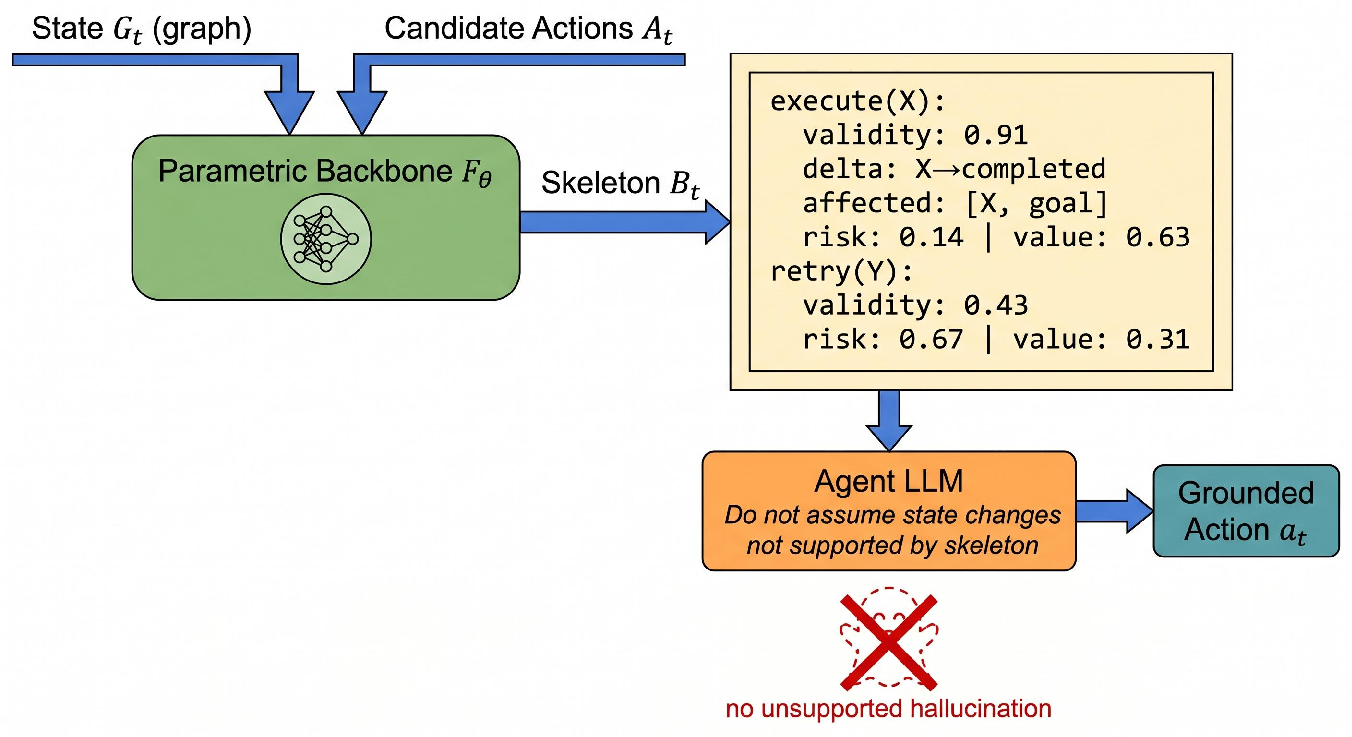
Skeleton Scoring: The backbone predicts action validity, state delta, risk, and value for candidate actions, compressing the set to manageable skeletons.
LLM Draft: The LLM agent receives the current state, goal, skeleton, and candidates, then returns selected action and imagined delta.
Consistency Gate: A Jaccard similarity is computed between the agent's imagined delta and the backbone's prediction; low consistency triggers a corrective re-prompt that explicitly names disagreeing atoms.
Risk Gate: High predicted risk by the backbone triggers escalation to lower-risk alternatives.
This architecture provides a targeted mechanism to intercept and revise hallucinated transitions during planning, rather than relying on broad post-hoc verification.
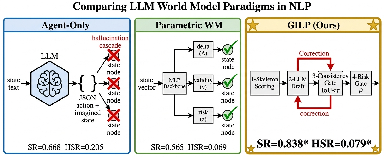
Figure 1: Three planning paradigms—agent-based, parameterized, and GILP—highlight divergence and integration points for semantic grounding and correction.
Figure 2: Illustration of the parametric skeleton insertion format, showing explicit predictions for validity, state delta, affected entities, risk, and value.
Error Metrics and Guarantees
The paper formalizes hallucination as disagreement between the agent's imagined delta and the oracle transition, measured by:
Hallucinated-State Rate (HSR): Fraction of node-status atoms disagreeing with ground-truth.
Propagation Depth (PD): Steps conditioned on a hallucinated atom before recovery.
Error-Explosion Slope (EES): Rate at which error magnitude compounds over steps.
A formal guarantee shows GILP contracts the expected error rate under non-adversarial correction, reducing total error by at least (1−γ) relative to baseline agent plans.
Experimental Analysis
Rigorous experiments are conducted on four graph-structured planning benchmarks (TaskGraph, ToolChain, ResourceAlloc, RepairFlow), using calibrated simulators validated against real GPT-4o-miniAPI runs. Eleven planners are compared, including agent-based, parameterized-only, hybrid variants, and GILP.
Key results:
GILP raises success rate from 0.668 to 0.838, cuts HSR from 0.205 to 0.079, shortens propagation depth from 2.45 to 1.51, and maintains a negligible token overhead (∼22 extra LLM calls).
On real GPT-4o-mini API runs, GILP reduces HSR from 0.176 to 0.035, an 80% reduction, with strong non-overlapping CIs across benchmarks.
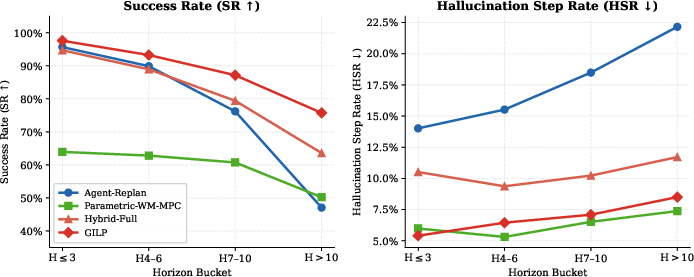
Figure 3: Horizon scaling: agent-based planning collapses beyond ten steps, while GILP maintains stable success and state faithfulness.
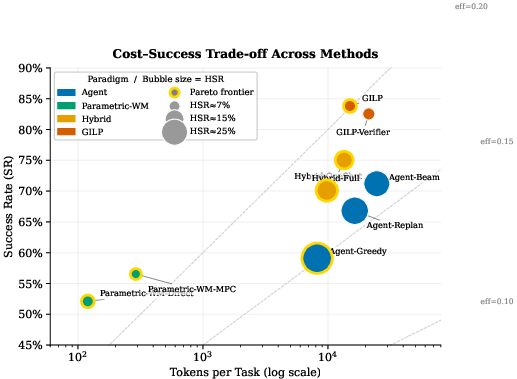
Figure 4: Pareto frontier—GILP attains maximal semantic success at modest token cost, outperforming both purely agent-based and parameterized planners.
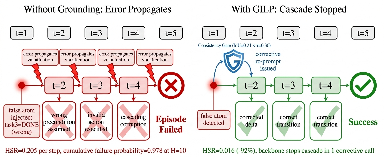
Figure 5: Correction of compounding hallucinations after a false completion—GILP's consistency gate intercepts erroneous state propagation.
Ablation, Backbone Evaluation, and API Robustness
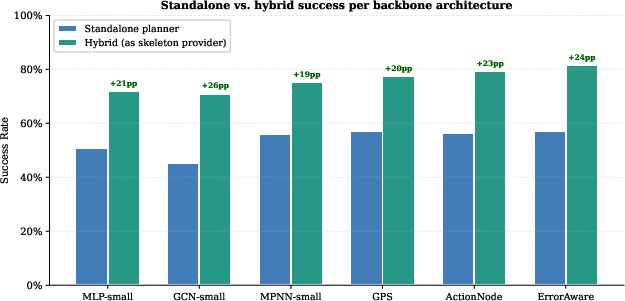
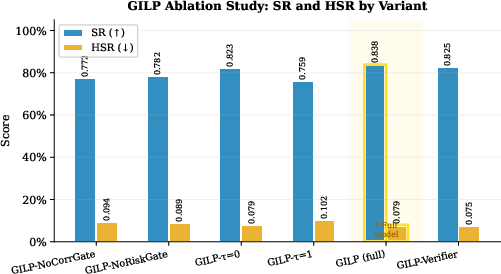
Ablation experiments dissect contributions from backbone signals (validity, delta, risk, value); the explicit correction (consistency gate) is essential for reduction in HSR, while the backbone itself need not be a strong planner to provide valuable grounding.
Figure 6: Standalone vs. hybrid backbone success—weak planners suffice as skeleton providers for error contraction.
Figure 7: GILP ablation: impact of the correction and risk gates, and optimal threshold selection for targeted re-prompting.
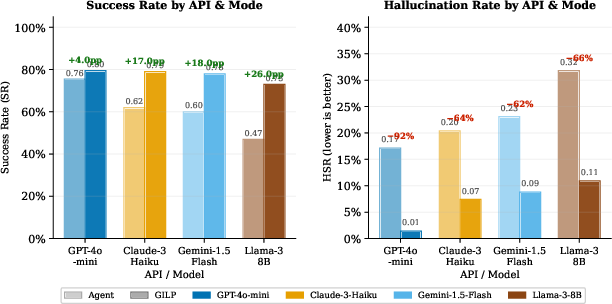
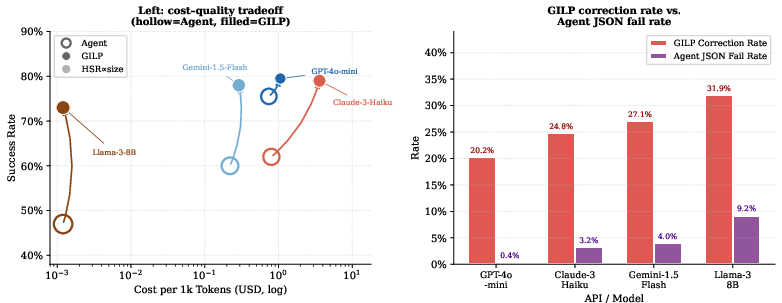
Multi-API comparisons demonstrate that GILP's grounding mechanism equalizes agent performance across GPT-4o-mini, Claude-3-Haiku, Gemini-1.5-Flash, and Llama-3-8B (self-hosted), dramatically reducing hallucination rates regardless of backend.
Figure 8: Success and hallucination rate before/after GILP grounding for four LLM APIs.
Figure 9: Cost-quality improvement and correction rates across APIs; higher correction rate directly mirrors baseline hallucination propensity.
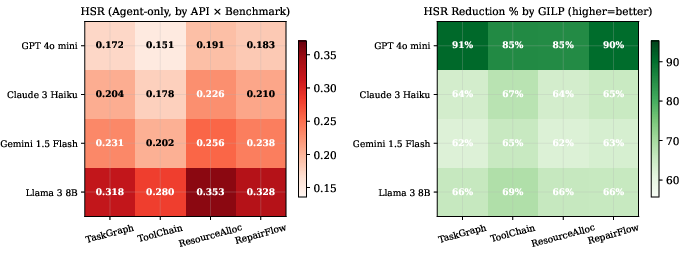
Figure 10: HSR reduction heatmaps—GILP achieves >85% reduction on every benchmark for GPT-4o-mini; 62–69% for other models.
Long-Horizon Error Bound and Knowledge Graph Transfer
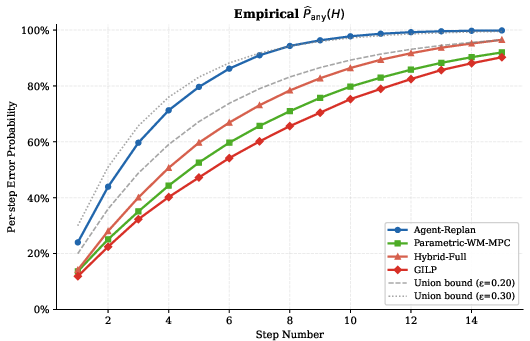
Empirical error-probability proxies confirm GILP contracts agent-side semantic error, particularly in long-horizon planning where compounding hallucinations are critical.
Figure 11: Empirical Pany(H) for semantic error—GILP maintains low error probability at increasing horizon.
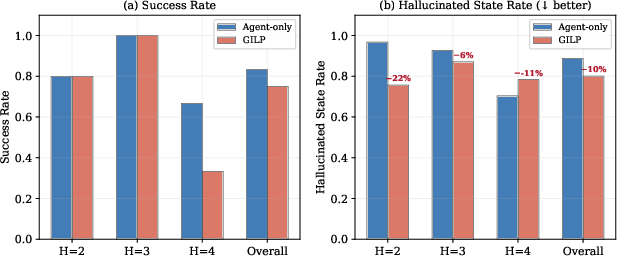
GILP's applicability to multi-hop knowledge graph traversal is validated, where it reliably detects and corrects hallucination of entity IDs; however, backbone calibration quality directly influences transfer performance.
Figure 12: Comparison of SR and HSR for agent-only vs. GILP in multi-hop KG traversal—agent reliably follows explicit paths but GILP corrects hallucinated result IDs.
Practical and Theoretical Implications
The division of labor between semantic reasoning (agent-based model) and explicit, auditable transition grounding (parameterized model) yields superior long-horizon performance and state faithfulness without extensive computational overhead. Simple MLP backbones, trained with a small number of oracle transitions, are sufficient to provide actionable error signals, facilitating scalable deployment.
The hybrid GILP approach sets a new operational standard for planning agents, with practical implications for high-throughput deployment, API cost minimization, and reliability across heterogeneous LLM backends. The theoretical formulation of hallucination propagation and its reduction opens further study in history-dependent error contraction, backbone calibration for open-form environments, and semantic verification in structured state representations.
Conclusion
The study systematically quantifies and addresses hallucination propagation in LLM-agent planning, demonstrating that a small parameterized world model combined with a targeted correction mechanism substantially improves success, lowers compounding state error, and enhances robustness across APIs. The GILP framework is a concrete instantiation of hybrid world modeling, balancing semantic flexibility and transition auditability for scalable, trustworthy agent deployment. Future directions include backbone adaptation in partially observable domains, richer state serialization formats, and advanced correction policies for adversarial backbone scenarios.
“Emergent Mind helps me see which AI papers have caught fire online.”
Philip
Creator, AI Explained on YouTube
Sign up for free to explore the frontiers of research
Discover trending papers, chat with arXiv, and track the latest research shaping the future of science and technology.Discover trending papers, chat with arXiv, and more.