- The paper introduces MCP-Cosmos, which integrates world model simulations to enable anticipatory planning and efficient task execution in MCP environments.
- It details a modular 'Bring Your Own World Model' framework that reduces redundant tool calls and optimizes planning via simulated lookahead.
- Experiments on MCP-Bench demonstrate improved task completion and execution quality, outperforming reactive agents in tool selection and efficiency.
MCP-Cosmos: World Model-Augmented Agents for Complex Task Execution in MCP Environments
Introduction
MCP-Cosmos establishes a new paradigm for agentic planning and execution in environments defined by the Model Context Protocol (MCP), unifying and elevating tool-augmented LLM agents via explicit world model (WM) integration. Existing agents, whether planning-centric or reactive, suffer from limited environment-awareness: planning agents often disregard execution dynamics, while reactive agents exhibit horizon myopia with inefficient or redundant tool use. MCP-Cosmos alleviates this bifurcation by enabling agents to perform speculative simulations using generative WMs before any real-world interaction, thus transforming tool-use reasoning from a reactive paradigm into one of predictive cognition.
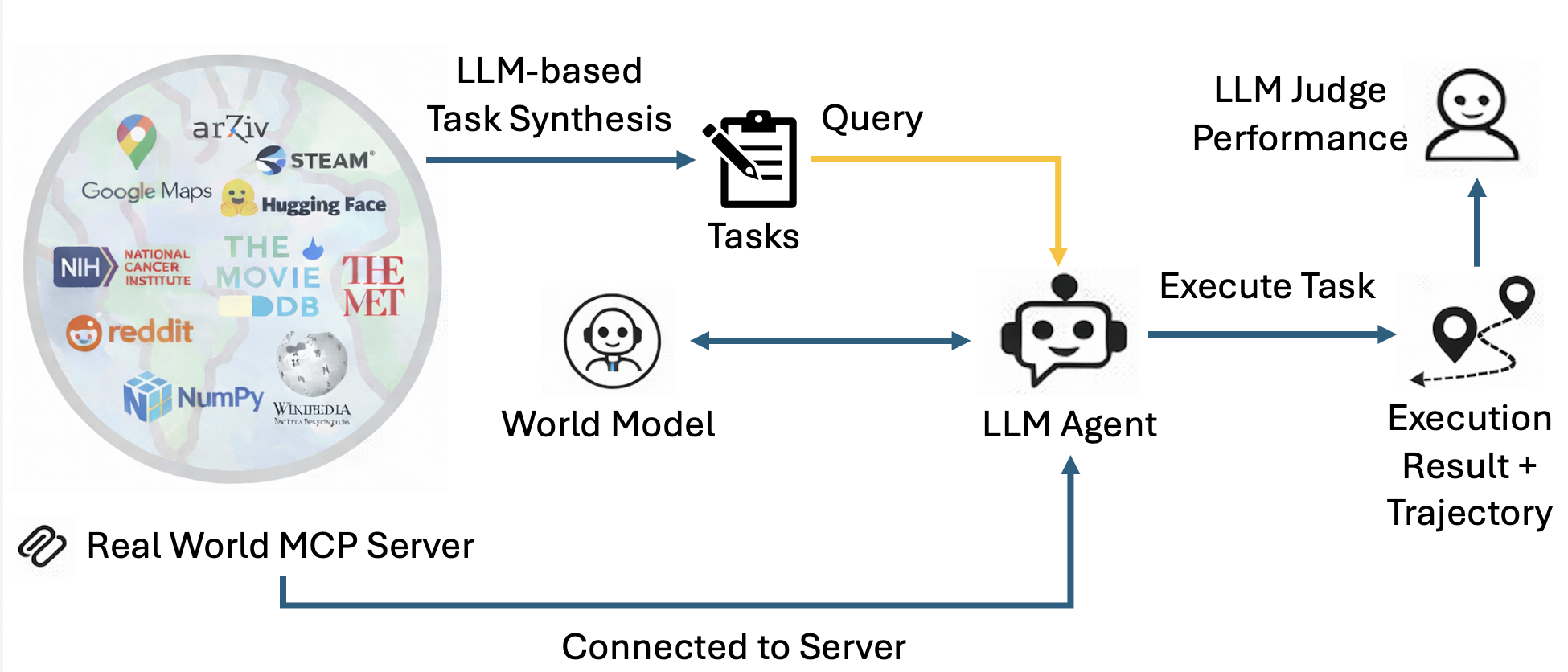
Figure 1: MCP-Cosmos architecture integrating world models to support predictive simulation for MCP-agent planning and execution.
The MCP-Cosmos framework supports modular "Bring Your Own World Model" (BYOWM) strategies, facilitating integration of diverse world models—including fine-tuned agent world models and generalist LLMs—into any MCP-compliant agent architecture. This augmentation enables agents to internalize and anticipate environment transition dynamics, simulating state trajectories in latent space, and refining plans off-policy prior to real tool execution.
MCP-Cosmos Framework and Architecture
The agent's operational flow within MCP-Cosmos decomposes into two principal phases: world model-simulated planning and real-world execution. During the simulation phase, the agent queries its WM to predict the effects of candidate tool calls, constructing a trajectory of action-observation pairs entirely within the model's latent environment. Only after plan validation does the agent proceed to real MCP tool invocation, executing the selected plan in the live environment and synthesizing a final answer contingent on real observations.
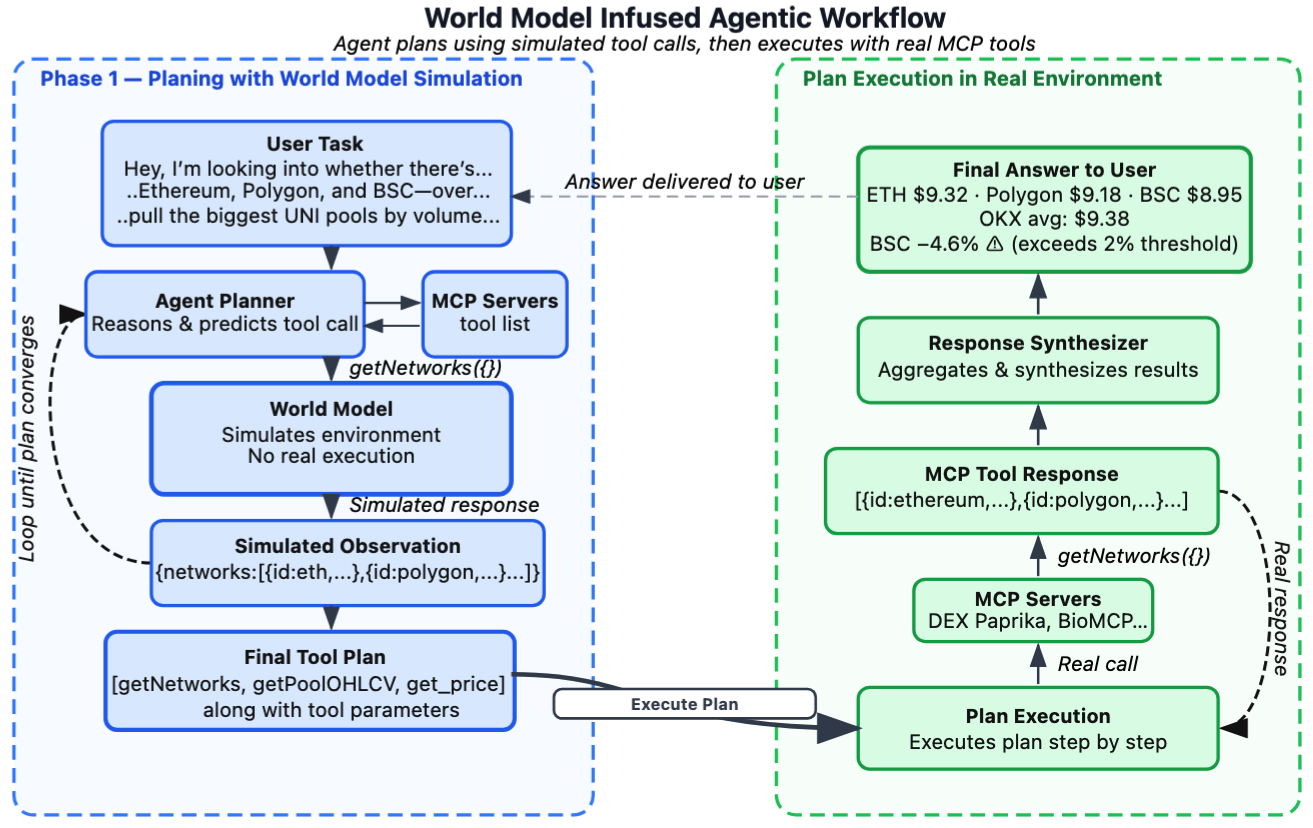
Figure 2: An agent workflow: simulation-based plan refinement, followed by execution and answer synthesis.
The abstract interfaces for both world models and agents are codified, supporting extensibility and compositional evaluation. The WM abstracts tool simulation via a high-level API, while agents use such simulations to proactively orchestrate tool calls, leveraging deterministic (e.g., MCTS) or non-deterministic (LLM policy) plan selection mechanisms.
Experimental Methodology
Evaluation Environments and Task Suite
MCP-Bench, the primary evaluation dataset, embodies ecosystem-scale MCP complexity: 28 live MCP servers and 257 tools span 24 challenging tasks targeting cross-domain, multi-step, and fuzzy-instruction scenarios. This selection emphasizes multi-server coordination, task-grounding difficulty, and configurational diversity.
Agent and World Model Configurations
Three agentic architectures are benchmarked:
- ReAct (Baseline): Reactive agent without WM simulation.
- ReAct-Plan-Exec: Enhanced variant with pro-active planning through WM simulation.
- SPIRAL-Exec: MCTS-driven agent utilizing LLM-based planning and WM-based simulation.
World model backbones include two LLMs (gpt-oss-120b and claude-sonnet-4.6) and the Arctic-AWM-4B model, the latter being a fine-tuned agent-environment predictive model. Seven unique agent-WM-planner configurations are systematically evaluated.
Metrics
Task outcome is assessed along three axes:
- Task Completion: Extent of requirement fulfillment and answer grounding.
- Tool Selection: Appropriateness and parameterization accuracy of invoked tools.
- Planning Effectiveness: Dependency awareness and parallelization efficiency.
A critical contribution is the novel Execution Quality metric—an aggregate of tool call success rate and normalized (inverted) tool call count—penalizing excessive, inefficient, or failed actions, thereby reflecting real-world resource constraints more accurately.
Results
World model-augmented agents outperform the ReAct baseline in overall efficiency and tool/parameter selection, notably with SPIRAL-Exec + gpt-oss-120b-WM reaching 44.8% aggregate performance versus ReAct's 36.1%. With Execution Quality included, the margin becomes even more pronounced (SPIRAL-Exec + gpt-oss-120b-WM: 56.5%, ReAct: 36.8%).
Key empirical findings:
- Tool and Parameter Selection: WM-augmented agents consistently demonstrate higher accuracy and efficiency, indicating that simulated lookahead planning reduces myopic retries.
- Task Completion vs. Efficiency: Baseline ReAct achieves highest strict task completion by brute-force trial and error, incurring high execution cost.
- Token Efficiency: World model simulation incurs higher token usage than pure reactive execution; cost is dominated by prompt (context) size, not model generation.
- Planner/WM Tradeoff: Ablation results reveal that upgrading the planner (e.g., to claude-sonnet-4.6) without a WM increases both accuracy and execution overhead—29.78 tool calls per task on average, 4× more than with a weaker planner.
- World Model Regularization: Even with a strong planner, explicit world model simulation acts as a regularizer, sharply reducing unnecessary tool calls and associated execution latency.
Analysis of Evaluation Metrics
The original MCP-Bench metrics primarily reward task fulfillment, not execution efficiency or resource conservation. The proposed Execution Quality metric corrects this by directly penalizing redundant or failed tool invocation, revealing that efficiency gains associated with world models are non-trivial and would be hidden by traditional evaluation.
For example, SPIRAL-Exec + Arctic-AWM-4B-WM achieves a perfect Execution Quality score due to minimal step count, despite middling task completion. Conversely, the most robust task-completers (ReAct, strong planners) often do so at unacceptable cost.
Theoretical and Practical Implications
The integration of WMs into real-world tool-using agents closes the loop between planning and execution, converging toward an agentic architecture that is both anticipatory and resource-aware. The modular MCP-Cosmos BYOWM approach aligns with scaling trends in foundation models, enabling evaluation and deployment of heterogeneous WMs in dynamic environments.
Practically, these results highlight the necessity of WM simulation for high-reliability, cost-sensitive, or latency-constrained deployment scenarios. Without WM constraint, scaling agent planners exacerbates inefficiency, compounding token usage and tool API exposure. Theoretically, the findings affirm that world model rollout regularizes policy exploration, curbing speculative breadth even in high-capacity planners.
Notably, the Arctic-AWM-4B-WM, despite being tailored to MCP environments, lags generalist LLMs in direct metrics; however, the MCP-Cosmos framework and evaluation may accelerate the co-evolution of domain-specific world models.
Limitations and Future Directions
Current WMs are static and lack capacity for online adaptation to evolving tool schemas. Computational overhead remains considerable, restricting deployment in resource-constrained environments. Metrics focus strictly on end-to-end outcomes, omitting intermediate reasoning interpretability. Future research directions include online WM adaptation, comprehensive cost-quality tradeoff evaluation, and simulation fidelity analysis for destructive or state-dependent tool use cases.
Conclusion
MCP-Cosmos demonstrates that explicit world model integration delivers tangible efficiency and robustness gains for agentic planning and execution within MCP environments. The framework's modular architecture and enhanced metrics provide rigorous foundation for developing and benchmarking both generalist and domain-specialized world models, paving the way for scalable, efficient tool-using LLM agents.

