- The paper presents a novel hybrid inference scheme that integrates shallow amortized initialization with targeted ISTA-style refinement to achieve high reconstruction quality with reduced latency.
- It rigorously compares ISTA, MFISTA, and LISTA-style methods, demonstrating that limited refinement steps significantly boost performance without the cost of deep amortization.
- The study highlights the robustness of the hybrid approach across varying model depths and sparsity regimes, making it promising for real-time applications and scalable vision models.
Accelerating Hierarchical Sparse Predictive Coding with Hybrid Amortized Inference
Overview and Motivation
Hierarchical sparse predictive coding is a biologically and computationally motivated framework that models perception as inference in hierarchically structured generative models with an explicit sparsity prior on latent representations. While such models (e.g., Sparse Deep Predictive Coding, SDPC) yield interpretable, parsimonious feature hierarchies with top-down and bottom-up interactions, their core practical limitation is the iterative complexity of latent variable inference. Classical inference engines—most notably ISTA (Iterative Shrinkage-Thresholding Algorithm) and accelerated variants like MFISTA—require many recurrent steps for each input, with cost growing further in deeper hierarchies. This bottleneck motivates the exploration of amortized inference methods, specifically those informed by algorithm unrolling (e.g., LISTA-style architectures), and the novel hybridization of these with post-hoc energy-based refinement.
"Accelerating Hierarchical Sparse Predictive Coding with Hybrid Amortized Inference" (2606.27802) presents a systematic and controlled empirical study of four inference schemes—ISTA, MFISTA, hierarchical LISTA (amortized), and a Hybrid approach (amortized initialization plus iterative correction)—in fixed-energy hierarchical sparse generative models. The central contribution is the delineation of quality, latency, and stability trade-offs across these inference engines in static image representation tasks, with precise analysis of allocation choices (i.e., amortized vs. refinement steps) and robustness to model depth, sparsity, and algorithmic hyperparameters.
Inference Architectures and Algorithmic Design
The energy function formulated in this work encompasses hierarchical generative reconstruction, hierarchical coupling, and ℓ1 sparsity, creating a coupled multi-layer inverse problem. Latent inference is thus defined as the minimization of this energy with respect to all latent layers {aℓ}, with dictionaries {Dℓ} held fixed during inference.
- ISTA: Layer-wise block-Jacobi proximal-gradient refinement is applied, using layer-specific step sizes derived from block-Lipschitz estimates, with soft-thresholding for sparsity. All gradients are computed simultaneously, improving parallelization but suffering from slow empirical convergence, particularly as depth increases.
- MFISTA: A monotone accelerated iterative reference is included as baseline, using a globally determined step size with extrapolation and energy-based acceptance, which provides improved stability but at the cost of reduced practical speed-up in deep hierarchical settings.
- LISTA-style Amortized Encoder: A feedforward encoder with ISTA-inspired structure is used as a fast initializer for hierarchical sparse inference. Each layer executes one or more learned shrinkage (soft-thresholding) stages, using weights initialized from the local dictionary and step-size heuristics, but ultimately trained end-to-end under the shared sparse coding objective. Distinct from classical LISTA, which targets single-layer sparse recovery, this variant is adapted for bottom-up inference in hierarchical objectives.
- Hybrid (Proposed) Scheme: The initialization is performed using a shallow (typically K=1) LISTA-style feedforward encoder, followed immediately by a small number of ISTA-style refinement steps (Tref). While the encoder parameters are end-to-end learned, refinement operates under detached dictionaries as in classical sparse inference. This method aims to approach ISTA/MFISTA quality at much lower latency by exploiting the encoder as a nontrivial prior over solutions, correcting for the deficiencies of amortized inference with fast local iterative dynamics.
Empirical Protocol and Experimental Results
Three benchmarks are employed: MNIST, Fashion-MNIST, and grayscale CIFAR-10, augmented in the appendix by 16×16 BSDS500 natural patches. The generative model, energy function, and optimizer are rigorously fixed across methods to isolate the effect of the inference mechanism.
Quality vs. Inference Budget and Measured Latency
Comparisons reveal that hierarchical LISTA achieves the lowest possible latency due to its purely amortized nature, but frequently underperforms in reconstruction error and test loss compared to iterative approaches, especially as dataset complexity and model depth increase. Adding additional amortized stages (K>1) yields marginal, often inconsistent gains, with potential for degradation in certain cases.
By contrast, the Hybrid method with K=1 and a handful of ISTA-style refinement steps (Tref=1--$7$) rapidly improves both reconstruction quality and test loss, consistently outperforming pure amortized inference and closely matching iterative baselines (ISTA, MFISTA) at dramatically reduced cost. Short hybrid recurrence (e.g., {aℓ}0--{aℓ}1) situates Hybrid at a regime where the marginal increase in latency is negligible compared to the large improvements in solution quality, while remaining an order of magnitude faster than full iterative solvers.
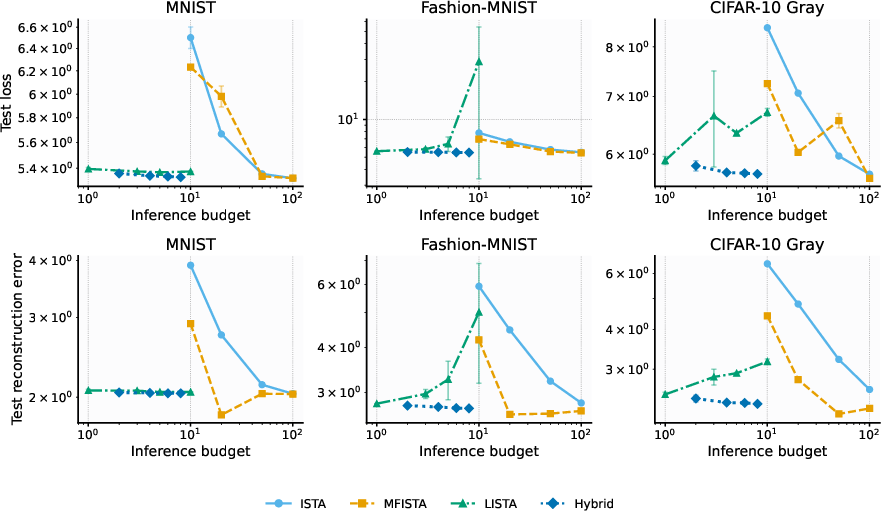
Figure 1: Quality versus inference budget for ISTA, MFISTA, LISTA, and Hybrid at fixed hierarchical depth. Hybrid (with fixed {aℓ}2) achieves clear gains over LISTA with minimal added budget.
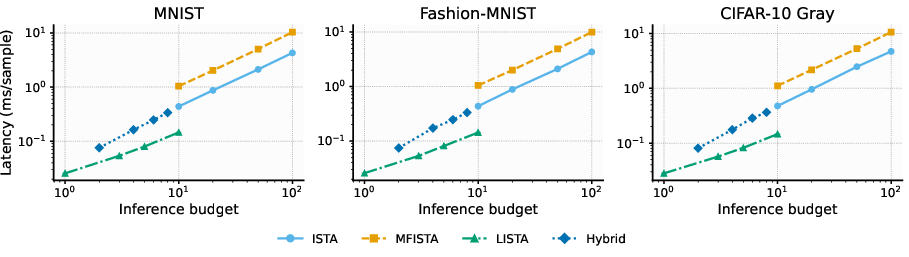
Figure 2: Measured latency as a function of inference budget confirms Hybrid's advantage—approaching iterative quality at much lower wall-clock inference cost.
Allocation of Hybrid Inference Budget
A focused analysis on the division of Hybrid budget ({aℓ}3 amortized stages, {aℓ}4 refinement steps) highlights a key empirical insight: increasing amortized encoder depth does not substitute for ISTA-style refinement in improving final solution quality. The majority of performance gains are realized by shallow ({aℓ}5) amortized initialization with subsequent correction. Allocating more steps to amortization reduces latency at the cost of worsened quality, and only refinement under the actual hierarchical energy provides substantial additional benefit.
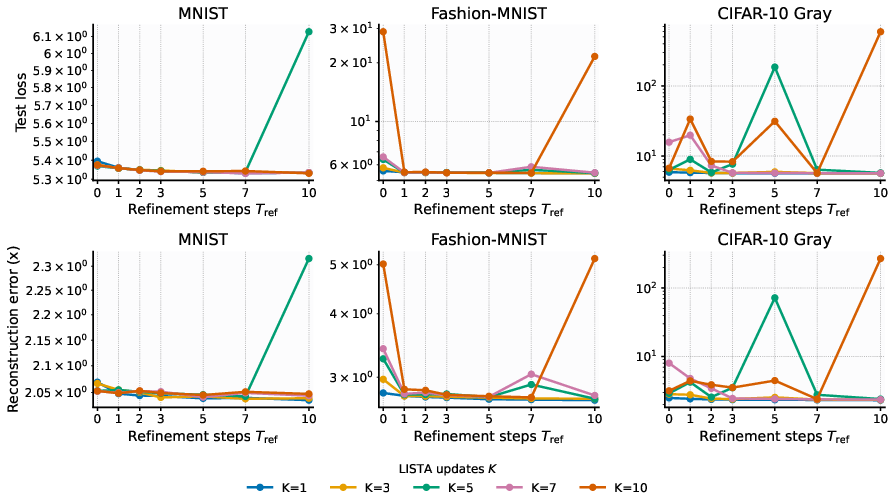
Figure 3: Hybrid allocation analysis across datasets—corrective refinement (increasing {aℓ}6 for fixed {aℓ}7) consistently outperforms adding amortized encoder stages.
Depth Scaling and Stability
Increasing the hierarchical depth ({aℓ}8) exacerbates the weaknesses of both pure iterative and pure amortized schemes: ISTA becomes highly unstable with significant variance across seeds, and LISTA's one-shot inference degrades more rapidly in both quality and stability. Hybrid inference tracks MFISTA for stability and quality up to moderate depths and remains significantly faster.
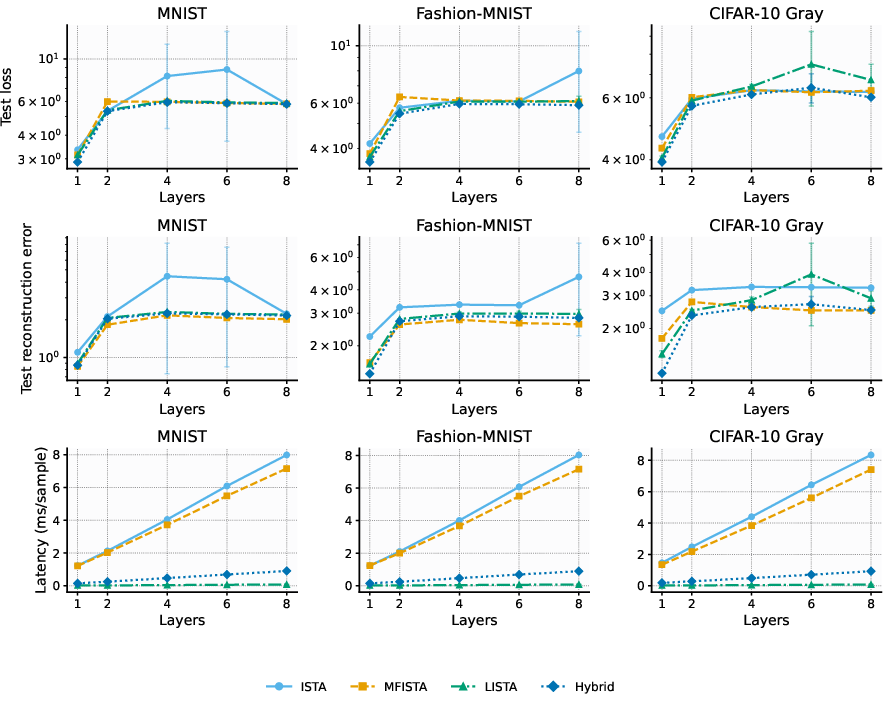
Figure 4: Objective quality and runtime as a function of model depth reveal the trade-offs in stability and efficiency; Hybrid maintains robustness where ISTA and LISTA degrade.
Robustness to Sparsity and Step-Size Hyperparameters
Varying the global sparsity parameter {aℓ}9 and the global step-size scale {Dℓ}0 demonstrates Hybrid's robustness: the qualitative improvement of short Hybrid refinement over pure amortization persists across both sparser and denser coding regimes, as well as mild rescaling of step sizes. While there is some sensitivity (optimal performance is observed near default parameters), Hybrid's core advantage is not hyperparameter-dependent.
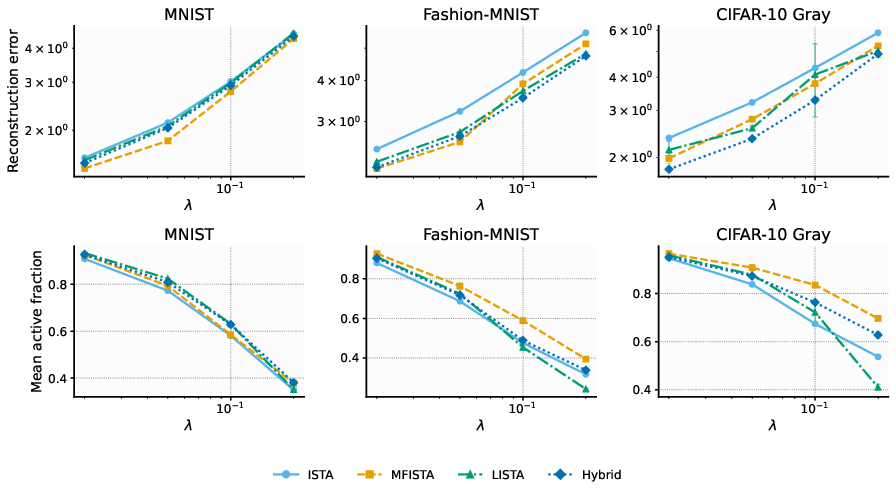
Figure 5: Reconstruction error and mean active fraction for different {Dℓ}1 values; Hybrid's advantage persists across sparsity regimes.
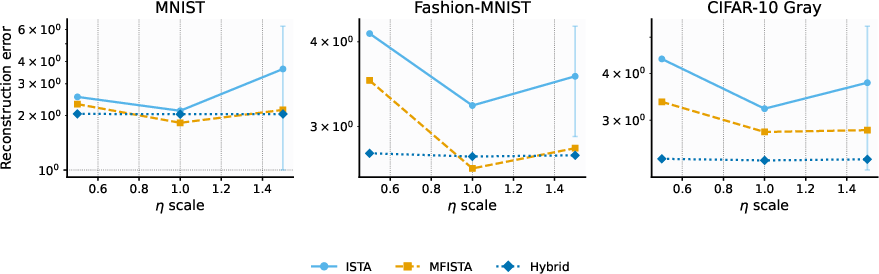
Figure 6: Sensitivity to ISTA/MFISTA/Hybrid step-size scaling; Hybrid results are robust to moderate tuning of {Dℓ}2.
Theoretical and Practical Implications
The controlled comparisons provide strong evidence that the effectiveness of amortized inference in hierarchical sparse coding can be substantially enhanced by coupling fast, shallow amortized initialization with limited local energy-based recurrence. The Hybrid mechanism reflects an efficient dual-process architecture for latent inference—fast amortized predictions serve as a non-generic prior, but structured iterative updates are essential to recapture the high solution quality typically associated with energy-based optimization.
Key claims supported by experiments include:
- A small number of correction steps post-amortization achieves most of the quality gains of full ISTA/MFISTA, at two orders of magnitude lower cost.
- Deepening amortized encoders (increasing {Dℓ}3) offers little or negative improvement compared to investing computation in refinement steps.
- Hybrid inference is robust to increased model depth, more demanding datasets, varying sparsity regimes, and moderate hyperparameter scaling, outperforming or matching both iterative and amortized references in practice.
These results have potential implications for both scalable sparse coding in large-scale vision models and for neurobiologically plausible models of hierarchical inference. The architecture is especially attractive in regimes where inference latency is a strict bottleneck, e.g., real-time perceptual tasks or models embedded in hardware systems.
Limitations and Future Work
The study's scope is deliberately confined to static image benchmarks and fully connected hierarchical architectures. The practical implementation does not address synchronization requirements, local learning rules, or the complexities of temporal data. Extensions to convolutional models, larger-scale vision tasks, modern algorithm unrolling (e.g., ALISTA), adaptive inference schedules, and safeguarded refinement schemes remain open directions. Incorporating continuous temporal data would further test the viability of Hybrid inference, especially in settings with streaming inputs and real-time constraints.
Conclusion
This work establishes, via rigorous controlled experiment, that Hybrid inference—amortized initialization plus a small number of principled corrections—provides a practical and robust middle ground in hierarchical sparse predictive coding. It effectively balances the trade-off between latency, reconstruction quality, and stability, offering a template for scalable inference in structured latent-variable models. The results indicate that shifting more inference budget to amortized initialization is suboptimal, and that the crucial regime is shallow amortization, rapid correction.
This delineation will inform both practical deployment of sparse hierarchical models and theoretical exploration of resource-efficient inference mechanisms in computational neuroscience and AI.