- The paper demonstrates that integrating QNNs into diffusion architectures reduces trainable parameters by nearly three orders of magnitude and enhances statistical fidelity.
- It combines quantum encoding and transformer self-attention to capture both short-term and long-range dependencies in financial time series.
- Empirical evaluations on IQM hardware show significant reductions in MAE and Wasserstein distance, leading to superior forecasting performance with synthetic data augmentation.
Quantum Generative Diffusion Model for Real-World Time Series: An Expert Overview
Introduction
The paper "Quantum Generative Diffusion Model for Real-World Time Series" (2606.27561) introduces QDiffusion-TS, a quantum-enhanced diffusion model specifically constructed for time series synthesis and validated on IQM's quantum hardware. The model integrates quantum neural networks (QNNs) into a classical diffusion architecture, targeting the denoising transformer components. This hybrid quantum/classical approach is empirically evaluated on financial time series data, demonstrating substantial improvements in statistical fidelity, modeling efficiency, and downstream predictive utility.
Model Architecture and Quantum Integration
QDiffusion-TS extends the transformer-based Diffusion-TS architecture for temporal generative modeling by substituting key feed-forward neural network components with QNNs. These QNNs use parameterized quantum circuits, encoding input features efficiently in quantum states, and leverage entanglement for expressive representations. The architecture retains the transformer’s self-attention mechanism, capturing both short-term and long-range temporal dependencies, and incorporates ancillary trend and Fourier synthesis layers for global and frequency structure modeling.
The transition from classical to quantum in the denoising path yields nearly three orders of magnitude reduction in trainable parameters per FFNN/QNN replacement, with a total model parameter reduction of about 20%. In the classical simulation regime, amplitude encoding and full statevector extraction are used; for quantum hardware, angle encoding and expectation value measurements are employed, adapting to device constraints.
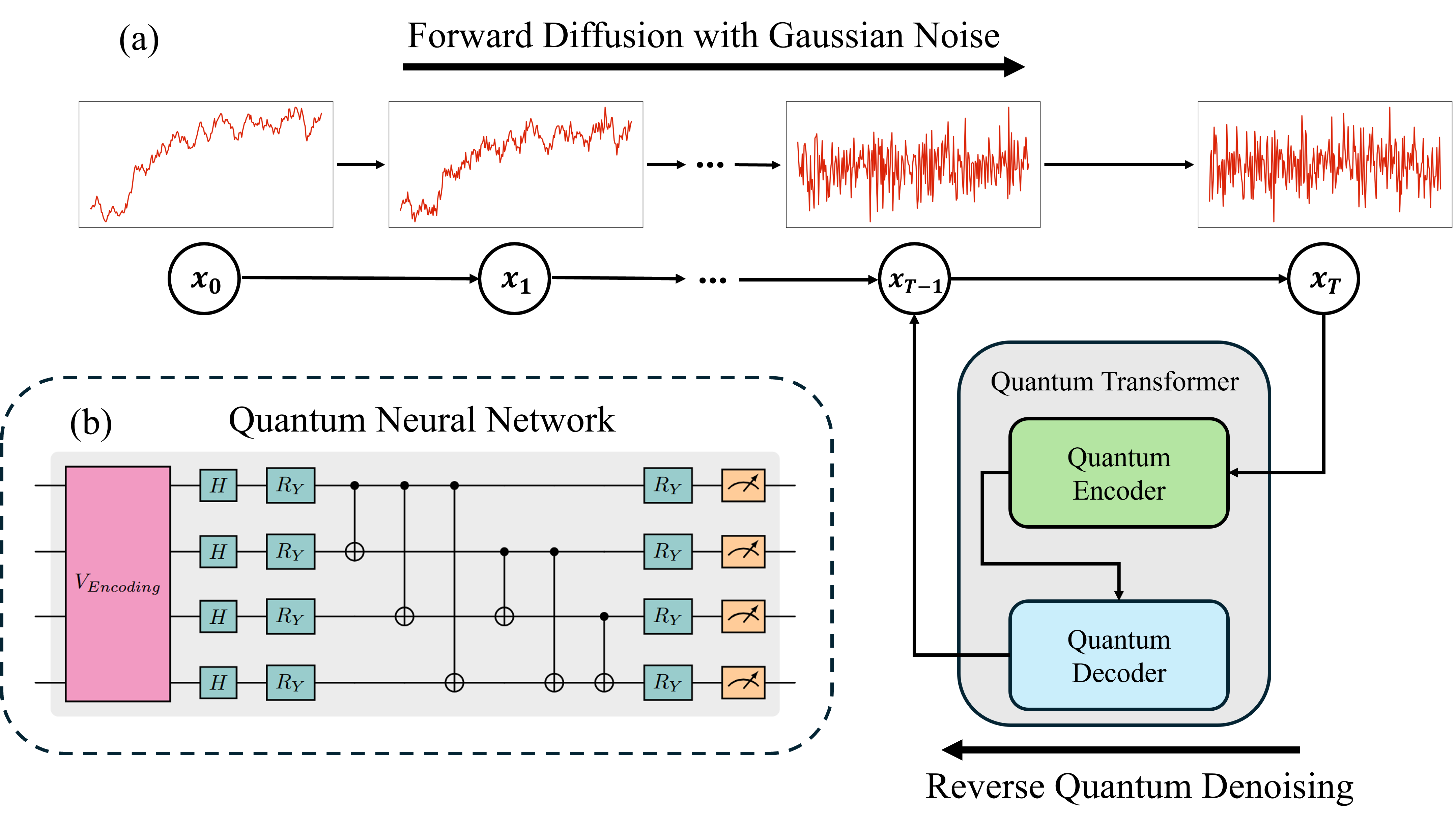
Figure 1: QDiffusion-TS architecture schematic with quantum denoising and detail of quantum encoder/decoder utilizing parameterized quantum circuits.
Statistical Fidelity and Empirical Evaluation
The model’s ability to replicate stylized facts and statistical properties of real financial time series (Apple/Amazon) is evaluated using log-return distributions, central moments, Wasserstein distance, and Kolmogorov-Smirnov statistics. QDiffusion-TS consistently achieves lower MAE in variance reproduction (63% improvement over classical) and yields reduced Wasserstein distances (44% average improvement). Statistical distance reductions are especially pronounced for Amazon time series.
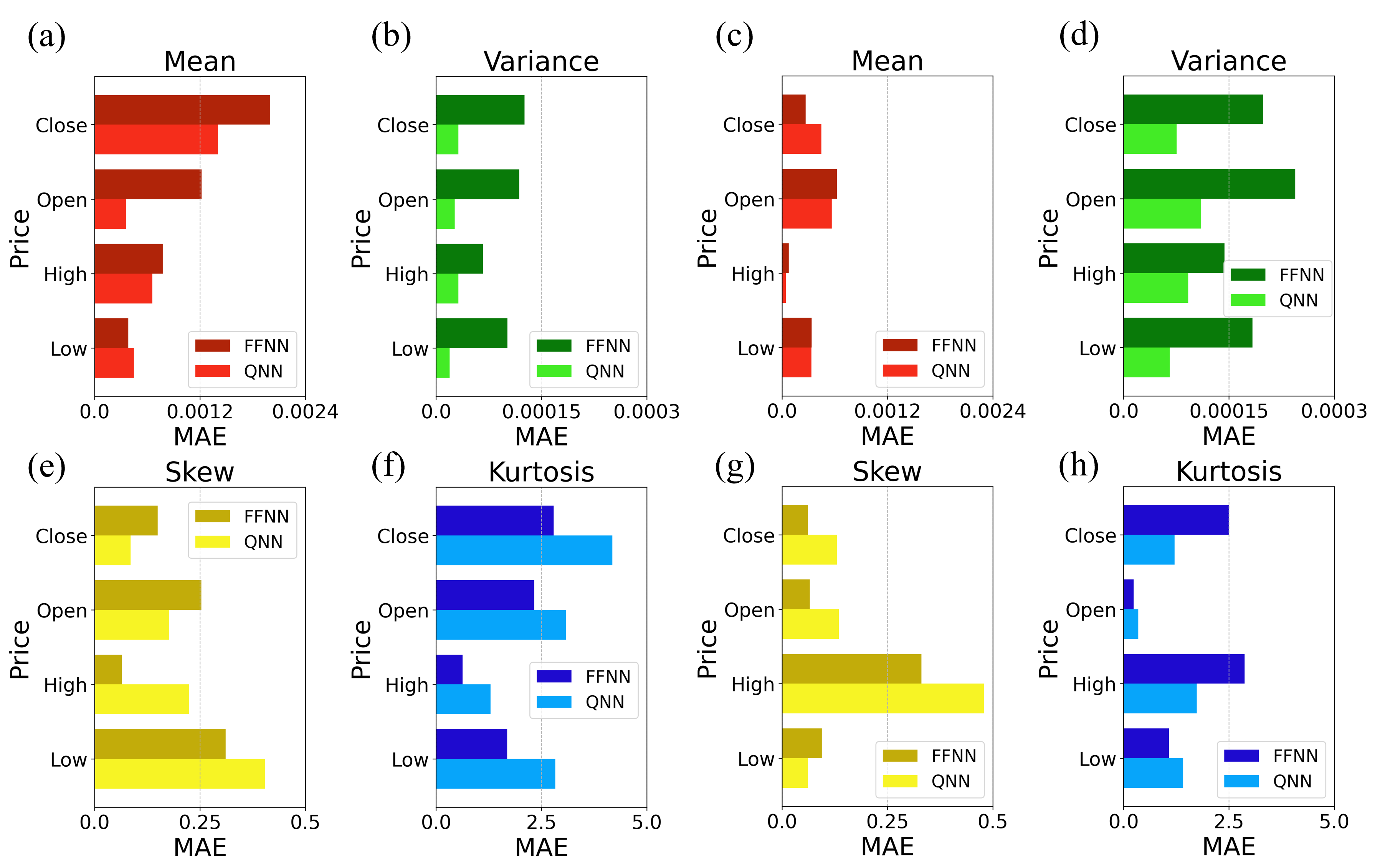
Figure 2: MAE between synthetic and real central moments (mean, variance, skewness, kurtosis) for Apple and Amazon datasets.
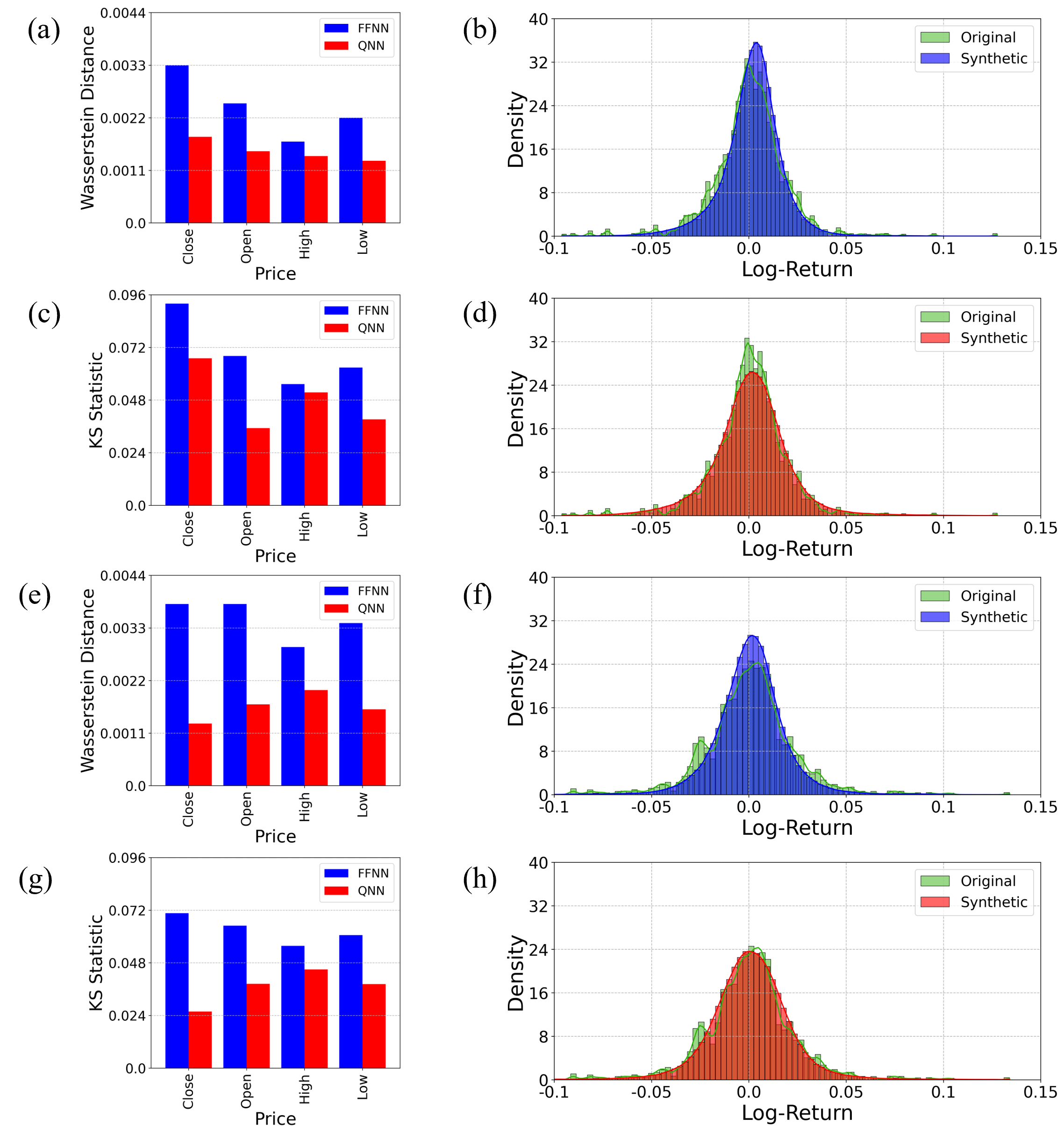
Figure 3: Aggregated log-return distribution comparison—QNN versus FFNN—showing reduced Wasserstein and KS distances and closer density alignment for QDiffusion-TS.
The model's performance remains robust across training set sizes, with quantum variants consistently outperforming classical models as sequence counts grow.
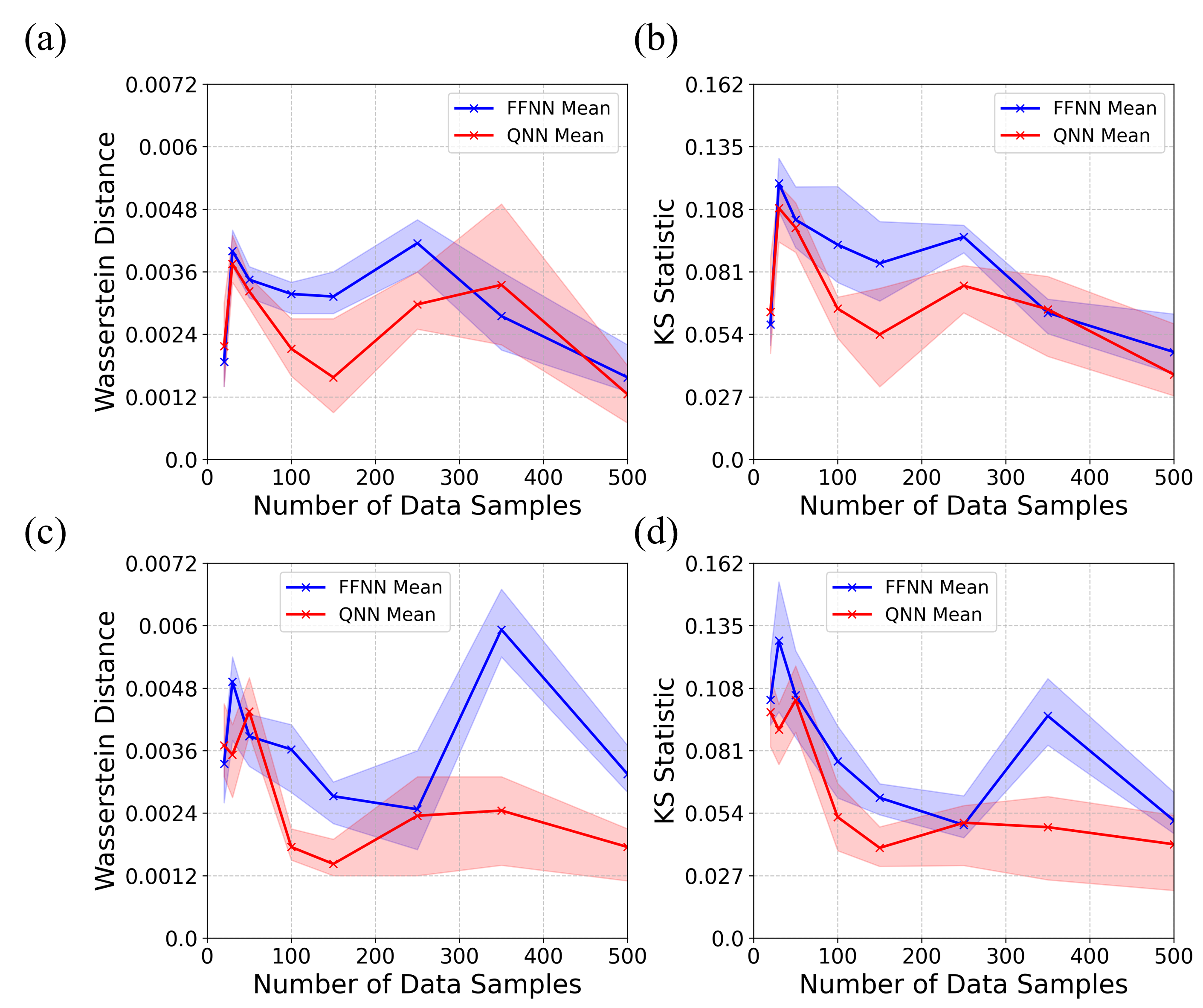
Figure 4: Mean Wasserstein and KS distances for varying sample regimes, demonstrating QNN’s improved fidelity with increasing data.
Downstream Forecasting and Synthetic Data Utility
Augmentation of forecasting datasets with QDiffusion-TS-generated synthetic sequences yields up to 71% reduction in RMSE compared to models trained exclusively on real data. Predictive improvement plateaus at moderate augmentation ratios (1:5); excessive synthetic augmentation does not further enhance accuracy. Notably, expanding training sets with additional real data does not match the efficacy of synthetic augmentation, often introducing detrimental non-stationarity and regime drift.
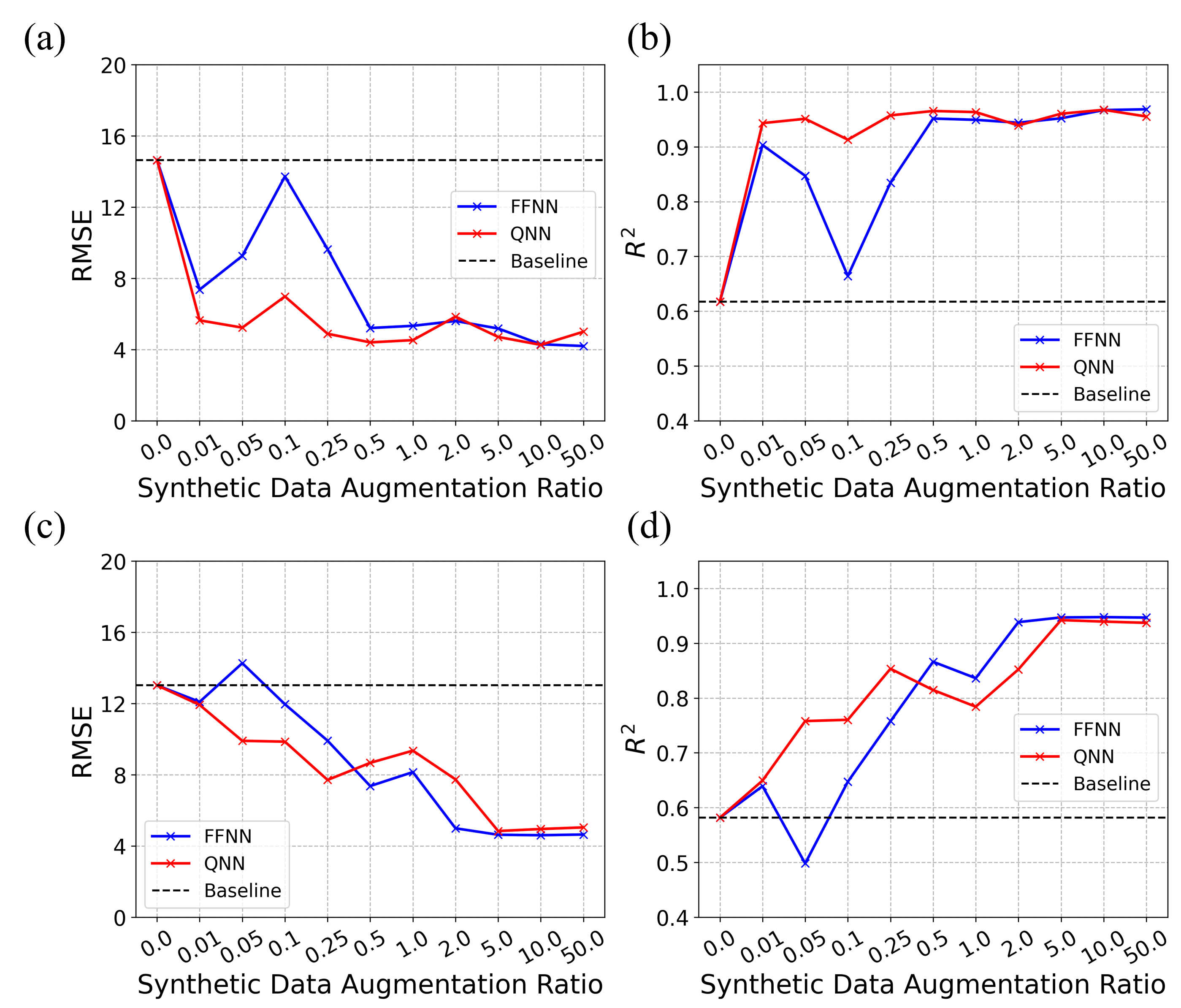
Figure 5: BiLSTM forecasting of closing price—RMSE and R2 as functions of synthetic data ratio, with QNN outperforming at low augmentation.
Quantum Hardware Execution and Noise Robustness
Inference using QDiffusion-TS on the IQM Emerald quantum device validates practical feasibility, with hardware-executed models outperforming both classical baselines and simulated quantum variants. Hardware-generated distributions exhibit up to 89% lower Wasserstein distance relative to classical and marginally surpass simulated quantum performance (~8% reduction), indicating that device noise does not impair—and may enhance—statistical alignment.
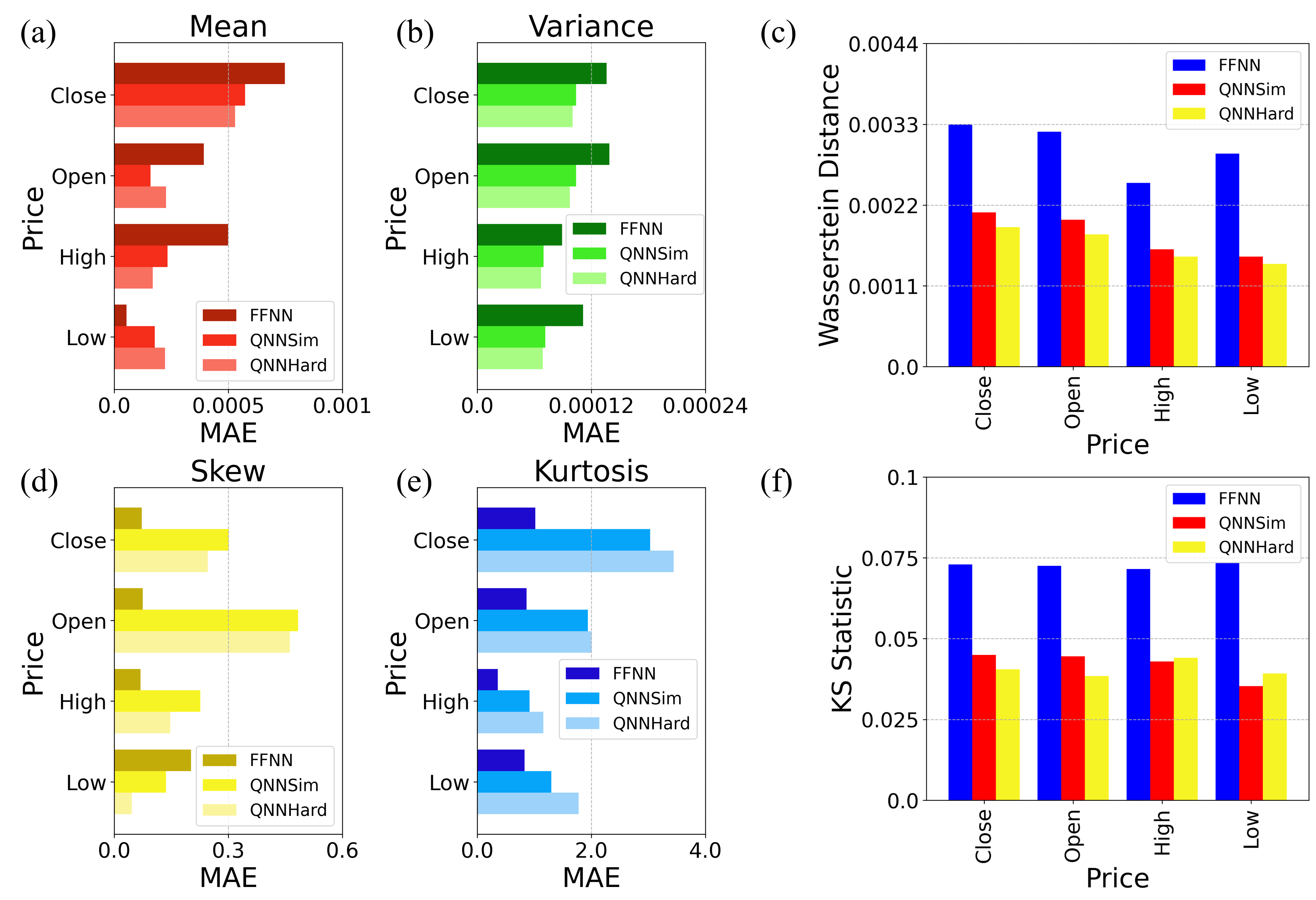
Figure 6: Comparison of MAE (mean, variance, skewness, kurtosis), Wasserstein, and KS statistics across classical, simulated quantum, and hardware quantum executions.
Theoretical and Practical Implications
The empirical results highlight quantum circuits’ capability for representing complex data distributions with substantial parameter efficiency—enabled by the exponential scaling of Hilbert space and entanglement for correlated features. The primary source of statistical fidelity improvements is attributable to more accurate variance modeling. While prior QML literature has demonstrated superior generalization in low-data regimes, QDiffusion-TS does not exhibit a sharp quantum advantage at minimal sample sizes, likely constrained by hybrid architectural factors.
The comparable predictive utility between quantum and classical generated sequences for downstream tasks suggests that statistical fidelity and sample diversity contribute in complementary fashions to model generalization. Synthetic augmentation delivers higher stability compared to expanding real datasets, emphasizing the role of generative models in maintaining distributional stationarity in non-stationary domains.
Crucially, operational robustness to hardware noise and the observation that stochasticity inherent in quantum devices may have constructive effects suggest promising avenues for future hybrid generative models. As quantum hardware scales and architectural integration deepens, parameter-efficient, quantum-enhanced generative modeling will likely become increasingly practical for temporal and other structured data domains.
Conclusion
QDiffusion-TS demonstrates that embedding quantum neural networks within generative diffusion architectures for time series enables highly parameter-efficient modeling, enhanced statistical fidelity, practical forecasting accuracy, and robust hardware execution. These findings establish quantum diffusion models as a viable foundation for scalable, hybrid generative modeling with practical utility in finance and other temporal domains. Progress in quantum device capability and integration strategies will further augment the potential for compact, expressive, and efficiently trainable generative models in real-world applications.

