- The paper presents a novel framework that integrates quantum models with classical error correction to improve forecasting accuracy.
- The methodology couples variational quantum circuits with neural networks to predict future values and correct residual errors.
- Empirical results demonstrate significant performance gains, with improvements up to 79% in MSE over traditional classical models.
Quantum-Classical Hybrid Models Based on Error Correction for Time Series Forecasting
Introduction and Motivation
The integration of quantum machine learning with established deep learning techniques presents novel avenues for augmenting time series forecasting. Historically, improvements in time series forecasting accuracy have hinged not merely on increasingly sophisticated singular models, but on the judicious hybridization of heterogeneous modeling paradigms, allowing for sequential error correction and model complementarity. The paper "Quantum-classical hybrid models based on error correction for time series forecasting" (2606.15213) systematically explores the first integration of quantum models with classical neural networks under an error-correction framework, moving beyond prior work where quantum modules were largely embedded within classical architectures, such as quantum-enhanced LSTMs or classical-quantum pipelines.
The central hypothesis motivating this work is that quantum models, by virtue of access to quantum feature spaces via superposition and entanglement, may capture time series regularities inaccessible to classical models, especially in low-sample or non-linear regimes. However, quantum models are prone to barren plateaus in their optimization landscape, leading to suboptimal performance unless coupled with classical refinements. The sequential Q+C error-correction schema, as proposed, leverages quantum models for primary forecasting and utilizes classical models post hoc to remove residual error, thereby maximizing hybrid synergy.
Hybrid Quantum-Classical Error Correction Architecture
The introduced architecture consists of (1) a quantum model (Q) trained on historical time series segments to predict future values, and (2) a classical model (C), typically a neural network, trained to map past errors of Q to future expected quantum modelling errors. The final forecast is produced by an additive correction: y^t+1Q+C=y^t+1Q+e^t+1C, where y^t+1Q is the quantum model prediction, and e^t+1C is the classical prediction of the quantum error (see Figure 1).
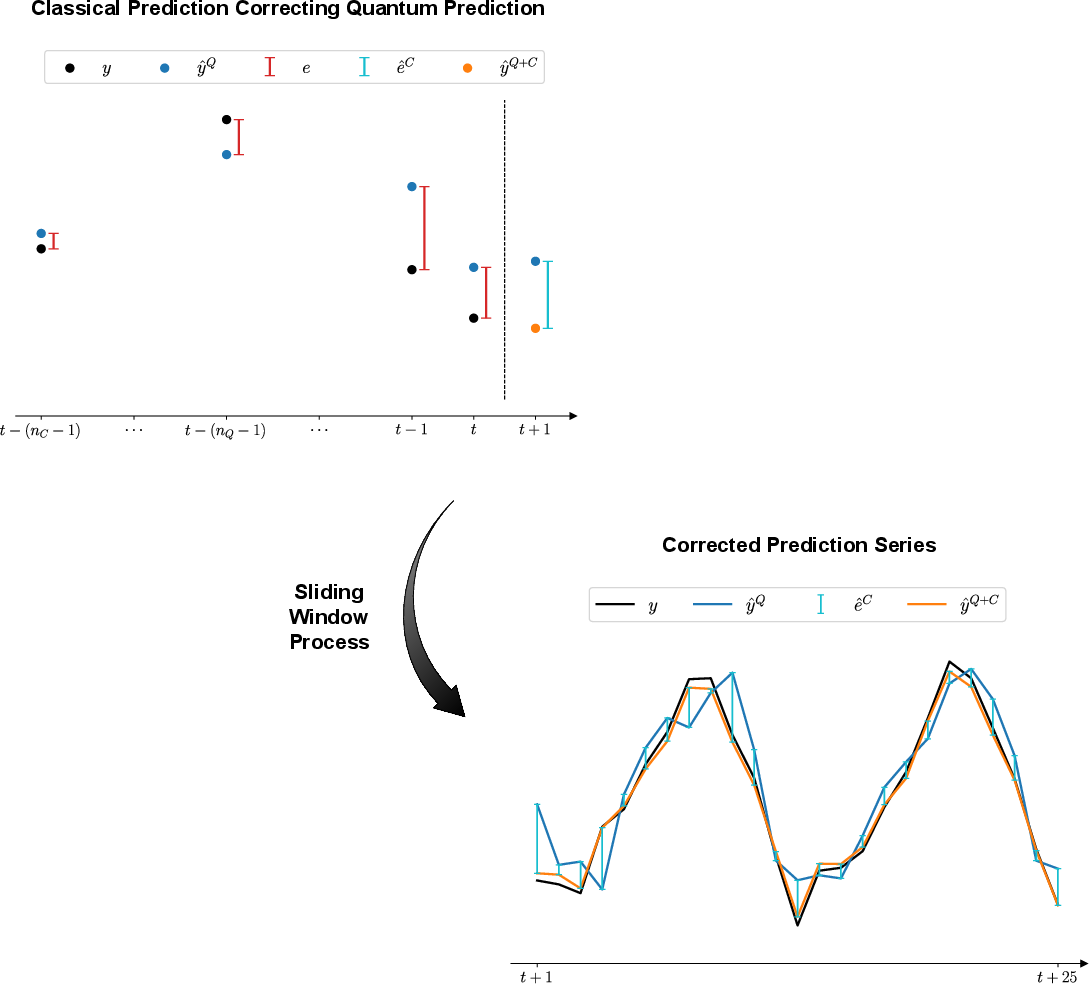
Figure 1: Illustration of the proposed error-correction-based quantum-classical hybridization for time series forecasting. The process iterates by sliding the window, using past observations and quantum errors for sequential correction.
The framework is instantiated using pools of candidate quantum and classical models. Quantum models are implemented as variational quantum circuits (VQCs) with differing encoding and entanglement strategies (e.g., EYZGU, EPPGYZ, EYGXYZ). Classical models include MLP, LSTM, and N-BEATS, with their hyperparameters tuned via extensive search. For each forecasting problem, the optimal quantum-classical pairing is determined via validation performance on Mean Squared Error (MSE), Mean Absolute Error (MAE), and Mean Absolute Percentage Error (MAPE).
The architectural flow is depicted in detail in Figure 2.
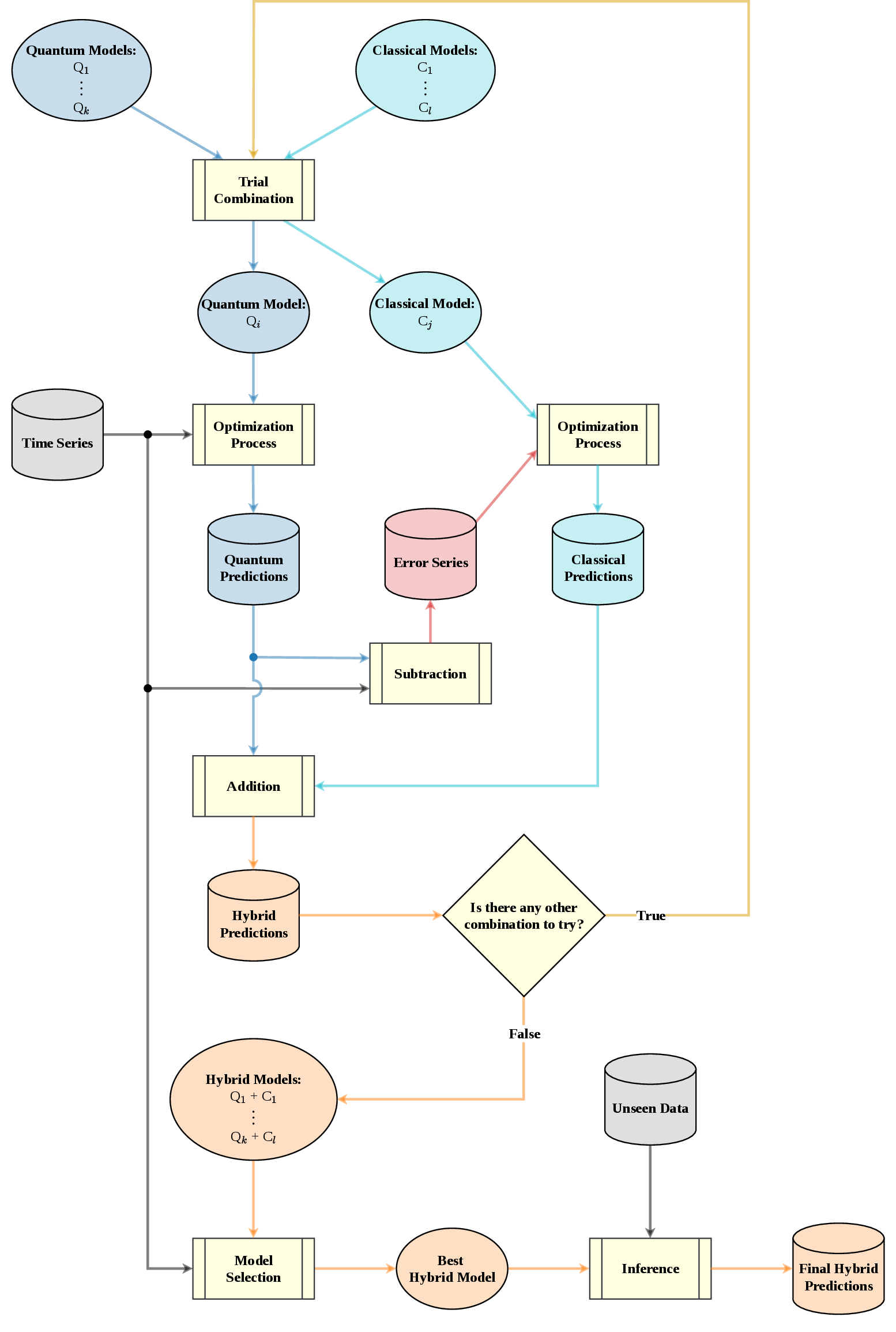
Figure 2: Pipeline for optimizing quantum-classical error-correcting hybrid models for a given forecasting task via combinatorial model selection and additive correction.
Empirical Evaluation and Results
Datasets and Experimental Setup
The study benchmarks the Q+C paradigm on seven canonical time series forecasting problems spanning meteorology, physics, sales, hydrology, and agriculture, all sourced from the Time Series Data Library. For each dataset, a 50/25/25 train/validation/test split is used, with series normalized to [−1,1] for quantum processing and to [0,1] for hybrid and classical processing.
The efficacy of the Q+C models is quantified as the relative improvement in test-set MSE over the best classical model and the best classical-classical hybrid (C+C), as seen in Figure 3.
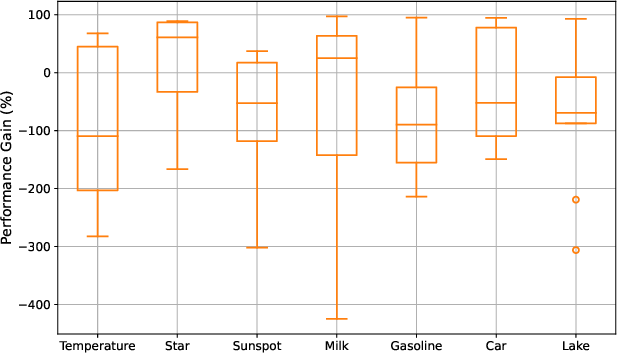
Figure 3: Distribution of performance gain (%) from Q+C models over base classical approaches across seven tasks; performance is highly dependent on model selection and dataset structure.
It is empirically demonstrated that quantum-classical combinations provide significant performance gains in a majority of tasks, with Q+C hybrids outperforming both C and C+C baselines in up to five/seven tasks based on MSE, and even more so using MAE and MAPE. Notably, the performance is non-uniform—many Q+C pairings degrade accuracy relative to classical models, corroborating the necessity of principled model selection.
Table-based results indicate average performance gains (where Q+C is superior) of 79% (MSE), 51% (MAE), and 60% (MAPE) over C, and 77% (MSE), 52% (MAE), and 43% (MAPE) over C+C, with some tasks seeing near-total reduction in forecasting error for select hybrid pairs.
Representative predictions for selected datasets are visualized in Figure 4, indicating sharpened tracking of peaks/valleys by Q+C reconstructions relative to both classical and quantum-alone predictions.
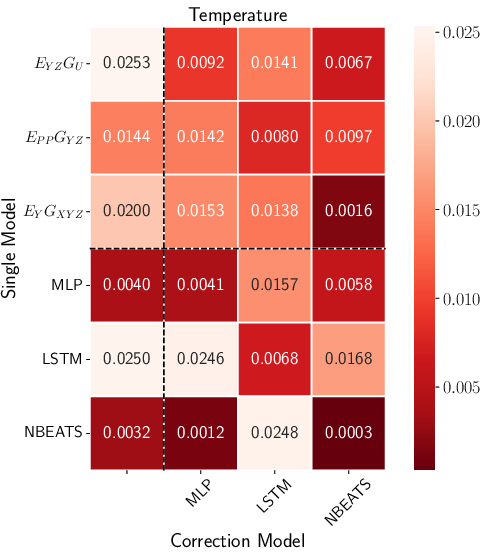
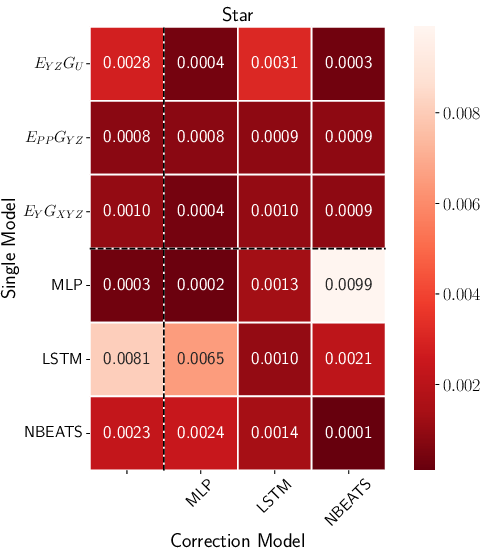
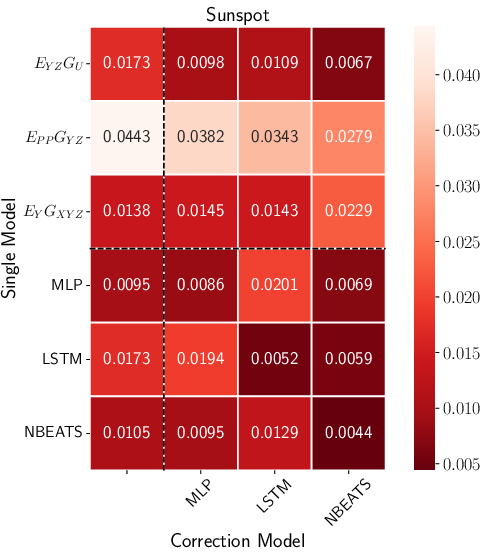
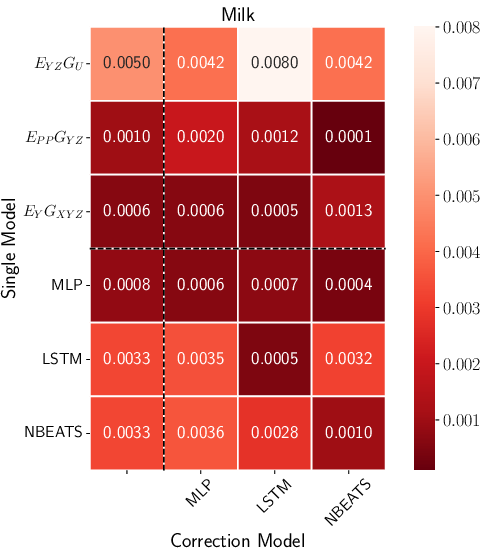
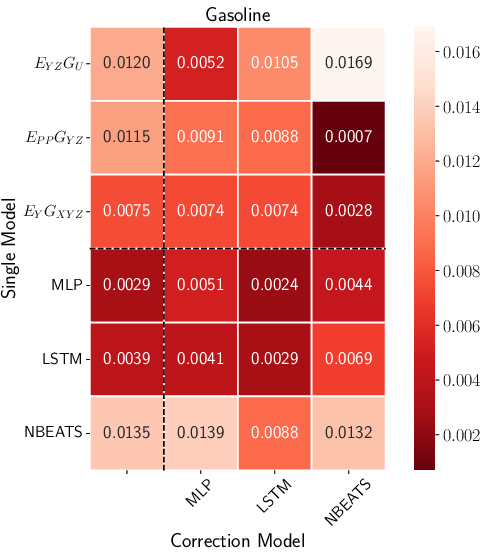
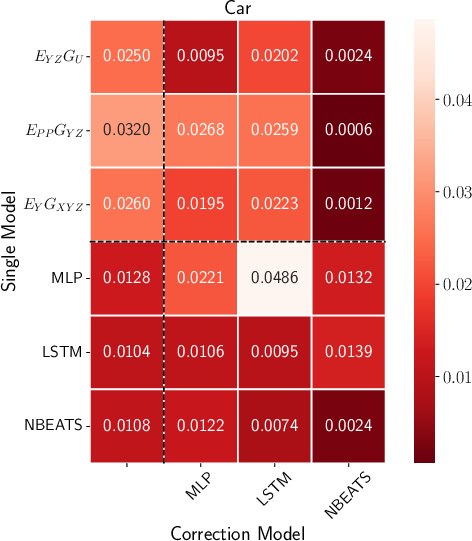
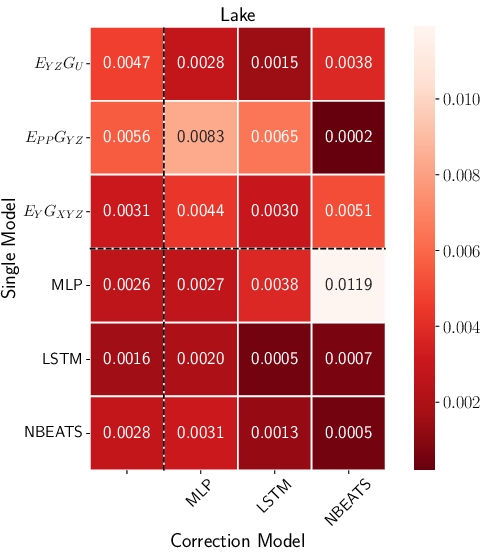
Figure 4: Q+C and baseline predictions on multiple forecast benchmarks, showing enhanced resolution of complex dynamics in the hybrid model outputs.
Failure Modes and Metric Disagreement
Further analysis reveals that Q+C model superiority is contingent on dataset and base model synergy, with negative performance gains (e.g., up to −300% in some tasks) when hybridization is mismatched. Metric sensitivity (MSE vs MAE vs MAPE) and error localization (e.g., error accumulation in tails or peaks) can shift which model is ranked as best, as shown by error series and accumulations in Figure 5 and Figure 6.
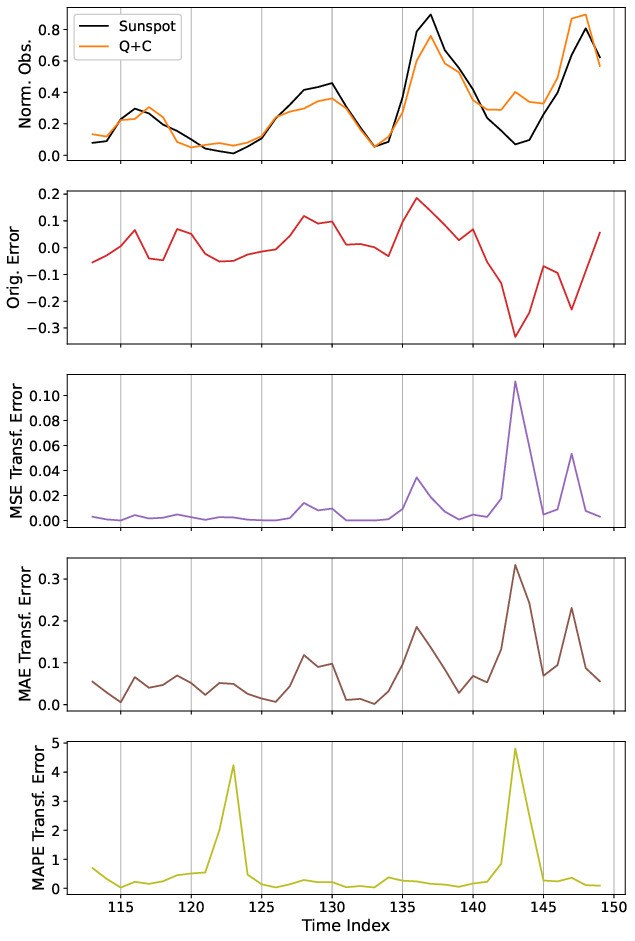
Figure 5: Original and transformed error series for Q+C predictions on the Sunspot task, highlighting how metric transformation affects perceived model quality.
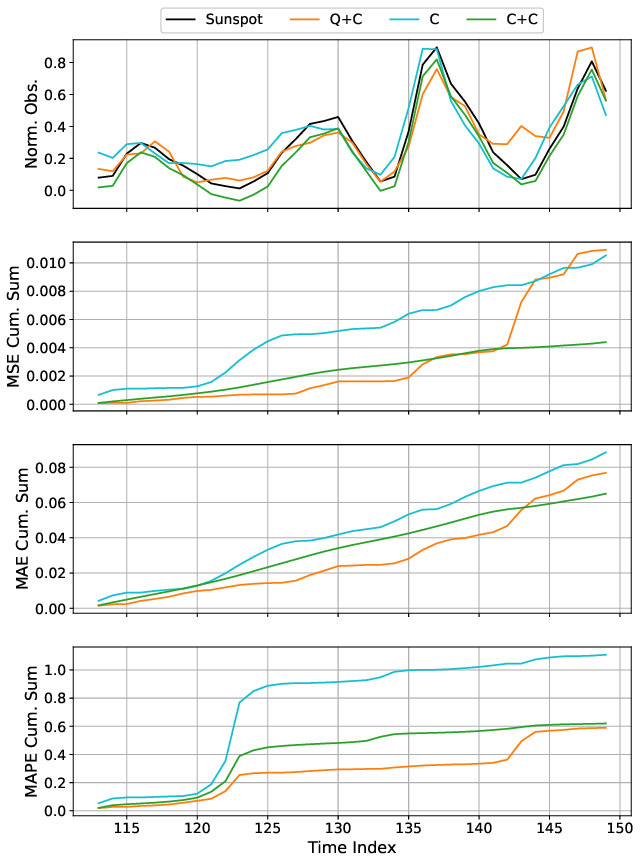
Figure 6: Cumulative error accretion by Q+C, C, and C+C in the Sunspot task, elucidating metric-induced disagreement in model selection.
Theoretical and Practical Implications
Expressivity and Complementarity
The documented empirical superiority of Q+C hybrids on several tasks confirms that quantum models—despite limited expressivity compared to overparameterized classical deep nets—do induce feature representations orthogonal to classical neural models. This supports recent theoretical findings on quantum feature space expressivity and the efficiency of quantum-enhanced kernels (2606.15213). Furthermore, it affirms the value of moving beyond simple quantum advantage arguments towards hybrid schemes that augment classical capacity in a task-dependent manner.
Model Selection Is Nontrivial
A key claim, substantiated by extensive negative results for naïvely combined Q+C hybrids, is that hybrid quantum-classical error correction requires joint model selection and extensive validation—not all combinations are beneficial, and poorly matched Q+C pairs can catastrophically degrade performance.
Implications for Quantum Machine Learning Practice
The work demonstrates that quantum submodules need not independently outperform classical models to provide net practical value; their utility may be realized in dual-stage hybrid systems. In particular, the additive error-correction schema is robust to the limitations of NISQ-era quantum devices, since the classical error module can compensate for quantum model underfitting or representation collapse due to barren plateaus.
Future Directions
Opportunities for extension include:
- Exploration of more expressive nonlinear fusion operators beyond simple addition (e.g., multiplicative gating, learned ensemble weights).
- Integration of statistical and quantum models in hybrid cascades.
- Scaling quantum model size (more qubits/layers) and exploring mitigation of barren plateau phenomena.
- Automated discovery of model orderings and correction structures appropriate for the task (meta-learning hybrid architectures).
Conclusion
This study establishes that error-correction-based quantum-classical hybrids represent a viable and, in many regimes, superior strategy for time series forecasting over classical or quantum-only approaches, provided that model selection is carefully performed. The framework provides both a methodological advancement for practical forecasting under model mismatch and an empirical benchmark for the utility of quantum ML in classical domains. Future research in quantum hybridization and automated architecture search is well-motivated by these findings, as is further exploration into the class of data patterns most efficiently modeled by such quantum-classical synergies.

