- The paper presents an exact solution of the Einstein equations for a Schwarzschild black hole embedded in an anisotropic dark matter halo.
- It independently derives the metric functions A(r) and B(r) via a deformation potential and compares phenomenological profiles such as Burkert, Einasto, and M-SFDM.
- The study confirms a near-reciprocal relation between A(r) and B(r) and validates energy conditions with a smooth junction analysis.
Metric Determination for Schwarzschild Black Holes Surrounded by Dark Matter Halos
Context and Motivation
The gravitational impact of dark matter at galactic centers necessitates a consistent relativistic description that incorporates both a supermassive black hole and its surrounding halo. Previous approaches often enforced a fixed relation between metric functions or derived spacetime from Newtonian rotation curves, potentially violating Einstein equations or energy conditions. This work systematically constructs an exact solution to the Einstein field equations for a Schwarzschild black hole embedded in a dark matter halo, modeled as an anisotropic fluid, without imposing relationships between the metric functions a priori. The methodology enables direct comparison of phenomenological and field-theoretic halo profiles—specifically, the Burkert, Einasto, and multistate scalar field dark matter (M-SFDM) distributions.
Exact Metric Construction
The metric is developed under static, spherical symmetry with independent temporal and radial functions:
ds2=−A(r)c2dt2+B(r)dr2+r2dΩ2
The energy-momentum tensor is chosen as an anisotropic fluid:
Tμν=diag(−c2ρ(r),Pr(r),PT(r),PT(r)),
allowing for distinct radial and tangential pressures. The radial function B(r) is derived using a Schwarzschild-inspired ansatz with the enclosed mass function m(r)=M∙+mh(r), where M∙ is the black hole mass and mh(r) quantifies the halo mass exterior to the innermost stable circular orbit (rin=6GM∙/c2). The temporal function A(r) utilizes a deformation potential ψ(r), such that:
A(r)=(1−c2r2GM∙)exp[c22ψ(r)]
All halo effects on the metric are parameterized by Tμν=diag(−c2ρ(r),Pr(r),PT(r),PT(r)),0 and Tμν=diag(−c2ρ(r),Pr(r),PT(r),PT(r)),1. The Einstein equations yield coupled differential equations for these functions, with pressures constructed semi-analytically from galactic rotation curves and the Tolman-Oppenheimer-Volkoff (TOV) relation.
Profile and Pressure Characterization
Three representative density profiles are tested:
- Burkert: cored phenomenological profile,
- Einasto: simulation-motivated, with continuously varying slope,
- M-SFDM: scenario from complex scalar field dark matter theory.
The density and pressure reconstruction for each profile employs exact integration and analytic approximation, ensuring consistency with observational Milky Way parameters. Radial pressure is determined by matching the rotation curve, and tangential pressure is deduced via energy-momentum conservation.
Metric Function Relation and Analytical Results
A central finding is the emergence of a near-reciprocal relation between the metric functions,
Tμν=diag(−c2ρ(r),Pr(r),PT(r),PT(r)),2
in the halo region—a relation commonly assumed without justification in prior works. The analytical derivation reveals that the product Tμν=diag(−c2ρ(r),Pr(r),PT(r),PT(r)),3 deviates from unity by only Tμν=diag(−c2ρ(r),Pr(r),PT(r),PT(r)),4, governed by a dimensionless halo compactness parameter Tμν=diag(−c2ρ(r),Pr(r),PT(r),PT(r)),5, where Tμν=diag(−c2ρ(r),Pr(r),PT(r),PT(r)),6 and Tμν=diag(−c2ρ(r),Pr(r),PT(r),PT(r)),7 are the profile normalization and radius. The dominant correction arises from the density, with the radial pressure yielding only higher-order effects in Tμν=diag(−c2ρ(r),Pr(r),PT(r),PT(r)),8.
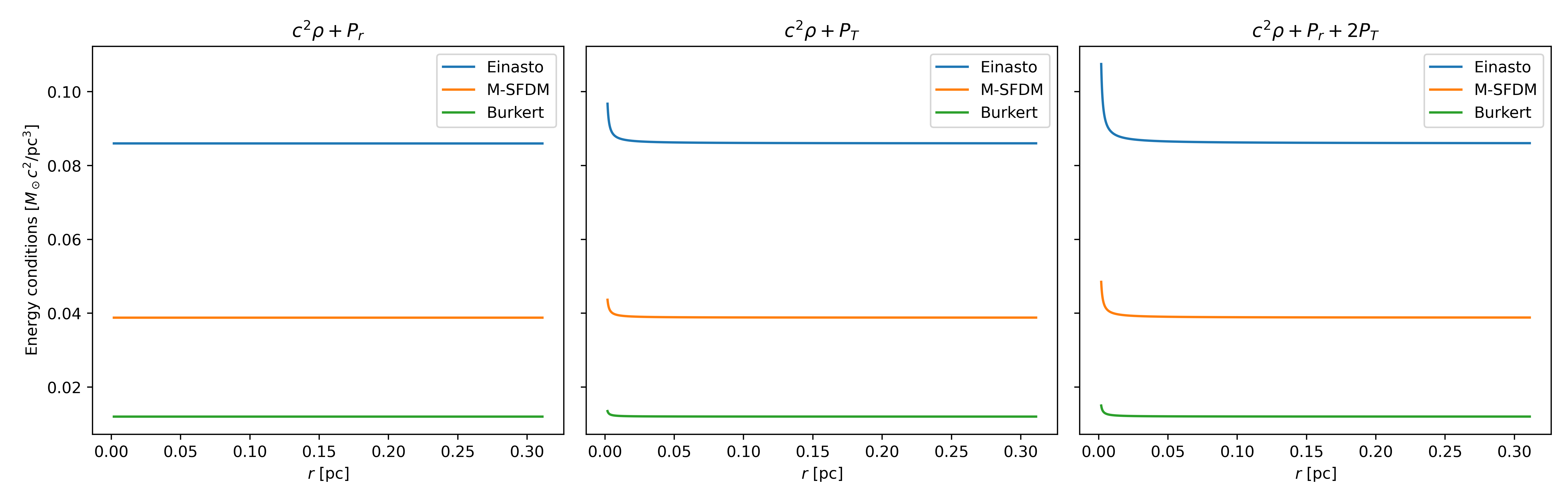
Figure 1: Analysis of the strong energy condition for the Einasto, M-SFDM, and Burkert density profiles.
Energy Conditions and Junction Analysis
All three profiles satisfy the strong energy condition for physical parameter values, as shown in Figure 1, confirming the absence of unphysical matter or superluminal sound speeds. The Darmois–Israel junction at Tμν=diag(−c2ρ(r),Pr(r),PT(r),PT(r)),9 is verified explicitly, showing continuity in both the metric and extrinsic curvature. No thin-shell contributions or surface energy arise, ensuring that the Schwarzschild region and halo are joined smoothly.
Numerical Results and Phenomenological Implications
Numerical evaluation demonstrates that:
- The metric functions B(r)0 and B(r)1 for all density profiles converge rapidly to flat spacetime values (B(r)2) at large radii.
- The differences between profiles are minimal for the Milky Way scale, due to the weak relativistic gravitational strength (B(r)3).
- Radial and tangential pressure profiles are distinct (see Figures 4 and 5), but are subdominant for the metric relation.
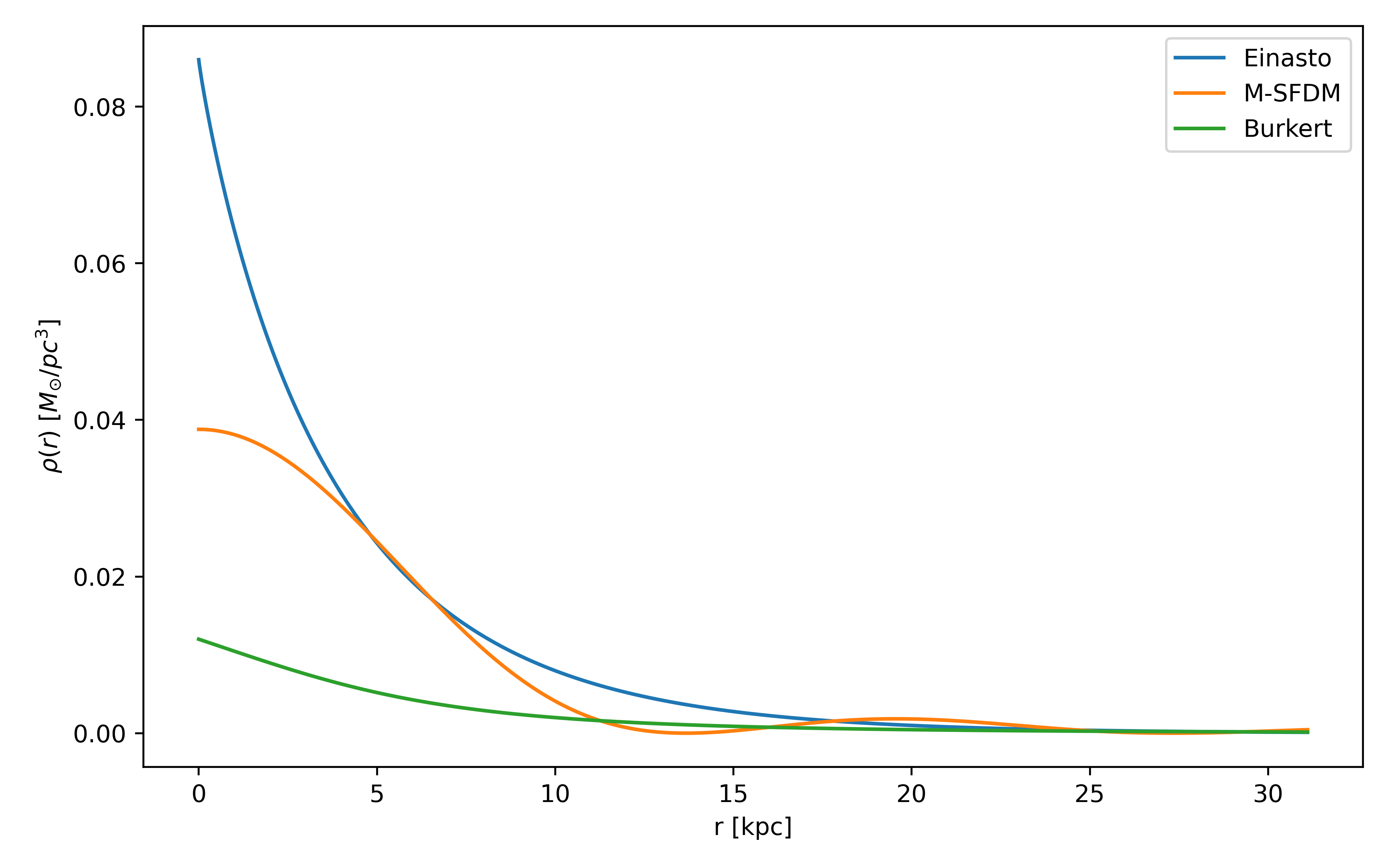
Figure 2: Density profiles of the Einasto, M-SFDM, and Burkert models for selected Milky Way parameters.
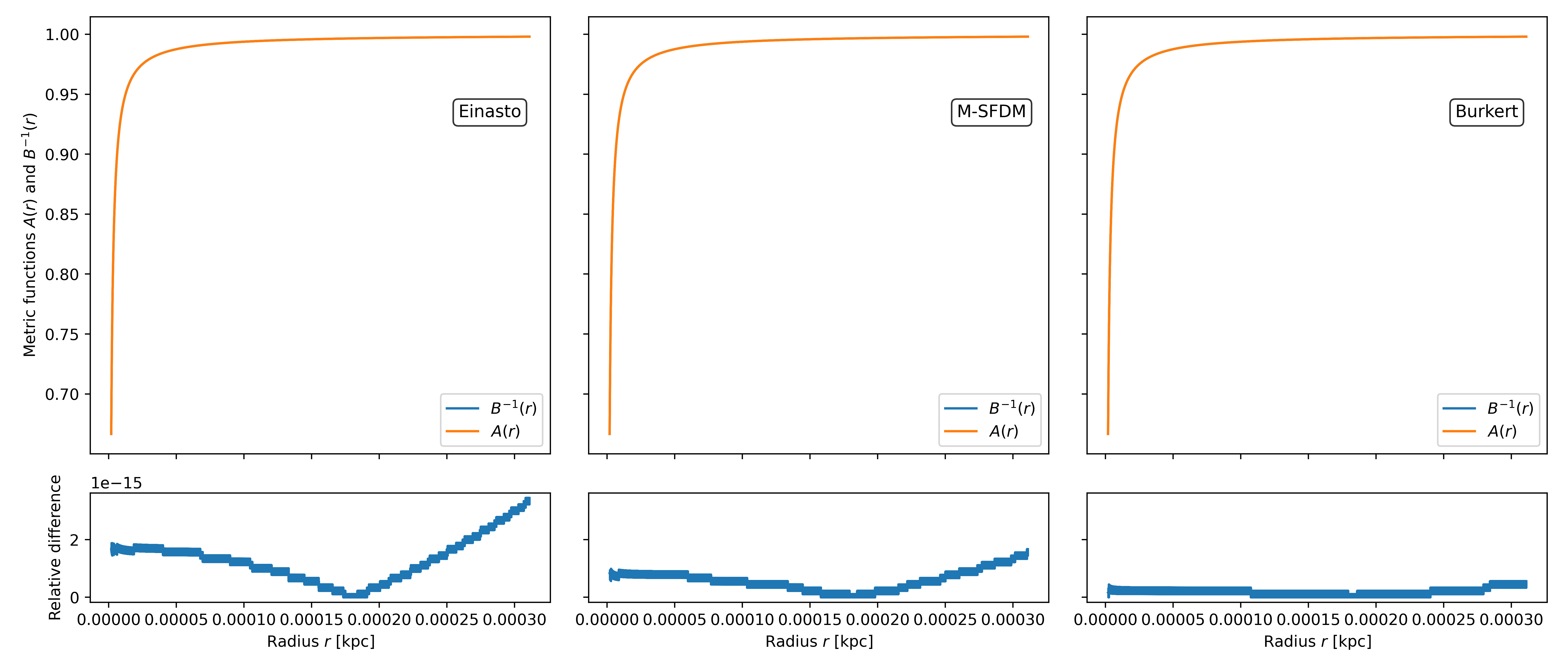
Figure 3: Comparison of the metric functions B(r)4 and B(r)5 for each density profile and their relative difference.
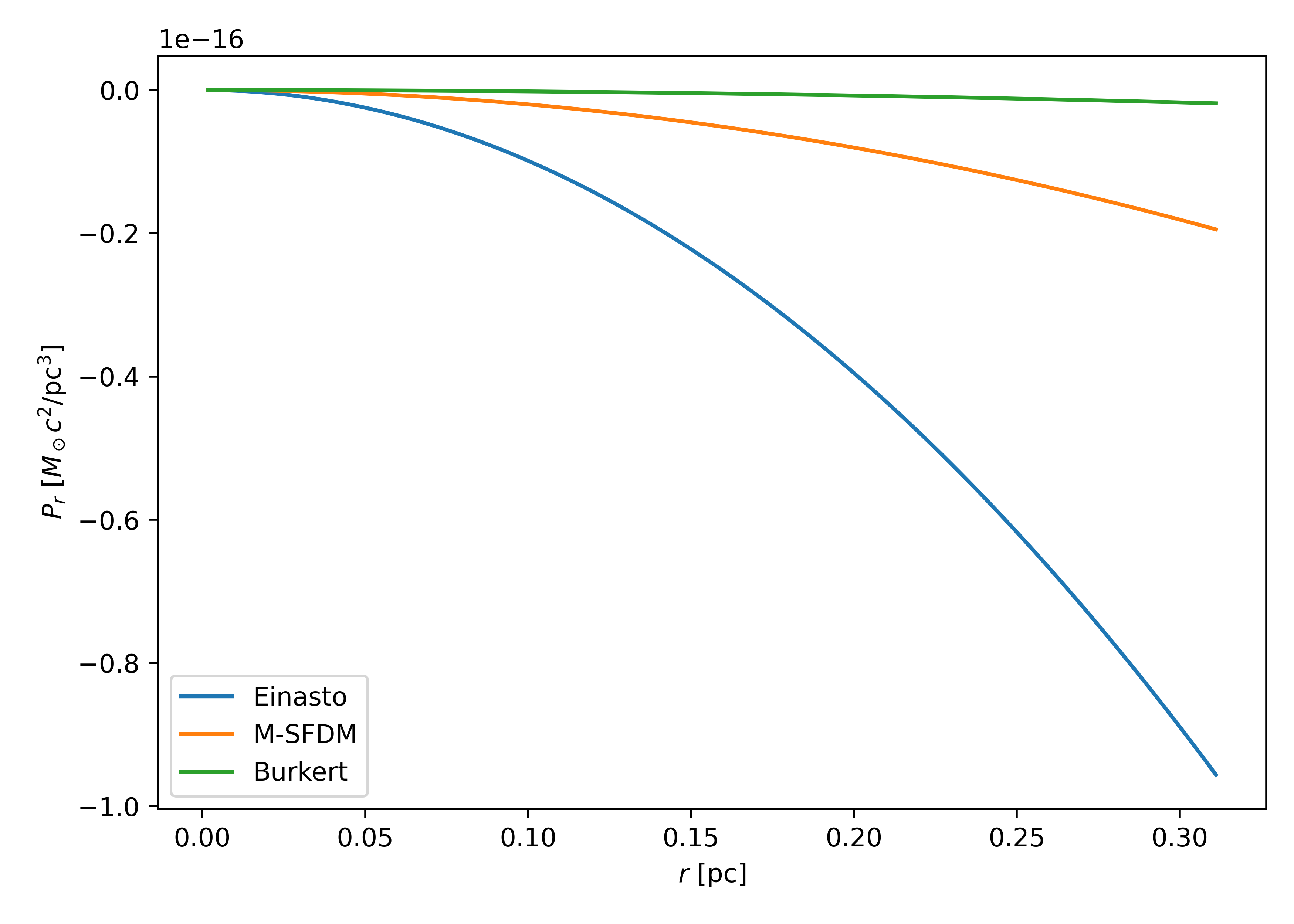
Figure 4: Comparison of radial pressure for each density profile.
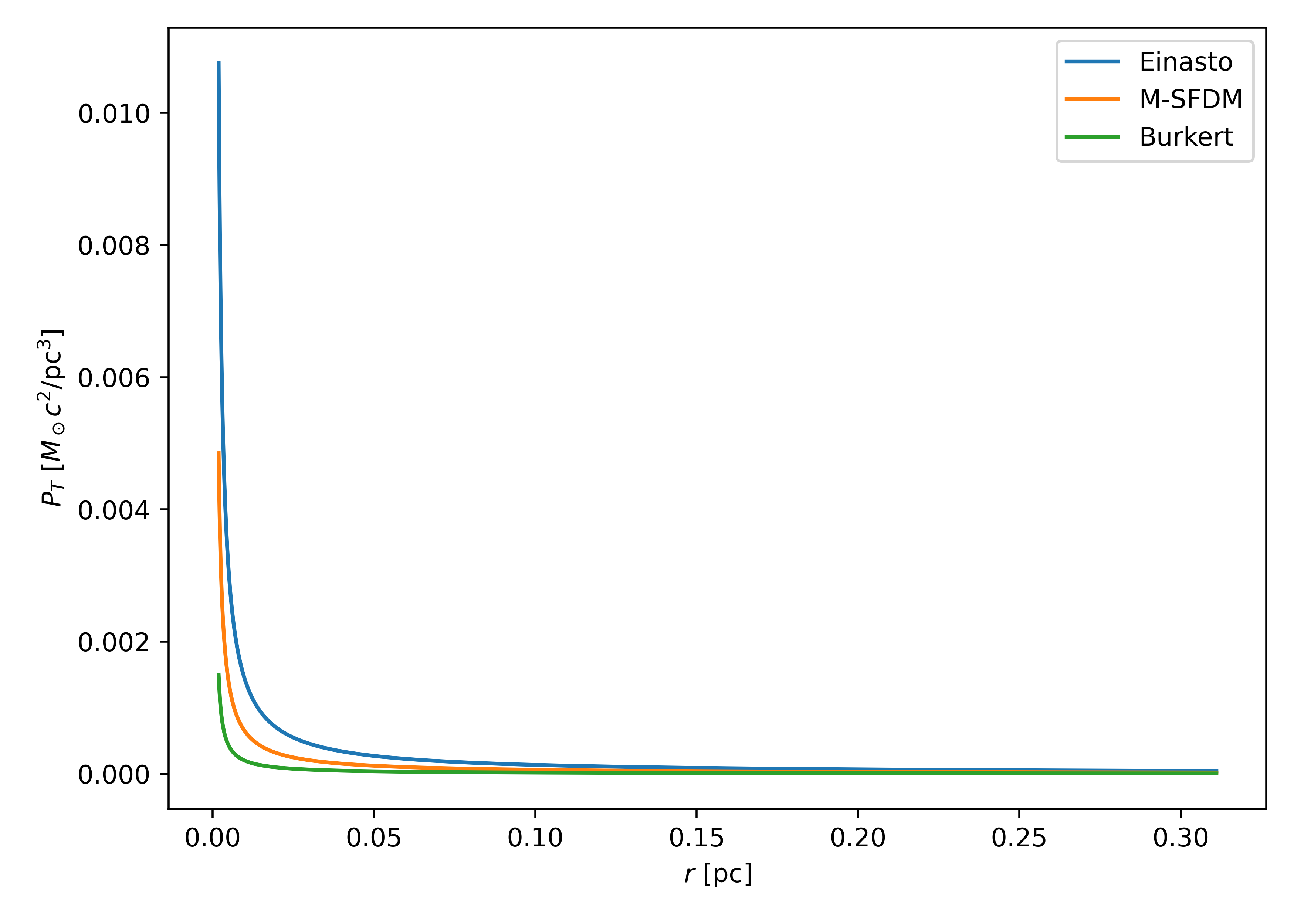
Figure 5: Comparison of tangential pressure for each density profile.
Null geodesic analysis (Figure 6) shows that, within the halo region, the profiles are indistinguishable for light trajectories at small radii; any discrimination would require direct measurement at larger distances.
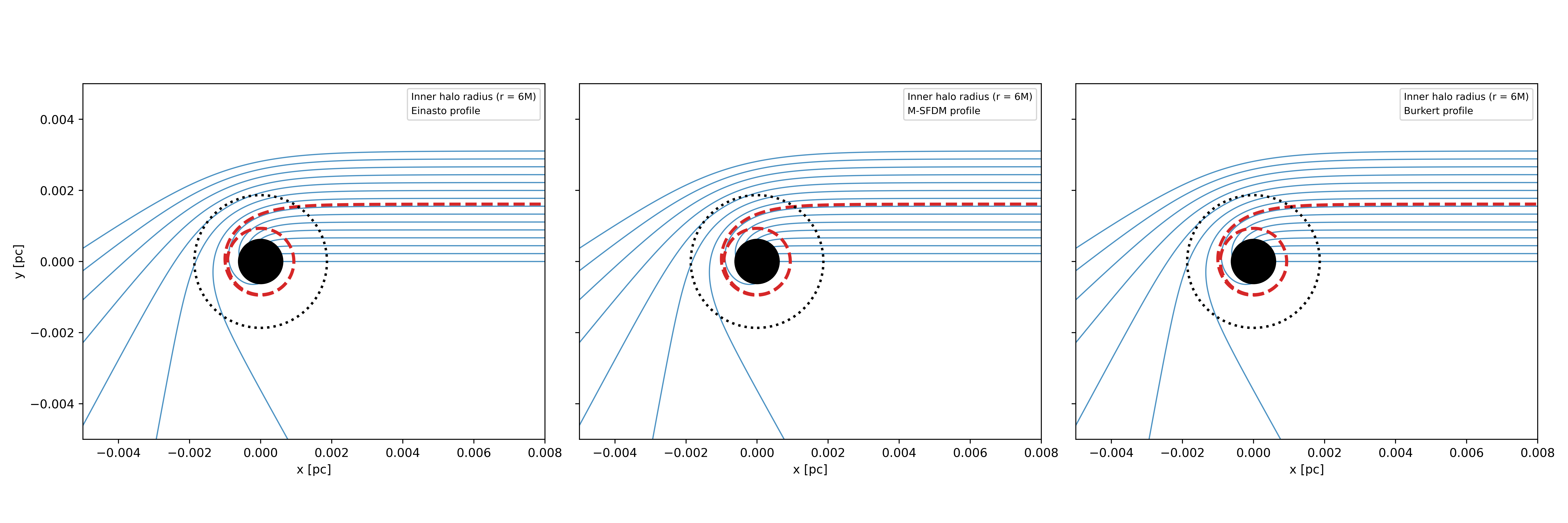
Figure 6: Null geodesics for each density profile.
Theoretical and Practical Implications
The metric construction establishes a rigorous framework for modeling galactic-center black holes with a surrounding matter distribution, free from arbitrary metric restrictions and maintaining compatibility with all Einstein equations and energy conditions. Practically, this method allows:
- Systematic exploration of shadow, lensing, and orbital behaviors for black holes in halos,
- Reliable baseline for gravitational wave propagation and environmental modeling,
- Extension to alternative density profiles or more complex matter equations of state.
Theoretically, the reciprocal metric relation arises generically for weakly compact matter distributions—this result should motivate revision of prior studies using imposed metric forms. The junction analysis ensures that observational signatures attributable to matter halos are not obscured by metric discontinuities or spurious shell effects.
Future Directions
Further studies could generalize the formalism to rotating black holes, incorporate dynamical halo evolution, or explore non-minimal couplings in scalar field models. Extension to strong-field scenarios or higher halo compactness may reveal significant deviations from reciprocal metric behavior. Additionally, new constraints from EHT and stellar orbit observations could refine profile parameterization and test the robustness of the pressure reconstruction method.
Conclusion
This work provides a mathematically consistent, physically transparent prescription for determining the spacetime metric of a Schwarzschild black hole in a dark matter halo, incorporating realistic density profiles and exact pressure reconstruction. The analysis confirms that the reciprocal relation between the metric functions is an emergent property for weakly relativistic halos, not a model-based assumption. The resulting metric is regular, satisfies all energy conditions, and allows precise matching of interior and exterior regions, thereby furnishing a robust platform for future astrophysical modeling and interpretation (2606.27482).

