- The paper establishes a formalism for extracting axial tidal Love numbers in Schwarzschild black holes embedded in anisotropic matter environments.
- The study employs both a small-compactness expansion and numerical integration to analyze different dark matter halo profiles such as NFW, Hernquist, and Einasto.
- The paper reveals that, with proper treatment of matter cutoffs, the axial TLNs are negative and large, underscoring the necessity of a vacuum exterior for precise tidal matching.
Axial Tidal Love Numbers of Black Holes Embedded in Matter Environments
Motivation and Context
The study investigates the axial (magnetic) tidal Love numbers (TLNs) for Schwarzschild black holes (BHs) surrounded by spherically symmetric matter, with a primary focus on environments modeled as anisotropic fluids. Traditional general relativity (GR) predicts that vacuum, nonrotating BHs possess strictly vanishing TLNs, a symmetry-driven feature that has gained renewed significance as gravitational wave detectors improve their sensitivity to tidal effects in compact binary coalescence. However, realistic BHs are typically embedded within astrophysical environments such as accretion disks or dark matter halos, which can induce nontrivial tidal responses. The detection of non-zero TLNs in gravitational wave signals may therefore be indicative not only of exotic compact objects or modified gravity, but also of environmental matter distributions. Establishing a rigorous formalism for environmental TLNs is crucial to avoid confounding new physics with astrophysical effects.
The core of the analysis is the perturbative treatment of a Schwarzschild BH immersed in a matter distribution described by a class of anisotropic fluid models, typified by the Einstein cluster prescription. This setup envisions a large number of non-interacting particles with isotropic angular momentum distributions, producing zero radial pressure but nonzero tangential pressure. The background metric is spherically symmetric, and perturbations are developed in the Regge–Wheeler gauge, with the axial (odd-parity) sector focusing exclusively on induced current multipole moments.
The perturbation equations are expanded to linear order in the metric, yielding a system coupled to the perturbed fluid velocities. The paper considers branches corresponding to either irrotational fluid motions (vorticity-free four-velocity) or strictly static limits, and shows that these lead to distinct physical interpretations and prescriptions for extracting the TLNs.
Definition and Extraction of Tidal Love Numbers
TLNs are defined as proportionality constants relating the induced moments to the external tidal field, specifically via the asymptotic metric expansion in the ACMC (asymptotically Cartesian and mass-centered) gauge. The axial TLNs, unlike polar ones, are purely relativistic and lack Newtonian analogues. For practical applications, dimensionless TLNs are constructed using the characteristic length scale of the system, typically the total enclosed mass.
Matter Profiles: Dark Matter Halo Models
Several astrophysically motivated matter profiles are considered: the Hernquist, Navarro–Frenk–White (NFW), and Einasto distributions, each parameterized to represent realistic dark matter halos with varying degrees of compactness and density falloff. The mass function m(r) for these profiles is computed both analytically and numerically, and provides the foundation for the perturbation equations.
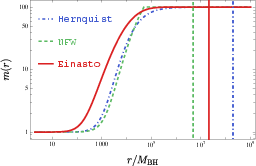
Figure 1: Mass function m(r) for the Hernquist, NFW, and Einasto profiles, with the R99 radii marking the location enclosing 99% of total mass.
Analytical Approach: Small-Compactness Expansion
To obtain explicit expressions for the TLNs, the perturbation equations are expanded perturbatively in the small halo compactness parameter C=M/a0, with M the total halo mass and a0 its characteristic scale. Zeroth-order solutions reproduce the vacuum result, with vanishing TLNs, while first-order corrections are determined by the mass function and its derivatives.
The Hernquist profile allows for closed-form expressions, but reveals the presence of logarithmic divergences in the asymptotic expansion of the perturbation, reflecting the non-compact support of the density. For the NFW profile, the introduction of a cutoff radius yields polynomial expansions and removes the pathological logarithmic behavior. The Einasto profile, though algebraically more complex, exhibits similar features upon imposing a cutoff.
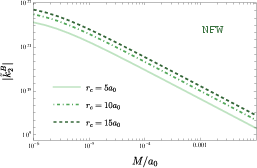
Figure 2: Analytic axial Love numbers $\Tilde{k}_2^B$ for various compactness values and cutoff radii for the NFW profile.
Numerical Results and Comparison
Numerical integration is performed for the perturbation equations using a vacuum boundary condition at a cutoff radius R99, chosen to enclose 99% of the total mass. The TLNs are extracted by ACMC matching, and the resulting values are systematically compared against analytical predictions.
For the NFW profile with a cutoff, numerical and analytical results are in close agreement across a wide range of compactness values, with fractional differences below 10−3% for realistic halo parameters.
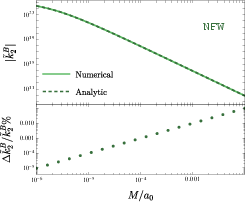
Figure 3: Axial Love numbers $\Tilde{k}_2^B$ for the NFW profile as a function of compactness; top: numerical vs analytic, bottom: fractional difference.
However, for the Hernquist and Einasto profiles lacking a cutoff, the analytical predictions diverge from numerical integration due to persistent logarithmic terms in the asymptotic expansion. These terms undermine the ACMC matching and introduce arbitrary scale dependencies not present in strictly vacuum regions. By imposing a cutoff at m(r)0 in the analytical treatment, agreement with numerical results is restored, substantiating that TLNs for extended matter distributions are only well-defined when the asymptotic region is strictly vacuum.
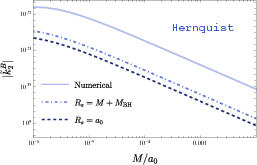
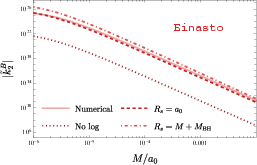
Figure 4: Axial Love numbers for the Hernquist profile as a function of compactness; numerical results vs analytic predictions with different scale choices.
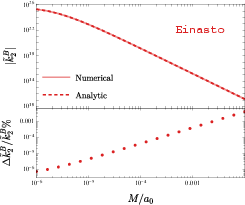
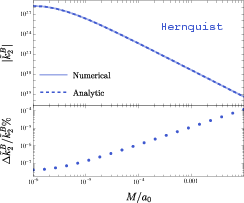
Figure 5: Comparison between numerical results and small-compactness expansion for the Hernquist profile with a radial cutoff at m(r)1.
Implications and Theoretical Discussion
A robust result of the study is that the axial TLNs for all computed matter profiles are negative and large in magnitude, reflecting the extended and weakly bound character of the ambient matter. This is consistent with previous reports for neutron stars and exotic objects in the irrotational limit. Crucially, the detection of non-zero TLNs in gravitational wave signals could either signal deviations from the vacuum BH paradigm or be caused by environmental effects; the latter must therefore be precisely characterized to avoid systematic biases in parameter estimation.
The analysis establishes that the presence or absence of compact support in the matter profile fundamentally determines whether TLNs can be rigorously defined. Logarithmic terms in profiles without compact support obstruct standard tidal matching and require a cutoff or alternative treatment. This has practical consequences for modeling BHs embedded in realistic astrophysical environments, and for interpreting gravitational wave data in searches for new physics.
Conclusion
The paper rigorously formulates and computes the axial tidal Love numbers for Schwarzschild black holes surrounded by spherically symmetric matter distributions, specializing to dark matter halo profiles. Through complementary analytical and numerical methods, the study demonstrates that TLNs become well-defined observables only when the matter profile possesses compact support—a vacuum exterior is necessary for standard tidal matching. The result highlights the necessity for careful control of environmental modeling in gravitational wave astrophysics, with implications for distinguishing genuine strong-field deviations from environmental effects. Future directions include extending the formalism to polar TLNs and exploring broader classes of matter environments, with the overarching goal of improving the interpretability of gravitational wave signatures from compact object binaries (2605.02633).

