- The paper presents the first fully analytic, three-layer gravastar solution that eliminates black hole singularities and event horizons.
- It derives explicit interior, shell, and exterior metrics using the Darmois–Israel formalism and evaluates dynamic stability via the Poisson–Visser potential.
- The analysis confirms compliance with energy conditions, thermodynamic limits, and identifies unique observational signatures through gravitational lensing and redshift evaluations.
Exact Gravastar Solution: A Rigorous Alternative to Black Holes
Introduction
The paper "Exact Gravastar Solution" (2604.09719) develops the first fully analytic, self-consistent three-layer gravastar solution to the Einstein field equations, addressing long-standing theoretical gaps in gravastar modeling. The work explicitly solves the field equations for each region—interior, shell, and exterior—and constructs unique, exact metric and matter configurations that avoid the pathological features of black holes, such as singularities and event horizons. All interfacial junctions are treated with the full Israel-Darmois formalism, and both energy and thermodynamic consistency conditions are thoroughly analyzed.
Model Construction and Field Equations
The proposed gravastar consists of:
- Interior (de Sitter core): Equation of state p=−ρ, leading to a spacetime line element with metric functions eν=C1(1−H2r2) and e−λ=1−H2r2.
- Shell (exact thick shell): p=−ρ/5. An exact analytic solution is given with eν=K/r, eλ=1/(rC−4), and energy-momentum components ρ=5/(8πr2) and p=−1/(8πr2). Rigorous bounds on r follow from positivity and coordinate consistency.
- Exterior: Schwarzschild, eν=1−2M/r, eν=C1(1−H2r2)0.
The solutions are matched using the full suite of Darmois–Israel conditions, ensuring that both the first and second fundamental forms are consistently handled. Explicit closed-form expressions for the surface energy density eν=C1(1−H2r2)1 and pressure eν=C1(1−H2r2)2 are derived.
Junction Analysis and Poisson–Visser Potential
Structural junctions at both core–shell and shell–exterior boundaries are analyzed via the extrinsic curvature jumps, generating explicit expressions for the surface terms and the Poisson–Visser effective potential eν=C1(1−H2r2)3. These yield both the stability and the allowed parameter domains for the system.
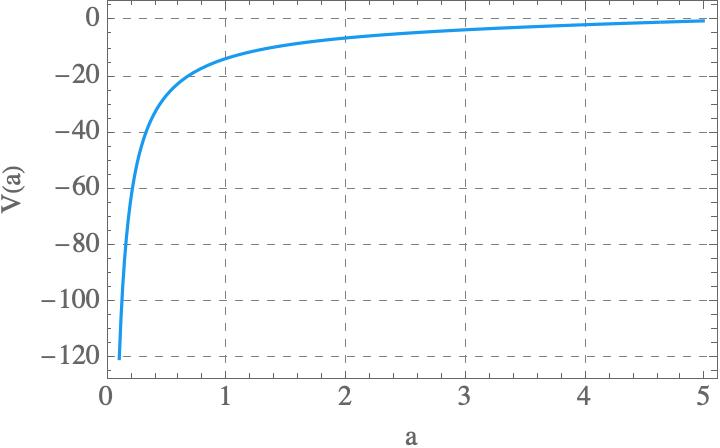
Figure 1: Plot of eν=C1(1−H2r2)4 vs eν=C1(1−H2r2)5 for the interior and shell region junction, showing parameter regimes supporting stable gravastar structure.
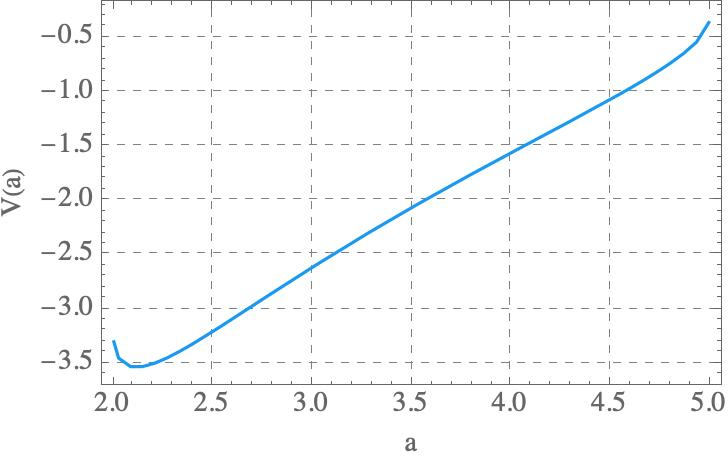
Figure 2: Poisson–Visser potential eν=C1(1−H2r2)6 at the shell–exterior junction, illustrating the existence of a potential minimum associated with shell stability.
In both cases, the presence of a minimum in eν=C1(1−H2r2)7 for physically reasonable parameter choices indicates configurations that are dynamically robust against radial perturbations.
Surface Redshift and Observational Constraints
The surface redshift eν=C1(1−H2r2)8 is computed, with explicit evaluation of the Buchdahl bound. The requirement eν=C1(1−H2r2)9 enforces e−λ=1−H2r20, while the condition e−λ=1−H2r21 implies e−λ=1−H2r22. The admissible parameter region for gravastar models is thus tightly constrained, ensuring that the objects mimic black holes exteriorly but remain compatible with gravitational compactness bounds.
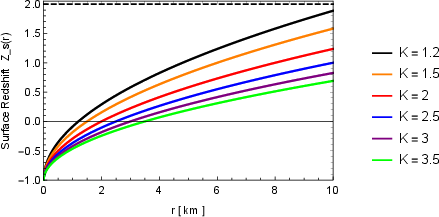
Figure 3: e−λ=1−H2r23 for representative e−λ=1−H2r24; the Buchdahl limit e−λ=1−H2r25 and physically permissible regions are emphasized.
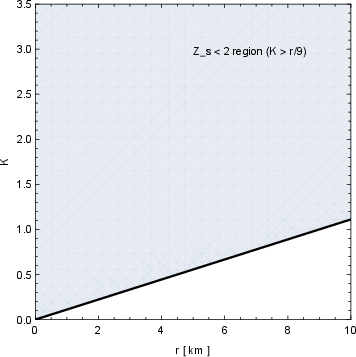
Figure 4: Admissible parameter space e−λ=1−H2r26 for non-blueshifted, sub-Buchdahl gravastar surfaces in the e−λ=1−H2r27 plane.
Causality, Stability, and Energy Conditions
The shell region features e−λ=1−H2r28, falling strictly within the causal interval. Herrera's cracking diagnostic and speed-of-sound criteria, as well as Abreu's anisotropy-based stability formalism, all confirm the absence of local instabilities. Analytical checks show monotonic, finite pressure and energy density, and all four classical energy conditions—Null, Weak, Strong, and Dominant—are globally satisfied for the shell matter:
- e−λ=1−H2r29 (NEC)
- p=−ρ/50, p=−ρ/51 (WEC)
- p=−ρ/52 (SEC)
- p=−ρ/53 (DEC)
This is a notable result, as many earlier gravastar constructions either violated one or more energy conditions or admitted unphysical stress-energy tensors.
Proper Thickness, Energy, and Entropy
The analysis of shell properties yields closed-form expressions for both the proper thickness p=−ρ/54 and proper energy p=−ρ/55, both determined exclusively from the model parameters and showing a non-trivial dependence on the underlying shell geometry.
The thermodynamic sector is treated with particular rigor. The entropy density is found to be: p=−ρ/56
using the Gibbs relation and Tolman temperature law. Integrating over the shell volume gives the total shell entropy: p=−ρ/57
which conforms to the Bekenstein bound p=−ρ/58 for all physically admissible parameter values. The entropy density monotonically decreases outward, and its convex profile ensures the gravitational system's tendency to concentrate entropy towards deeper gravitational wells.
Gravitational Lensing and Deflection
The Jacobi metric formalism is employed to compute the deflection angle for massive test particles traversing the shell region. The analysis reveals a characteristic dependence of the deflection angle on both the shell parameters and the test particle velocity/impact parameter, supporting the expectation that gravastars, while indistinguishable from black holes at large distances, may yield observable differences in lensing and orbital precession signatures near the compact object's surface.
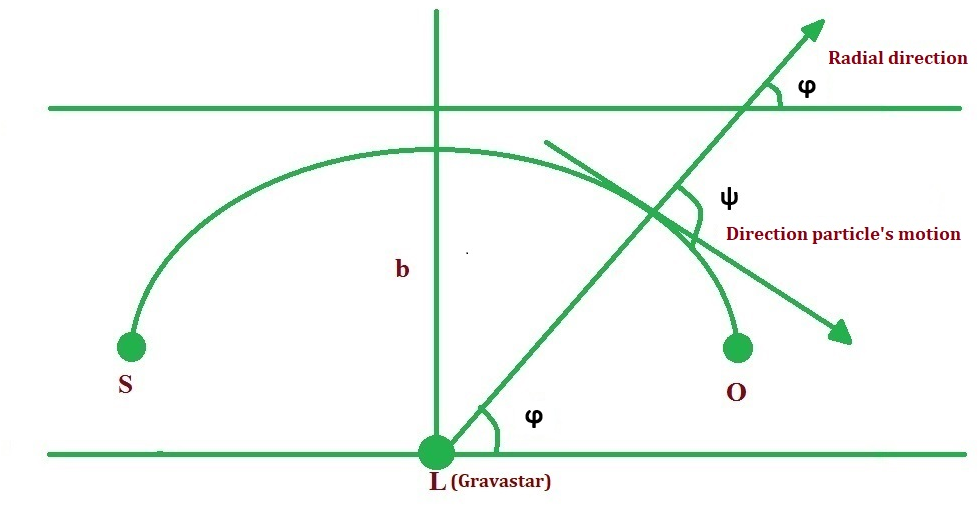
Figure 5: Representative orbital trajectory of a massive particle near the shell, illustrating weak-field lensing and closest-approach effects.
Implications and Future Directions
This work definitively demonstrates that gravastar solutions need not resort to ad hoc or patched metrics: it is possible to construct a model with continuous, exact solutions and a thick shell that satisfies all of general relativity's field and physical viability requirements. The precise determination of surface redshifts and entropy structure enables, in principle, distinguishing compact gravastars from black holes through high-resolution gravitational and electromagnetic signatures.
Practically, these results provide new motivation for the observational search for black hole alternatives. Theoretically, the techniques employed here can be generalized to other equations of state, different shell compositions (including exotic fields or charges), or rotating/axially symmetric spacetimes.
Conclusion
The paper provides the first complete, exact, and physically consistent gravastar model with a thick shell, resolving mathematical and physical challenges plaguing previous constructions. The model admits no singularities or event horizons, satisfies all energy and causality conditions, respects thermodynamic laws and entropy bounds, and remains stable against radial and anisotropic perturbations. The analytic insight into redshift, entropy, junction structure, and particle deflection offers a foundation for both further theoretical study and potential astrophysical tests distinguishing gravastars from black holes.

