- The paper demonstrates that strong lensing observables near black holes show subpercent-level deviations when embedded in SI-SFDM halos compared to idealized Schwarzschild metrics.
- It employs a detailed numerical reconstruction using the Einstein cluster formalism to resolve photon sphere and deflection angle corrections with precisions on the order of 10⁻¹⁵.
- The study highlights that time-delay measurements, with corrections up to 20 minutes for massive BHs, offer a promising avenue for distinguishing dark matter halo models in future observations.
Strong-Lensing Degeneracies of Black Holes Embedded in Self-Interacting Scalar Field Dark Matter Halos
Introduction and Motivation
This study rigorously examines the strong gravitational lensing signatures of black holes (BHs) embedded within self-interacting scalar field dark matter (SI-SFDM) halos, juxtaposed with canonical Navarro-Frenk-White (NFW) halo configurations. The motivation lies in understanding to what extent realistic galactic environments—where the central BH is necessarily surrounded by baryonic and dark matter—alter relativistic lensing observables. While the Schwarzschild and Kerr vacuum metrics remain highly accurate near the photon sphere, even small corrections from extended matter distributions potentially encode astrophysical information in high-precision observations, such as those enabled by the Event Horizon Telescope (EHT).
The authors utilize a compact anisotropic matter formalism (Einstein cluster) to numerically reconstruct the spacetime geometry around a Schwarzschild BH embedded in either SI-SFDM or NFW halos. The analysis systematically characterizes the influence of these environments on null geodesics, photon sphere location, critical impact parameter, and the entire hierarchy of strong-lensing signatures, with emphasis on relativistic image properties, shadow and Einstein ring radii, magnification, and associated time delays for the well-studied supermassive black holes M87* and Sgr A*.
Methodological Framework
The spacetime metric is modeled as
ds2=−f(r)dt2+g(r)dr2+r2(dθ2+sin2θdϕ2)
where g(r)=1−2m(r)/r, with source terms for energy density and tangential pressure derived from the dark matter (DM) halo profile and Einstein cluster ansatz. The density is specified by a core+envelope SI-SFDM profile: a solitonic (quantum pressure-supported) core transitions to a classical isothermal (power-law) envelope, capturing the essential structure predicted by self-interacting DM theories. NFW counterparts serve as reference models.
The mass function m(r) and lapse f(r) are obtained by direct numerical integration subject to boundary conditions at the BH horizon, the marginally bound radius, and the outer halo edge. All quantities are numerically computed with sufficient precision to resolve O(10−15)-scale changes in photon sphere properties, ensuring the reliable extraction of subpercent-level corrections to lensing observables.
Spacetime and Halo Structure
The SI-SFDM and NFW models present a solitonic core or cusp, respectively, with the extended halo characterized by a distinct slope:
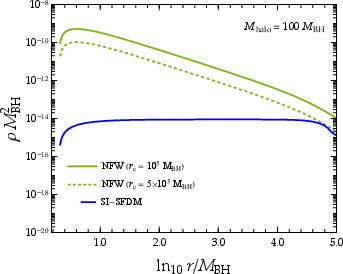
Figure 1: Halo density profiles for Mhalo=100MBH depict the clear core-envelope structure of SI-SFDM compared to the monotonically decreasing NFW profile.
Key structural characteristics are:
- Photon sphere radius (rp): Practically unaffected, with numerical deviations <10−14MBH across all halo models.
- Critical impact parameter (bc): Sensitive at the ∼10−3 relative level, encoding measurable, though small, environmental effects.
Metric differences near the photon sphere translate to small modulations in the effective photon potential g(r)=1−2m(r)/r0:
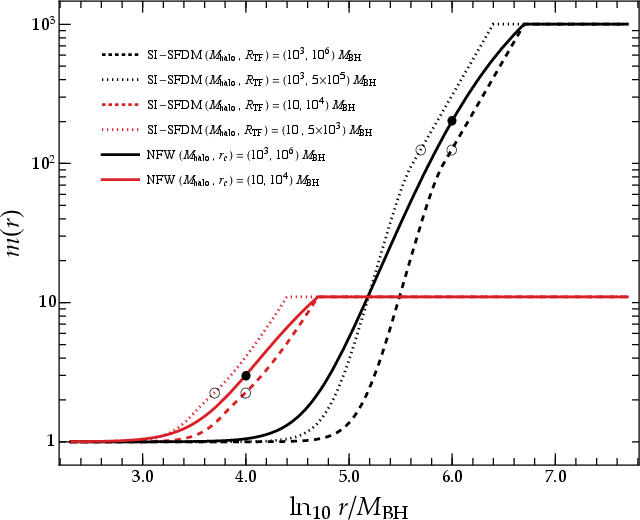
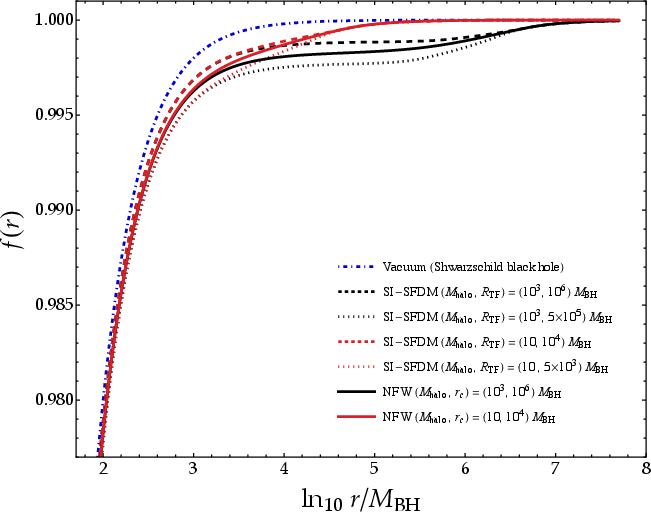
Figure 2: Profiles of the mass function g(r)=1−2m(r)/r1 and lapse g(r)=1−2m(r)/r2 for SI-SFDM and NFW halos with varying compactness.
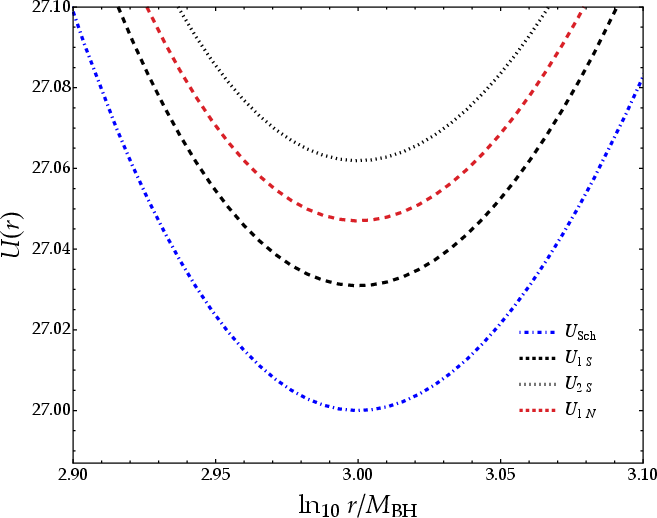
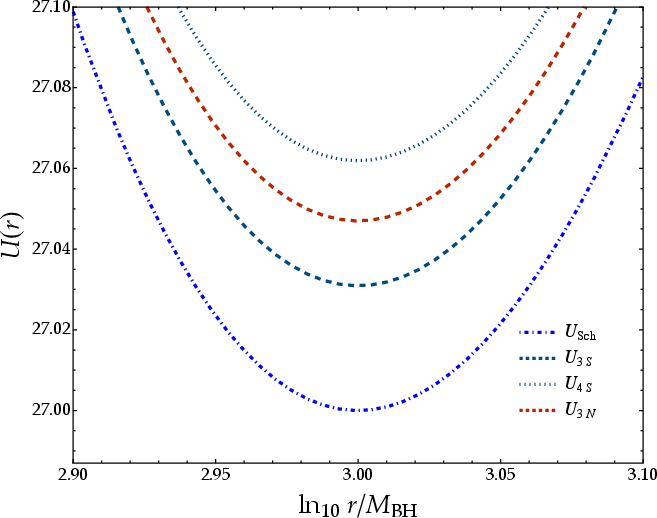
Figure 3: Radial profile of the effective potential g(r)=1−2m(r)/r3, with halo configurations lying just above the Schwarzschild baseline due to the mass distribution outside the horizon.
Impact on Strong Lensing Observables
Photon Sphere and Shadow
The photon sphere remains robust, and the shadow radius g(r)=1−2m(r)/r4 exhibits corrections
g(r)=1−2m(r)/r5
where g(r)=1−2m(r)/r6 parameterizes the halo configuration, yielding only g(r)=1−2m(r)/r7 level dispersion. All predicted shadow radii are well within current EHT bounds for both Sgr A* and M87*.
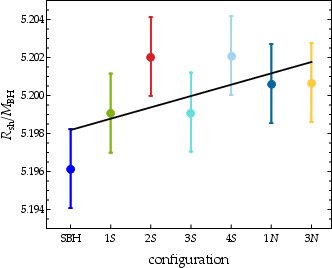
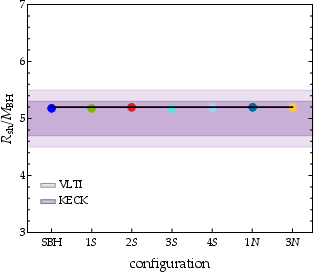
Figure 4: (a) Apparent shadow radius for various halo configurations; (b) Comparison with EHT observational bounds for Sgr A
, showing all predictions are within the allowed range.*
Deflection Angle and Relativistic Images
Bending angles increase minutely with halo mass and compactness, but variations among models remain strongly degenerate. Deflection angle corrections g(r)=1−2m(r)/r8 demonstrate this systematically:
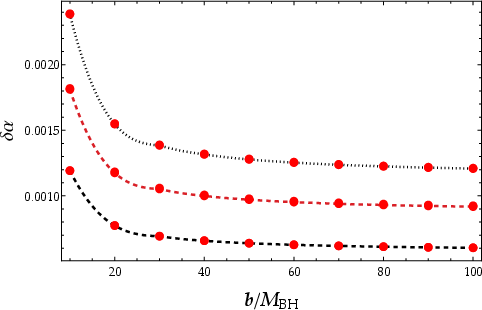
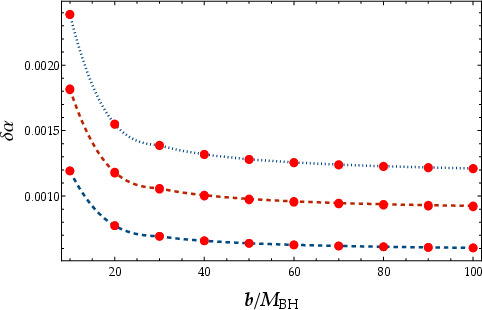
Figure 5: Bending angle deviations g(r)=1−2m(r)/r9 relative to Schwarzschild for each halo configuration.
Einstein Rings and Finite-Order Images
Relativistic Einstein ring positions, as well as finite-order image angular positions and separations, are computed explicitly for astrophysically realistic distances and masses:
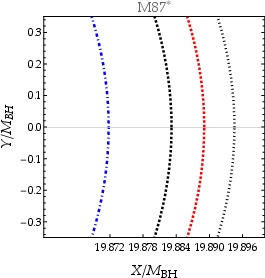
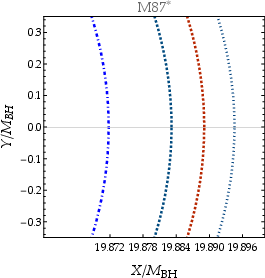
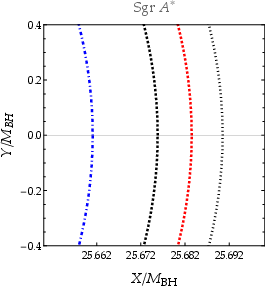
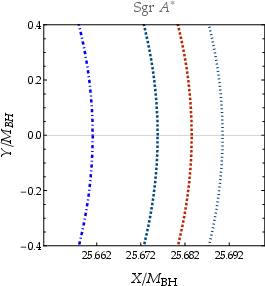
Figure 6: Outermost relativistic Einstein ring (RER) radii for M87
(a,b) and Sgr A* (c,d) for all halo models in celestial coordinates.*
Absolute differences in the first two relativistic image positions (m(r)0, m(r)1) show only a common shift across models, with image separations m(r)2 remaining nearly unchanged:
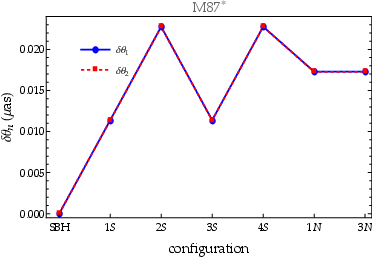
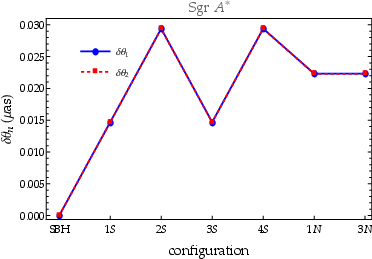
Figure 7: Deviations of finite-order image positions for M87
and Sgr A* as a function of halo model.*
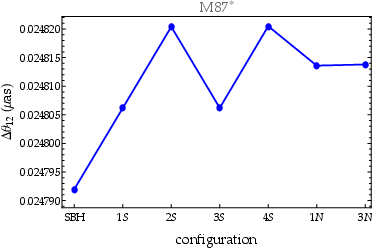
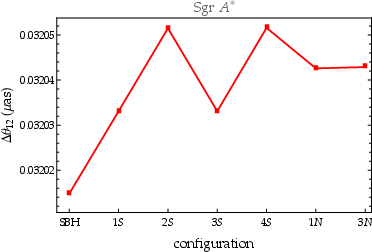
Figure 8: Separation m(r)3 between the first two relativistic images across halo configurations.
Magnification and Hierarchy
Magnification of relativistic images and their ratios are found to have negligible dependence on halo details. Rescaling of magnifications is uniform across the first few images, resulting in minimal changes in the brightness hierarchy:
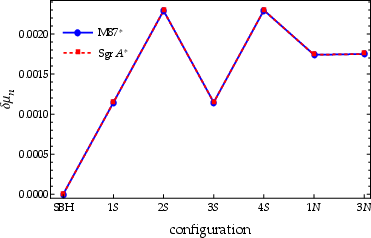
Figure 9: Relative magnification deviation m(r)4 for m(r)5 as a function of halo configuration.
Time Delays
Time delays between successive relativistic images exhibit the largest absolute deviations due to their direct dependence on m(r)6 and the BH mass:
- For M87*, the maximum absolute correction is m(r)7 minutes;
- For Sgr A*, the correction is m(r)8 minutes.
Relative deviations always remain at the m(r)9 level.
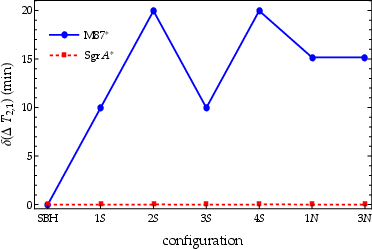
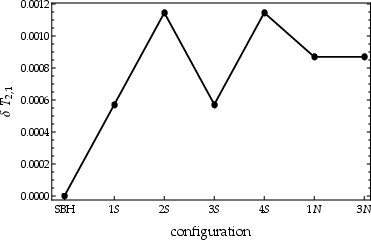
Figure 10: (Left) Absolute time-delay deviation f(r)0 for the first two relativistic images; (Right) Relative deviation, closely mirroring the fractional change in f(r)1.
Discussion
This work robustly establishes that, within the SI-SFDM and NFW paradigms and for a broad set of plausible halo configurations, all standard primary strong-lensing observables (shadow size, Einstein ring radii, finite-order image positions, separations, and magnifications) are observationally degenerate with the Schwarzschild expectation at better than f(r)2 relative accuracy. The time delay observable, uniquely, amplifies the absolute effect for massive enough BHs due to f(r)3 scaling while preserving the relative smallness, offering a potential probe in the next generation of ultra-precision time-domain lensing studies.
The hierarchy of deviations among the models is primarily set by the effective halo compactness in the photon sphere vicinity rather than the total halo mass. Extended, low-density halos with large mass can imprint even less than more compact, less massive ones, underscoring the need for high-fidelity modeling of DM distributions in lensing analyses.
Implications and Future Directions
- Constraints from EHT and future VLBI: Present EHT data cannot differentiate between these DM halo scenarios; future increases in angular and time-domain resolution (e.g., ngEHT) may especially benefit from focusing on time delay measurements between relativistic images.
- Perturbative extensions: Incorporating the gravitational back-reaction of the BH on the inner DM profile and vice versa will further refine constraints but, given the subpercent-level corrections identified here, only modestly relax the degeneracy.
- Dark matter characterization: The findings reinforce that standard strong-lensing observations near supermassive BHs are not sensitive probes of the nature of DM halos unless non-standard scenarios or environmental signatures much larger than considered here are present.
Conclusion
Through numerically exact, physically motivated modeling, this paper demonstrates that realistic self-interacting scalar field dark matter and NFW halos—covering a wide astrophysical parameter space—produce only minute, systematic corrections to the strong-lensing phenomenology of BHs. The potential for experimental discrimination among such models is limited with present techniques but may become accessible via time-domain observables in the future, especially for extremely massive BH systems. This work provides a concrete baseline for interpreting high-precision gravitational lensing data in environments with non-negligible environmental structure.

