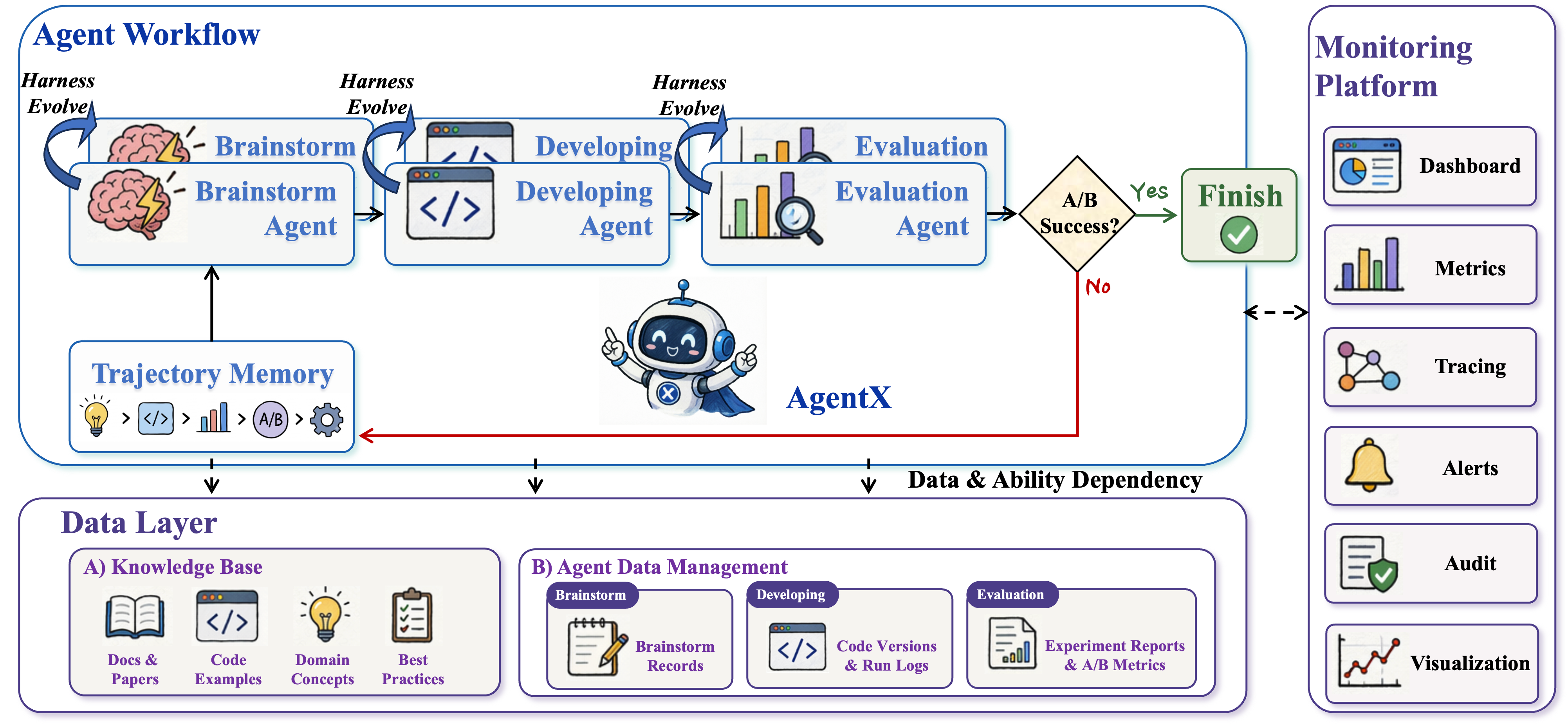
- The paper introduces AgentX, a self-iterating framework that integrates brainstorming, development, and evaluation agents to automate recommendation system improvements.
- It employs semantic-gradient prompt optimization to refine agent performance, achieving throughput enhancements and significant revenue gains in production deployment.
- The framework demonstrates practical viability through rigorous A/B testing and closed-loop feedback, shifting engineer roles from manual iteration to strategic oversight.
AgentX: An Agent-Driven Self-Evolving Framework for Industrial Recommender Systems
Motivation and Structural Innovation
AgentX addresses the bottlenecks inherent in industrial recommender system R&D, where iteration has historically relied on labor-intensive, engineer-driven processes. The transition from hypothesis generation to production rollout, A/B evaluation, and attribution remains blocked by sequential, manual handoffs that scale linearly with human effort. AgentX overcomes this through an agent-driven closed-loop architecture that autonomously generates, implements, evaluates, and iteratively refines recommendation strategies, leveraging trajectory data and real online feedback as compounding assets, rather than mere automation artifacts.
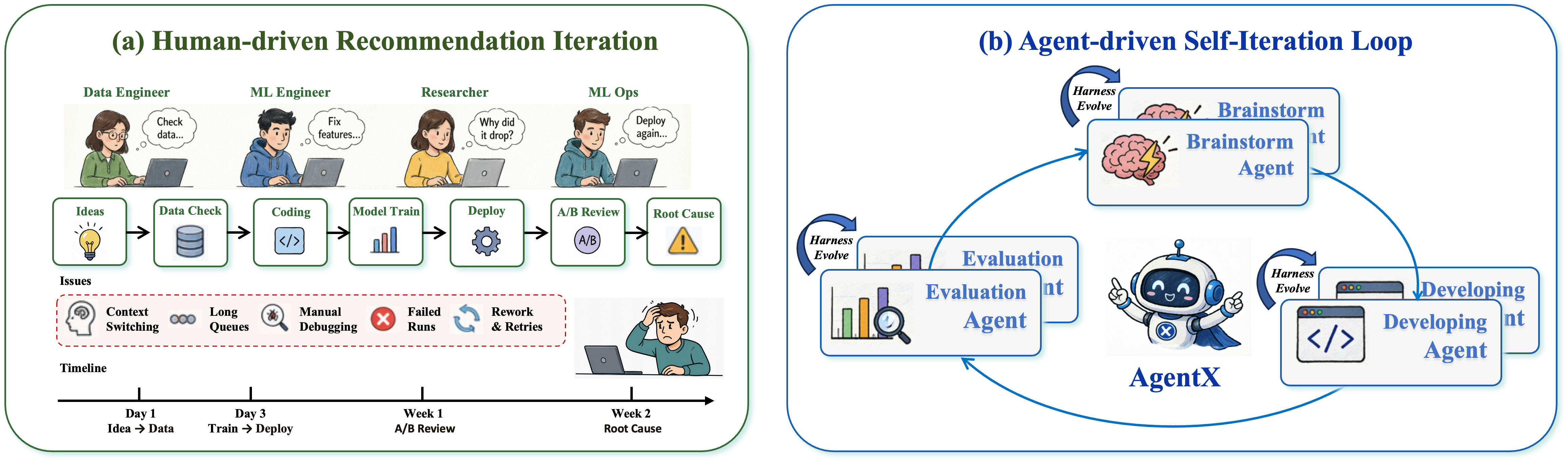
Figure 1: AgentX transforms recommendation iteration from a human-driven, manually handed-off pipeline into an agent-driven closed loop, where online A/B feedback and trajectory data continuously improve the system itself.
System Architecture
AgentX orchestrates four tightly integrated agents within a feedback-driven closed loop:
Agent Workflows and Verification Protocols
Brainstorm Agent
This agent not only proposes ideas but enforces operational precision through intake boundary normalization, batch proposal exploration classified by maturity (ready-to-implement, probe-first, moonshot-backlog), and evidence weighting across Experiment KB, System KB, Data Analysis, and Model Research. Candidate scoring integrates objective alignment, business validity, implementation feasibility, handoff completeness, and risk, with historical knowledge re-used to avoid known failure modes.
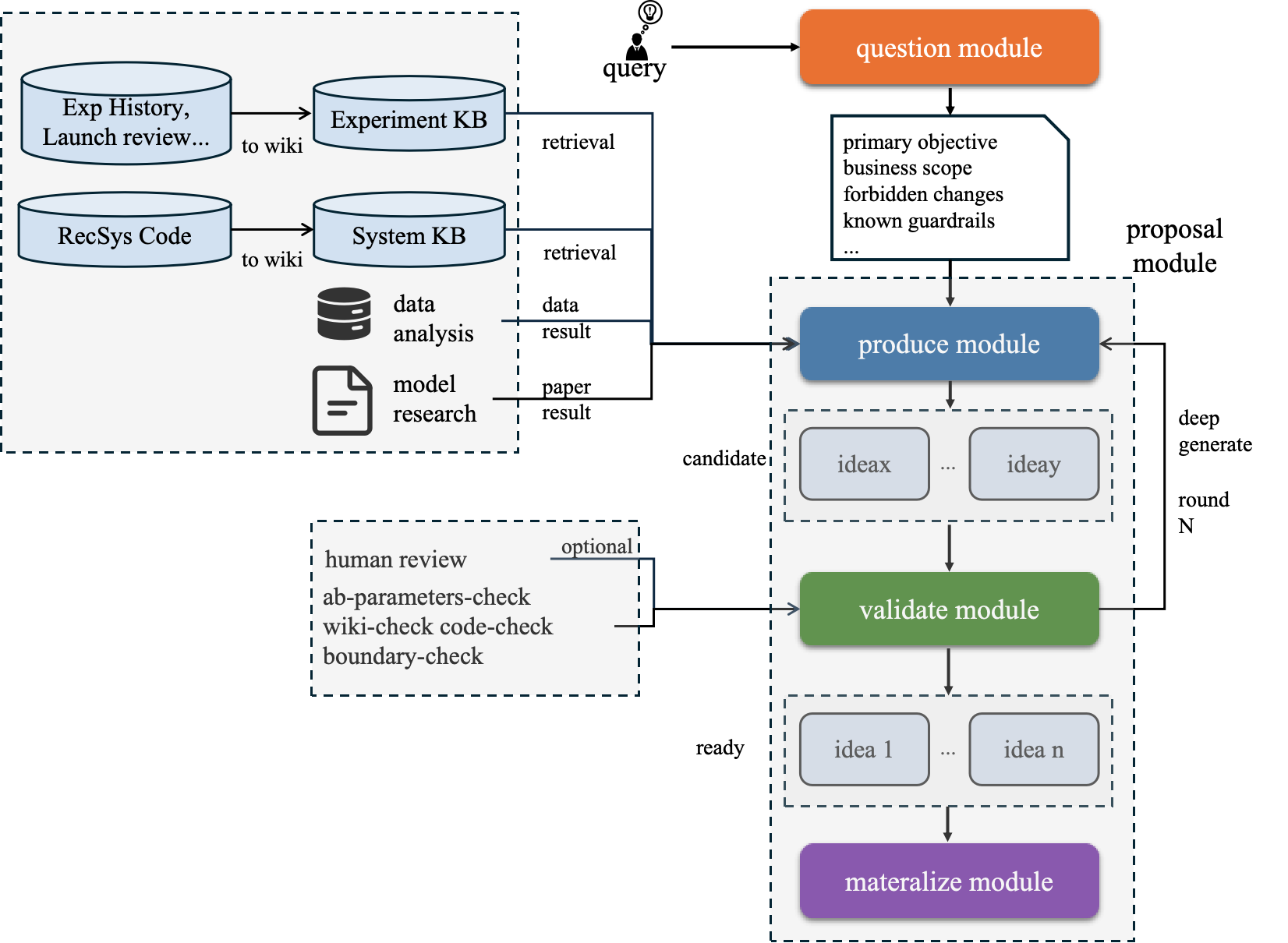
Figure 3: Brainstorm Agent workflow, showcasing evidence aggregation, proposal validation, and materialization leveraging Experiment KB and System KB.
Developing Agent
The Developing Agent realizes approved proposals into production-ready code, differentiated into online strategy and offline model tracks. Reliability is maintained through schema queries, DSL and syntax checkers, static linters, and repository knowledge. Implementation follows a staged plan-abstraction, atomic execution, verification, and dryrun loops, scored by weighted reliability metrics with severity factors prioritizing semantic correctness and default-off safety.
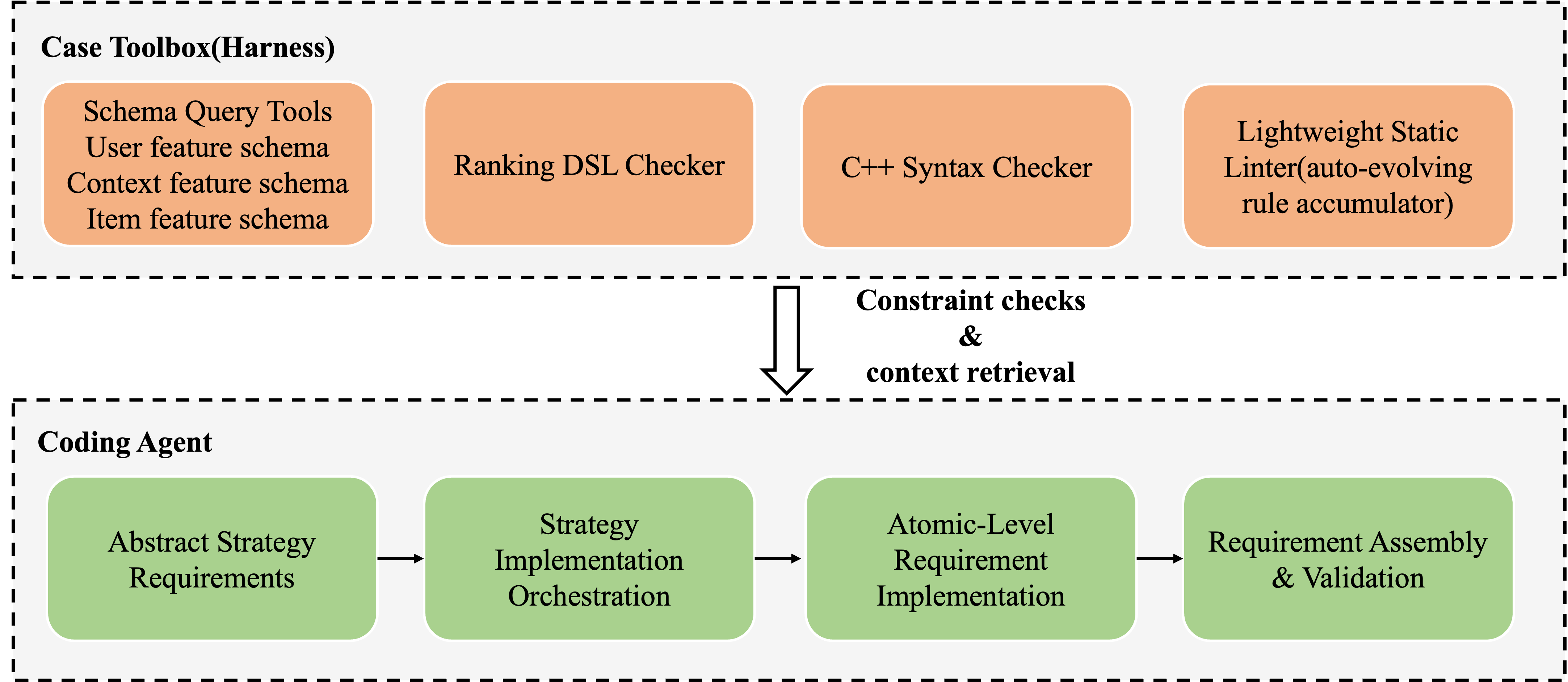
Figure 4: Architecture of the Developing Agent for the online strategy track, emphasizing repository-grounded generation and verification.
For offline model track, the Coding Agent enforces policy declaration, code verification, deterministic metric extraction, and attribution checking. Expert consensus and causal-chain validation are prerequisites for trustworthy conclusion assetization.
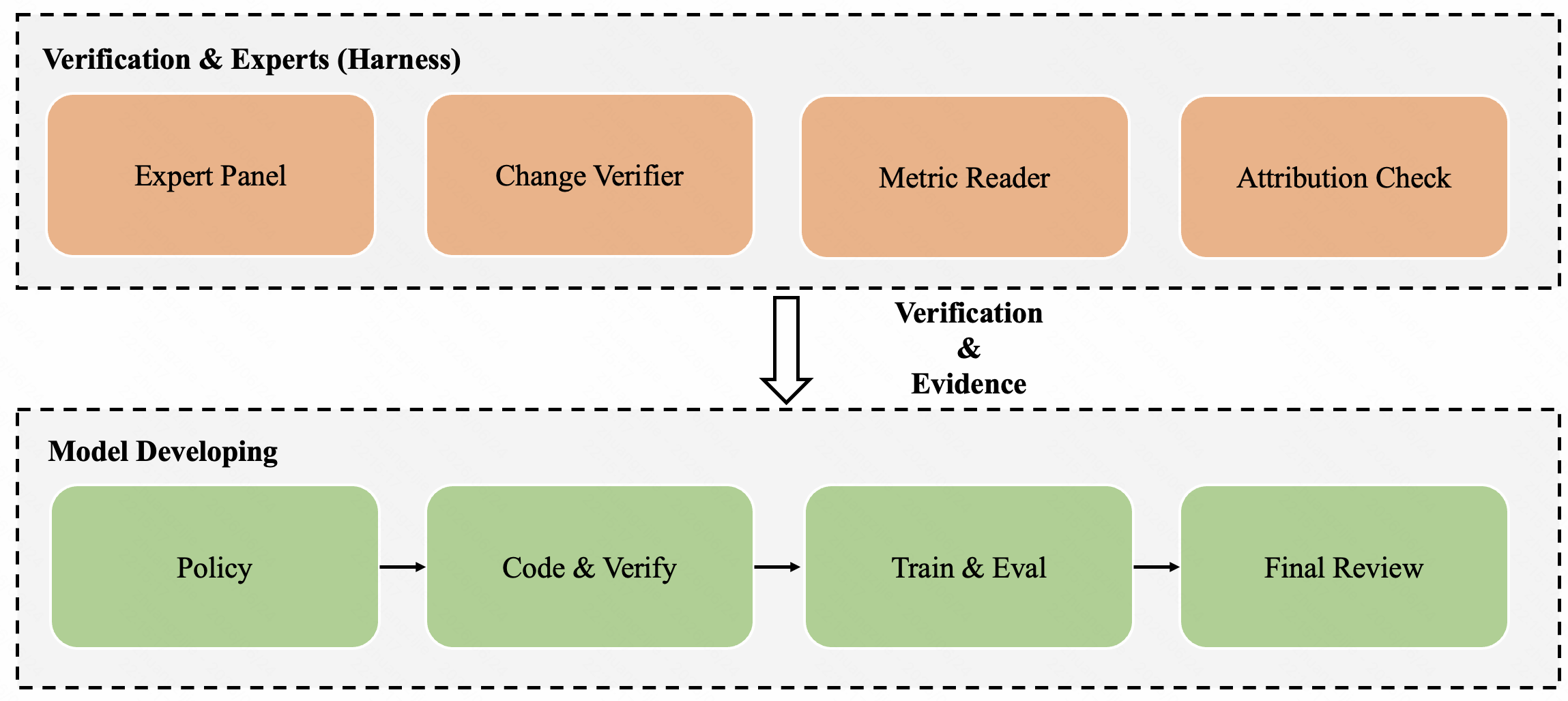
Figure 5: Architecture of the Coding Agent for the offline model track, combining policy declaration, code change verification, training execution, and expert attribution.
Evaluation Agent
This agent operationalizes safe deployment and traffic assignment, rigorous metric extraction, composite guardrail evaluation, and verdict assetization, integrating negative results as reusable exploration constraints.
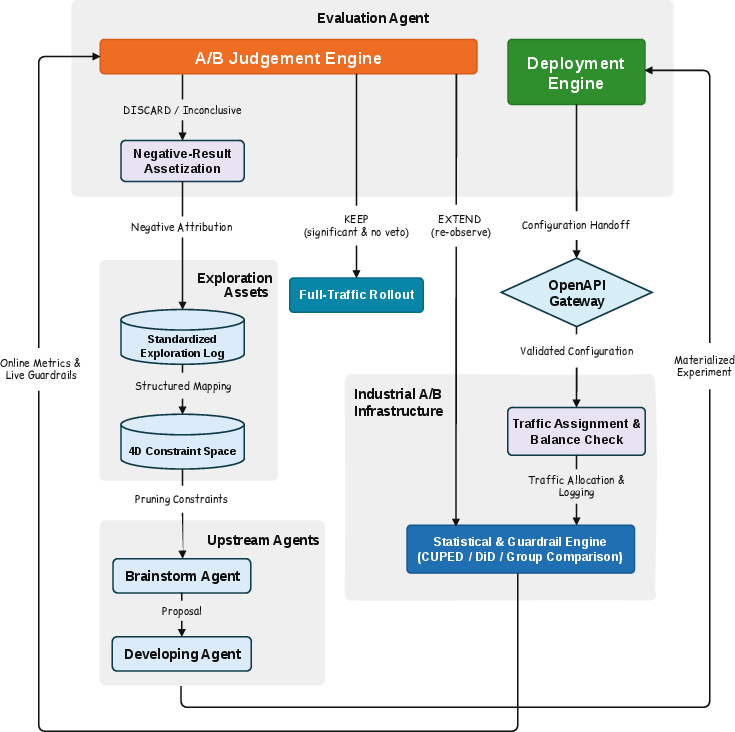
Figure 6: Architecture of the Evaluation Agent, chaining OpenAPI-mediated deployment, A/B execution, and guardrail-vetoed judgment.
Harness Evolution via Semantic Gradient Prompt Optimization
AgentX's harness evolution utilizes SGPO, which distills trace-based evidence and rubric-encoded replay tasks into structured semantic gradients, updating subagent harness specifications and admitting edits solely through paired replay. Two modes—SGPO-I for brainstorm evolution, SGPO-II for coding harness refinement based on merge request replay—demonstrated improvements from 75% to 98% replay score and per-dimension gains from 2.60 to 4.90.
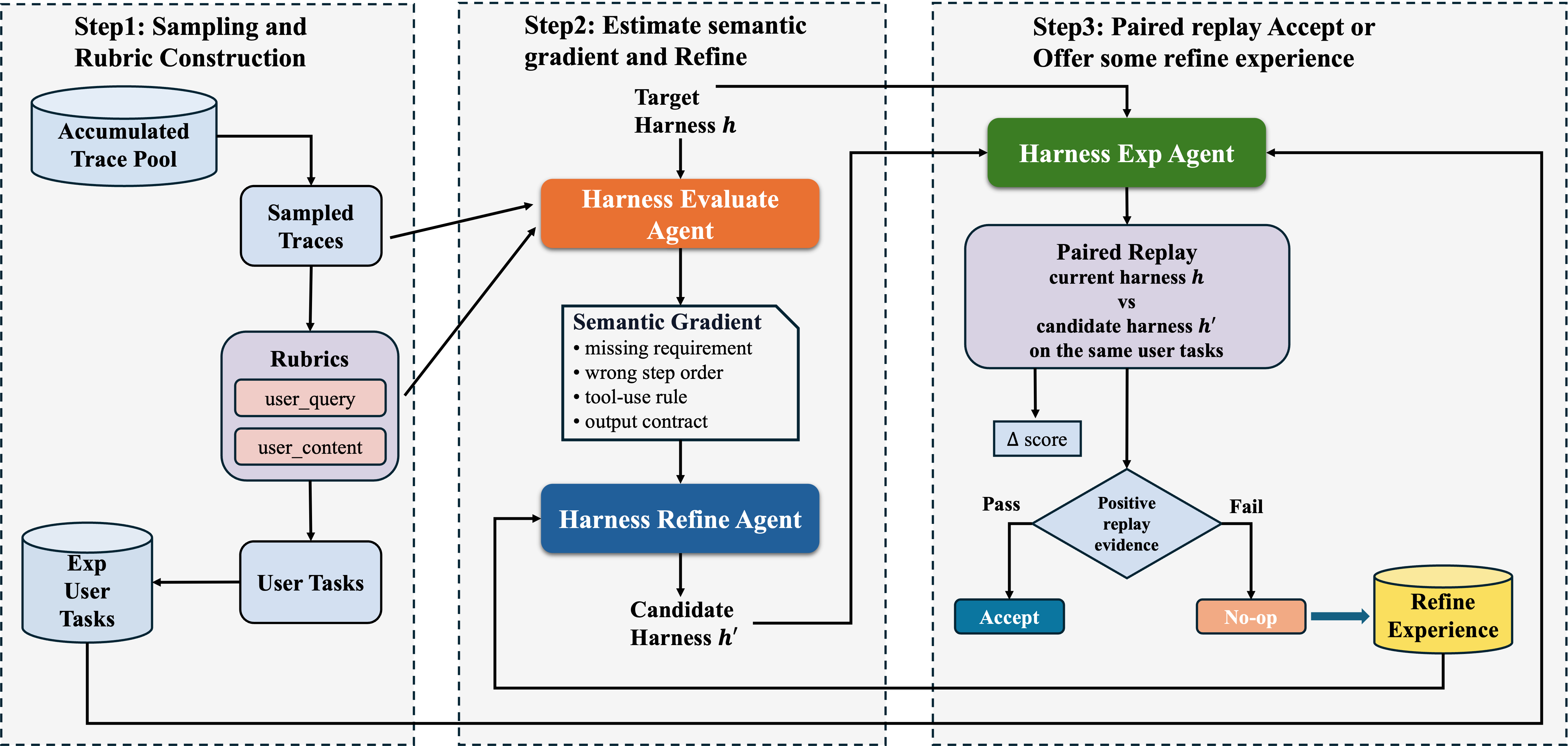
Figure 7: SGPO-I trace-based harness evolution, illustrating sampling, evaluation, refinement, and paired replay gate.
SGPO evolution is non-monotonic but robust by the admission gate, preventing regressive updates based on evaluator misdiagnosis.
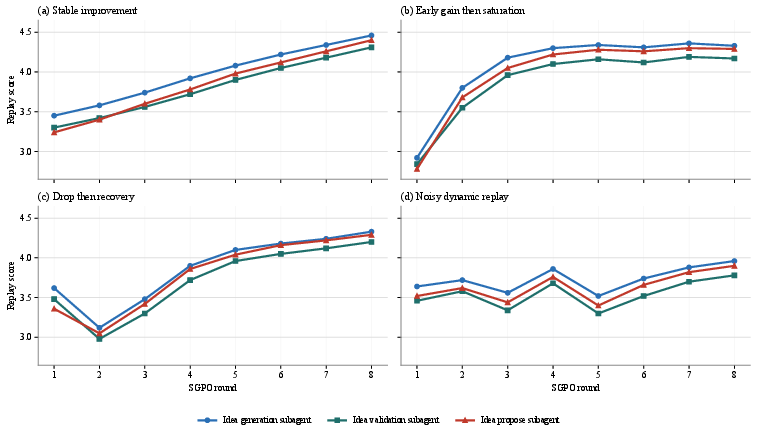
Figure 8: Representative SGPO-I evolution patterns on brainstorm workflow—showing dynamic, non-monotonic improvement trajectories across subagents during harness evolution.
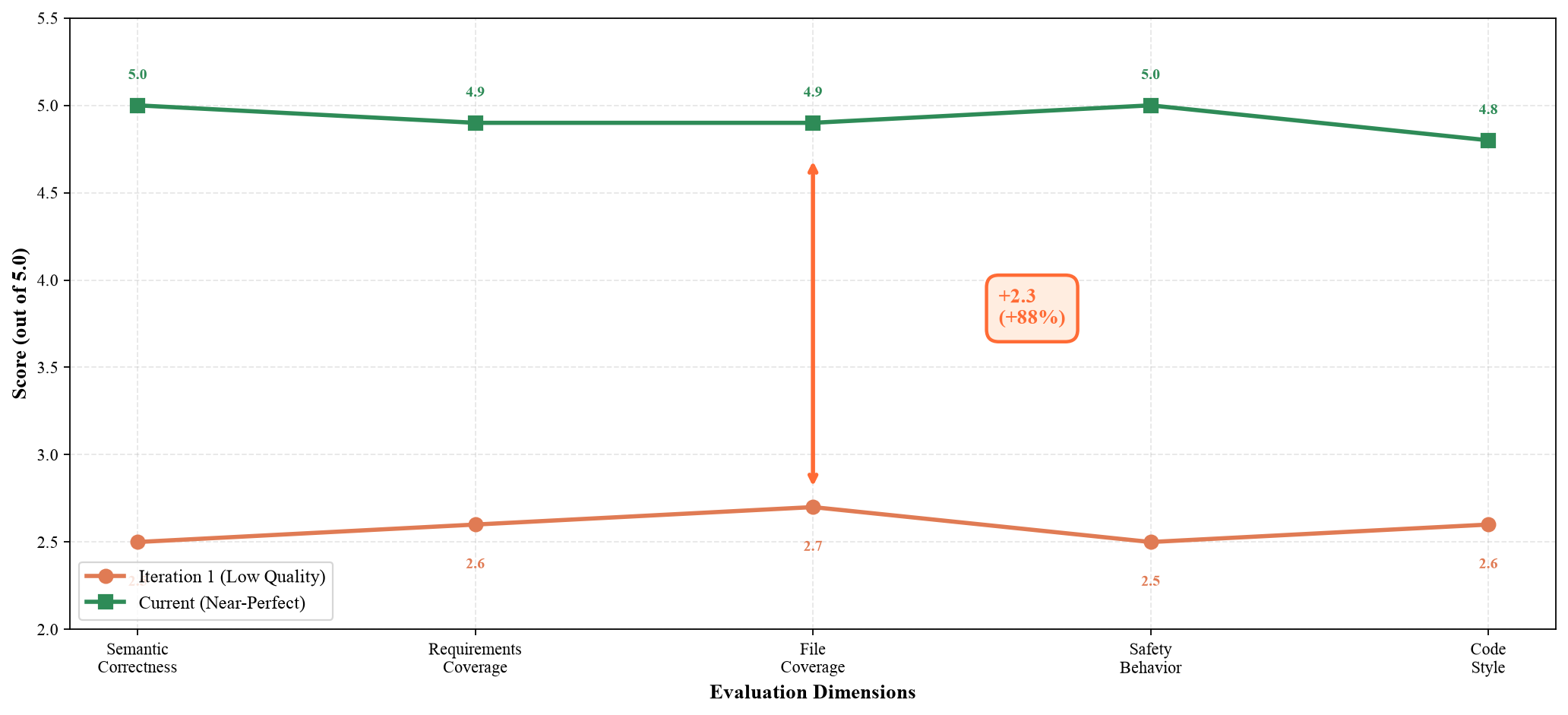
Figure 9: Case study of per-dimension score trajectory for a complex async module across SGPO-II self-evolution iterations.
Empirical Results: Throughput and Online Business Impact
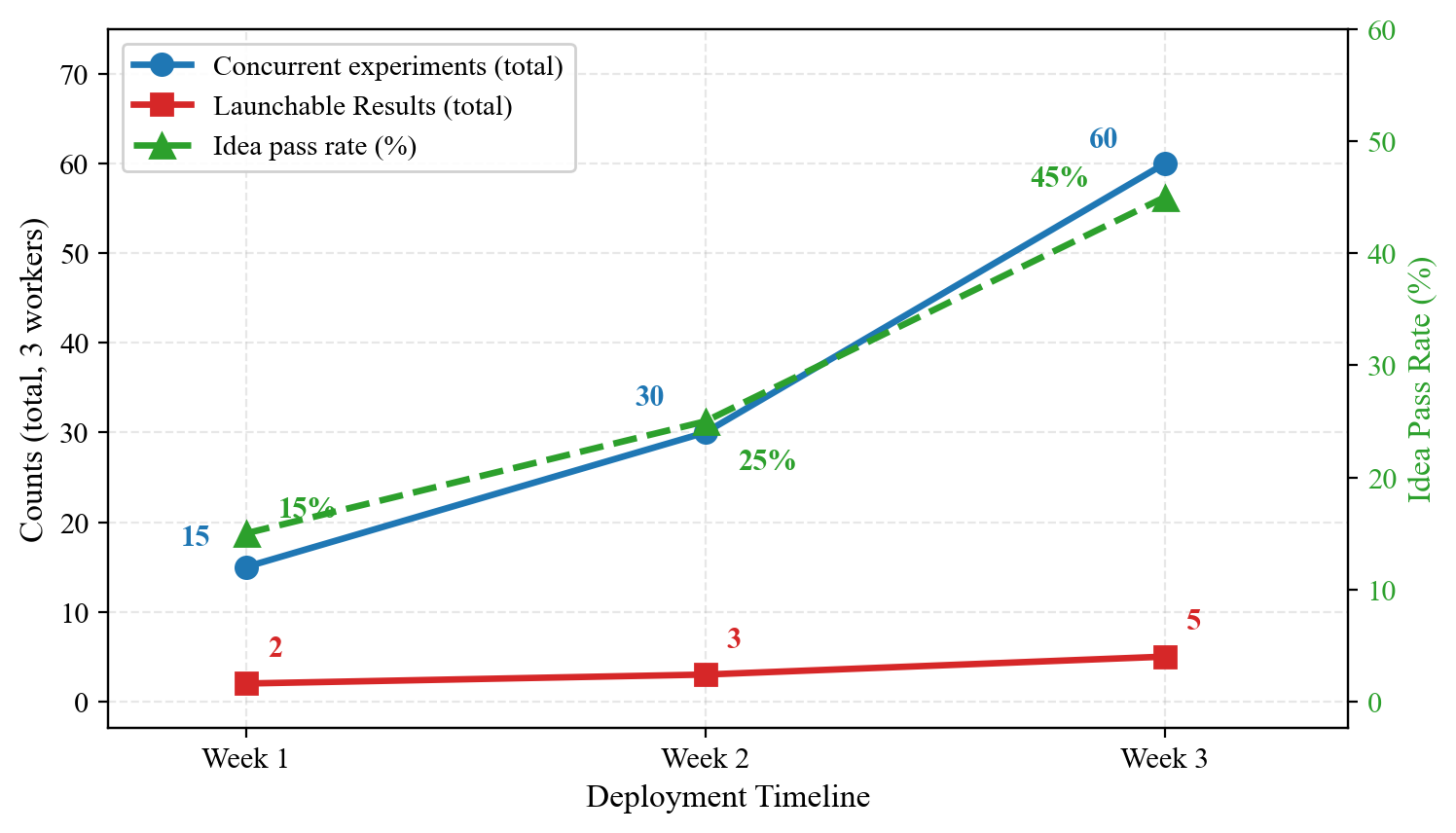
Over a three-week production deployment on the Kuaishou App, AgentX demonstrated:
Practical and Theoretical Implications
AgentX establishes that agent-driven, self-evolving industrial recommendation systems are not speculative but production-viable, delivering scalable and compoundable leverage. The division of labor shifts; engineers focus on evolving agent frameworks and selection, while agent systems drive the iterative loop autonomously. The trajectory data from every experiment fuels both engineering and agent system evolution, linking execution to long-term intelligence growth.
In offline model benchmark reproduction, AgentX consistently translated paper designs into executable modules, surfacing cross-dataset discrepancies and demonstrating genuine method transferability. Automated combinatorial module exploration further improved AUC on industrial datasets, validating the framework for both theoretical exploration and practical deployment.
Future Directions
Potential developments include:
- Extension of agentic closed loops to new business verticals and non-recommendation ML domains.
- Integration of more granular traffic and business feedback into agent evolution.
- Advancement of foundation models via continuous agent-data-driven pretraining.
- Broader adoption of agent-driven automation across R&D infrastructure, reducing structural bottlenecks and increasing leverage beyond human headcount.
Conclusion
AgentX demonstrates a robust, agent-driven closed-loop architecture for industrial recommender system evolution, rebalancing the production function from linear human labor to compoundable agent leverage. With strong empirical gains, rigorous trace-based harness evolution, and practical deployment at scale, AgentX invites further exploration and adoption of agentic automation in recommendation and broader AI engineering domains.
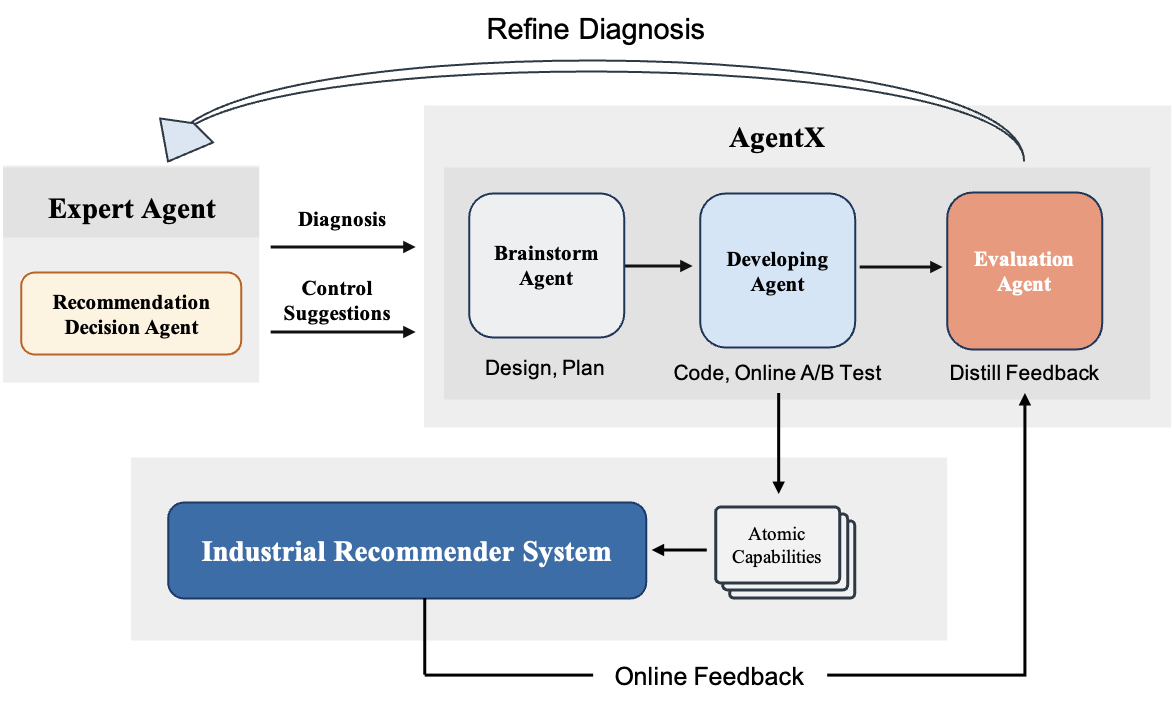
Figure 11: Production flow for the life-service recommendation decision agent—AgentX converts diagnostic signals into production operators, expanding atomic action space available to the decision agent.
(2606.26859)