- The paper introduces a hierarchical framework that decouples global semantic planning from local reactive control using LLM-guided planning, scene graph encoding, and goal-aware fusion.
- It employs multi-layer R-GCNs and CLIP-based features to encode spatial-semantic relationships, leading to improved success rates on benchmarks like iTHOR and RoboTHOR.
- Reinforcement learning via an A3C Actor-Critic policy validates the framework's efficiency in long-horizon reasoning and robust navigation under challenging conditions.
SAGE-Nav: Hierarchical Navigation via LLM Planning and Scene Graph Alignment
Framework Overview and Motivation
SAGE-Nav addresses the Object-Goal Navigation (ObjNav) task, wherein an embodied agent must locate a specified object using solely egocentric observations. Prevailing end-to-end DRL methods lack explicit scene-level semantics, resulting in suboptimal generalization and long-horizon reasoning failures. SAGE-Nav introduces a hierarchical architecture composed of three core modules: an LLM-Guided Hierarchical Global Planner (H-GP); a Hierarchical Scene Graph Encoder (HSGE) for semantic-spatial grounding; and a Goal-aware Alignment-Fusion Network (GAFN) for multi-modal policy alignment. By decoupling global semantic planning from local reactive control, SAGE-Nav leverages both commonsense reasoning and structured priors to maximize navigation performance.
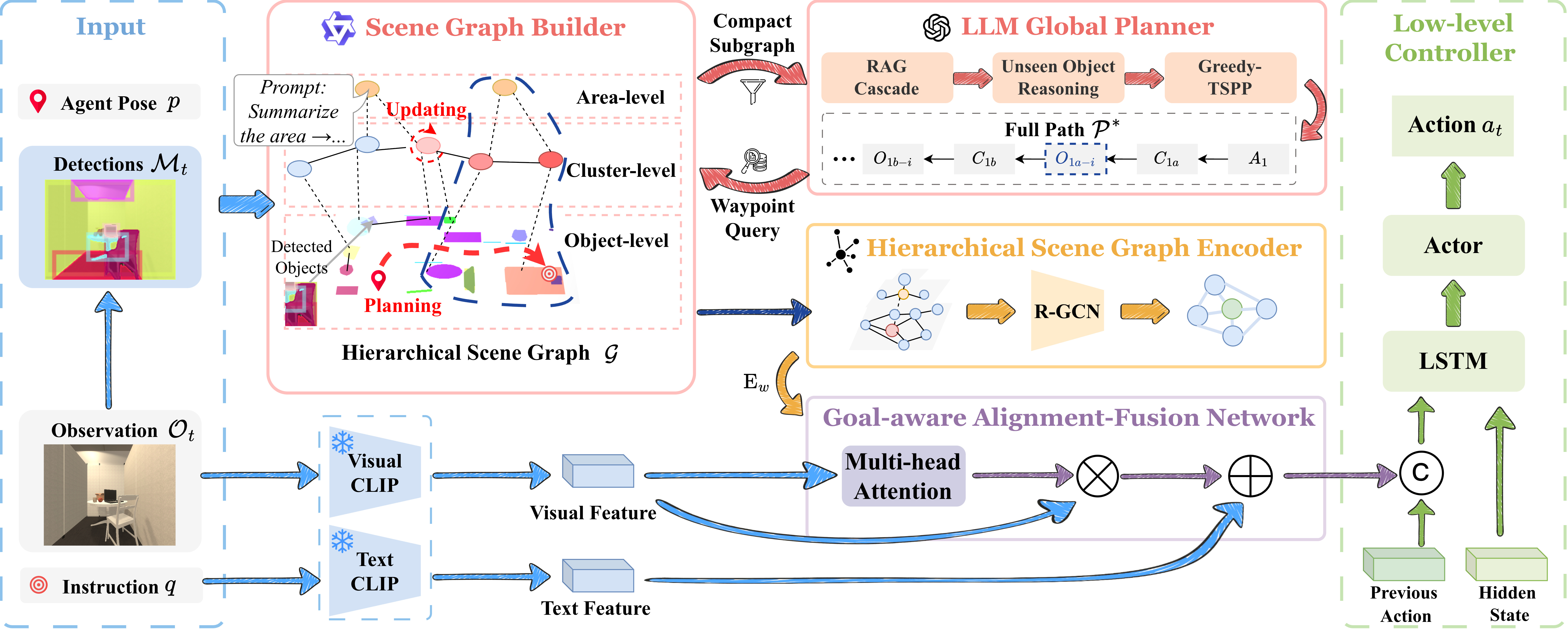
Figure 1: The SAGE-Nav pipeline: (i) LLM-Guided Global Planner produces semantic waypoints; (ii) HSGE grounds the plan in structured spatial-semantic representations; (iii) GAFN dynamically fuses aligned perception and graph priors for efficient RL-based navigation.
Hierarchical Global Planning via LLMs and Scene Graphs
SAGE-Nav constructs a hierarchical scene graph G with multi-level object and cluster nodes, encoding both semantic and spatial relationships through heterogeneous edges and relational graph convolutions. During navigation, a retrieval-augmented instruction-relevant subgraph GQ is generated, where each candidate node's semantic prior is boosted by its neighborhood and hierarchy. The LLM planner operates asynchronously over GQ, solving a Greedy-TSPP to yield coherent sequences of waypoints, balancing semantic desirability and geometric cost via a hierarchical coherence weight:
W(vi,vj)=λsemSmulti-level(vi,vj)−λdistDgeo(vi,vj)
Unseen object reasoning is handled by LLM-induced probabilistic inference, dynamically integrating virtual target nodes into the planning substrate.
Structural Encoding and Waypoint Conditioning
The HSGE module translates abstract plans into actionable embeddings Ew, using multi-layer R-GCNs to encode hierarchical scene structure and leveraging CLIP-based semantic and sinusoidal positional features. Object-level and cluster-level nodes are processed with intra-level relational encoding:
hv(ℓ)=FR-GCN(ℓ)(xv,E(ℓ))+Wresxv
Waypoint-conditioned attention refines structural relevance, followed by level-wise pooling and MLP projection to produce the structure-aware embedding for the current plan's waypoint.
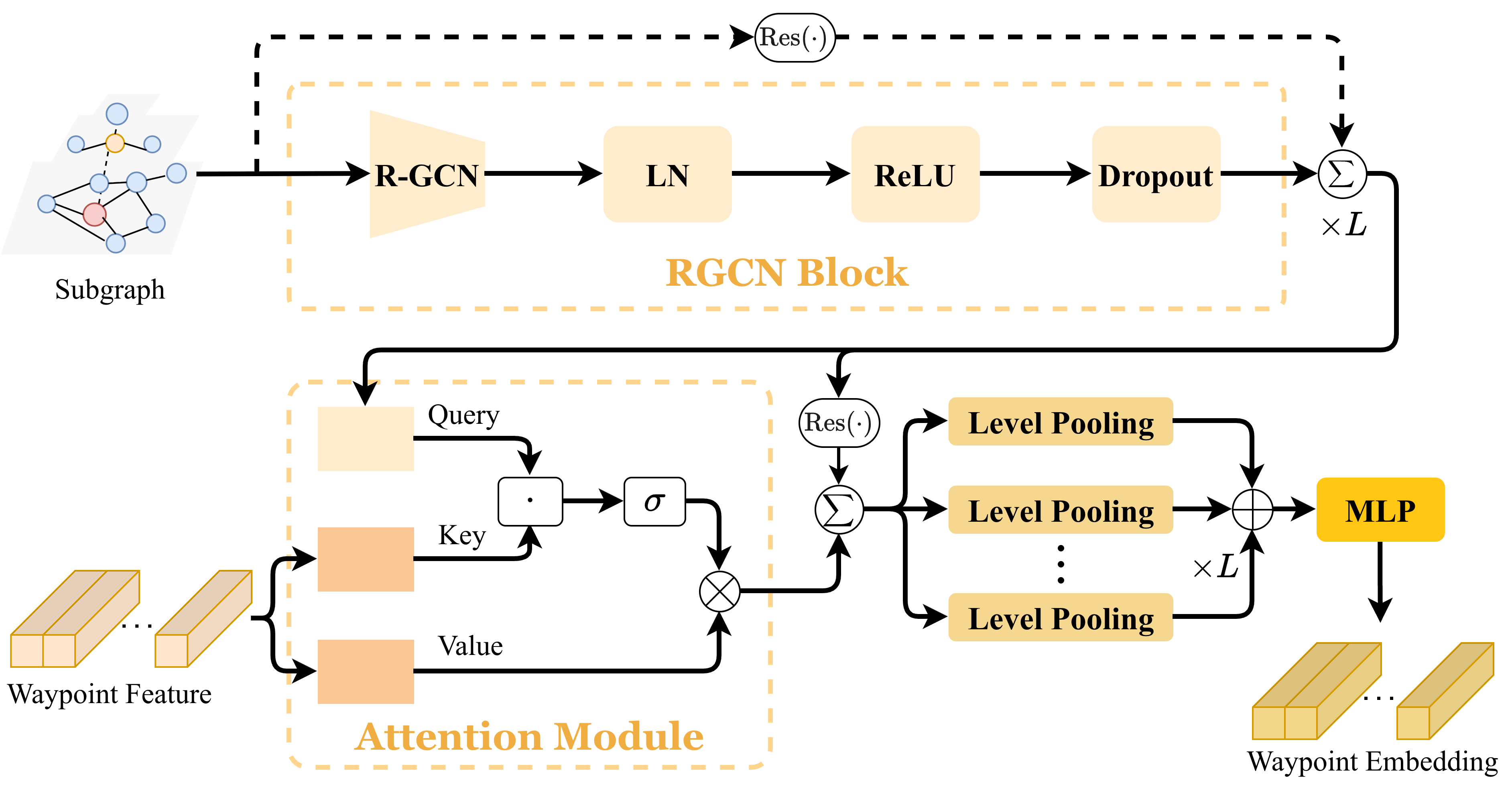
Figure 2: HSGE architecture: Multi-layer R-GCN for structural encoding, residual attention for task alignment, and level-wise pooling for final structure-aware waypoint embedding.
Goal-Aware Alignment-Fusion Mechanism
GAFN aligns real-time egocentric visual features with structural priors from the HSGE via cross-attention. The module computes a semantic alignment score αt and adaptively modulates fusion through an explicit gating mechanism:
λ(αt)=σ(MLP([Fv;Fa;Ew;αt]))⋅(1−ησ(καt))
This design structurally incentivizes the agent to rely more on abstract guidance as visual and topological alignment increases, facilitating robust progress in long-horizon and occluded scenarios, and balancing obstacle avoidance against goal pursuit.
Reinforcement Learning Optimization
The fused representation Ff is passed to a two-layer LSTM-based A3C Actor-Critic policy. The reward formulation simultaneously encourages goal-reaching, efficient trajectory, exploration, and penalizes redundant actions:
Rnav=5⋅Ivis+0.01⋅Ifwd+max(λΔdt,0)−0.01⋅(1−Ivis)
Optimization is performed over 6 million episodes, with frozen CLIP visual encoders and Qwen2.5-VL-7B LLM for planning. Training is strictly decoupled from LLM runtime overhead, focusing on HSGE and the policy network.
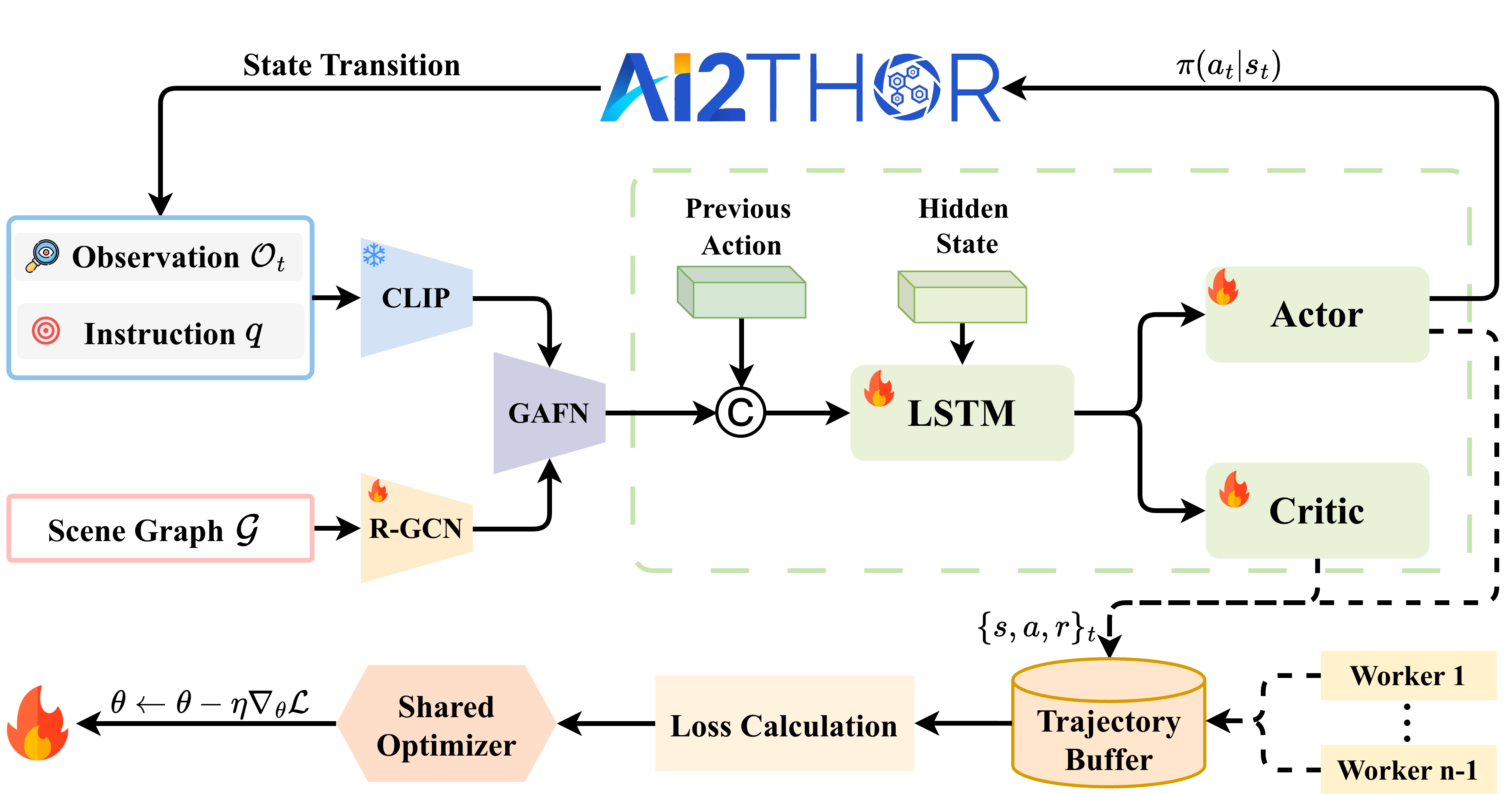
Figure 3: Asynchronous A3C training architecture. Parallel workers collect trajectories, with frozen modules and shared optimizer for network updates.
Experimental Results
SAGE-Nav exhibits strong numerical gains in iTHOR (SR GQ0 overall, GQ1 for GQ2) and RoboTHOR (SR GQ3, SPL GQ4, DTS GQ5), consistently outperforming prior SOTA methods (e.g., TSOG, CGI-GAIL, AKGVP-CI) across all major navigation benchmarks. The efficiency analysis demonstrates SAGE-Nav achieves the lowest control latency (GQ6 s) and sparse LLM queries (GQ7 calls/episode), surpassing CogNav in SPL and SG-Nav in computational cost.
Zero-shot and Ablation Results
SAGE-Nav achieves GQ8 SR, GQ9 SPL, and GQ0 m DTS on zero-shot categories, significantly outperforming baselines. Ablation indicates GAFN is crucial for cross-domain adaptation and alignment; removing HSGE results in pronounced SR and DTS deterioration, emphasizing the importance of structural encoding.
Qualitative Analysis
Navigation trajectory visualizations reveal that SAGE-Nav avoids common failure modes, such as redundant paths and premature terminations, exhibited by previous baselines. Waypoint-guided planning enables superior path efficiency and target localization.
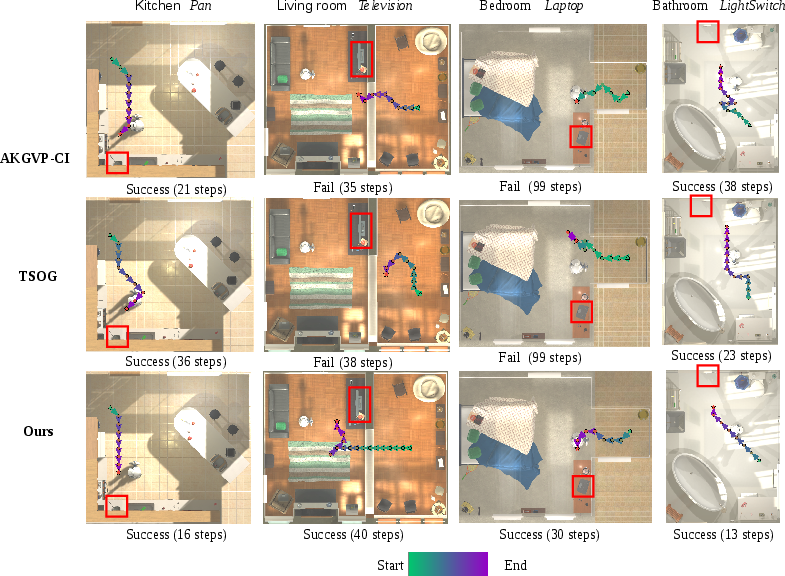
Figure 4: Agent trajectory visualizations in unfamiliar scenes: SAGE-Nav consistently selects efficient paths and avoids rotational loops present in prior baselines.
Limitations and Future Directions
Failure case analysis highlights four main limitations: target visibility failures, detector errors, entrapment in constrained spaces, and premature termination. Addressing these issues will involve integrating robust open-vocabulary detectors, active vision for perceptual adjustment, and 3D volumetric representations for extrication and obstacle avoidance.
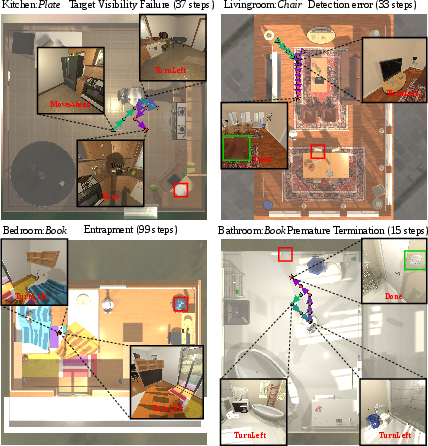
Figure 5: Failure case visualizations: Representative errors include missed targets, false positives, entrapment, and premature episode termination.
Conclusion
SAGE-Nav establishes a hierarchical paradigm in embodied navigation, integrating LLM-powered global planning with dynamic scene graph priors and explicit perceptual alignment. Empirical results validate substantial performance improvements in efficiency, long-horizon reasoning, and zero-shot generalization. The explicit structural cascade facilitates robust adaptation in complex unseen environments. Future work will extend SAGE-Nav with generative active perception and scalable 3D representations to enhance real-world deployment resilience.

