Brevity is the Soul of Inference Efficiency: Inducing Concision in VLMs via Data Curation
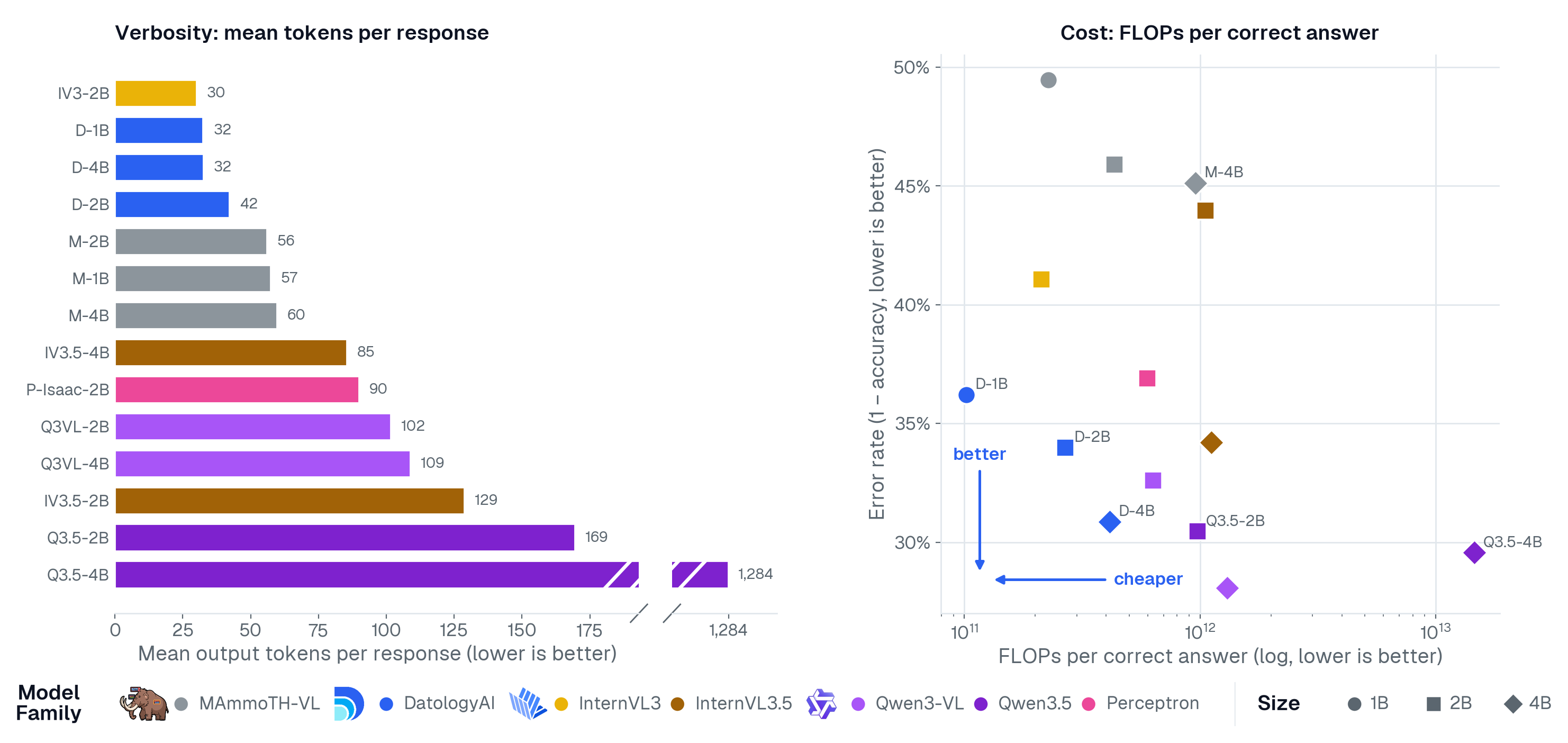
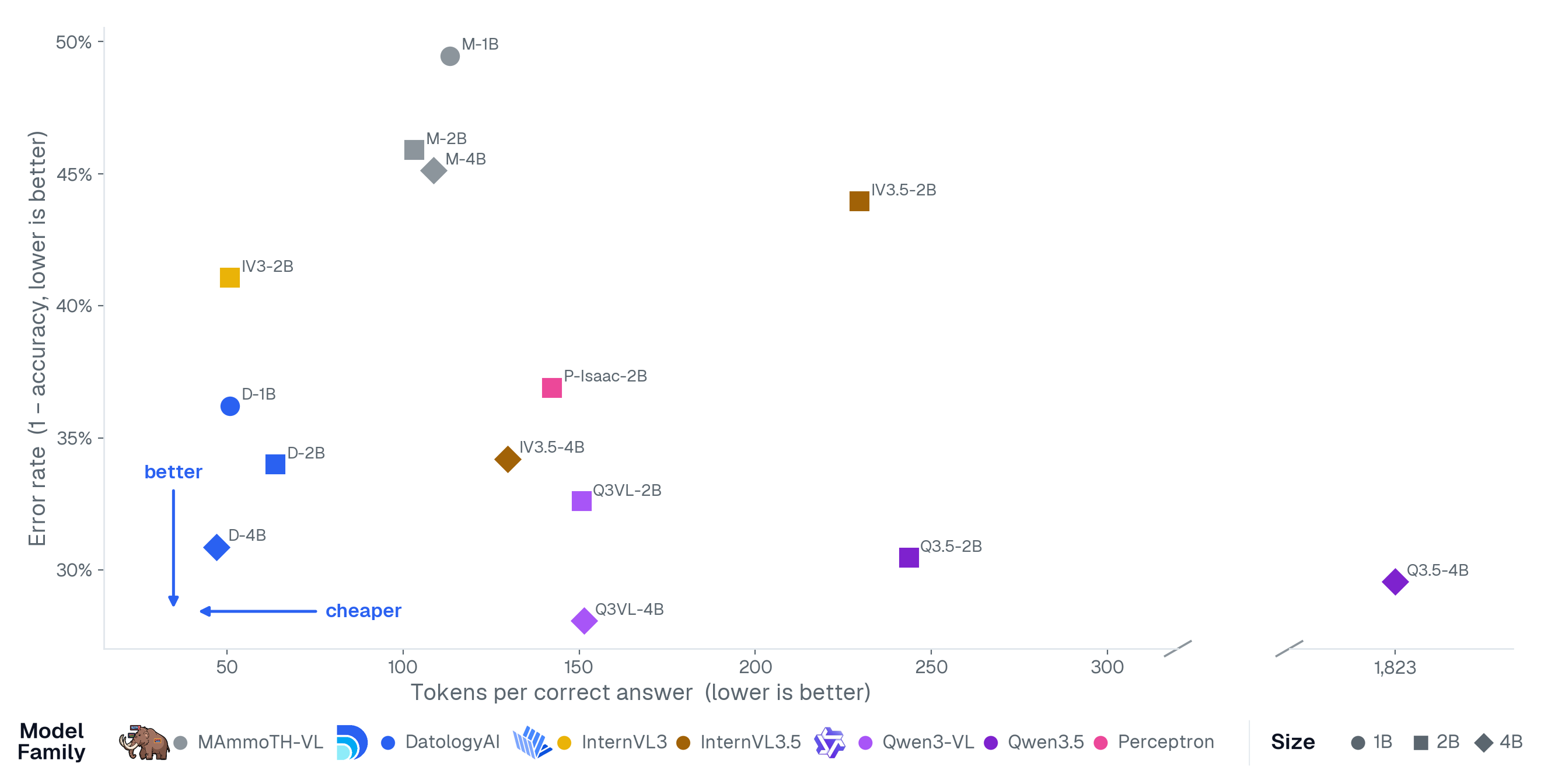
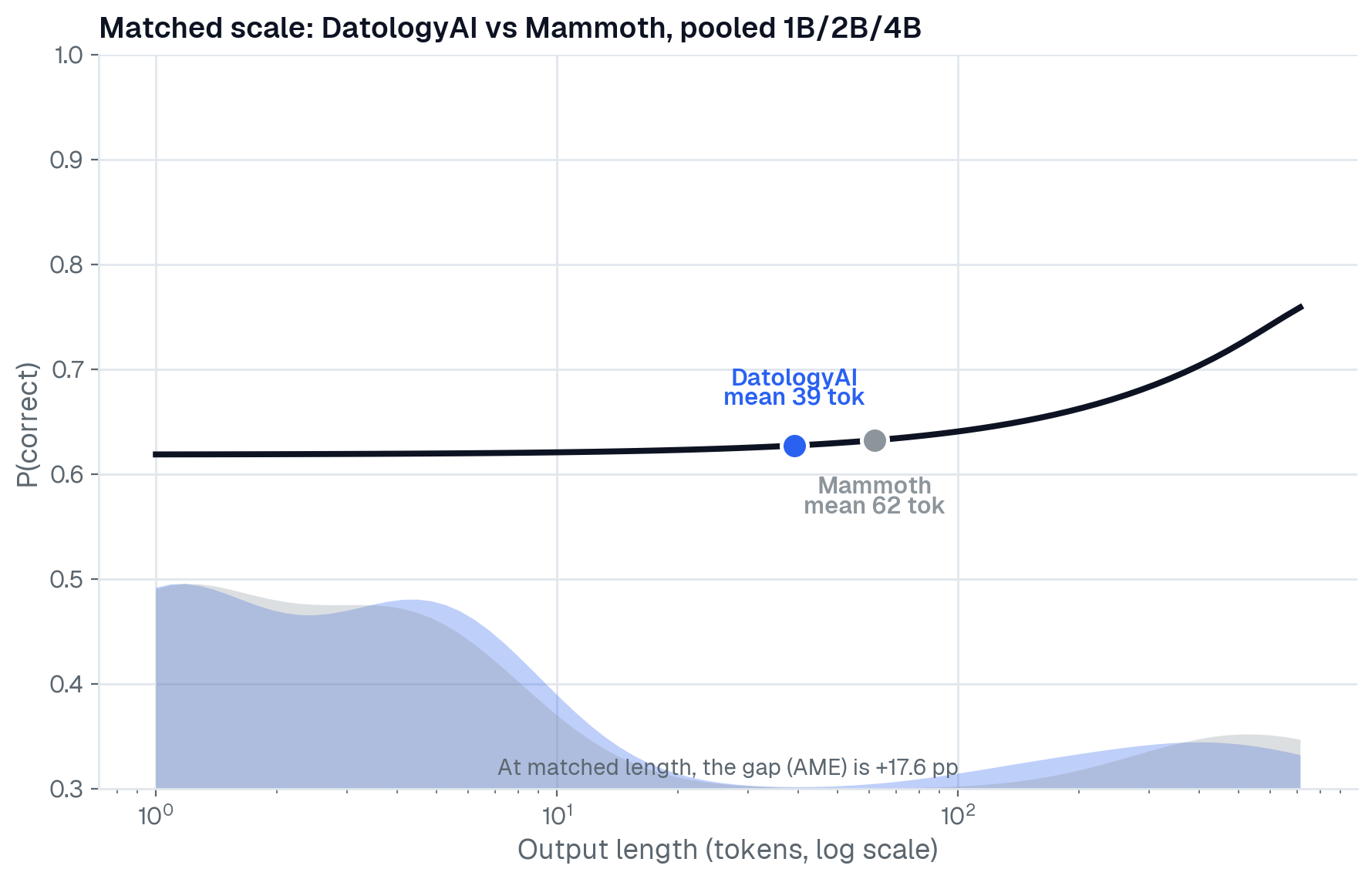
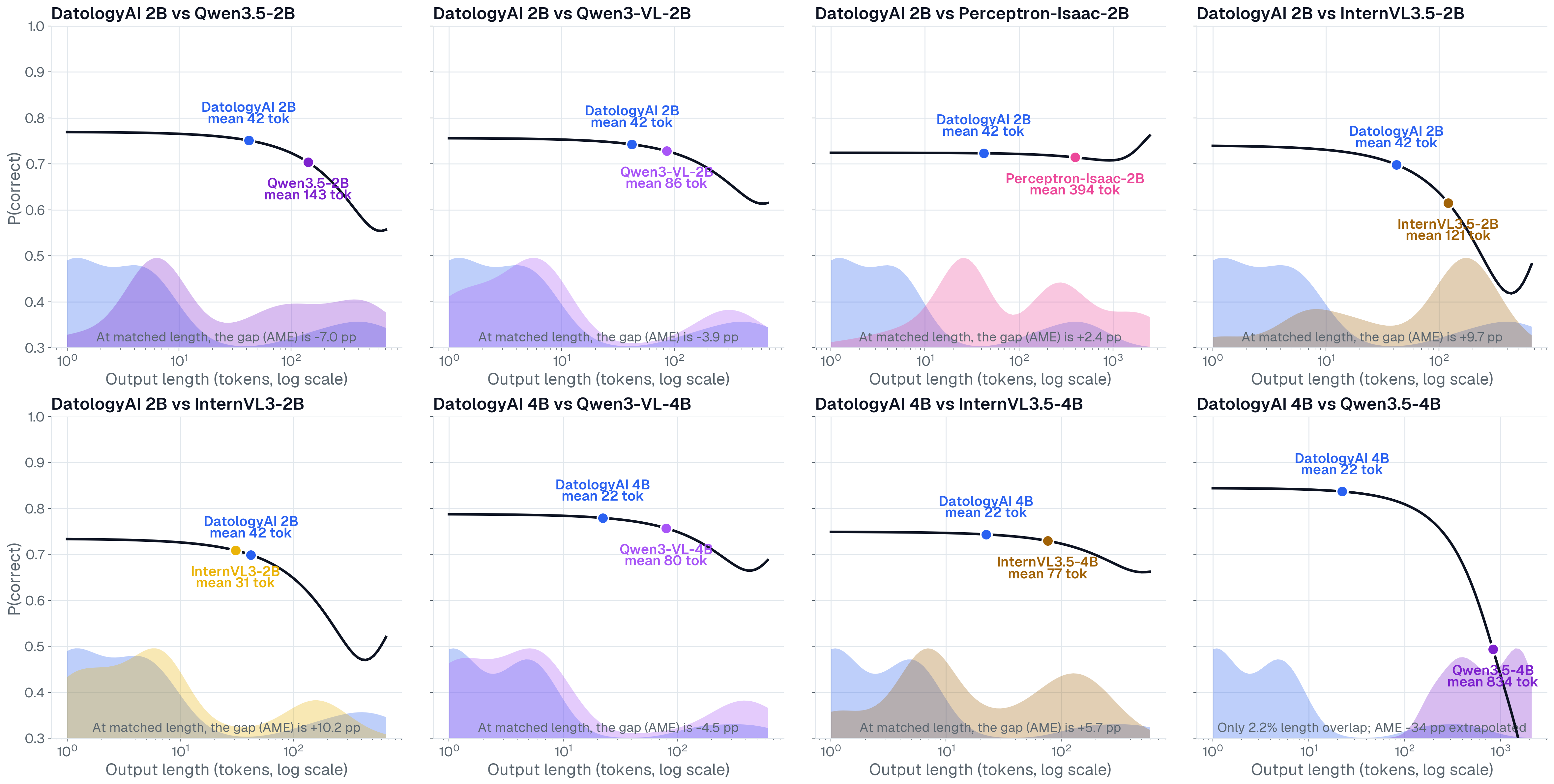
Abstract: Inference efficiency is typically pursued by shrinking the model: distillation, pruning, quantization, and sparse routing each lower per-token cost while treating token count as fixed. But output length has been inflating, and it is precisely the component the standard toolkit leaves untouched. Here, we argue that brevity is the missing inference-efficiency lever, and that pretraining data curation is a practical way to pull it: a model trained on concise, correct data learns to answer in fewer tokens; i.e. it has a lower Cost-of-Pass. We apply our VLM curation pipeline to the MAmmoTH-VL single-image subset, and compare models trained on our curated data, the standard MAmmoTH-VL data, and external open-weight frontier VLMs. On a controlled 20-evaluation set and 14 VLMs at 1B-4B activated parameters, we hold output length fixed with a per-model regression, separating brevity from quality, and price models in FLOPs per correct answer. Curation buys a 35x Cost-of-Pass advantage over the most verbose 4B comparator (Qwen3.5-4B) within $\sim$1 pp of accuracy (0.41 vs 14.58 TFLOPs per correct answer; 0.691 vs 0.704 mean accuracy). Curation also buys a +17.55-percentage-point matched-length accuracy gain over the uncurated baseline that grows with model scale (from +16.7 pp at 1B to +21.2 pp at 4B). This brevity improvement concedes no quality: generic verbosity buys no accuracy at any capability or scale, and the window where reasoning-structured verbosity still earns its tokens shrinks from 4 of 8 capability groups at 2B to 1 of 8 at 4B. Per example, the concise model even reaches correct answers the verbose reasoning model misses, marking reasoning as a distinct curation target rather than something brevity gives up. Inference efficiency in this regime is a tokens-per-correct problem, and brevity is the lever that targets it directly.

Paper Prompts
Sign up for free to create and run prompts on this paper using GPT-5.
Top Community Prompts
Explain it Like I'm 14
A simple explanation of the paper
What this paper is about (big picture)
The paper asks a simple question: What if AI models could give shorter answers without getting worse at being right? It argues that making answers short (concise) is a powerful way to make AI cheaper and faster to use. Instead of only shrinking the model or using fancy tricks at test time, the authors show that carefully choosing and cleaning the training data can teach a model to answer briefly and correctly by default.
Think of it like texting on a pay‑per‑word phone plan. Most AI research makes each word cheaper. This paper makes the whole message shorter.
What questions the researchers wanted to answer
In easy terms, they wanted to know:
- Can we train vision-LLMs (VLMs) to be brief and still accurate, just by curating (cleaning and selecting) their training data?
- If two models are equally accurate, but one uses fewer words (tokens), how much cheaper and faster is it?
- Are long, “think out loud” answers (chain-of-thought) really helping, or are they often just extra words?
- Does being concise trade away reasoning ability, or are brevity and reasoning separate skills we can train separately?
How they tested their ideas (methods in plain language)
- What is a VLM? A Vision-LLM takes images and text as input and produces text answers (for example, describing a picture or answering a question about it).
- What is a token? Roughly a word piece. Longer answers = more tokens = more time and money to run.
- Their idea: Curate the training data so examples are concise and correct. The model then learns to answer briefly and accurately, like learning good habits.
- What they compared:
- Their “curated” models (trained on concise, clean data).
- “Uncurated” models (trained on the usual dataset).
- Several popular open models (like Qwen and InternVL) as external baselines.
- Fair testing:
- They evaluated across 20 different tests and 14 models of similar sizes (about 1–4 billion parameters activated).
- They separated “being short” from “being good” using a matched-length analysis. In other words, they compared the accuracy of models at the same answer length to make sure shortness wasn’t tricking the scores.
- Measuring cost: Cost-of-Pass
- They estimate the compute cost to get one correct answer (in FLOPs per correct answer). Intuition: fewer tokens per correct answer = lower cost and faster responses.
- They also looked at “tokens per correct answer,” a length-only way to see efficiency without hardware details.
Analogy: Instead of charging just “per word,” they look at “how many words does it take you to get the right answer?” That is the true bill you pay.
What they found (main results)
Here are the most important findings, written simply:
- Curated models are much cheaper per correct answer, with similar accuracy.
- A curated 4B model needed about 0.41 trillion FLOPs per correct answer, while a very verbose 4B model (Qwen3.5-4B) needed about 14.58 trillion FLOPs—around 35× more—yet both had almost the same accuracy (~69–70%).
- Why? The curated model used about 30 tokens per answer; the verbose model used about 1,284. That’s roughly a 40× difference in length.
- The accuracy boost is real, not a “short answer” trick.
- When they forced a fair comparison at the same output lengths, the curated model was still about +17.6 percentage points more accurate than the uncurated baseline on average.
- This accuracy gain got bigger for larger models (about +21 pp at 4B).
- Being verbose (long answers) rarely pays off.
- Models that are long-winded but not actually reasoning (just more words) didn’t get better results.
- Even “reasoning-style” long answers helped only on a shrinking set of tasks, and less so as models got bigger. In many areas, the concise model did better.
- Brevity and reasoning are different skills.
- The concise model sometimes got questions right that the verbose “reasoning” model missed, and vice versa. That means you can train for concision without giving up reasoning—just curate for both, separately.
- The short model plus small size multiplies savings.
- A small curated model (1B) was about 143× cheaper per correct answer than the very verbose 4B comparator, with only a modest accuracy drop. Small + concise = compounding savings.
Why this matters (impact and implications)
- Faster and cheaper AI
- Shorter answers mean lower bills and quicker replies. This helps apps, websites, phones—any place you run AI a lot.
- Better reporting and fair comparisons
- The paper shows that some “improvements” come from longer answers, not smarter models. We should compare models at the same length and report cost-per-correct, not just accuracy.
- A new lever: the training data
- You can get big efficiency gains by curating training data so the model learns to be concise and correct. That’s like paying the “thinking cost” once during training, not every time you ask a question (the authors call this idea “amortized inference”—learning to answer directly instead of re-deriving it step by step).
- Works with other techniques
- Concision stacks with model compression and other efficiency tricks. Halve the model size and halve the answer length, and you roughly quarter the cost per correct answer.
- Practical guidance
- If you build or deploy VLMs, don’t just tune decoding settings to force short outputs afterwards. Teach brevity during training by curating concise, reliable examples. Then, add reasoning examples where it truly helps.
One-sentence takeaway
Teaching models to answer briefly and correctly—by carefully curating their training data—can cut the cost per right answer by tens of times, without giving up accuracy, and sometimes even improving it.
Knowledge Gaps
Knowledge gaps, limitations, and open questions
The paper makes a strong case for data-curation-induced brevity as a lever for inference efficiency in VLMs, but several aspects remain untested or under-specified. Future work could address the following:
- External validity beyond single-image VLMs: Does the brevity advantage hold for multi-image inputs, video, temporal reasoning, or document-page sequences where context length and visual prefill dominate?
- Scale limits: How do brevity and Cost-of-Pass gains evolve for models larger than 4B (e.g., 7B–70B, MoE) and for ultra-small models (<1B)? Are the effects monotonic with scale?
- Architecture dependence: The cost proxy assumes similar per-token FLOPs at fixed active parameters; how robust are conclusions across different decoder stacks, vision encoders, tokenizer vocabularies, and attention implementations (e.g., FlashAttention, KV caching)?
- Compute accounting fidelity: The FLOPs proxy omits attention and prefill/vision-encoder cost; do the results hold under end-to-end, measured latency/energy on real hardware across batch sizes and sequence lengths?
- Tokenizer sensitivity across languages: The study is effectively English-centric; do brevity and cost gains persist in multilingual settings with different tokenization granularity and morphology?
- Task generality: Brevity is evaluated on a 20-eval suite with primarily short-form answers; what happens on tasks that inherently require long-form outputs (summarization, step-by-step tutorials, detailed reports, creative writing)?
- Multi-turn interactions: Does brevity per turn reduce tokens per successful task or merely shift tokens into more turns (i.e., tokens-per-task vs tokens-per-turn)?
- User preference and helpfulness: Are concise answers preferred by humans for open-ended/helpfulness tasks? Quantify trade-offs via pairwise preference studies and length-controlled human evaluations.
- Safety and calibration: Does brevity suppress necessary disclaimers, uncertainty expression, or safety guidance? Assess calibration (e.g., ECE), selective prediction, and safety adherence under adversarial and sensitive prompts.
- On-demand verbosity control: Can curated concise models reliably produce detailed reasoning/explanations when explicitly requested without losing brevity by default? Measure style controllability and instruction-following fidelity.
- Reasoning as a separate curation target: The paper notes different error sets between concise and reasoning-verbose models but does not test curation strategies tailored to concise-vs-reasoning dual-style training. What mixtures best preserve accuracy with optional explicit rationales?
- Decoding-policy interplay: How do data-induced brevity and decoding controls (length penalties, constrained sampling, early exit, speculative decoding) compose? Are gains additive or redundant?
- Comparator operating points: The Qwen3.5-4B comparison assumes default “reasoning” mode; what is the accuracy–cost trade-off if Qwen is prompted or configured for concise outputs (e.g., reasoning off, strict length caps)? Is there a practical concise operating point with acceptable accuracy?
- Refusal behavior under stress: The refusal-length decomposition is limited to standard evals and one stress test; does brevity hold without increased refusal on broader, safety- and compliance-heavy datasets?
- Distribution shift and leakage: How robust are results out-of-distribution (domains like medical, legal, geospatial), and is there any risk of train–test overlap due to using public corpora (despite curation)?
- Curation pipeline attribution: Which specific curation steps (e.g., deduplication, hallucination filtering, style normalization, answer-format constraints) most strongly drive brevity vs accuracy? Provide ablations to isolate drivers.
- Amortization economics: What is the break-even point where added curation/training cost is offset by inference savings at production scale? Provide a quantitative ROI model (training cost vs operational savings).
- Stability under alignment: After SFT/RLHF, do brevity gains persist or does RLHF re-inflate length? Systematically test RLHF recipes with length-neutral or length-penalized rewards on curated models.
- Coverage vs concision: Does brevity reduce recall in list-style or multi-entity answers (e.g., missing items in visual counting/composition)? Introduce coverage-sensitive metrics where appropriate.
- Fairness and bias: Does filtering for concise, “correct” text skew linguistic style, cultural representation, or dialects in ways that introduce bias? Audit across demographic and linguistic slices.
- Tool-use and retrieval: How does brevity interact with tool calls or RAG? Does concise generation increase/decrease external calls, and what is the net cost per correct when tool-compute is included?
- Mechanistic understanding: What representations or training signals internalize brevity? Are there identifiable circuits or behavior changes (e.g., shorter decoding entropy tails)? Apply mechanistic/behavioral analyses.
- Attention-cost regimes: For very long outputs where attention dominates, are the reported FLOPs-per-correct gaps larger than estimated? Provide measurements in regimes where attention is the primary bottleneck.
- Latency tails and reliability: Beyond means, how do variance and tail latencies behave for concise vs verbose models, especially under batching and memory pressure?
- Reproducibility and release: Are curated datasets, exact curation rules, and trained checkpoints publicly available to validate claims? If not, how can others replicate the pipeline and results?
- Generalization to other modalities: Do the brevity benefits transfer to audio, video, and 3D modalities where output length and temporal grounding differ substantially?
- Evaluation with human judges free of verbosity bias: Even with length controls, LLM/multimodal judges can carry residual verbosity bias; validate with blinded human judgments and adversarially length-balanced sets.
- Causal identification of length effects: GLM controls suggest correlation; can randomized interventions (e.g., enforced token budgets per example across the same model) establish causal effects of length on accuracy?
- Internal vs external reasoning: If brevity reflects “amortized” internal reasoning, can we verify hidden-chain behavior (e.g., via logit lens or diagnostic probes) and ensure it doesn’t degrade interpretability for auditing/regulatory use cases?
Practical Applications
Overview
This paper shows that curating pretraining data to be concise and correct makes vision-LLMs (VLMs) dramatically cheaper and faster at inference without sacrificing accuracy. Instead of shrinking models alone, the authors treat “tokens per correct answer” as the primary lever of inference efficiency and achieve large reductions in Cost-of-Pass (FLOPs/dollars per correct answer) by training on concise data. Key empirical findings include:
- Up to 35× lower FLOPs per correct answer at comparable accuracy versus a verbose 4B comparator.
- +17.6 percentage points higher accuracy at matched output length versus an uncurated baseline, with gains growing with scale.
- Verbosity rarely earns its token cost; generic verbosity helps nowhere, and even reasoning-structured verbosity helps on a shrinking set of capabilities as models scale.
- The brevity lever composes with standard inference optimizations and capacity reductions; a curated 1B can be 143× cheaper per correct than a verbose 4B.
Below are practical applications for industry, academia, policy, and daily life, grouped by immediate and long-term viability. Each entry notes sector, potential tools/products/workflows, and key assumptions/dependencies.
Immediate Applications
These applications can be deployed now using the paper’s findings and metrics.
Software, MLOps, and Product Engineering
- Cost-of-Pass and tokens-per-correct as first-class KPIs (software)
- Tools: evaluation dashboards that track FLOPs-per-correct, tokens-per-correct (OckScore), and length-controlled accuracy; CI gates on “performance vs compute.”
- Dependencies: reliable task-level accuracy signals; token logging; model-length telemetry; agreement on FLOPs proxies across hardware.
- Brevity-tuned data curation and fine-tuning (software)
- Workflows: curate in-domain training data to prefer concise, correct answers; build brevity preference pairs; length-controlled SFT; filter long rambling responses.
- Tools: data curation pipelines, preference dataset builders, length-aware sampling scripts.
- Dependencies: access/rights to training data; domain-validated ground truth; careful audits to avoid deleting essential content.
- “Answer-first, rationale-on-demand” interaction patterns (software, enterprise)
- Workflows: default to short answers; expose “explain more” or “show steps” on demand; cap outputs in common cases and escalate when needed.
- Tools: prompt policies, decode-time length governors, escalation heuristics on uncertainty.
- Dependencies: reliable uncertainty proxies; UI affordances to request detail; policies for safety-critical exceptions.
- Budget-aware inference routing (software)
- Workflows: set per-task token/latency budgets; route low-risk tasks to concise models and escalate to verbose reasoning only when necessary.
- Tools: orchestration/middleware with length budgets, early-exit/stop-if-confident, cascades.
- Dependencies: calibrated thresholds; task taxonomy; monitoring for failure modes when brevity is inappropriate.
Enterprise Operations and Customer Support
- Concise agents for support, IT ops, and HR (software, enterprise)
- Products: agents that answer in minimal steps with on-demand elaboration; shorter tickets and runbooks reduce cost and latency.
- Dependencies: guardrails to avoid truncating critical steps; log policies for auditability; scenario tests for edge cases.
Healthcare
- Short, accurate clinical summaries with escalation paths (healthcare)
- Use cases: problem lists, discharge-note impressions, radiology “impression-first” drafts; detail on demand.
- Dependencies: clinician-in-the-loop verification; domain evaluation beyond generic VLM benchmarks; regulatory/privacy compliance; guardrails so brevity never omits safety-critical information.
Finance and Legal
- Cost-efficient summarization and compliance notes (finance, legal)
- Use cases: concise market/news briefs; short compliance memos with link-out to detailed analysis; rationale on demand.
- Dependencies: strict accuracy checks; audit trails; policies for when detail is required by regulation.
Education
- Hint-first tutoring and assessment feedback (education)
- Products: short hints before step-by-step; concise grading rationale on request; token budgets per activity.
- Dependencies: pedagogy evaluations (some learners need more scaffolding); transparency toggles for educators.
Robotics, Edge, and AR
- On-device concise VLMs for perception and instruction following (robotics, edge)
- Use cases: referring expressions, short captions, quick OCR on-device with lower energy and latency.
- Dependencies: domain-specific accuracy tests (e.g., grounding boxes, task success rates); model compression plus brevity curation.
Sustainability and Cost Governance
- Carbon and cost accounting by Cost-of-Pass (energy, finance, procurement)
- Workflows: set per-task carbon and dollar budgets using FLOPs-per-correct; prioritize brevity-tuned models for high-volume workloads.
- Dependencies: org-level carbon accounting; standardized FLOPs-to-cost conversion; usage forecasting.
Benchmarking and Model Selection
- Length-controlled evaluation as a standard gate (academia, industry)
- Workflows: report accuracy vs length curves; compare models at matched output length; penalize length gaming in benchmarks and reward brevity at equal quality.
- Dependencies: benchmark suites with example-level scoring; length-controlled statistical analyses (e.g., GLMs).
Long-Term Applications
These require further research, scaling, or ecosystem development.
Training, Algorithms, and Architectures
- Closed-loop amortized inference data flywheel (software, academia)
- Workflows: mine production logs for long responses; curate concise gold; retrain to compile long deliberations into short answers.
- Dependencies: data privacy; continuous evaluation; robust data quality controls.
- Cost-aware RL and reward models (software, academia)
- Approaches: multi-objective rewards that optimize for correctness and brevity; length-residualized reward models; “verbalization overhead” minimization.
- Dependencies: avoiding degenerate short answers; stable training; domain-specific reward shaping.
- Latent reasoning with short verbalization (software, academia)
- Approaches: architectures that deliberate in latent space with minimal natural-language tokens; early-exit decoders and halting policies.
- Dependencies: methods to preserve accuracy and safety; interpretable on-demand rationales.
Standards, Policy, and Procurement
- Performance-versus-compute reporting as a norm (policy, standards bodies)
- Policies: require Cost-of-Pass, tokens-per-correct, and accuracy-vs-compute curves in model cards; length-controlled benchmarks for public reporting.
- Dependencies: community consensus on units and measurement protocols; third-party auditing.
- “Green AI” procurement and regulation anchored to tokens-per-correct (policy, sustainability)
- Policies: incentives or thresholds for carbon-per-correct; disclosure of test-time compute for public-sector deployments.
- Dependencies: accepted conversion from FLOPs to energy; sector-specific compliance frameworks.
Business Models and Platform Economics
- Pricing per solved task (per-correct) and budget SLAs (software, platforms)
- Products: API tiers with “price per correct within X tokens”; SLAs on tokens-per-correct and latency.
- Dependencies: robust correctness measurement; dispute resolution; defenses against metric gaming.
Sector-Specific Innovation
- Healthcare-grade concise VLMs with regulatory approval (healthcare)
- Products: on-device or edge hospital systems that default to concise outputs, escalating to detailed rationales when flagged.
- Dependencies: clinical trials; FDA/EMA pathways; monitoring for omission risks.
- Finance-grade assistants with compute-and-compliance budgeting (finance)
- Products: assistants that obey token/cost budgets, store rationales only when required by policy.
- Dependencies: model validation under stress tests; alignment with record-keeping requirements.
- Education platforms with “hint budgets” and outcome-optimized brevity (education)
- Products: adaptive systems that balance brevity with learner needs, quantifying learning outcomes versus token spend.
- Dependencies: long-term studies on learning efficacy; ethical guidelines.
Systems and Hardware Co-Design
- Inference schedulers optimized for brevity (systems, cloud)
- Workflows: cluster-level scheduling that prioritizes short generations; dynamic memory/allocation keyed on predicted output length.
- Dependencies: accurate length predictors; integration with serving stacks (e.g., vLLM/TGI); fairness across tenants.
Assumptions and Dependencies Affecting Feasibility
- Generalization: The reported gains are on a 20-eval VLM suite (1B–4B). Benefits likely transfer but should be validated in specialized domains (e.g., clinical, legal).
- Safety and completeness: Brevity must not omit safety-critical content. Human-in-the-loop review and domain guardrails are essential.
- Measurement: Cost-of-Pass uses FLOPs proxies and length-controlled regressions; organizations need consistent tokenization, telemetry, and evaluation pipelines.
- Data availability: Effective curation requires access and rights to representative, concise, correct training data.
- Task fit: Some tasks genuinely require long outputs (e.g., formal reports, creative writing). Deploy budget-aware routing and rationale-on-demand rather than hard caps.
- Reasoning trade-offs: Reasoning-structured verbosity can help in narrow capability windows (e.g., certain math/OCR tasks). Systems should detect and escalate when needed.
- Ecosystem norms: Adoption of performance-vs-compute reporting, standard benchmarks, and carbon accounting will influence incentives and comparability across models.
In summary, the paper’s central lever—training for brevity via data curation—enables immediate cost and latency savings across sectors, and it points to a longer-term shift toward cost-aware, brevity-optimized model development, evaluation, and policy.
Glossary
- activated parameters: The number of model parameters actually used during inference, often smaller than total parameters in sparse or routed models. "14 VLMs at 1B--4B activated parameters"
- affine transform: A linear transformation plus a constant; used here to relate token counts to dollar cost at fixed model size. "Because the dollar version of Cost-of-Pass is a constant- affine transform of token counts"
- AlpacaEval: A benchmarking framework for instruction-following models; its length-controlled variant adjusts for verbosity biases in evaluation. "Length-Controlled AlpacaEval"
- amortized inference: Paying computational cost during training so inference can be faster and cheaper at test time, effectively caching computation in the weights. "Cognitive science already has a name for paying a cost once so you needn't re-derive an expensive answer every time: amortized inference"
- attention's quadratic-in-length term: The computational cost of self-attention that grows with the square of sequence length. "once attention's quadratic-in-length term is counted"
- average marginal effect (AME): In regression, the average change in predicted probability from a one-unit change in a variable; used here to express length-controlled accuracy gaps in percentage points. "The coefficient is converted to an average marginal effect (AME)"
- chain-of-thought: An explicit reasoning style where models generate intermediate steps, often increasing output length and cost. "Qwen3.5-4B's accuracy is bundled with its chain-of-thought verbosity"
- CHAIR: A standard metric for object hallucination in image captioning, measuring mentions of objects not present in the image. "CHAIR (the standard object-hallucination metric for image captioning)"
- context length: The maximum number of tokens a model can consider at once; affects memory and compute. "Within each pair: same base LLM, same VL training recipe, same context length, same eval pipeline."
- Cost-of-Pass: The expected compute (or dollars) spent per correct answer, combining cost per generation and accuracy. "The metric we use throughout is Cost-of-Pass: the compute, and ultimately the dollars, a model spends per correct answer"
- decode-dominated proxy: An approximation that models inference cost primarily by the decoding phase, proportional to parameters and output tokens. "We measure cost per answer in FLOPs, via the decode-dominated proxy of \S\ref{subsec:m-cost}"
- decoding controls: Inference-time techniques that shape generated text, such as constraints or sampling tweaks that influence length and style. "decoding controls and length-aware sampling"
- distillation: Compressing a model by training a smaller student to mimic a larger teacher, typically to improve efficiency. "distillation, pruning, quantization, and sparse routing"
- early-exit: An inference technique allowing computation to stop early when confidence is high, reducing cost. "early-exit, and cascading"
- FLOPs: Floating-point operations; a hardware-agnostic measure of computational cost. "We measure cost per answer in FLOPs"
- GPQA-Diamond: A challenging QA benchmark; here used to discuss how progress can reflect increased inference spending rather than algorithmic gains. "roughly half of GPQA-Diamond progress at the frontier tracks increased inference spend"
- H100 roofline: A performance-and-cost model for NVIDIA H100 GPUs used to translate FLOPs into dollar costs under assumed utilization. "a dollar translation under a self-hosted H100 roofline is in \S\ref{subsec:m-cost}"
- HC1 (heteroskedasticity-consistent) robust errors: A variance estimator for regression that is robust to heteroskedasticity. "LPM cross-check (HC1)"
- inference efficiency: How much compute or money is required to generate correct outputs at test time. "Inference efficiency is typically pursued by shrinking the model"
- length penalties: Decoding adjustments that penalize longer outputs to encourage brevity. "output-layer length penalties in decoding"
- length-aware sampling: Sampling strategies during generation that explicitly account for or constrain output length. "decoding controls and length-aware sampling"
- length-controlled regression: A statistical approach that isolates accuracy differences by controlling for output length when comparing models. "we fit a length-controlled regression on the pairs of models trained on curated vs uncurated data"
- linear-probability model (LPM): A regression model that predicts probabilities using ordinary least squares; used as a robustness check. "The linear-probability-model (LPM) cross-check"
- logistic GLM: A generalized linear model for binary outcomes (e.g., correctness), modeling log-odds as a linear function of predictors. "We fit a logistic GLM on per-model output tokens, benchmark fixed effects, and scale fixed effects"
- length-residualization: Removing the effect of output length from reward model judgments to reduce verbosity bias. "length-residualization adds to the RewardBench average"
- majority voting: An inference-time technique that aggregates multiple sampled outputs, often improving accuracy at extra cost. "majority voting and self-refine rarely justify their cost"
- Mixture-of-Experts (MoE) routing: A model architecture that routes tokens to different expert subnetworks, activating only subsets of parameters per token. "MoE routing"
- OckBench: A benchmark focusing on per-token efficiency and reasoning cost. "OckBench \citep{ockbench2025}, which proposes per-token intelligence as an evaluation axis"
- OckScore: A metric from OckBench that evaluates efficiency as tokens per correct answer. "OckScore (OckBench's per-token-intelligence framing, \S\ref{subsec:related-reasoning}; \citealp{ockbench2025})"
- Overthinking Tax: The extra inference cost incurred when models generate unnecessarily long reasoning. "coins the 'Overthinking Tax' for the verbosity of distilled small models"
- Pareto-dominant: Strictly better in at least one objective without being worse in others; here, lower cost and higher accuracy. "thoughtful data curation is Pareto-dominant on inference cost"
- Pareto front: The set of models that are non-dominated on multiple objectives, such as cost and accuracy. "the curated model holds the cost-efficient Pareto front against six of seven comparators"
- per-token FLOPs: Compute spent per generated token, typically proportional to active parameters in dense models. "Per-token FLOPs are identical at fixed parameters by construction"
- pruning: Removing weights or neurons from a model to reduce computation and memory. "distillation, pruning, quantization, and sparse routing"
- quantization: Reducing numerical precision of model parameters/activations to cut memory and compute. "distillation, pruning, quantization, and sparse routing"
- refusal rate: The frequency with which a model declines to answer, which can confound length-based comparisons. "the refusal-rate shift contributes at most 1.8\%"
- RewardBench: A benchmark suite for evaluating reward models used in RLHF and preferences. "length-residualization adds to the RewardBench average"
- RLHF (reinforcement learning from human feedback): A training approach that aligns models with human preferences via a learned reward model. "In chat RLHF, a reward that depends on nothing but response length reproduces most of the downstream improvement of RLHF over SFT"
- self-refine: An inference-time method where a model iteratively critiques and improves its own outputs. "majority voting and self-refine rarely justify their cost"
- Spearman ρ: A nonparametric rank correlation coefficient measuring monotonic association. "Spearman "
- speculative decoding: A technique that speeds generation by drafting tokens with a small model and verifying with a larger one. "speculative decoding"
- sparse routing: Activating only parts of a model (e.g., experts) per token to reduce compute. "quantization, and sparse routing"
- spline (length-accuracy spline): A smooth, flexible function (here, a spline) used to model how accuracy varies with output length. "The length-accuracy spline, the GLM's smooth fit of accuracy against output length"
- tokenizers: Algorithms that split text into tokens for model input/output, affecting length and cost comparisons across models. "tokenizers, speeds, and per-token costs all differ"
- tokens per correct answer: An efficiency metric counting how many output tokens are needed, on average, to get a correct response. "tokens per correct answer"
- training-efficiency triangle: The tradeoff among speed, quality, and size when allocating training gains. "A training-time gain can be cashed out along three fungible axes (speed, quality, and size) that together form the training-efficiency triangle"
- two-pass generation: A pipeline where text is first produced and then summarized or refined in a second pass. "post-hoc summarization or two-pass generation"
- VLM (vision-LLM): Models that jointly process visual and textual inputs to generate or understand multimodal content. "our VLM data-curation pipeline"
- VQA (visual question answering): Tasks where models answer questions about images; often implicitly control for length. "VQA evals implicitly control for length while captioning does not"
Collections
Sign up for free to add this paper to one or more collections.

