- The paper introduces BluTrain, a fully native C++/CUDA deep learning framework that leverages compile-time specialization and operator-level optimization for maximal hardware performance.
- The paper details a modular architecture featuring native GEMM, reverse-mode autograd, and a distributed training manager for deterministic memory management and robust fault recovery.
- The paper demonstrates improved efficiency with a 3% throughput gain on GPT-2, up to 22% lower memory usage, and enhanced long-context training compared to traditional frameworks.
System Design Principles and Architectural Components
BluTrain is structured as a vertically integrated deep learning training stack, written entirely in standard C++ and native CUDA, with zero dependencies outside the core language and NVIDIA's programming model. The architecture prioritizes absolute control over execution semantics and hardware expression. Key principles include compile-time specialization (via C++ templates), nanosecond-granularity profiling, deterministic memory management, and full-stack operator optimization—each explicitly tuned for target microarchitecture.
The execution pipeline is modular, with a typed tensor system, native GEMM (BluBLAS), reverse-mode autograd, deterministic caching allocator, distributed-training manager (DTMS), profiler, comprehensive test modules, and an MLIR-based deep-learning compiler for global fusion and hardware-specific kernel lowering. Every layer is co-designed for maximal hardware utilization, uncompromising numerical fidelity, and minimal host-side overhead.
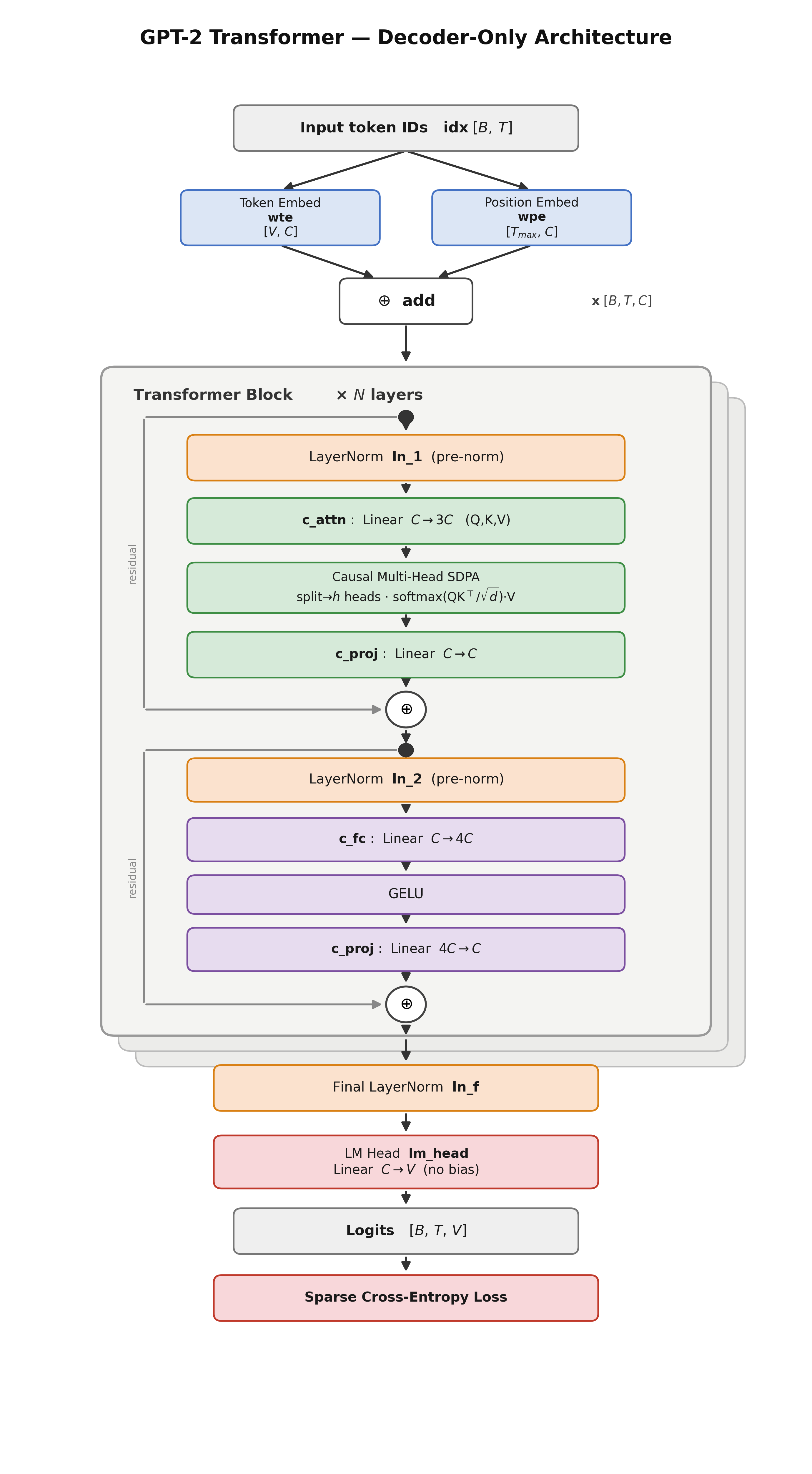
Figure 1: The modular GPT-2 decoder-only Transformer architecture, highlighting the multi-head attention and GELU feed-forward composition.
Native Kernel Engineering, Optimization, and Execution
All primary operators—dense matmuls, normalization, activation (GELU), reduction, loss, and optimization—are implemented at the instruction level in C++/CUDA. Algorithmic and hardware-dependent optimizations are applied in tandem, ensuring arithmetic intensity aligns with roofline saturation (compute- vs memory-bound), explicit vectorized memory access (128-bit float4 loads), and warp-level reductions.
Compile-time specialization eliminates runtime dispatch overheads, yielding branch-free, fully unrolled executables. Key kernels are statically adapted for problem geometry—shape, data type, and hardware architecture—collapsing host-device boundaries for cross-environment execution. Precision is validated via bit-level comparison and norm metrics, confirming that numerics are never sacrificed for speed.
Profiling confirms that BluTrain kernels systematically approach practical hardware limits, outperforming baseline frameworks across latency, FLOPS, and bandwidth metrics. For example, attention forward/backward and cross-entropy loss kernels yield superior throughput and lower step-latency compared with PyTorch.
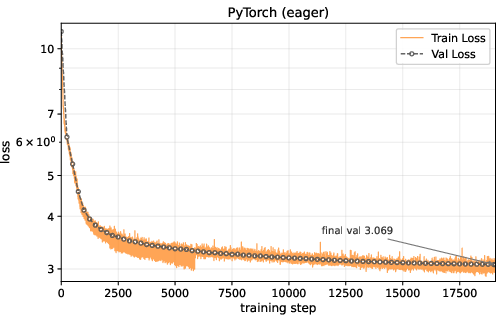
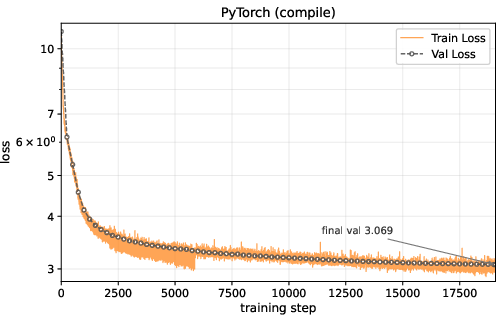
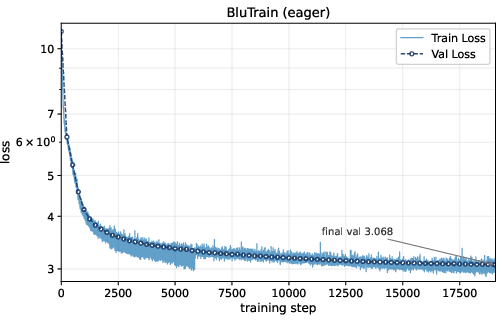
Figure 2: Raw training and validation loss curves for PyTorch (eager mode), exhibiting matched convergence to BluTrain validation benchmarks.
Distributed Execution: Parallelism and Orchestration
BluTrain's DTMS subsystem exposes data, tensor, and context parallelism as independently selectable primitives. Data parallelism implements asynchronous, bucketed AllReduce overlap using CUDA streams and events, decoupling gradient synchronization from critical execution. Tensor parallelism shards matrices symmetrically across device meshes, continuously hiding synchronization latency behind compute through dual-stream overlap (adapted from AsyncTP). Context parallelism supports sequences far exceeding device memory via ring-rotator pipelines and blockwise LogSumExp aggregation.
Orchestration infrastructure provides robust fault detection (temperature, ECC, link, OOM, straggler divergence), checkpointing, NUMA-aware gang allocation, and operational recovery, yielding operational invisibility to typical GPU/data-center faults. Trend analysis and fault taxonomies enable process restart from last uncorrupted checkpoint, maintaining stable long-duration runs despite hardware anomalies.
On a standardized 124M GPT-2 configuration (8 RTX 6000 Adas), BluTrain achieves a sustained throughput of ~406,600 tokens/sec vs PyTorch baseline ~394,700 tokens/sec—a 3% aggregate gain. Maximum gap in validation-loss is below 3×10⁻³; final losses are indistinguishable (∼3.07), indicating strict numeric reproduction. BluTrain's memory footprint is up to 22% lower (21.5 GiB vs 27.5 GiB), allowing larger batch/context sizes and increased parameter ceilings on fixed hardware.
Long-context runs (16,384 tokens) demonstrate a 15% reduction in VRAM usage and 20% throughput gain over PyTorch. For large-scale models (2.42B parameters), BluTrain fits and trains natively on a single device where PyTorch fails with OOM, with sustained throughput of 13.6K tokens/sec.
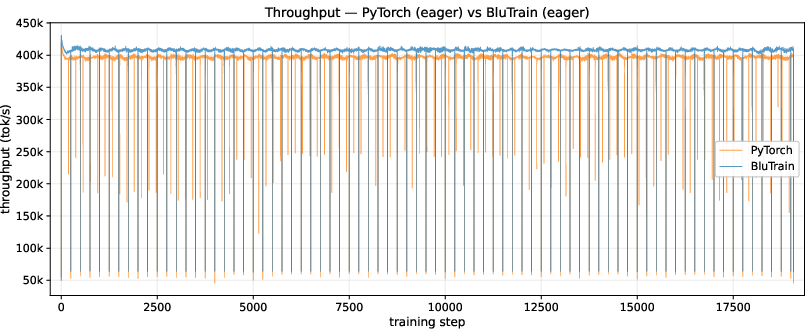
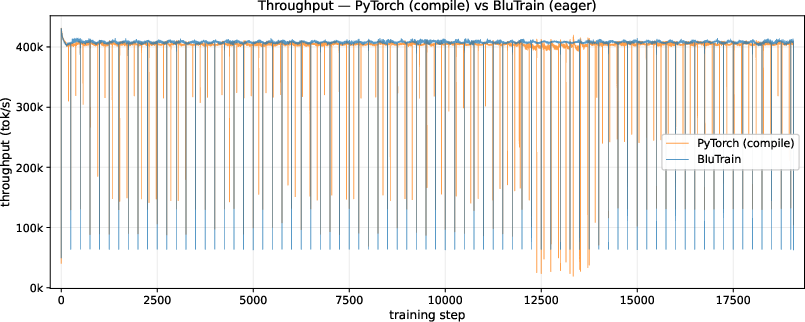
Figure 3: Per-step throughput across the full 19,073-step GPT-2 run; BluTrain in eager mode tracks above PyTorch eager and compile baselines.
Appendix microbenchmarks confirm per-kernel latency and bandwidth wins across matmul, reduction, normalization, loss, and optimizer kernels, with BluTrain saturating device roofline and exhibiting consistent memory headroom and hardware utilization.
Limitations and Future Directions
Current evaluations are confined to a single model family (GPT-2) and a single-node, 8-GPU configuration; systematic component ablations and broader architectural validation are pending. Fault recovery logic, distributed scaling across multi-node, and hardware heterogeneity demands further operational calibration and empirical study. The stack is currently NVIDIA-centric, with future work aiming for hardware-agnostic MLIR compiler backends.
Investigations are ongoing into microarchitectural determinants of numeric precision (accumulation order, arithmetic format, fused operation ordering) and deterministic reproduction of reference training curves. Expansion to NLP, Vision, Speech, Recommender, and Multimodal architectures are planned, leveraging BluTrain's native efficiency as foundational infrastructure.
Conclusion
BluTrain establishes a rigorously engineered, highly performant native C++/CUDA framework for AI systems, with structural memory and throughput advantages over Python-based and generalized stacks. The framework enables absolute control over execution and numerics, yielding reproducible convergence and maximal silicon utilization. Its modular, architecture-general design forms a stable base for future advances in distributed deep learning and system-level AI research.

