- The paper introduces a solid-state Dicke-like quantum battery model where a graphene-based JJ and an LC resonator enable both single- and two-photon energy transfer.
- The study reveals that longitudinal interactions enhance two-photon resonance charging, achieving up to 60% stored energy under optimal conditions.
- The work compares charging protocols, showing that phase-difference modulation provides an effective and scalable strategy for energy storage in cQED platforms.
Quantum Batteries in Two-Dimensional Material-Based Josephson Junctions
Context and Motivation
Quantum batteries (QBs) have emerged as miniature energy storage devices leveraging quantum mechanical effects for on-demand energy transfer, storage, and release. Advances in quantum thermodynamics have characterized QBs in various platforms, including spin chains, molecular ensembles, nuclear spins, and superconducting circuits. Dicke-like QBs, employing collections of two-level systems (TLSs) coupled to photonic resonators, exhibit quantum advantage in charging rate and storage capacity, both theoretically and experimentally [Campaioli24, Ferraro26, Quach23, Hymas26]. The present work investigates implementing Dicke-like quantum batteries in two-dimensional material-based Josephson junctions (JJs), with a focus on solid-state architectures utilizing graphene as an exemplary platform.
Device Architecture
The device consists of a superconducting ring interrupted by a short superconductor-semiconductor Josephson junction (JJ), inductively coupled via a mutual inductance M to a superconducting LC resonator. The ring containing the JJ acts as the quantum battery, while the resonator serves as the charger. In the short-junction regime, Andreev bound states (ABSs) form within the JJ due to Andreev reflections at the superconductor-semiconductor interfaces, which are spatially localized below the superconducting gap and are energetically non-degenerate. Each ABS is associated with a conduction channel and effectively models a TLS, leading to a platform accommodating a finite ensemble of non-interacting TLSs with tunable energy splitting and coupling.
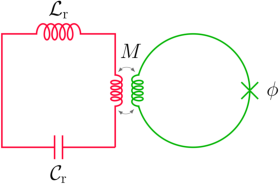
Figure 1: Scheme of a resonant circuit implementing inductive coupling between an LC charger and a graphene-based Josephson junction, forming the quantum battery.
The interaction enables both single-photon and two-photon transfer processes between the resonator and the ABSs. Crucially, the coupling between the LC circuit flux and the JJ supercurrent induces longitudinal interaction terms absent in the conventional Dicke model, with significant implications for energy transfer dynamics.
The Hamiltonian describes the LC resonator as a quantum harmonic oscillator and the JJ as a collection of TLSs with energy splittings determined by the ABS structure:
H^=H^r+H^B+g(a+a†)n=1∑NPn⋅σn+2g2(a+a†)2n=1∑NDn⋅σn
Here, H^r is the resonator, H^B the battery (ABS ensemble), g is the coupling strength, and Pn/Dn encode single-photon and two-photon coupling parameters dependent on the ABS transmission probabilities and superconducting phase difference ϕ. This structure enables both paramagnetic and diamagnetic interactions and supports longitudinal coupling terms arising from the JJ supercurrent.
Resonance Phenomena and Charging Protocols
By tuning ϕ, it is possible to bring subsets of ABSs into resonance with either single-photon (2εn(ϕ)=ℏωr) or two-photon (H^=H^r+H^B+g(a+a†)n=1∑NPn⋅σn+2g2(a+a†)2n=1∑NDn⋅σn0) transfer processes. The main charging protocol considered is based on a sudden quench of the light-matter coupling, initiating energy transfer from the resonator to the QBs. The analysis focuses on the energy stored in the QBs as a function of time, phase difference, and coupling strength.
Numerical simulations utilize a fully quantum approach, addressing the complete Hilbert space of ABSs and a truncated photon sector to account for relevant excitation numbers.
Numerical Analysis: Resonant and Off-Resonant Dynamics
The study explores charging dynamics for various regimes:
- In weak coupling (H^=H^r+H^B+g(a+a†)n=1∑NPn⋅σn+2g2(a+a†)2n=1∑NDn⋅σn1), charging peaks emerge distinctly at phase values corresponding to two-photon resonance for ABSs with substantial transmission (H^=H^r+H^B+g(a+a†)n=1∑NPn⋅σn+2g2(a+a†)2n=1∑NDn⋅σn2), achieving up to H^=H^r+H^B+g(a+a†)n=1∑NPn⋅σn+2g2(a+a†)2n=1∑NDn⋅σn3 of maximal stored energy.
- At intermediate coupling (H^=H^r+H^B+g(a+a†)n=1∑NPn⋅σn+2g2(a+a†)2n=1∑NDn⋅σn4), more uniform and higher charging (H^=H^r+H^B+g(a+a†)n=1∑NPn⋅σn+2g2(a+a†)2n=1∑NDn⋅σn5) is observed, and the selectivity between single- and two-photon resonance is reduced.
Strong numerical evidence demonstrates that the longitudinal interaction term (H^=H^r+H^B+g(a+a†)n=1∑NPn⋅σn+2g2(a+a†)2n=1∑NDn⋅σn6) enhances energy transfer and storage in two-photon resonance regimes, while in single-photon resonance, it acts as a disturbance, suppressing charging efficiency.
Fine Structure: Role of Transmission Probability and ABS Distribution
A simplified model, where all ABSs share the same transmission probability, reproduces the scenario commonly adopted in experiments for short JJs with a single H^=H^r+H^B+g(a+a†)n=1∑NPn⋅σn+2g2(a+a†)2n=1∑NDn⋅σn7. Here, block-diagonal symmetry reductions allow tractable computations. In this case, charging peaks at resonance become more pronounced, and the detrimental effect of longitudinal terms at single-photon resonance remains, confirming that the non-flat ABS energy distribution in the actual device facilitates selective enhancement of the charging via two-photon resonance.
Alternative Charging Protocol: Phase Modulation
Beyond the sudden quench of the coupling, an alternative protocol is introduced, relying on modulation of the superconducting phase difference H^=H^r+H^B+g(a+a†)n=1∑NPn⋅σn+2g2(a+a†)2n=1∑NDn⋅σn8 instead of the coupling strength. This approach, feasible in circuit-QED setups, enables charging without the need for tunable quantum couplers. Direct comparison shows the phase-difference protocol to be equally effective in the weak-coupling regime, with negligible differences in maximum stored energy and charging dynamics, suggesting practical advantages for scalable hardware.
Implications and Outlook
This work demonstrates that two-dimensional material-based JJs, especially short graphene JJs, are robust platforms for Dicke-like quantum batteries exploiting collective quantum phenomena in energy storage. The presence of longitudinal coupling terms, unique to this architecture, allows for enhancement of charging via two-photon processes, contradicting predictions from conventional Dicke models. The device further accommodates flexible charging protocols, including phase-difference modulation, offering practical routes toward scalable quantum energy technology.
Results explicitly show:
- Strong enhancement (H^=H^r+H^B+g(a+a†)n=1∑NPn⋅σn+2g2(a+a†)2n=1∑NDn⋅σn9) of stored energy in two-photon resonance regardless of the detailed ABS energy spread.
- Longitudinal couplings, as first-order terms in H^r0, can be both beneficial (in two-photon resonance) and detrimental (in single-photon resonance) for charging efficiency, enabling protocol optimization.
- Theoretical predictions suggest that implementation in graphene JJs is compatible with state-of-the-art experimental cQED platforms.
Conclusion
The research provides a comprehensive theoretical framework for Dicke-like quantum batteries based on two-dimensional material JJs, shows novel collective charging effects aided by unique longitudinal interaction terms, and validates practical protocols for efficient energy storage in solid-state quantum devices. Future developments include experimental realization of phase-controlled QBs, optimization of charging via reinforcement learning, and exploration of materials with richer ABS structure for quantum advantage in energy manipulation (2605.22582).

