- The paper introduces a cavity-based method using a two-cavity architecture to suppress self-discharging and retain ergotropy in quantum batteries.
- Numerical simulations and analytical models show that strong inter-cavity coupling and coherent initial states critically boost energy retention.
- Results indicate that multi-qubit batteries benefit from collective Tavis-Cummings effects, enhancing ergotropy preservation as the system scales.
Suppressing Self-Discharging of Quantum Batteries by Cavity Interactions
Overview
The paper "Suppressing Self-Discharging of Quantum Batteries by Cavity Interactions" (2606.23999) delivers a comprehensive analysis of self-discharging suppression in quantum batteries via environment engineering, particularly through a two-cavity architecture. The study addresses the ergotropy retention in quantum batteries coupled to lossy cavities, with an auxiliary cavity coherently interfaced, at finite temperature and for variable battery sizes. Numerical simulations and analytical results are provided for single, two-qubit, and multi-qubit batteries, emphasizing the critical influence of inter-cavity coupling strength and initial state structure.
Model Architecture and Dissipative Dynamics
The core architecture consists of N identical qubits embedded in a lossy cavity (C1), which is coupled through photon-exchange interaction to an auxiliary cavity (C2). Both cavities dissipate into independent thermal baths characterized by occupation numbers nˉ1, nˉ2 (Figure 1).
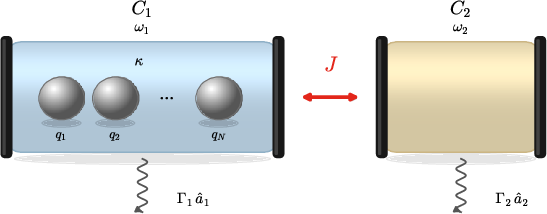
Figure 1: Architecture of a quantum battery with N qubits in cavity C1 coupled to auxiliary cavity C2, each linked to its own reservoir.
The evolution is governed by a Lindblad master equation in the local dissipator regime, encompassing both spontaneous emission and thermally induced absorption. The principal control parameters are the qubit--cavity coupling (κ/Γ1), inter-cavity coupling (J/Γ1), and mean thermal occupation (C10). The battery's performance metric is ergotropy C11, quantifying extractable work from the reduced qubit subsystem.
Single-Qubit Analysis
For a single-qubit battery, the paper introduces a dark-mode construction arising in the qubit+cavity system, notably in the single-excitation manifold, where C12 is stationary under lossy-cavity dissipation (Figure 2). The overlap of the initial state with this dark mode determines asymptotic coherence retention, controlled via C13.

Figure 2: Composition of the single-excitation dark mode C14 as a function of C15, showing the protection mechanism against dissipation.
Two preparations are analyzed: a fully excited state C16 (population imbalance) and a superposition C17 (coherence). Strong inter-cavity coupling (C18) leads to pronounced suppression of self-discharging, with retention fraction scaling as C19 for the coherent preparation. Notably, the population-based preparation suffers faster ergotropy decay at elevated temperatures due to thermal absorption channels.

Figure 3: Normalized ergotropy C20 for single-qubit batteries, contrasting two initial states and varying inter-cavity couplings.
Two-Qubit Batteries: Correlations and Interaction Effects
For C21, the study extends to three initial states: fully excited, separable coherent, and maximally entangled (Bell state). The inclusion of Heisenberg qubit-qubit interactions negligibly impacts ergotropy retention within the relevant parameter regime. The Bell state preparation consistently leads to higher long-time ergotropy, reinforcing the beneficial role of quantum coherence and entanglement—particularly under moderate inter-cavity coupling.
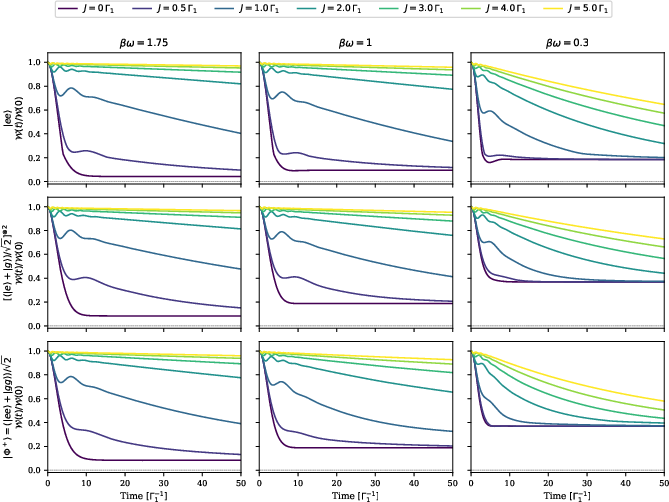
Figure 4: Ergotropy retention for two-qubit batteries under different initial states, temperature regimes, and inter-cavity couplings.
Robustness against auxiliary cavity loss is examined, demonstrating that the protection mechanism is dominated by the magnitude of C22, with only weak sensitivity to C23 (Figure 5).
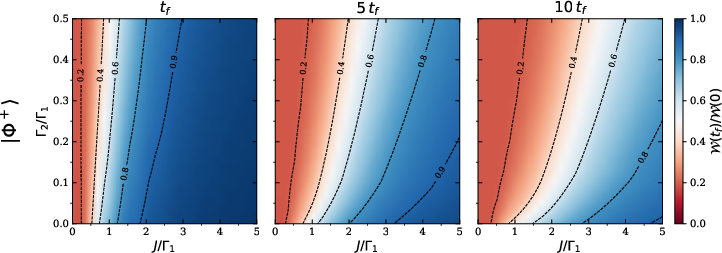
Figure 5: Robustness of ergotropy retention in the Bell state as a function of C24 and auxiliary cavity loss rate C25.
Multi-Qubit Batteries and Collective Effects
Analyzing batteries with C26–C27 qubits, all initially prepared in GHZ states, the study discovers a monotonic enhancement of normalized retained ergotropy with increasing C28 at fixed C29 (Figure 6). This trend is rooted in collective Tavis-Cummings coupling within the symmetric Dicke manifold, redirecting emission into protected auxiliary modes. The findings constitute a dissipation-phase analogue of collective charging speedups, now focused on retained ergotropy.
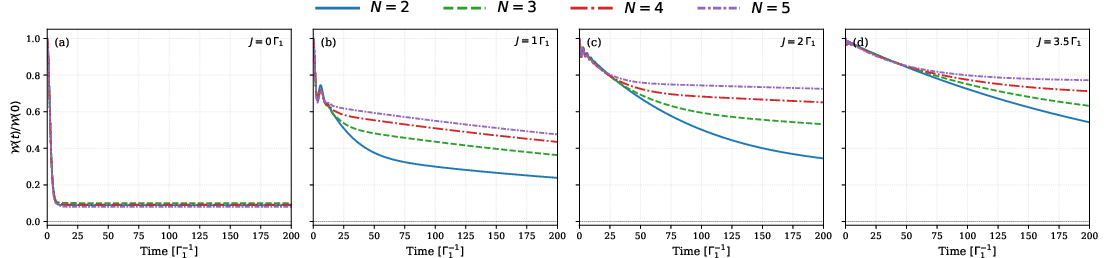
Figure 6: Normalized ergotropy for GHZ-charged batteries with nˉ10–nˉ11 qubits under different inter-cavity couplings.
Theoretical Implications and Practical Feasibility
The implications are manifold. Suppression of self-discharging by cavity interaction offers a controllable knob for battery lifetime extension, scalable with the number of qubits and robust to moderate non-idealities. The importance of coherence and entanglement in initial state preparation for energy retention is affirmed, questioning designs relying solely on population-based charging. The collective enhancement in multi-qubit settings underscores the necessity of symmetrized coupling for optimal protection.
Experimental feasibility is supported by translation of dimensionless parameters to circuit-QED and organic-microcavity setups, showing compatibility with present day hardware capabilities.
Conclusion
The paper establishes cavity-mediated protection as an effective strategy for suppressing self-discharging in quantum batteries at finite temperature, across battery sizes and dissipative regimes. Strong inter-cavity coupling maximizes ergotropy retention, with collective advantages emerging as the system scales. The robustness to auxiliary cavity losses and the enhanced preservation in coherent (and entangled) preparations are notable outcomes. Future explorations should address robustness under asymmetric losses and extend analysis to a broader array of many-body initial states, progressing toward scalable, long-lived quantum battery architectures.