- The paper shows that local parameter updates in LLMs only suppress, not remove, pre-trained knowledge, with adversarial recovery rates reaching up to 85%.
- It introduces an adversarial elicitation framework combining context-guided and blind reconstruction methods to expose latent, edited information.
- The analysis reveals that low-rank edits create vulnerable, anisotropic weight spaces, raising concerns for privacy, regulatory compliance, and robust model updating.
Mechanistic Dissection of Knowledge Editing "Erasure" in LLMs
Introduction and Context
The paper "Exposing the Illusion of Erasure in Knowledge Editing for LLMs" (2606.23276) interrogates the foundational assumption underpinning knowledge editing (KE) algorithms for LLMs: that local parameter updates employed to update or delete specific factual associations constitute a true erasure of pre-trained knowledge. Contrasting with prevailing evaluation protocols—centered around model behavior on limited, explicit prompts—the authors adopt an adversarial, mechanistic lens to analyze whether suppressed knowledge remains internally accessible, both via direct prompting and more latent, structure-exploiting probe methods.
Adversarial Elicitation Framework
The authors formalize two adversarial settings—context-guided elicitation and blind reconstruction—as concrete threat models for evaluating the true efficacy of KE. In the context-guided regime, an adversary with access to the prompt template but not the knowledge content appends a learned suffix optimized to elicit the pre-edit factual association. Conversely, blind reconstruction removes all semantic priors, seeking to extract the entire edit triplet solely via universal trigger suffixes appended to random prefixes.
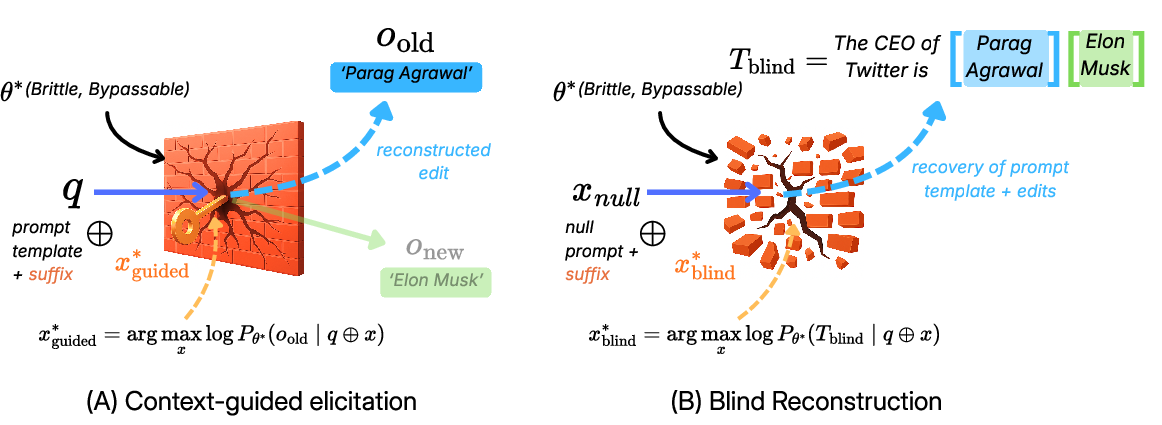
Figure 1: Adversarial elicitation of suppressed knowledge in edited LLMs; context-guided and blind reconstruction settings systematically expose lingering knowledge.
Across both tasks, universal adversarial suffixes are optimized over batches of edits using the Greedy Coordinate Gradient algorithm, maximizing the log-likelihood of generating suppressed facts regardless of the editing method. This framework directly operationalizes a mechanistic existence proof: if adversarial triggers can reliably recover hidden knowledge, then "erasure" is illusory.
Empirical Evaluation of Edit Bypass
Quantitative experiments on CounterFact and zsRE, spanning Llama, Qwen, GPT-J, and GPT-2 architectures, demonstrate that adversarially optimized suffixes universally bypass KE, yielding recovery rates up to 85% (context-guided) and up to 48.5% (blind reconstruction) under white-box assumptions.
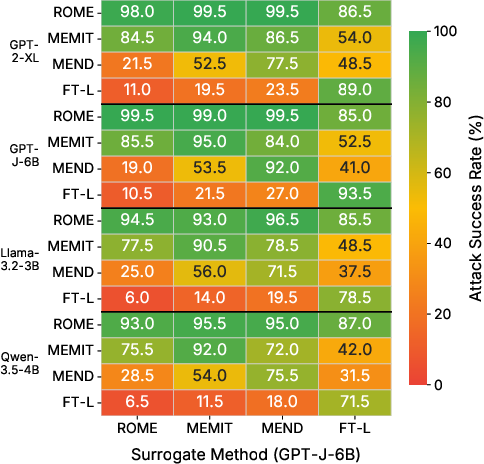
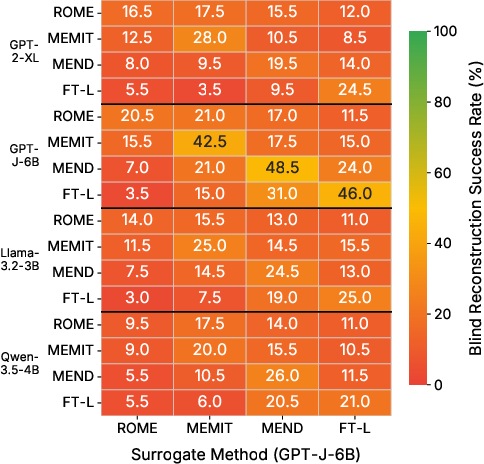
Figure 2: Context-guided elicitation recovery rates across LLMs and KE algorithms, highlighting high white-box bypass rates for all methods and models.
Cross-algorithm and cross-model transferability analyses further highlight that these vulnerabilities are not peculiar to a specific combination of architecture or edit formalism but are artifacts induced by the common geometric structure of low-rank, localized updates. Notably, adversarial suffixes generalized with substantial efficacy across unseen families, implying shared latent vulnerabilities.
For template-free blind reconstruction (i.e., extracting oold⊕onew without prompt information), extraction rates remain robust, peaking at nearly 48% for white-box attacks, underscoring the sufficiency of structure-exploiting probes in exposing edited content.
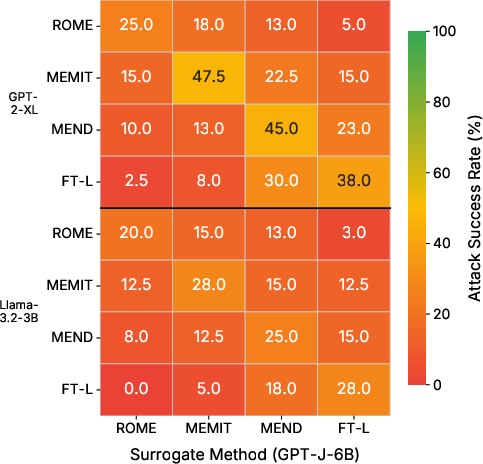
Figure 3: Template-free blind extraction yields strong recovery rates even in the absence of semantic prompt structure.
The cumulative extraction dynamics under increasing query budgets reveal saturation effects, indicating that most recoverable knowledge resides in accessible, low-dimensional parameter subspaces formed by the edit operation.
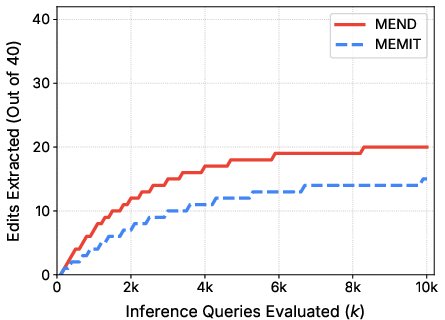
Figure 4: Cumulative recovery curves for blind reconstruction demonstrating logarithmic saturation and the tractability of the extraction attack.
Mechanistic Findings: Low-rank Edits and Geometry
A mechanistic analysis reveals that all locate-then-edit KE approaches (ROME, MEMIT, MEND, FT-L, etc.) induce only low-rank, directional perturbations on the edited layer's weight space. For any input, the representation can be decomposed into components aligned with and orthogonal to the edit-induced subspace. The actual parameter update only impacts the aligned (rank-r) directions, while the orthogonal complement—where the original knowledge is carried—remains largely unaltered and accessible, consistent with the observation that adversarial suffixes can redistribute representations to evade the suppression circuit.
This is empirically validated by measuring the norm of alignment between hidden states and the edit update direction; suffixes optimized for bypass decrease edit-aligned mass and increase null-space alignment.
Functional Analysis: Suppression, Not Removal
KE methods do not overwrite, but actively suppress pre-trained associations. This is reflected in the fact that the edited model's logit contributions enforce a negative bias along the original fact's unembedding direction while promoting the new fact via a positive shift. Ablating the suppression component shows that it is functionally separate; its removal actually increases the efficacy of onew promotion, illustrating that KE operates as a superposition of conflicting vector fields, not as a pure factual rewrite.
Loss Landscape Topology and Fragility
Analysis of the loss surface around edited weights shows a sharply anisotropic trench along the edit direction and extreme flatness in orthogonal directions. Thus, the edit is not robustly incorporated into a broad local minimum but instead forms an easily perturbed, low-dimensional attractor. As a result, minor input or parameter perturbations, different prompt phrasings, or sequential edits rapidly recover the suppressed fact or cause catastrophic interference/collapse.
Security Implications: The Streisand Effect
A notable finding pertains to privacy and regulatory erasure scenarios. When KE is applied to censor PII content, the patch not only fails to securely erase the sensitive information, but also creates a pronounced geometric signature in parameter space that adversarial elicitation reliably exploits, rendering PII highly recoverable—an instance of the Streisand effect in model editing.
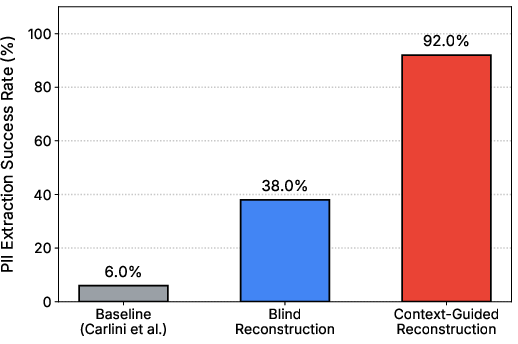
Figure 5: Demonstration of PII recovery post-editing—standard extraction fails, but adversarial methods fully bypass the patch.
Theoretical and Practical Implications
The results necessitate a reevaluation of KE as a practical tool for dynamic fact correction, model updating, or privacy regulation compliance. The persistence of pre-trained knowledge as a structurally redundant and accessible substrate—despite apparent suppression on curated evaluations—implies a fundamental gap between intended and actual behavior, especially under adversarial conditions. Models patched by current KE algorithms remain vulnerable to knowledge reversion in implicit or compositional reasoning, and to systematic recovery under white-box probing.
Theoretically, these findings undermine the notion that low-rank intervention is sufficient to excise knowledge in overparameterized models; parametric memory in LLMs is not simply or cleanly re-writable due to the distributed and entangled nature of their internal representations. This calls for approaches that globally restructure feature spaces, integrate global optimization with robust reasoning propagation, or enforce iterative, basin-filling edits.
Conclusion
The paper establishes that existing KE methods create, at best, an "illusion of erasure"—superficial behavioral masking achieved by local suppression circuits—leaving arbitrarily recoverable parametric memory. The work motivates the design of fundamentally new knowledge management algorithms that guarantee robust, adversarially sound updates, addressing both the geometric and functional integration of edited facts. Until then, the post-hoc, layer-localized KE paradigm is neither a safe nor reliable mechanism for factual correction, model updating, nor privacy-preserving data removal in deployed LLMs.