- The paper introduces a geometric masking technique to decouple end-effector representations, achieving progression rates of 81-88% in zero-shot cross-embodiment tasks.
- The methodology employs real-time mask augmentation and attention gating within vision encoders, ensuring pixel-aligned occlusion and robustness to unseen morphologies.
- Experimental results demonstrate that Cloak-VLA maintains high task performance on unseen platforms while reducing retraining needs, paving the way for scalable manipulation in heterogeneous settings.
Cloak: Zero-Shot Cross-Embodiment Manipulation by Masking the End-Effector from the VLA
Introduction
The paper "Cloak: Zero-Shot Cross-Embodiment Manipulation by Masking the End-Effector from the VLA" (2606.22836) addresses the critical limitation in robotic manipulation policies that arises when deploying on previously unseen embodiments. Specifically, the authors observe that the end-effector consistently occupies a large region in wrist-mounted camera views, forming a strong visual prior tied to the embodiment. Consequently, policies trained on gripper-centric datasets are highly specialized and fail to generalize across new hardware—particularly with more complex or anthropomorphic hands—unless additional target-specific data collection and retraining is performed. The Cloak methodology demonstrates that masking the end-effector in visual input removes this entanglement, enabling a Vision-Language-Action (VLA) policy trained solely on parallel-jaw gripper demonstrations to transfer zero-shot to unseen end-effectors and arms, including five-fingered hands.
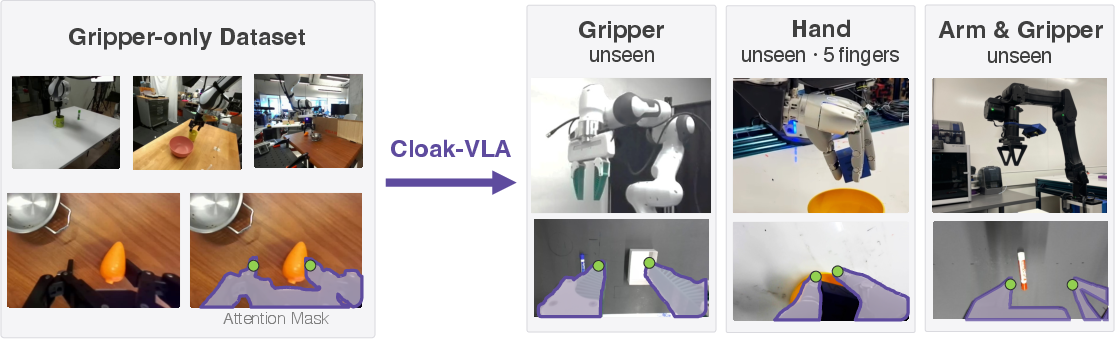
Figure 1: Cloaking the end-effector decouples the VLA's visual representation, facilitating zero-shot transfer from a parallel-jaw gripper to previously unseen morphologies, such as a five-fingered hand.
Technical Methodology
Embodiment Masking and Augmentation
Central to Cloak is the real-time computation of geometric masks that occlude the end-effector region from the wrist camera input. These masks are rendered in simulation using robot kinematics, link meshes, and calibrated camera extrinsics, ensuring pixel-level alignment. During training, mask augmentation is performed via unioning random capsules to distort the silhouette and subtracting disks from the interior. This exposes the model to a distribution of plausible end-effector shapes, strengthening robustness against unforeseen morphologies.

Figure 2: Representative mask optimization illustrates accurate alignment between simulated masks and real wrist views, ensuring robust occlusion during training.
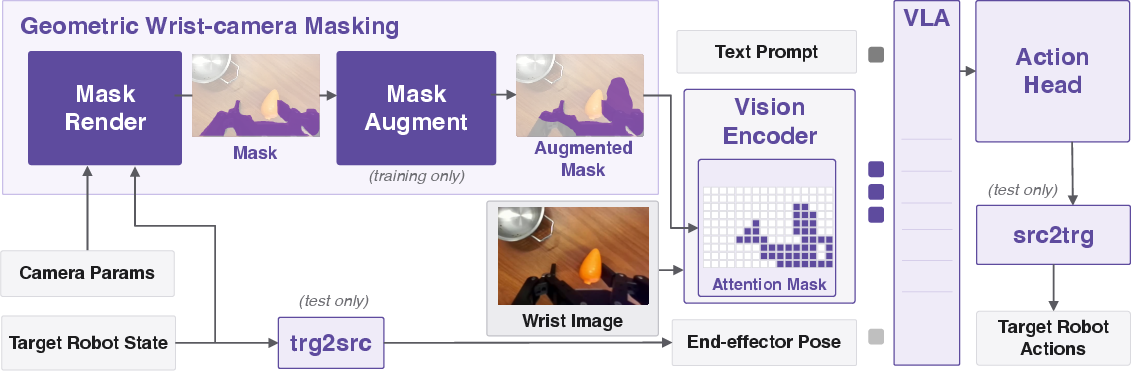
Figure 3: Cloak pipeline overview—geometric masking, augmentation, and attention gating are applied to visual encoder patches, enabling deployment via tip-pose retargeting across embodiments.
Masked Attention in Vision Encoders
The augmented wrist images are tokenized into patches using a ViT-style vision encoder. Mask information is downsampled to the patch grid, and self-attention is gated such that queries cannot access masked patches. Masked tokens persist in the sequence but are fully occluded from attention, preserving positional consistency while filtering embodiment-specific information.
Cross-Embodiment Retargeting
To overcome kinematic and action mismatches, Cloak employs tip-pose retargeting: FK and IK operations are used to map state and action spaces between source and target robots via designated tip points, typically the gripper jaws or corresponding fingers. For dexterous hands, matching strategies such as thumb-middle finger pairing are used. Regularization terms in IK objectives are included to avoid instability and null-space divergence in retargeted motions.
Training Protocol
Cloak-VLA is obtained by finetuning π0.5 [black2025pi_] on the DROID dataset, with mask augmentation applied online at each training step. The only embodiment-specific information seen by the policy is filtered by the masking protocol; training leverages wrist and external views, proprioceptive state, and language prompts.
Experimental Evaluation
The paper evaluates Cloak-VLA on four manipulation tasks (pick-and-place, remove, move, fold/unfold) across four hardware embodiments: the original parallel-jaw gripper (source), an unseen UMI gripper, the YAM arm+gripper, and the Sharpa five-fingered hand. Metrics include progression rate and success rate over 48 randomized trials per task.
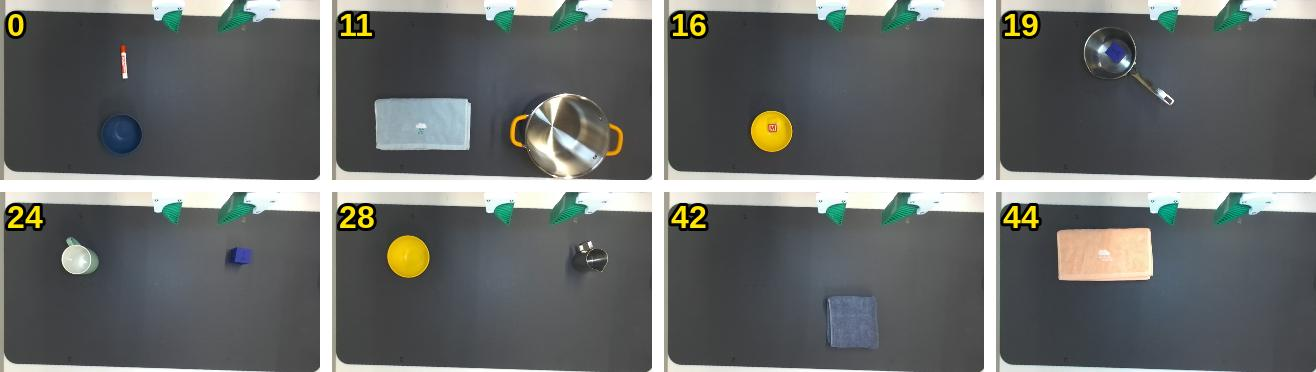
Figure 4: Visualization of experiment task setups across manipulation domains; each trial is indexed for reproducibility.
Quantitative Results
Cloak-VLA maintains source-embodiment performance with minimal degradation (progression rate: $88.0$), and preserves this rate on unseen embodiments: $85.1$ (UMI gripper), $86.3$ (YAM arm), $81.8$ (Sharpa hand). Competing baselines—either lacking masking or misaligning at language-action interfaces—exhibit sharp drops, especially on the Sharpa hand (as low as $54.4$). Cloak-VLA leads across all unseen embodiments, confirming that masking is the critical conduit for generalization.
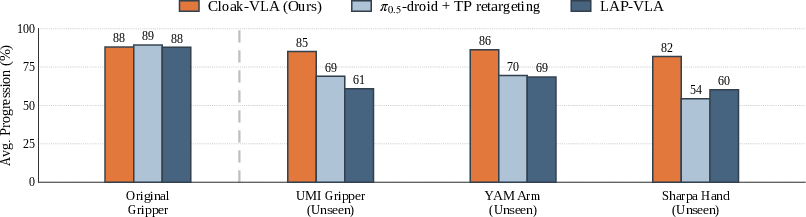
Figure 5: Task-averaged progression rate across all embodiments. Cloak-VLA uniquely sustains performance under transfer, while baseline policies degrade on unseen bodies.
Qualitative Rollouts and Mask Ablations
Keyframe rollouts confirm that Cloak closes the vision gap: policies lacking masking fail to grasp, misalign, or drift out of distribution, while Cloak-VLA executes precise actions on unseen hardware.
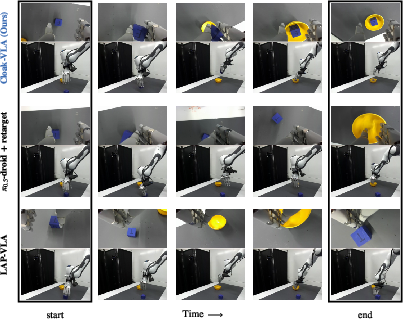
Figure 6: Qualitative rollouts—Cloak-VLA accurately grasps and places objects with the Sharpa hand, while baselines fail to align or transport objects.
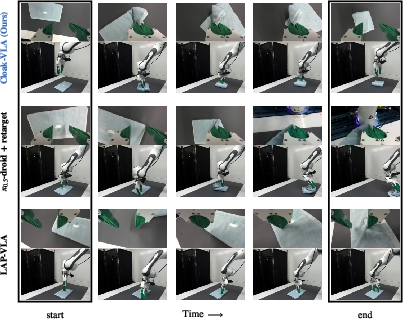
Figure 7: Cloak-VLA completes towel folding with the UMI gripper; non-masked baselines collapse or miss critical grasp points.
Ablation experiments on masking strategies (no augmentation, pre-computed target overlays) show Cloak-VLA's superiority and underscore the importance of training-time silhouette randomization.
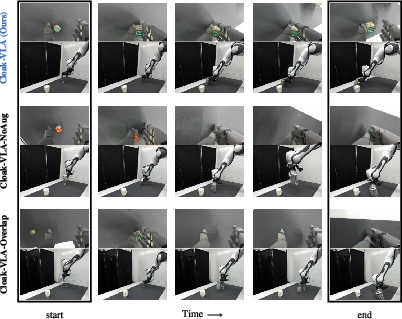
Figure 8: Mask augmentation ablation on the Sharpa hand. Only Cloak-VLA generalizes to the unseen morphology; fixed or target-overlayed masks fail to close the embodiment gap.
Practical and Theoretical Implications
The Cloak paradigm demonstrates that robotic manipulation data can be reused across evolving hardware, eliminating the need for costly per-embodiment data collection and retraining. This decoupling of skill from embodiment implies that large-scale gripper-centric datasets retain their utility as new platforms emerge, providing lasting value and robust initialization points for continual learning or further adaptation. The model's ability to operate visually body-agnostic also paves the way for scalable generalist VLAs and enables easier deployment in heterogeneous warehouse or industrial fleets.
Limitations and Future Directions
Cloak currently addresses manipulation tasks tractable via two-tip retargeting and does not extend to in-hand reorientation or advanced dexterous maneuvers demanding richer contact modeling. Limitations of tip-based IK (null-space instability, tilting suppression) impose constraints on transfer flexibility. Expansion to finer-grained control spaces, richer observation modalities, and minimal-shot adaptation protocols are natural extensions. Integrating generative or learned segmentation with geometric masking may further improve robustness in scenarios with malformed or occluded meshes.
Conclusion
Cloak establishes that rigorous masking of the end-effector during VLA training enables zero-shot transfer across diverse robotic embodiments, including anthropomorphic hands. The masking protocol, paired with embedding-agnostic attention and robust state-action retargeting, allows policies to generalize far beyond their original hardware, with strong quantitative and qualitative results validating its effectiveness. Cloak enables persistent reuse of manipulation demonstrations, decouples skill acquisition from hardware idiosyncrasies, and underscores the importance of visual disentanglement in robotics generalization.