- The paper introduces KITE, a framework that decouples task reasoning from motor control by leveraging a contact-based latent intent interface for zero-shot cross-embodiment manipulation.
- It employs synthesized kinematic supervision without target-task demonstrations, achieving up to 100% success on cube picking and 93–96% on bottle pumping tasks.
- The approach demonstrates robust simulation and real-world transfer across structurally diverse robot embodiments, challenging fixed action mapping paradigms.
KITE: Decoupling Kinematics and Interaction for Zero-Shot Cross-Embodiment Manipulation
Introduction
The paper proposes KITE (Kinematic Interaction Transfer across Embodiments), a framework addressing the long-standing challenge in robotic manipulation: transferring policies across embodiments with structural differences, in the absence of task demonstrations on the target embodiment. Standard policy architectures intertwine task semantics and embodiment-specific action spaces, leading to poor generalization across kinematic and morphological variations. KITE introduces an explicit decoupling of task reasoning and motor control, enabling zero-shot transfer by leveraging contact-based latent representations and embodiment-specific action decoders. This design aligns with the theoretical notion that cross-embodiment generalization is fundamentally a representation problem, not merely a matter of scaling policy capacity or dataset diversity.
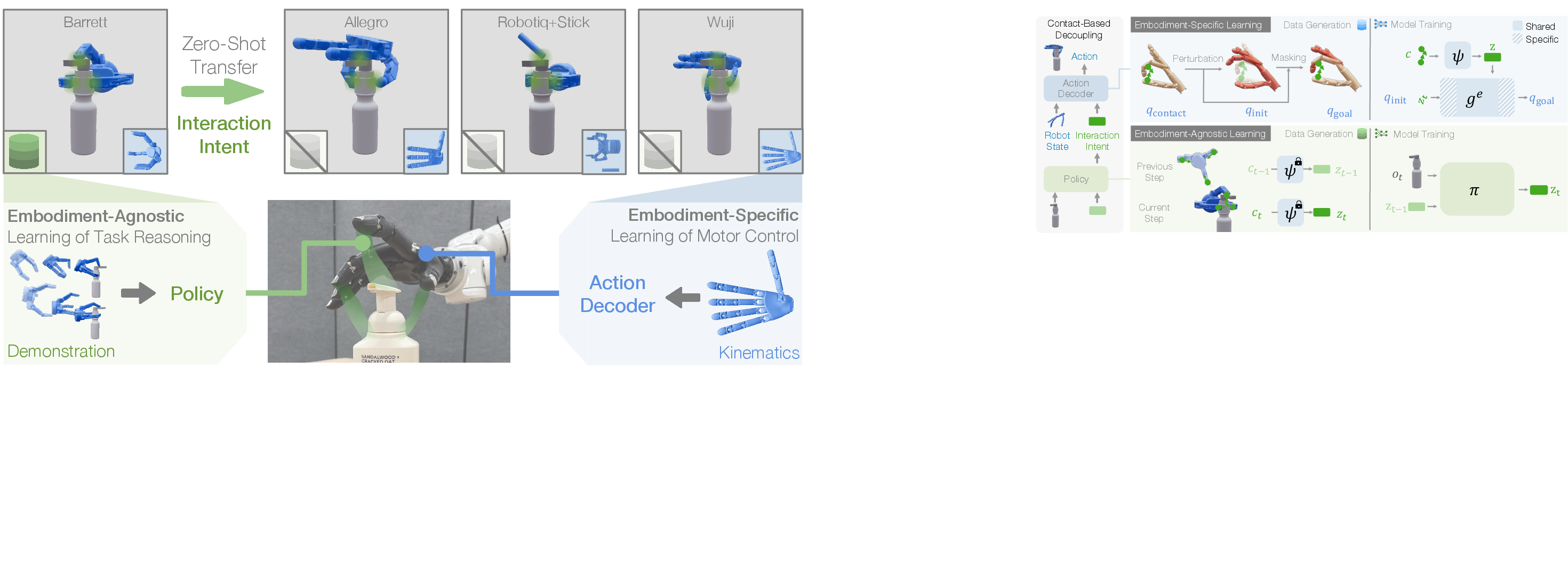
Figure 1: KITE conceptualization—decoupling manipulation into embodiment-agnostic task reasoning and embodiment-specific motor control via a learned latent intent interface.
Methodology
Zero-shot cross-embodiment transfer is defined as deploying a manipulation policy trained on a source embodiment onto a structurally different target embodiment, given only task demonstrations from the source and the target’s kinematic model. The target embodiment may have arbitrary configuration and action spaces, and only its kinematic description (e.g., URDF) is assumed available. The objective is to solve the manipulation task on the target without requiring task-specific demonstration data.
KITE decomposes manipulation into two paradigms:
- Embodiment-Agnostic Task Reasoning: A policy π predicts a contact-based latent intent—encoding intended manipulator-object engagement in 3D workspace—derived from source-task observations.
- Embodiment-Specific Motor Control: An action decoder ge translates latent intents into motor commands for a particular embodiment, trained solely from its kinematic model via synthesis of contact-configuration pairs.
A permutation-invariant encoder ψ maps unordered, variable-length contact sets to fixed-dimensional latent intents zt, establishing an action interface that is agnostic to morphology and topology.
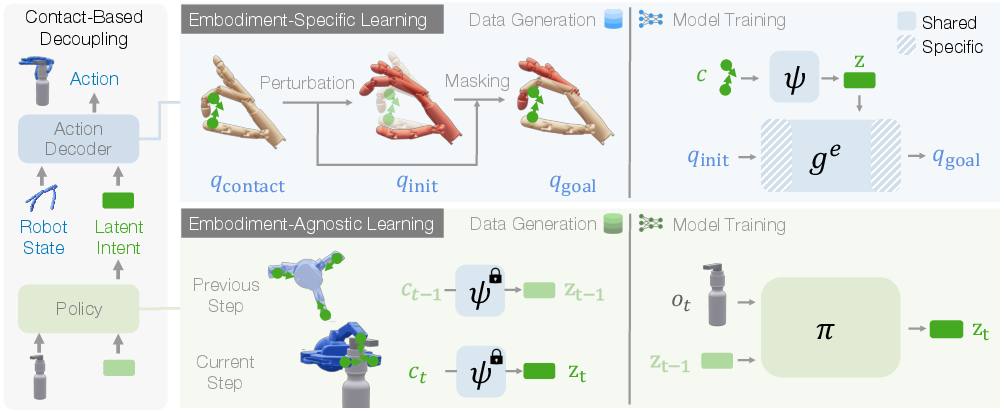
Figure 2: KITE overview—policy π predicts latent intents; embodiment-specific decoder ge maps these to actions using only kinematic data.
Training Procedures
- Action Decoders are trained from synthesized data: surface templates are generated from the embodiment’s geometry, contact configurations are sampled uniformly in joint space, and goal configurations are defined for only the relevant joints (via joint masks). No task demonstrations or reward signals are used in training.
- Policy π is trained by imitation learning on the latent intent space using converted source demonstrations. The policy backbone (e.g., iDP3, diffusion models) is unchanged, and proprioceptive feedback is replaced with previous latent intents to achieve embodiment agnosticism.
Experimental Results
Simulation Experiments
KITE is evaluated on three manipulation tasks (cube picking, keyboard pressing, bottle pumping) across five structurally distinct embodiments (parallel grippers, composite controllers, dexterous hands). The framework achieves consistent, highly successful zero-shot transfer, significantly outperforming embodiment-aware and retargeting baselines (OHRA, D(R,O), SPIDER), which either fail or exhibit limited applicability due to fixed correspondences or single-pose limitations.
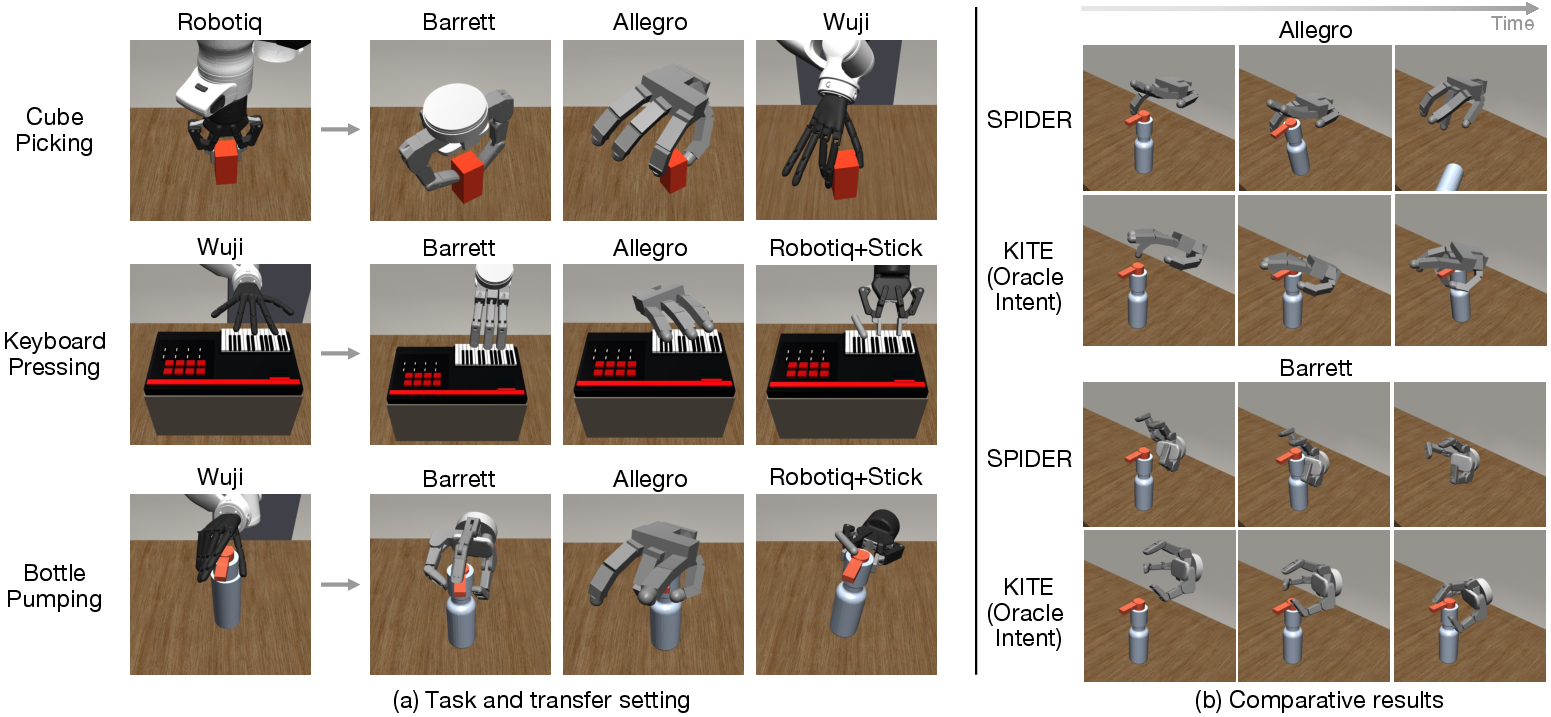
Figure 3: (a) Transfer settings; arrows indicate task and source-to-target direction. (b) On bottle pumping, KITE adapts contact regions dynamically, outperforming fixed retargeting schemes.
KITE's full variant reaches 100% task success on cube picking across all dexterous hands, and 93–96% on bottle pumping under structural transfer. Notably, the policy's latent intent representation enables dynamic adaptation to shifting task-relevant contact regions, addressing failures in methods reliant on fixed part correspondences.
Ablations
Removing the latent intent interface and relying on raw contact representations degrades performance by up to 24 percentage points on complex tasks. Using ground-truth oracle intents (bypassing policy prediction) shows that the action decoder rarely limits performance, validating the efficacy of the latent intent interface. Importantly, incorporating target-task demonstrations into action decoder training provides no material performance benefit, demonstrating that kinematic supervision alone suffices.
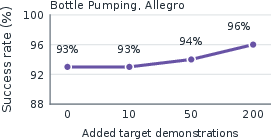
Figure 4: Adding target-task demonstrations to the action decoder yields a flat success trend, confirming kinematics-only supervision sufficiency.
Qualitative Analysis
The action decoder achieves the same latent intent via diverse embodiment regions, illustrating non-reliance on explicit part correspondences. Robustness to initialization perturbations is exhibited—moderate pose variations maintain intended contacts, but severe offsets degrade efficacy, revealing heuristic limitations in nearest-contact selection.
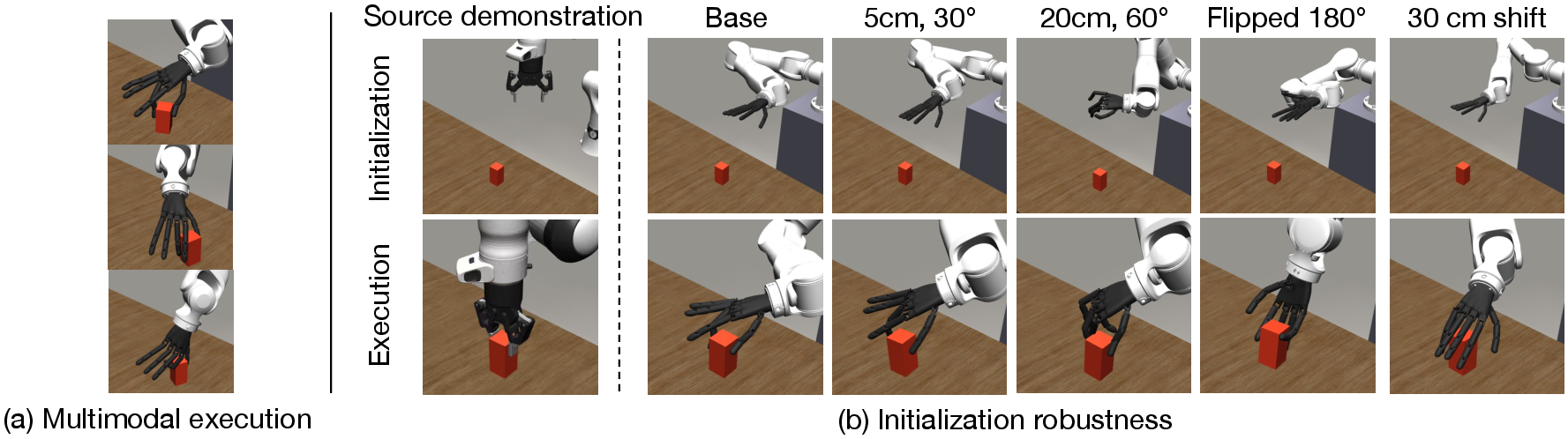
Figure 5: (a) Decoder realizes identical intents through varied hand regions; (b) robust to moderate pose perturbations, less so for extreme cases.
Real-World Transfer
KITE demonstrates robust transfer to a physical Wuji hand, both from parallel gripper and human-hand demonstrations (parameterized via MANO). Zero-shot policy deployment achieves $7/10$–$8/10$ success under real-world perception and physics, validating practical applicability and the utility of human-to-robot demonstration transfer.
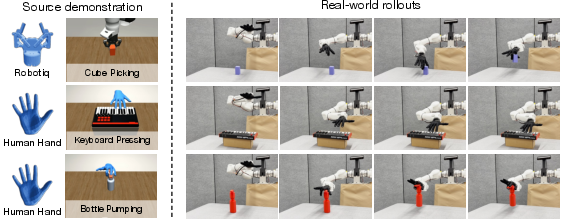
Figure 6: Real-world deployment—source demonstration (robot or human hand) successfully transferred to physical Wuji hand in zero-shot manner.
Implications and Future Directions
KITE defines a new paradigm for cross-embodiment manipulation by making task knowledge portable via contact-based latent intents and embodiment-specific decoders trained solely from kinematics. The abstraction separates what interaction should occur (encoded in latent intents) from how it is realized, leveraging prior knowledge of the target’s structure. This approach exposes the limits of scale-dependent, structure-aware policies and part-correspondence-based retargeting, which demand task data or demonstrations for each new embodiment.
Theoretically, KITE suggests that manipulation representation is the core bottleneck for generalization, not merely policy scaling or architectural conditioning. Practically, the framework enables substantially more efficient task policy deployment across diverse robot bodies, with broad implications for hardware-agnostic policy rollout, sim-to-real transfer, and integration of human demonstrations.
Future research directions include:
- Extending latent intent representations for tasks where contact is not the primary success criterion.
- Addressing kinematic faithfulness gaps induced by compliance, actuation limitations, and sim-to-real mismatch.
- Optimizing decoder training pipelines for large families of target embodiments.
- Exploiting cross-modal intents (e.g., vision-language-action) incorporating contact semantics for even more general policy transfer.
Conclusion
KITE achieves zero-shot cross-embodiment manipulation via explicit decoupling of task reasoning and embodiment-specific motor control, operationalized through contact-based latent intents and kinematics-trained action decoders. The framework proves effective across structurally diverse tasks and embodiments in both simulation and real-world environments, without relying on target-task demonstrations. KITE challenges prevailing policy-scaling paradigms, positing that action interface representation is foundational for generalization and reuse of manipulation knowledge across robotics platforms.

