- The paper advances multifunctional quantum networking by integrating robust routing under heterogeneity, calibration-aware link orchestration, and programmable quantum repeaters.
- The paper presents analytical and numerical results showing that high-quality repeaters and grey-box routing significantly improve network fidelity and reduce blocking probabilities.
- The paper introduces a hybrid quantum-classical instruction set for repeaters, offering scalable, cross-layer strategies to mitigate hardware drift and calibration challenges.
Expert Summary of "Making Quantum Networks Work: Routing, Calibration, and Programmable Quantum Repeaters" (2606.22316)
This thesis presents an integrated cross-layer perspective on the design and operation of quantum networks, advancing beyond the conventional siloed approaches of routing, link management, and node control. Emphasizing scalable, operationally meaningful frameworks, the work addresses network performance under realistic heterogeneity, partial knowledge, hardware drift, and practical calibration constraints. The central technical axes include robust quantum routing algorithms, calibration-aware link orchestration, and a programmable repeater node abstraction grounded in experimentally relevant quantum hardware.
Quantum Network Foundations and Components
The quantum network paradigm departs fundamentally from classical networks due to quantum mechanical constraints: probabilistic operations, no-cloning, finite quantum memory, and decoherence. The network structure involves quantum devices (end-nodes), quantum repeaters, quantum links (optical fiber or free-space), and logically-centralised or decentralised network controllers. Core primitives—teleportation, entanglement swapping, purification, and quantum error correction—constitute the building blocks for applications from QKD to distributed quantum computation.
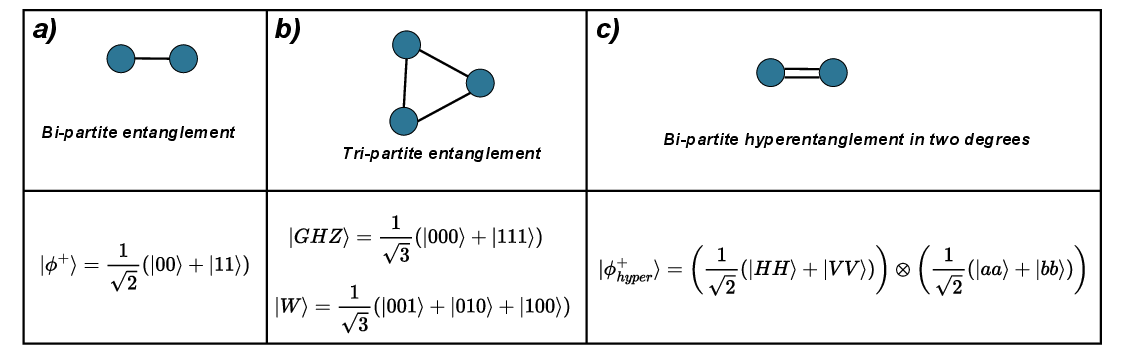
Figure 1: Examples of different types of entanglement, from bipartite Bell states to hyperentanglement, underlying quantum network operations.
Cross-layer Routing Under Heterogeneity and Limited Knowledge
Routing under Chain and Network Topologies
The thesis formalizes routing in quantum repeater networks incorporating two crucial aspects: (i) mixed efficiency classes for repeaters and (ii) uncertainty/partial knowledge of link qualities. The network is modelled as an undirected graph where nodes can be high-quality (HQ) or low-quality (LQ), quantified by a per-repeater efficiency parameter ηg. End-to-end path fidelities are evaluated using generalizations of the Briegel-Dür model with per-node heterogeneity.
Key Findings:
- The fraction ξ of HQ repeaters dominates achievable network fidelity and throughput.
- Substantial performance improvements only manifest once ξ surpasses a threshold (e.g., >0.8), highlighting critical bottleneck effects even with partial upgrading.
- Heterogeneity-aware (knowledge-aware, KA) routing yields a sharp reduction in blocking probability compared to shortest path (SP) baselines, especially at moderate fidelity thresholds (Fth).
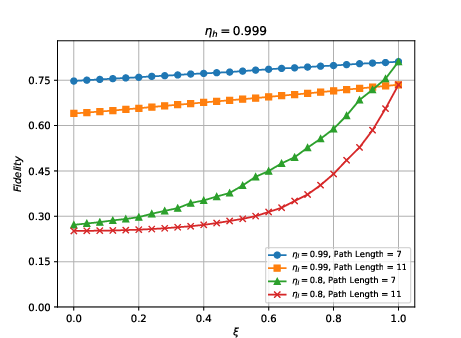
Figure 2: Fidelity versus the fraction of HQ nodes, demonstrating the strong nonlinearity and sensitivity to heterogeneity in path performance.
To address the lack of trustworthy or up-to-date per-link information, the work introduces grey-box routing: the controller relies only on network topology and sampled end-to-end fidelities (obtained via in-band benchmarking), without requiring detailed link/node metrics. Several routing policies are rigorously compared, including:
- K-shortest Path (KSP): Choosing among candidate paths to minimize resource contention.
- kx Path Selection: Restricts selection to paths within x hops of the shortest.
- Knowledge-Aware (white-box) and SP (black-box) baselines.
Key Numerical Results:
- The kx (esp. k0) policy achieves near-optimal blocking probability and fairness, robust to sampling noise and network size.
- Random topologies allow greater path diversity, resulting in lower blocking rates and improved fairness compared to regular topologies, but require careful management of resource allocation.
- Under realistic fidelity sampling errors, kx selection retains strong performance except in the regime of both high load and high inaccuracy.
- The blocking probability per edge scales sub-quadratically with increasing network density.
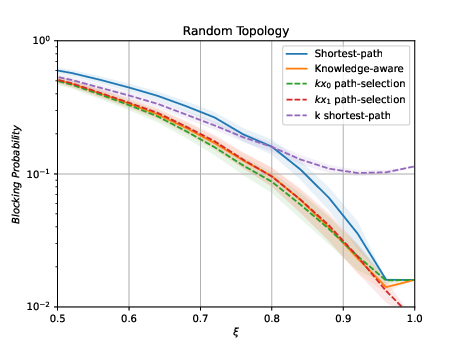
Figure 3: Blocking probability as a function of HQ node fraction ξ0 for a random transport network, illustrating the comparative efficacy of grey-box (ξ1) and knowledge-aware approaches.
Calibration-Aware Quantum Link Operation
The dissertation rigorously incorporates experimentally validated hardware drift and calibration overheads into network operation models.
Empirical Drift Model and Orchestration Theorems
Experimental evidence demonstrates that continuous entanglement generation leads to exponential fidelity decay on deployed fiber links, necessitating periodic calibration phases (deadtime). The system is modelled using activation time ξ2, calibration time ξ3, and an exponential drift constant ξ4 per link.
Analytical Contributions:
- Efficient link throughput is maximized by balancing activation duration against fidelity decay and calibration deadtime.
- For chain networks, the Quantum Link Orchestration (QLO) Theorem and corresponding recursive allocation algorithm (Algorithm QLO) provide globally optimal calibration schedules under per-link and end-to-end fidelity constraints.
- In general networks with overlapping (shared) links, the minimum-selection rule and a greedy orchestration heuristic (GRO) resolve calibration conflicts, with worst-case complexity scaling as ξ5 per chain and ξ6 over all paths.
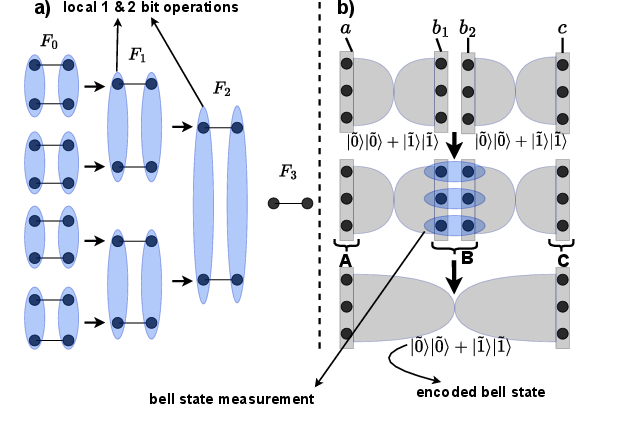
Figure 4: Entanglement purification and resource allocation schemes amplify link fidelity, yet interact directly with calibration cycles under hardware drift.
Programmable Quantum Repeaters as Instruction-Set Architectures
The thesis advances a novel abstraction for repeater nodes: a hybrid quantum-classical instruction set architecture (ISA), instantiated for nitrogen-vacancy (NV) center platforms but extensible to other hardware.
Controller-Driven Programmability
- Deterministic and Coherent Register Control: Nodes are modelled with one electron spin and a register of nuclear spins, enabling both classical (deterministic) and quantum (coherent superposition) programmability.
- Instruction Format: Includes operation code, parameter fields, register-pattern selection, and control mode (deterministic/coherent).
- Diagnostic and Calibration procedures: Coherent control allows in-situ interference-based validation, fidelity witnessing via linear combinations of unitaries, and efficient error assessments, unattainable in fixed-function nodes.
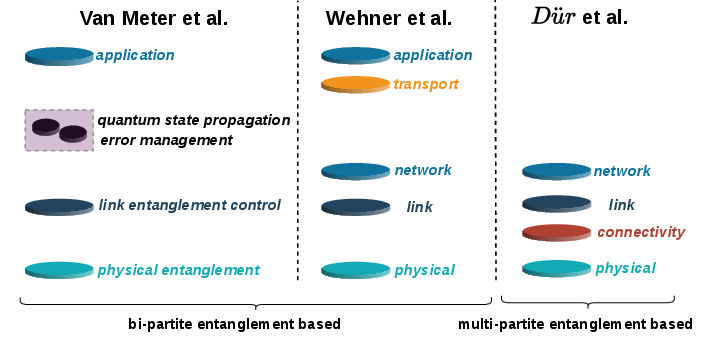
Figure 5: Quantum internet protocol stacks as layered abstractions; the repeater ISA sits at the cross-road between hardware and network control layers.
Performance-Programmability Tradeoff:
Round throughput per electron spin ξ7 is inversely proportional to the size of the nuclear register due to reset deadtimes, introducing practical constraints on the breadth of real-time programmable operation.
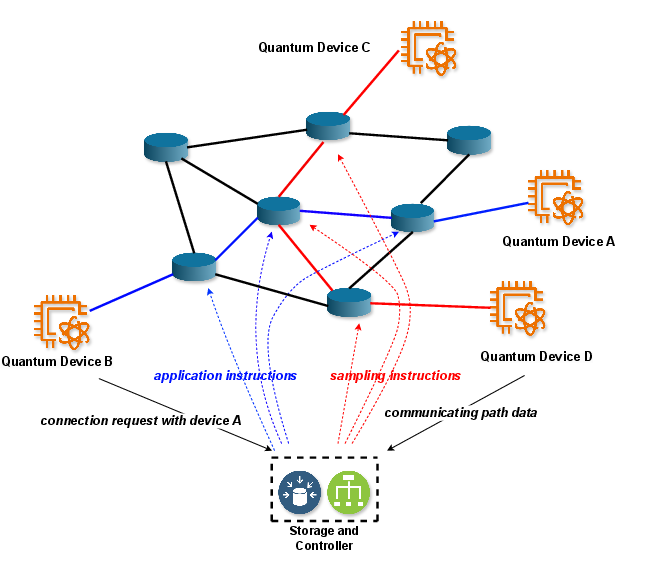
Figure 6: Quantum network architecture, showing programmable repeaters interfaced to both quantum and classical control, enabling distributed implementation of network-layer protocols.
Cross-layer Interactions and Design Implications
A central message is that none of routing, calibration, or node control should be designed in isolation. The thesis articulates several design principles:
- Calibration as a resource: Should inform routing, not be a purely background process.
- Hierarchical control: Decompose path selection, calibration scheduling, and node operations for tractable complexity and robustness.
- Programmability as a first-class enabler: Explicit ISA abstractions decouple protocol definition from hardware implementation.
- Fairness at both user and hardware levels: Resource allocation strategies must distribute calibration effort equitably.
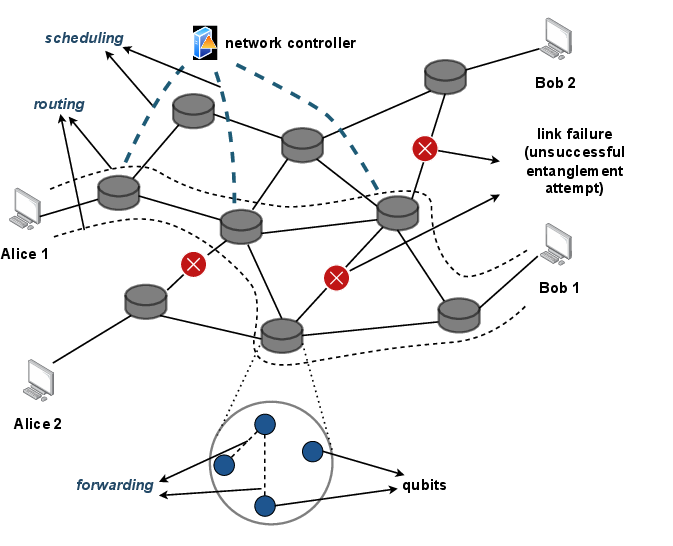
Figure 7: Quantum routing, forwarding, and scheduling—requiring cross-layer coordination among resource allocation, entanglement operations, and calibration cycles.
Theoretical and Practical Implications, Limitations, and Future Directions
Implications
- Robust routing is achievable under strong uncertainty: End-to-end measurement-based routing attains high throughput and fairness without full network observability.
- Hardware constraints fundamentally reshape feasible protocols: Calibration cycles and drift must be first-order architectural concerns; ignoring these leads to severe overestimation of network reliability and capacity.
- Programmable nodes are essential for scalable, adaptive networks. Protocol innovation, diagnostics, and experimental calibration all benefit directly.
Limitations
- Analytical results for orchestration optimality and throughput are exact only for chain (linear) topologies; in general networks, heuristics and local optimality are provided.
- The programmable repeater architecture is theoretically grounded and tied to state-of-the-art NV platforms, yet awaits deployment in large-scale testbeds.
Future Work
- Joint optimisation of routing and calibration in arbitrary topologies, potentially via learning-assisted or decomposition methods.
- Extension and standardisation of ISA abstractions to heterogeneous quantum hardware.
- Integration and validation of presented frameworks in real-world testbeds and quantum internet pilot deployments.
Conclusion
This comprehensive cross-layer treatment establishes that operational quantum networking—robust to heterogeneity, drift, and partial knowledge—demands tightly integrated design of routing algorithms, calibration-aware link orchestration, and expressive programmable node architectures. The framework and analytical results lay a rigorous foundation for both near-term experimental deployment and long-term scalable design of the quantum internet.