- The paper demonstrates that a hybrid GHZ-BSM routing method can restore distance-independent entanglement rates despite decaying GHZ measurement success probabilities.
- It rigorously compares performance across various network models—grid, Waxman, scale-free, and SURFnet—highlighting where conventional BSM routing remains robust.
- The study underscores the necessity for topology-aware, hybrid protocols that merge local GHZ strategies with BSM techniques to overcome physical constraints.
Routing Entanglement in Complex Quantum Networks Using GHZ States
Introduction and Motivation
Efficient entanglement distribution over quantum networks underpins a range of quantum information applications, including quantum key distribution, distributed sensing, and distributed quantum computation. The prevailing physical constraints—particularly photon loss in optical fibers—demand robust entanglement routing protocols. Conventional approaches rely on Bell state measurements (BSM) to dynamically stitch together end-to-end entangled links across multi-hop quantum networks. However, since BSMs succeed probabilistically, end-to-end rates degrade exponentially with distance due to compound loss over multiple hops.
Protocols leveraging Greenberger-Horne-Zeilinger (GHZ) state generation and measurement, as introduced in prior works, can—in principle—achieve end-to-end rates that are independent of distance, given sufficiently high link and measurement success probabilities. Nevertheless, these idealized models assume all k-qubit GHZ measurements succeed with comparable probability, which is not physically viable in realistic photonic implementations. The paper "Routing Entanglement in Complex Quantum Networks Using GHZ States" (2604.03155) investigates the impact of non-uniform (and decaying) GHZ measurement success probabilities on routing efficacy across several network models. Furthermore, it introduces a hybrid GHZ-BSM protocol and delivers thorough empirical assessments in square grid, Waxman, scale-free, and real-world topologies.
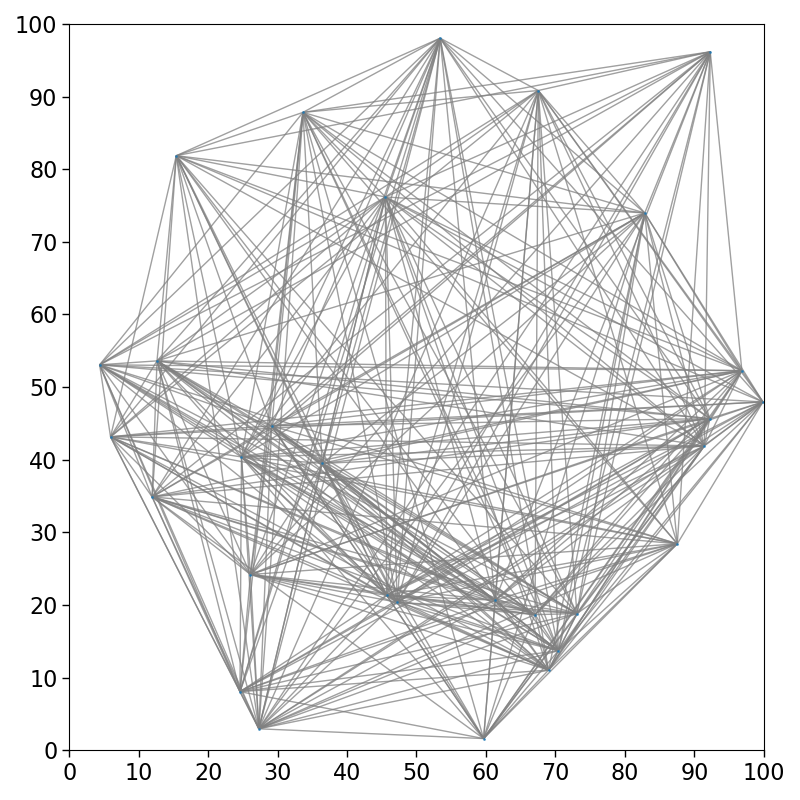
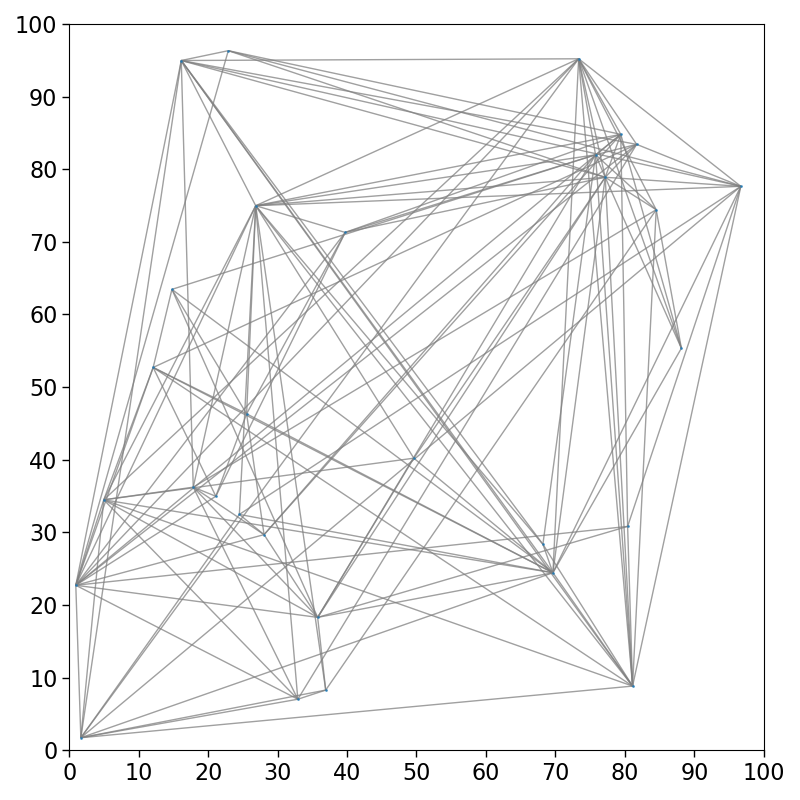
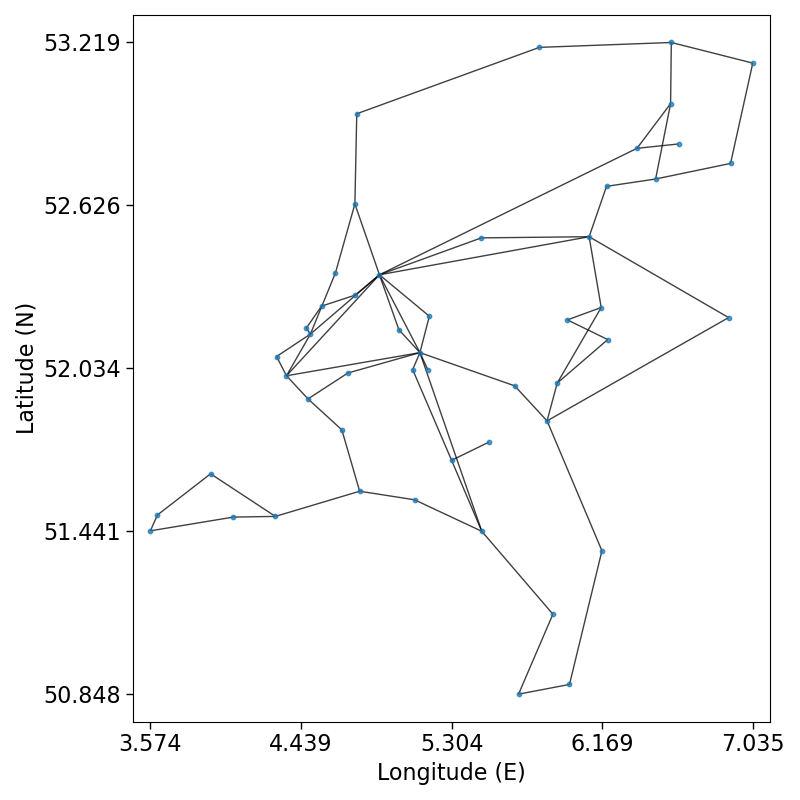
Figure 1: Physical topologies for Waxman, scale-free, and SURFnet networks implemented over a 100km×100km region.
Network Models and Protocol Definitions
The study distinguishes between physical and virtual network topologies. Physical networks consist of nodes connected via optical fibers, where link success depends on distance-dependent loss. Virtual networks represent established entanglement links after successful transmission attempts.
- Square Grid: Nodes placed on grid vertices exhibit regular degrees and geodesic connectivity.
- Waxman: Nodes connect probabilistically as a function of distance, yielding moderately homogeneous random graphs.
- Scale-Free: Preferential attachment produces hub-dominated heavy-tailed degree distributions, reflecting real-world internet-like structures.
- SURFnet: A real-world topology derived from a European research network.
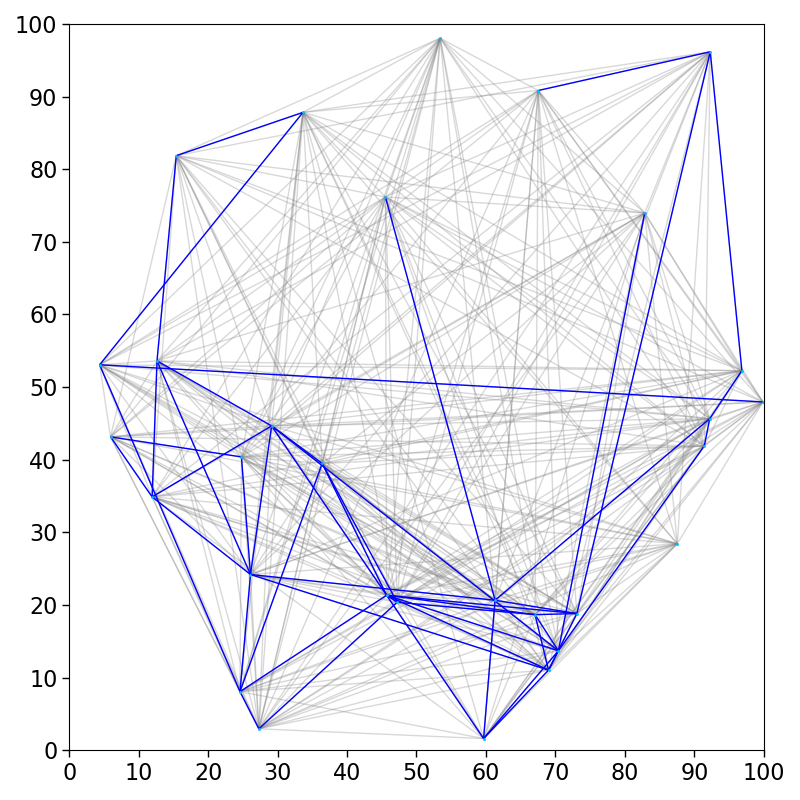
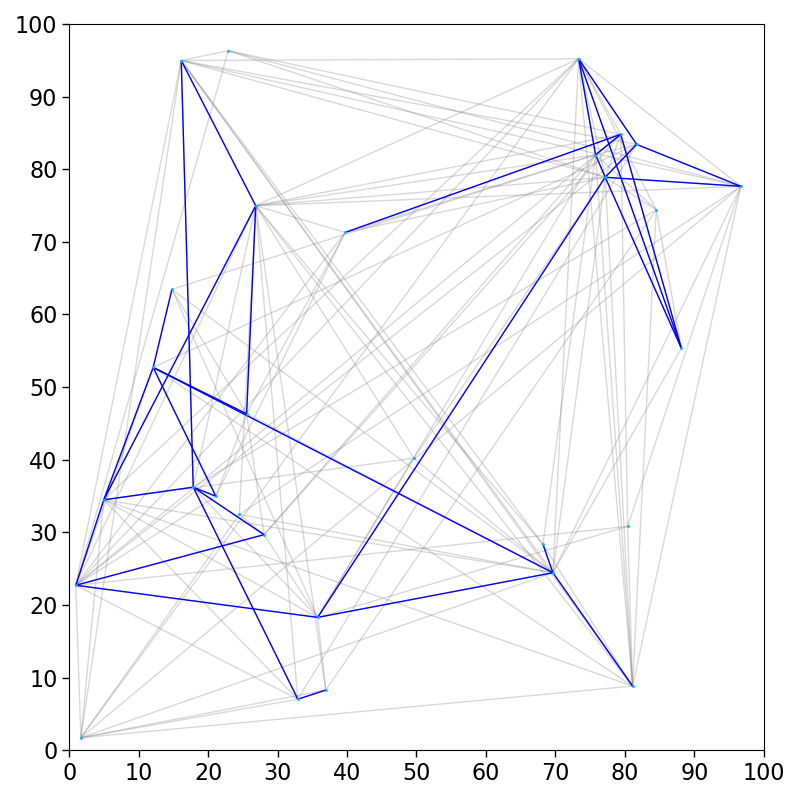
Figure 2: Virtual topologies for Waxman and scale-free networks, indicating successfully established entanglement links after photon loss.
The paper defines several entanglement-swapping protocols:
- Uniform-success GHZ routing (idealized)—all k-GHZ measurements have uniform success probability.
- Exponential-decay GHZ routing—k-GHZ measurements succeed as qk−1.
- (2,3)-GHZ routing—only two- and three-qubit operations; all others are forbidden.
- Hybrid GHZ-BSM routing—local GHZ state preparation at helpers, followed by BSMs; BSMs simulate GHZ projections with local resources.
Hybrid Protocol Mechanism
The hybrid GHZ-BSM protocol is constructed to circumvent the exponential decay associated with large-k GHZ measurements in photonic platforms. Each cycle consists of:
- Probabilistic generation of Bell states across physical links (loss modeled as 10−γd/10).
- Local preparation of k-GHZ states at helper nodes.
- BSMs to project across edges in the virtual network, with post-selective Pauli corrections based on classical messages.
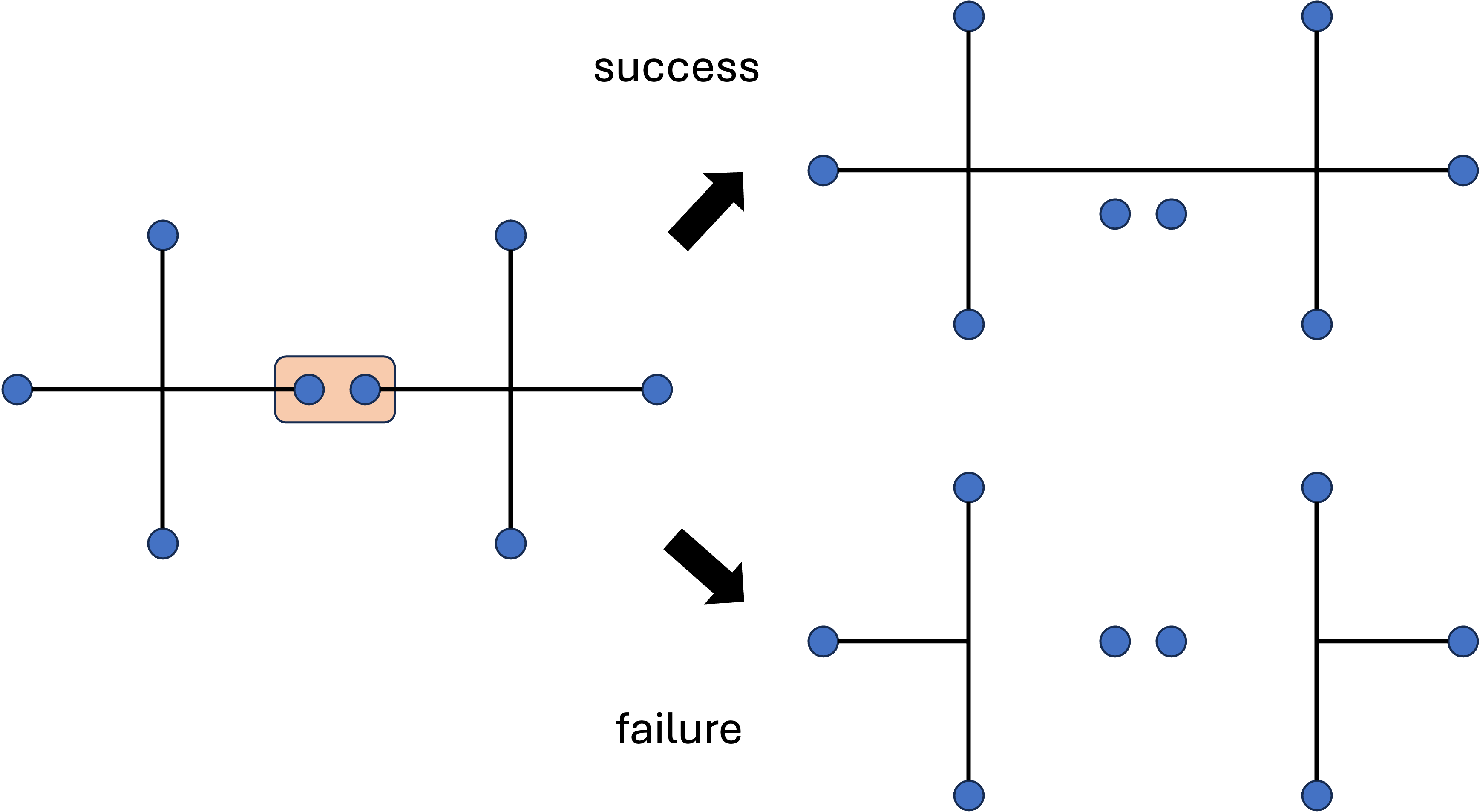
Figure 3: Output states after performing a Bell state measurement.
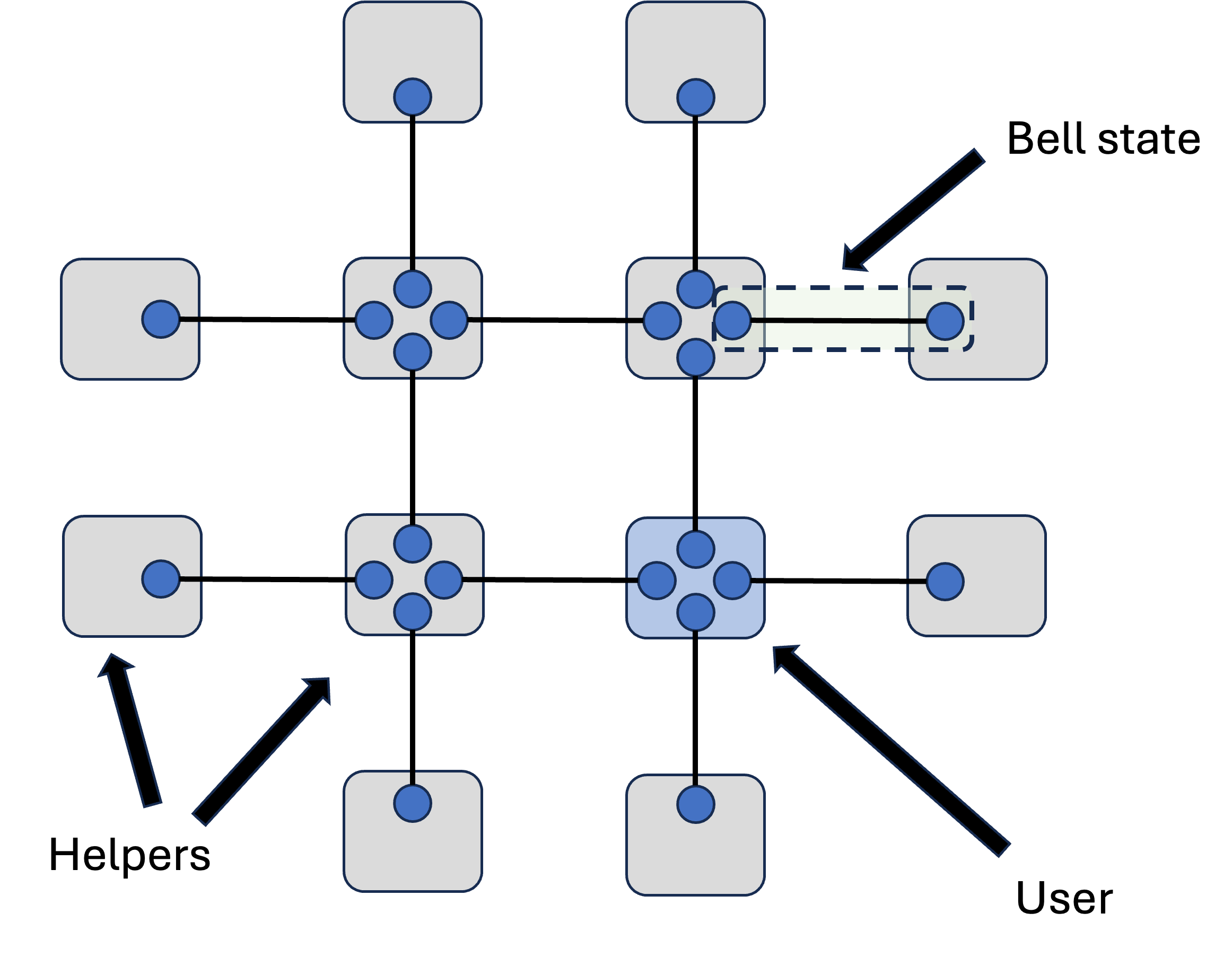
Figure 4: (a) Schematic of the hybrid GHZ-BSM protocol on a square grid. (b) Schematic of the original GHZ measurement protocol.
This hybrid approach amalgamates the locality of GHZ-based strategies (exploiting local addressing) with the flexibility of BSM-based path selection.
Numerical Results and Comparative Analysis
Performance metrics are based on the end-to-end rate, the expected number of Bell pairs delivered per network use, averaged over all node pairs or as a function of pairwise distance.
Square Grid Networks
Experiments reveal key phenomena:
- In the idealized regime (uniform-success), GHZ-based protocols exhibit a percolation-driven transition: below a threshold, end-to-end rates decrease exponentially with distance; above threshold, rates become distance-independent.
- The hybrid GHZ-BSM protocol, under realistic parameters, recaptures this distance-independence at sufficiently high measurement success probability, outperforming standard BSM routing for large grids.
- For low q, all protocols decay due to fragmentation.
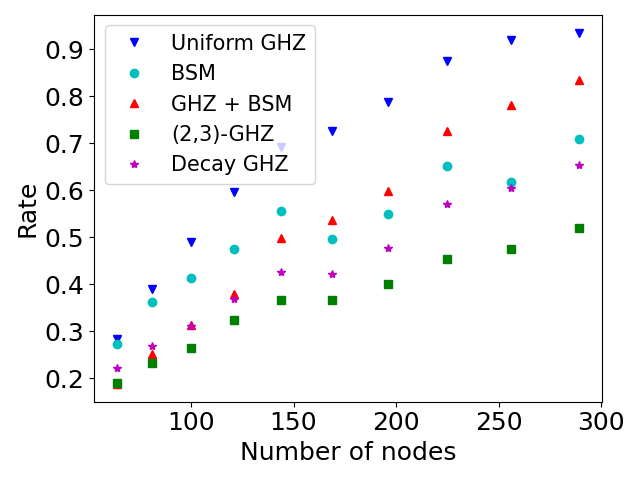
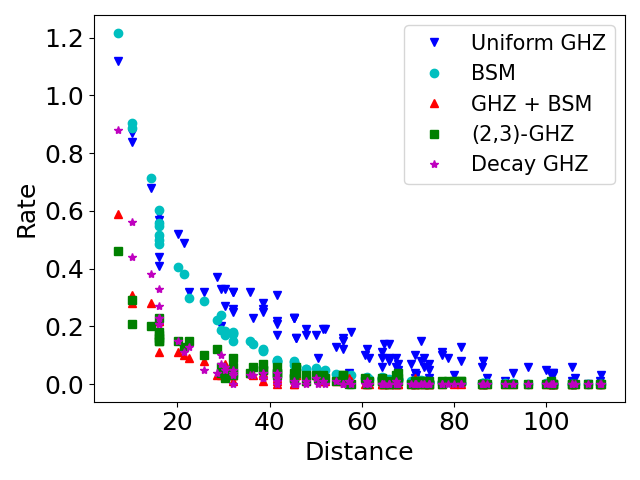
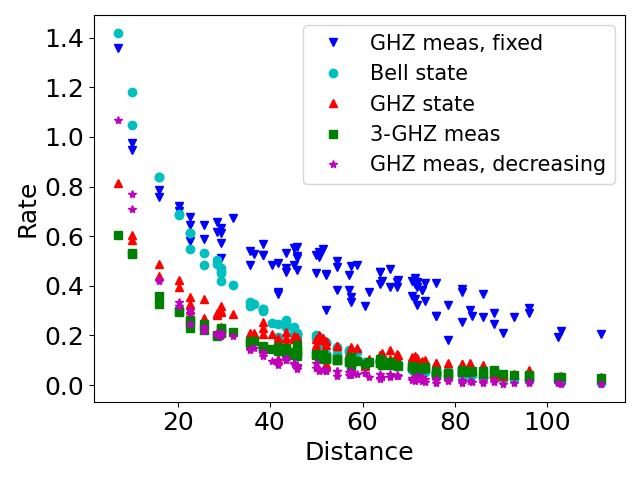
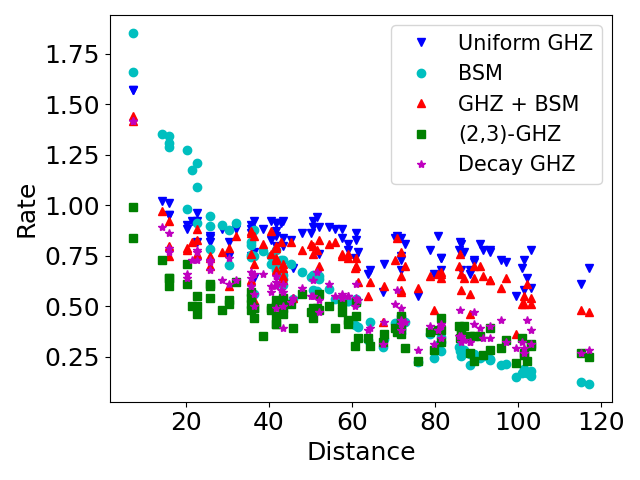
Figure 5: Average rate and rate-vs-distance performance for square grid networks as a function of q and network size.
Waxman Networks
Compared to grids, Waxman networks present higher path diversity with shorter average path length given their scaling properties. Outcomes include:
- BSM routing leverages multi-path redundancy efficiently, maintaining high rates as 100km×100km0 increases; all variants of GHZ-based routing yield strictly lower rates.
- GHZ-based approaches fail to exploit path redundancy, as only one end-to-end entangled pair is typically produced even when many paths exist.
- The "phase transition" exists, but BSM routing is structurally favored.
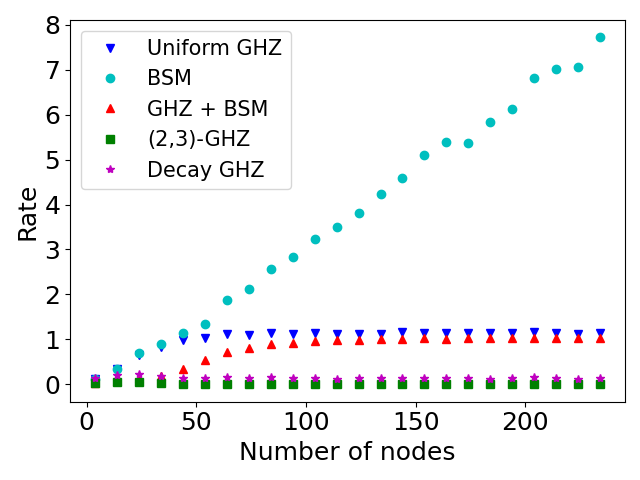
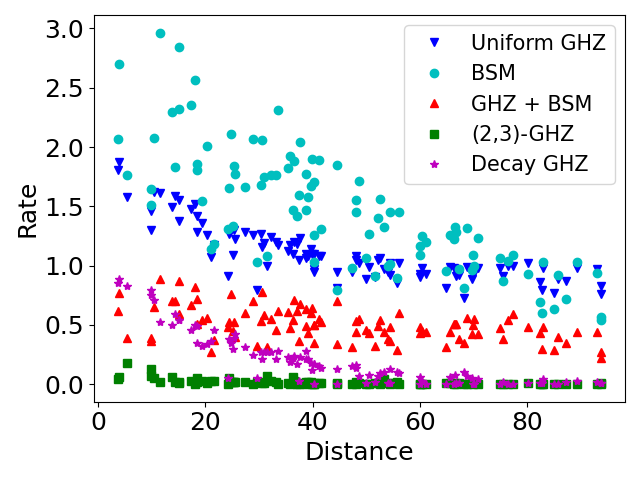
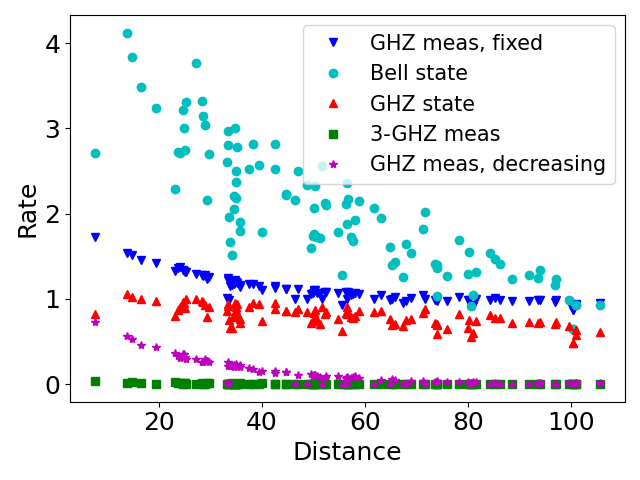
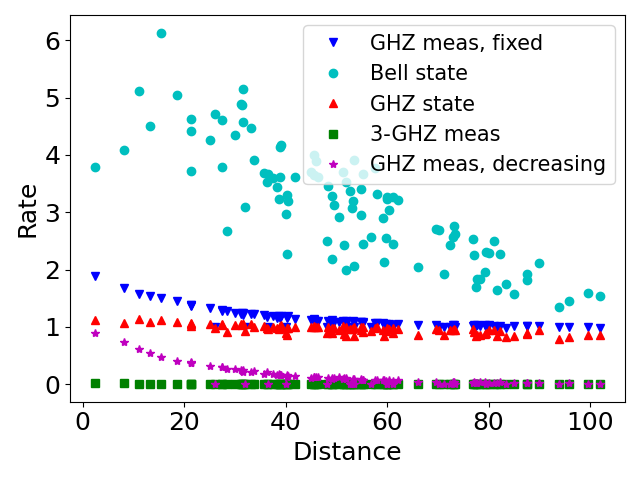
Figure 6: Performance curves for Waxman networks demonstrate the limitations of GHZ-based routing under realistic conditions.
The study further analytically relates the Waxman percolation crossover to expected path multiplicity, showing that segmentation and parallel hybrid routing within regions can asymptotically restore rate scaling.
Scale-Free Networks
For scale-free networks, the hybrid GHZ-BSM protocol with realistic parameters offers competitive performance compared to BSM routing in the large-100km×100km1 limit, but only when uniform success is (artificially) assumed does GHZ routing dominate.
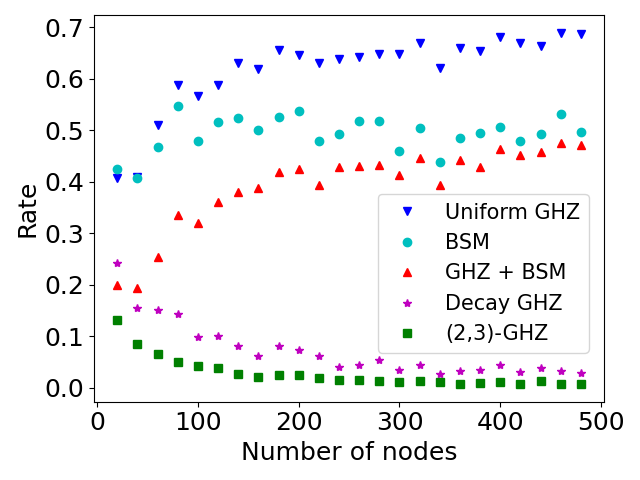
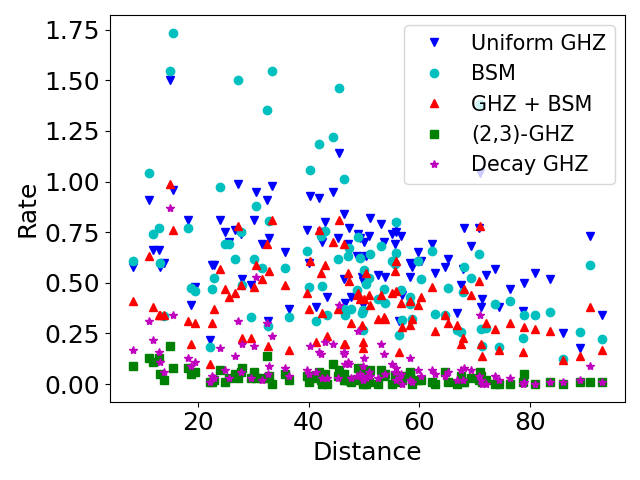
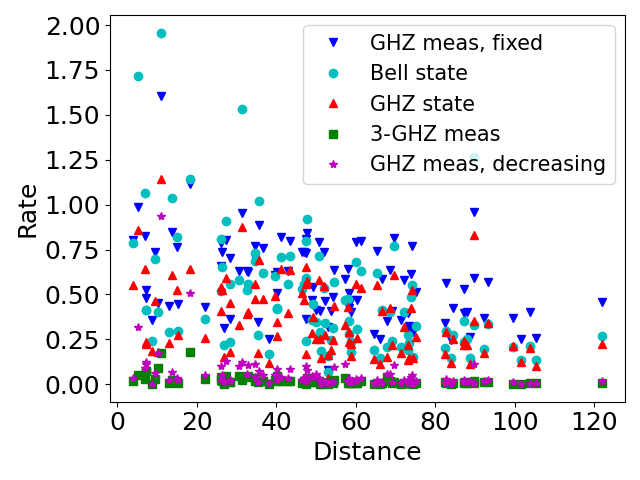
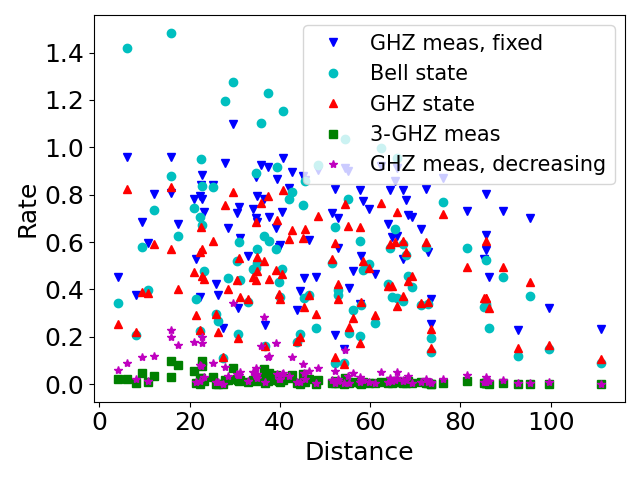
Figure 7: Rate behavior in scale-free networks as a function of network size and pairwise distance.
SURFnet Real-World Topology
Simulations on the SURFnet topology show that at sufficiently high 100km×100km2, GHZ-based strategies approach distance-independence in rate, though BSM routing continues to perform robustly for practical 100km×100km3. Under realistic measurement constraints, (2,3)-GHZ routing essentially fails.
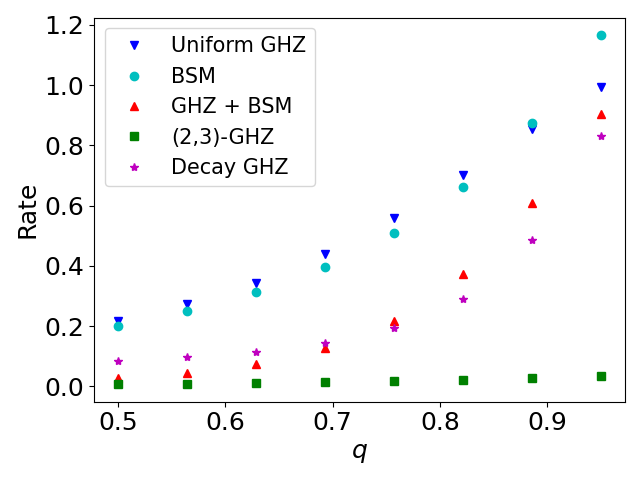
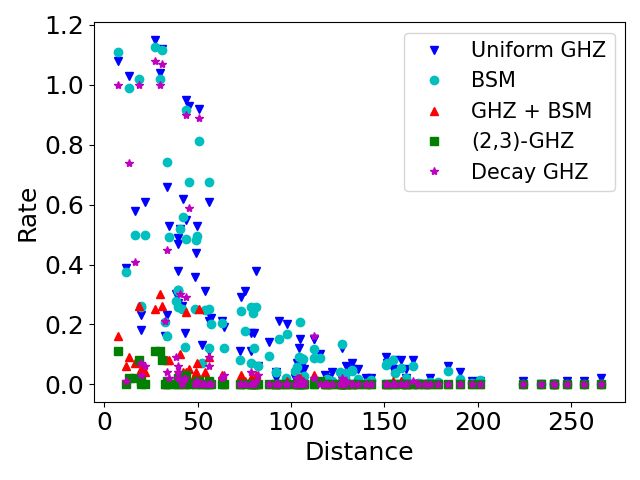
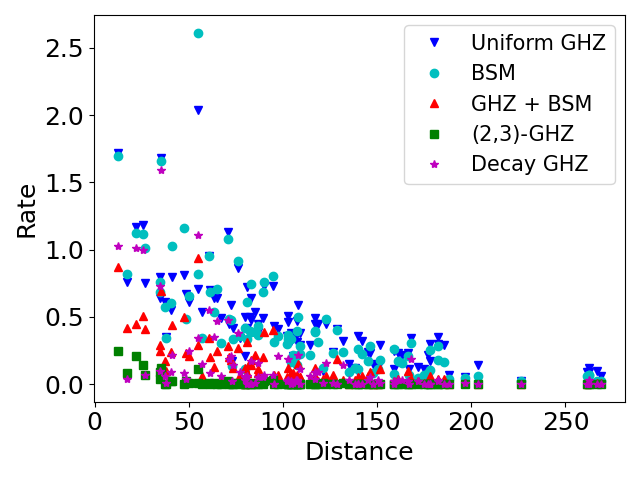
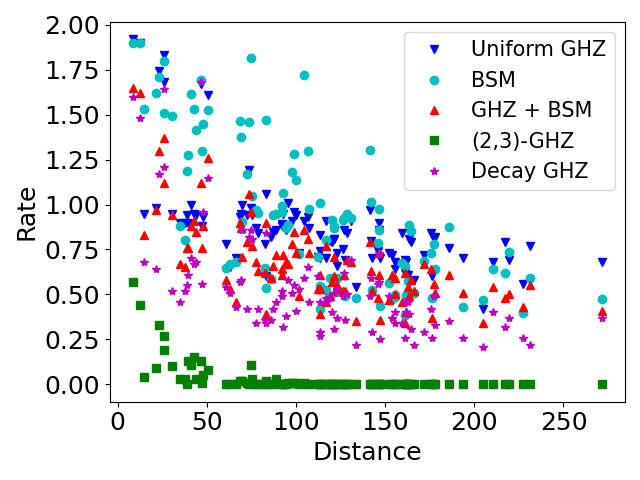
Figure 8: Rate vs. measurement probability and distance for SURFnet, showing only mild GHZ benefit at large 100km×100km4.
Implications and Future Directions
This study establishes that the principal benefit of GHZ-based routing—distance-independence of the entanglement rate—is only compatible with either idealized or appropriately hybridized protocols in practical photonic networks. Critically, naive GHZ approaches without new coordination mechanisms are suboptimal except on topologies with regular structure (e.g., grids). BSM-based routing remains the robust baseline, especially in complex, path-redundant, scale-free, or real network topologies.
A key theoretical implication is the necessity of architectural innovations—such as regional segmentation and hybridized measurement schemes—that blend local and limited global information to harness both the percolation advantage and multi-path redundancy. Hierarchical protocols analogous to OSPF in classical networking could be valuable. Moreover, this work motivates the derivation of tight information-theoretic bounds for general quantum network capacities under realistic decoherence and measurement constraints.
On the applied front, future developments should integrate discrete-event simulations, hardware-induced noise, and more detailed measurement device models. Extensions may further include adaptive or learning-based routing that can reconfigure operations on the fly to optimize rates under varying physical constraints.
Conclusion
The detailed analysis in "Routing Entanglement in Complex Quantum Networks Using GHZ States" (2604.03155) illuminates the nontrivial interactions between network topology, physical loss, entanglement-swapping operations, and routing protocol design. The hybrid GHZ-BSM protocol offers a pragmatic path to leveraging the strengths of both BSM and GHZ approaches, but highlights the need for sophisticated, topology-aware strategies for scalable entanglement distribution in realistic quantum networks. This work lays essential groundwork for the development of future quantum network protocols, which must jointly address physical device constraints and the combinatorial complexity of network connectivity.

