- The paper introduces a graph complement method that reconfigures network topology, enabling direct remote adjacencies without traditional pathfinding.
- It employs sequential Pauli-X measurements on super-nodes to transform the entanglement structure, reducing routing latency and classical overhead.
- The approach supports simultaneous parallel entanglement with minimal qubit resources, paving the way for scalable and flexible quantum networks.
A Graph Complement Approach to Quantum Routing: Theory and Implications
Introduction
Quantum routing is a foundational challenge in the development of quantum networks and the envisioned Quantum Internet. Prior methodologies have predominantly extended classical routing concepts—most notably, pathfinding based on entanglement swapping across quantum repeaters. This architecture is inherently reactive and dependent on full path discovery, incurring exponential computational overhead as network complexity scales. The paper "Beyond Traditional Quantum Routing" (2508.18023) proposes a substantive departure from these paradigms by leveraging entanglement-enabled connectivity realized via multipartite graph states and, crucially, employing a direct graph complement strategy. This methodology reconfigures connectivity by manipulating the entanglement structure, facilitating direct remote node adjacency and supporting parallel request fulfillment even with minimal quantum resources.
Quantum Routing: From Pathfinding to Graph Manipulation
Traditional quantum routing architectures are direct derivatives of classical paradigms: routing is bound to pathfinding algorithms, and entanglement is established reactively along computed paths with virtual links constructed via entanglement swapping. The bottleneck is explicit—parallelism is severely constrained by qubit resources per node, and the entire process is gated by the complexity of discovering and coordinating across paths, especially in multi-domain or confidential topologies.
With the introduction of the graph complement strategy, the framework shifts from one where routing is entanglement-driven by path discovery, to one where network topology is artificially molded using operations in the graph state formalism. Here, the adjacency between remote nodes can be toggled by appropriate graph manipulation, specifically, via the X-basis (Pauli-X) measurement procedure which operationalizes the complement operation in the quantum domain.
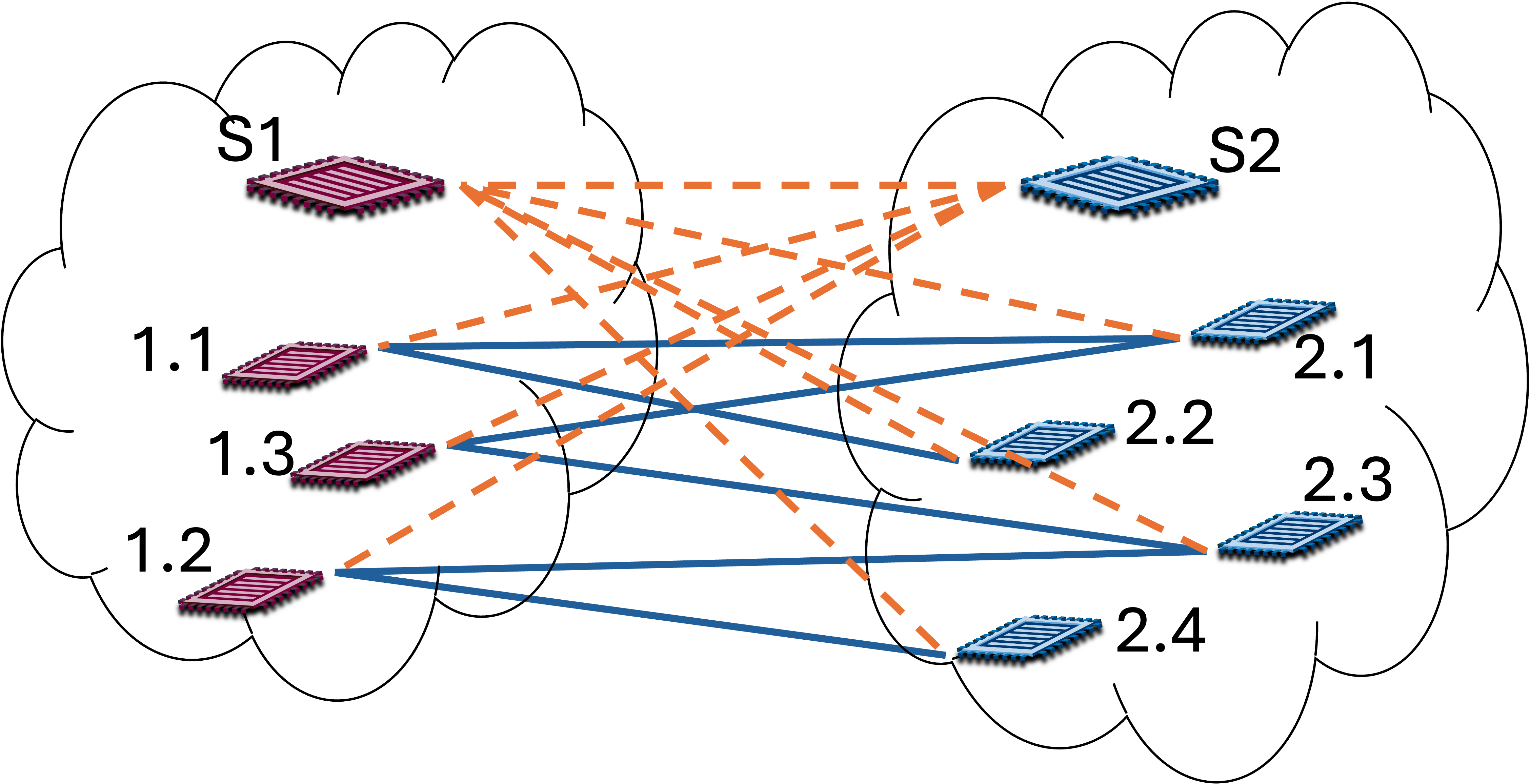
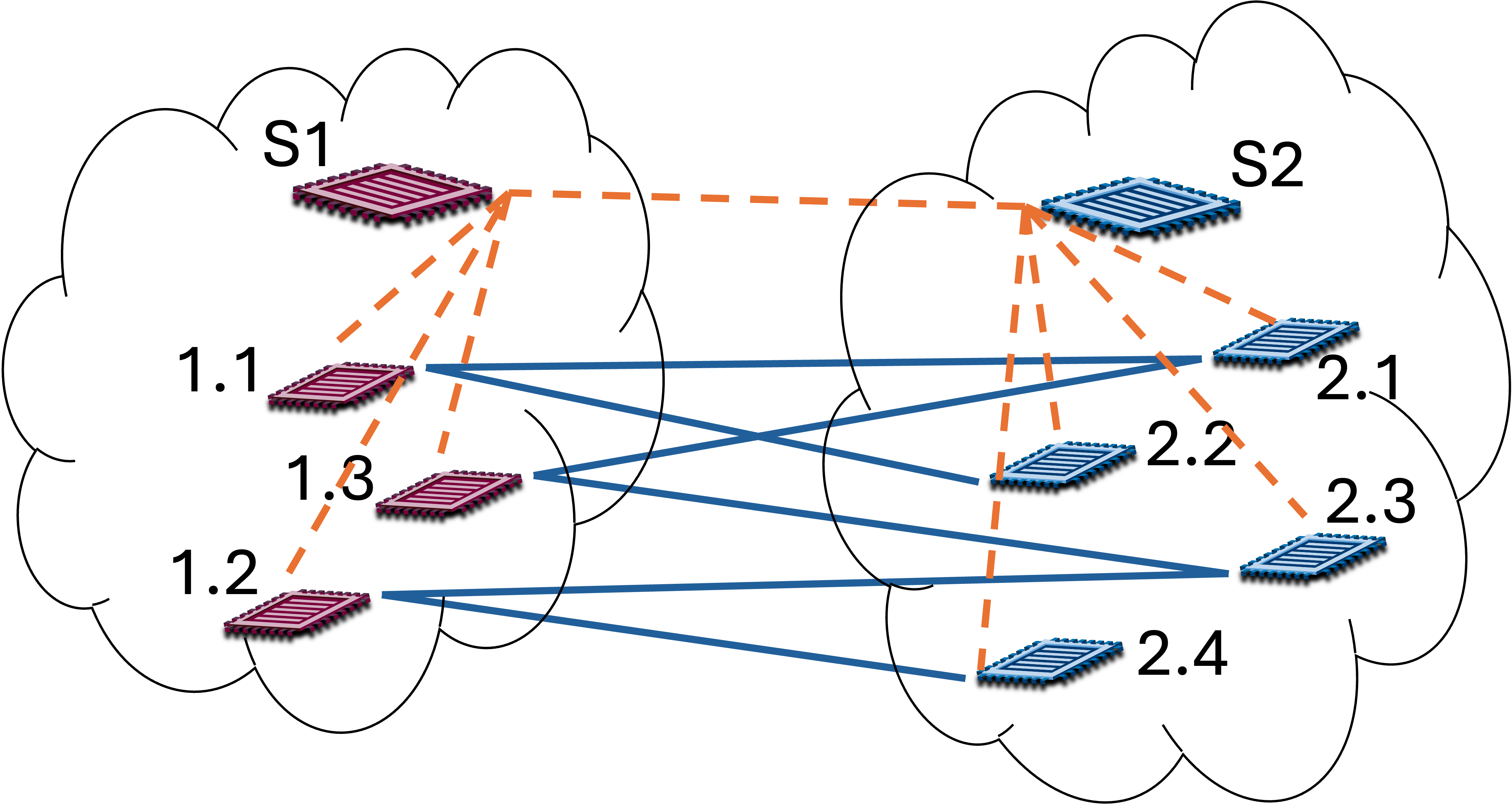
Figure 2: Examples of Inter-QLAN and Inter-QLAN-like structures satisfying Lemma 1 and Lemma 2, demonstrating constructions permitting efficient complement-based entanglement.
The figure above visually encapsulates the core methodology: original inter-QLAN networks are augmented with highly-connected super-nodes; through local operations and classical communication (LOCC) based protocols, a transformation to a complement inter-QLAN graph is achieved, where required remote pairs are now directly connected. This structural manipulation obviates the need for pathfinding and unlocks parallelism otherwise impossible in traditional configurations.
Theoretical Foundations: Super-nodes, Complement Construction, and LOCC
The paper formalizes new graph-theoretical constructs for quantum network topologies—explicitly, inter-QLANs, complement inter-links, and complement inter-QLANs. The main technical results are two lemmas:
- Lemma 1 stipulates that, given the existence of a super-node in each QLAN (each connected to all the opposing QLAN’s client nodes and each other), performing sequential Pauli-X measurements on these super-nodes transforms the network to its complement structure. The result is a (n1+n2)-qubit bipartite graph state enabling fully parallel direct entanglement of all remote pairs of nodes in different QLANs.
- Lemma 2 generalizes this by allowing the construction of "inter-QLAN-like" networks where super-nodes are locally connected within their own QLAN. This mild relaxation (which slightly violates the pure inter-QLAN edge constraint) maintains complement switching capabilities.
Both constructions are efficiently realizable using LOCC-only protocols. The complement operation can be realized with only two sequential Pauli-X measurements, providing a concrete, algorithmically simple pathway from the original to the complement network state. Theoretical analysis guarantees that partial complements can be enacted by appropriately restricting super-node connections.
Numerical and Architectural Implications
The primary numerical and operational advances are:
- Removal of computational bottlenecks: By bypassing the pathfinding process, routing latency and required classical signaling are drastically reduced.
- Resource advantage: The technique supports simultaneous satisfaction of multiple connection requests, even when nodes possess only a single communication qubit—a regime intractable for entanglement-swapping-based approaches.
- Modularity and scalability: The approach supports arbitrary inter-domain connectivity patterns and is robust to partial network topology confidentiality.
Additionally, the protocol produces a significant reduction in network overhead, with direct implications for next-generation quantum network deployment, quantum cloud infrastructure, and potentially for large-scale distributed quantum computing.
Practical and Theoretical Implications for Future Quantum Networks
The adoption of a graph complement strategy for quantum routing has notable consequences:
- Architectural Flexibility: Networks can alternate between original and complement topologies via LOCC and simple augmentation (super-node addition), providing on-demand restructuring.
- Decoupling of Physical and Entanglement Topology: Artificial links defined by multipartite entanglement mean that the effective communication topology can be manipulated independently of physical constraints, supporting dynamic reconfiguration and policy-based orchestration.
- Parallelism and Robustness: The possibility of serving multiple requests in parallel inherently enhances network throughput and resilience, crucial for global-scale quantum Internet scenarios.
Future research is likely to extend these results to scenarios with partial or noisy entanglement, analyze trade-offs with resource overhead (e.g., super-node physical realization), and integrate these approaches with quantum error correction and network control plane protocols. System-level simulations, security analysis (particularly in multi-domain/private QLAN environments), and physical-layer feasibility studies will determine the practical limits and adoption timeline for graph complement quantum routing.
Conclusion
"Beyond Traditional Quantum Routing" (2508.18023) presents a rigorous new perspective on the quantum routing problem, advancing the state-of-the-art from pathfinding-centric schemes toward direct graph state manipulation. Through the concept of graph complement and the utilization of multipartite entanglement resources, the work demonstrates that end-to-end entanglement can be achieved with minimized overhead and enhanced parallelism. The theoretical constructs and proposed protocols offer new paradigms for scalable, flexible, and practical quantum networking, setting the foundation for advanced quantum Internet architectures.