- The paper introduces a new family of topology-agnostic quantum protocols that enhance entanglement distribution across ultra-large-scale networks.
- The methodology leverages greedy optimal path selection, entanglement swapping, and distillation to achieve superior end-to-end entanglement compared to classical methods.
- Simulation results on synthetic and real-world networks demonstrate scalability up to 10^8 nodes and emphasize the importance of small-world, scale-free topologies.
Enabling Quantum Communication in Ultra-Large-Scale Networks
Introduction
This paper ("Enabling quantum communication in ultra-large-scale networks" (2606.08326)) addresses the fundamental challenge of scaling quantum communication to networks of unparalleled size, comparable to or exceeding the Internet. Building on the classical approach of modeling quantum networks as weighted graphs, the author introduces a new family of quantum communication protocols that are both topology-agnostic and computationally feasible for networks with up to hundreds of millions of nodes. The analysis demonstrates both experimentally and theoretically that these protocols enable sustainable quantum communication provided the network displays a heterogeneous, small-world topology—a property common to technological, social, and biological networks. The results establish conditions under which the envisioned Quantum Internet can support scalable, large-scale entanglement distribution and communication analogous to the existing global Internet infrastructure.
Quantum Network Modeling and Protocol Framework
The quantum network is mapped onto a classical weighted graph according to the Acín et al. prescription, with each edge’s weight corresponding to the entanglement of the underlying qubit pair. This abstraction enables quantitative analysis using network theory, sidestepping hardware and physical-layer idiosyncrasies.
The family of protocols centers around three core operations:
- Greedy Optimal Path Selection: Paths maximizing the channel entanglement between source and target node are selected greedily, with extension to the disjoint-edge shortest path problem for maximal redundancy.
- Entanglement Swapping: Sequential application of swapping operations along identified paths to extend entanglement over long distances.
- Entanglement Distillation: Aggregation of parallel entangled channels for quality enhancement, using parallel edges between node pairs.
The principal protocol, Quantum Entangled Percolation (QEP), is then generalized to heterogeneous QEP (hxQEP), denoted h1QEP, h2QEP, etc., where entanglement routing takes advantage of high-degree repeater nodes (selected according to the "friendship paradox") to segment and optimize long-distance communication. For comparative purposes, a fully classical protocol, Classical Entanglement Percolation (CEP), is also discussed.
Extensive numerical simulations are performed on both classical real-world networks and synthetic scale-free graphs. For illustration, the Zachary Karate Club network is used to provide a qualitative baseline and demonstrate protocol operation.
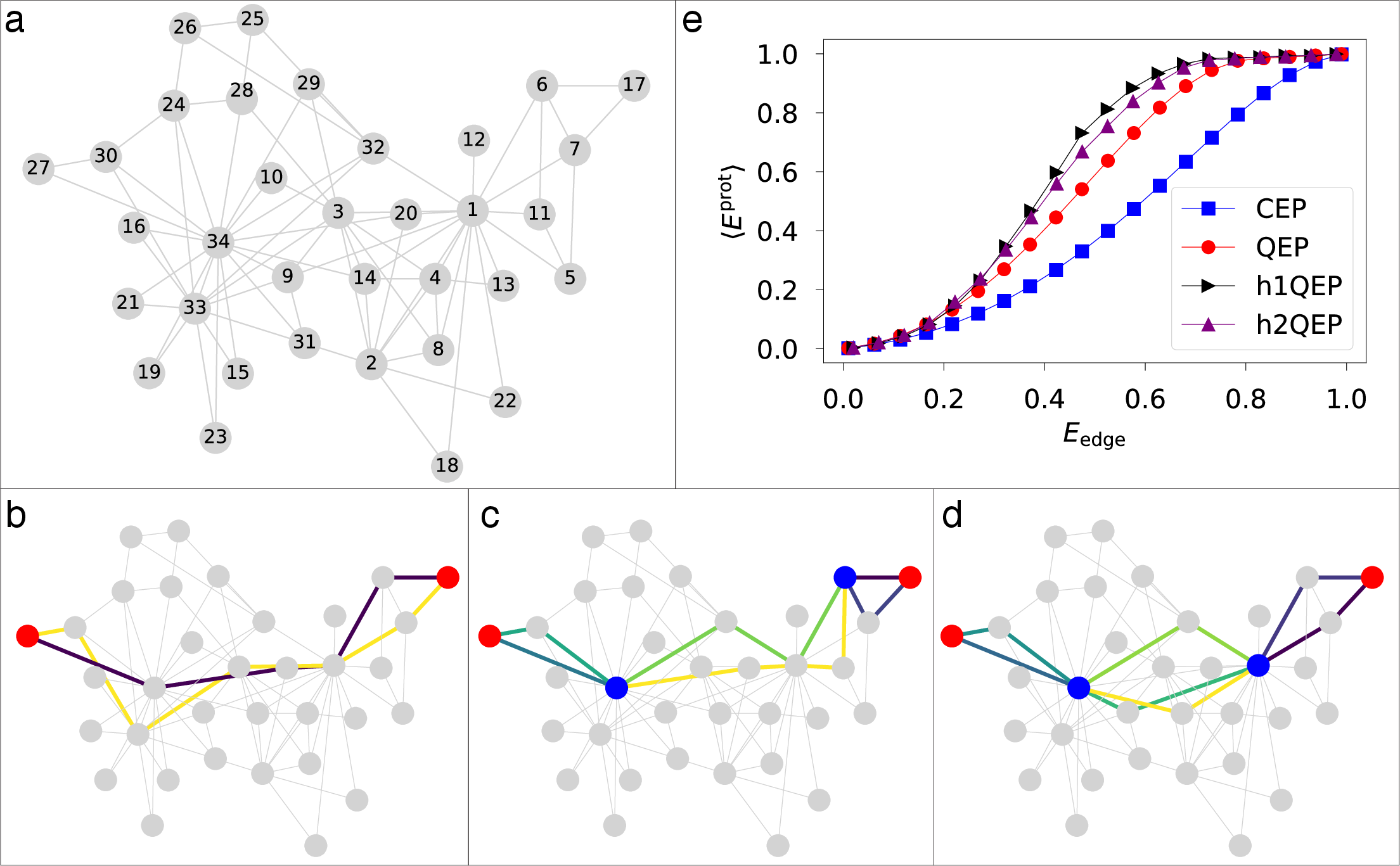
Figure 1: Channel construction and entanglement measures for QEP, h1QEP, h2QEP, and CEP protocols in the Zachary Karate Club network; protocol paths and entanglement performance visualized as a function of link entanglement.
The key findings from this analysis are:
- Superior Protocol Performance: QEP and its heterogeneous variants (h1QEP, h2QEP) robustly outperform CEP. For given edge entanglement, QEP achieves higher end-to-end entanglement and reaches maximal values at lower local entanglement thresholds.
- Finite-Size Effects: In finite, especially power-law (scale-free, 2<γ≤3) networks, both QEP and hxQEP maintain high entanglement even as system size approaches 108 nodes.
- Thermodynamic Limitations of Simple Protocols: In the asymptotic N→∞ limit, both CEP and standard QEP protocols fail for generic non-maximal entanglement, with average performance (AUC metric) vanishing unless each edge is maximally entangled (Eedge=1).
These behaviors are captured quantitatively through the Area Under the Curve (AUC) metric for the mean achievable entanglement across varying edge entanglement levels, plotted against network size and degree distribution.
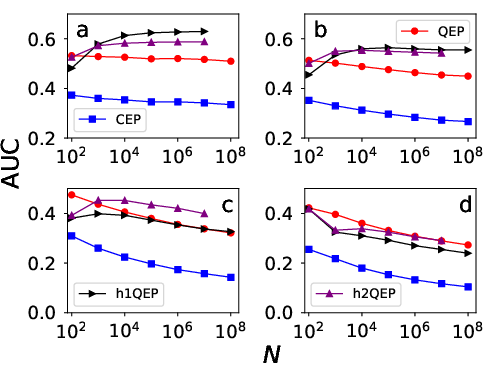
Figure 2: AUC metric for QEP, hxQEP, and CEP protocols as a function of network size and power-law degree exponent γ; demonstrates sustainability and scalability limitations of protocols.
Theoretical Analysis and Protocol Sustainability
A rigorous analysis is provided for the scaling behavior of quantum channel robustness:
- Critical Channel Redundancy and Path Length: The minimum edge entanglement required to support perfect quantum communication between random node pairs (Eedge∗(k,ℓ)) depends on the minimum local degree k (channel redundancy) and the geodesic path length ℓ. In scale-free graphs, k remains finite for random nodes, but 1080 diverges (logarithmically or doubly-logarithmically).
- Importance of Heterogeneous Routing: Protocols that leverage high-degree nodes accessible via small neighborhoods (1081 in hxQEP) offset the divergence of 1082 by exploiting neighborhoods growing rapidly with 1083 (due to the underlying network topology and degree distribution). This enables sustainable large-scale quantum communication for all practical purposes even as 1084 increases.
- Asymptotic Regimes: In the ultra-small-world regime (1085), with appropriate scaling of repeater node degree, perfect communication is achievable for any nonzero edge entanglement in the infinite-size limit.
Results on Real-World and Synthetic Networks
A comprehensive empirical study is performed on 101 diverse real-world networks, validating the synthetic findings in practical settings. Degree heterogeneity and network clustering do not preclude sustainable quantum communication under the proposed protocol family.
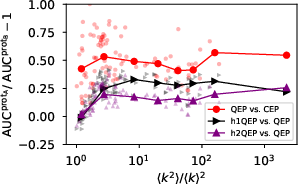
Figure 3: Relative AUC improvements for QEP versus CEP, h1QEP versus QEP, and h2QEP versus QEP across 101 real networks, grouped by degree heterogeneity.
The results confirm:
- QEP consistently outperforms CEP regardless of network category.
- The heterogeneous variants (h1QEP, h2QEP) further improve over QEP, with the advantage most pronounced in large, highly heterogeneous networks.
- h1QEP and h2QEP display similar empirical performance due to finite-size effects, with theoretical analysis predicting eventual superiority of higher-radius variants as 1086.
Practical and Theoretical Implications
The protocols are predicated on global network knowledge and single-pair routing, placing bounds on their distributed applicability in dynamic or resource-constrained environments. Nevertheless, the demonstration that large-scale, reliable quantum communication is feasible (contingent on scale-free, small-world topologies) underpins the potential viability of the Quantum Internet at global scale.
Key implications include:
- Architectural Guidance: The Quantum Internet must adopt or evolve toward scale-free, small-world connectivity to support sustainable, ultra-large-scale distributed entanglement.
- Protocol Flexibility: The proposed family is agnostic to network topology, degree distribution, and clustering, making it adaptable as real-world quantum infrastructures mature.
- Research Directions: Future work is warranted on distributed routing, multiuser concurrent communication, practical resource allocation, and resilience in the face of node/edge failures—critical elements for real-world deployment.
Conclusion
This paper establishes that quantum communication over ultra-large-scale, heterogeneous networks is theoretically and practically viable under a family of protocols integrating greedy path selection, entanglement swapping, and distillation. The essential condition for sustainable scaling is the presence of scale-free, small-world network topology—a property mirrored by the present Internet and emerging quantum network testbeds. These results lay the groundwork for the protocol engineering and network design of the future Quantum Internet, while highlighting open challenges pertaining to distributed routing and concurrent utilization in realistic settings.

