- The paper introduces a boundary-aware quantum simulation framework that accurately estimates relativistic kinetic energy moments under periodic and Dirichlet conditions.
- It employs translation-moment and boundary-overlap estimators to reconstruct second- and fourth-order momentum moments with precision, achieving discrepancies below 10⁻¹³.
- The methodology demonstrates statistical efficiency and scalability, validated through analytical, numerical, and Monte Carlo benchmarks.
First-Quantized Relativistic Quantum Simulation with Periodic and Dirichlet Boundary Conditions
Overview and Motivation
This paper introduces a robust and formally well-structured methodology for simulating relativistic quantum systems in one spatial dimension using first-quantized grid-based encodings on quantum hardware, explicitly addressing boundary conditions by formulating lattice Hamiltonians suitable for both periodic boundary conditions (PBC) and Dirichlet boundary conditions (DBC). The central problem is to construct boundary-consistent estimators for the positive-energy relativistic kinetic operator, specifically its expansion in momentum moments ⟨P^2⟩ and ⟨P^4⟩, which are required in the weakly relativistic regime. The paper demonstrates how these moments are reconstructed via translation measurements for PBC, and by augmenting the translation estimator with boundary-local corrections for DBC, enabling accurate and efficient quantum measurement protocols.
The relativistic kinetic term is expanded to leading order,
T^rel=2mp^2−8m3c2p^4+O(m5c4p^6),
requiring estimation of both the second- and fourth-order lattice momentum moments. The paper constructs lattice Hamiltonians adapted to PBC and DBC:
- PBC: The kinetic operator is defined using unitary cyclic translations (quantum modular addition operations), matching the physical topology.
- DBC: An open-chain finite-difference operator is constructed, eliminating the unphysical wrap-around coupling inherent in cyclic translations, and supplemented by explicit boundary-local terms.
Observable Estimator Workflow
Measurement protocols are derived for each boundary condition:
- Translation-Moment Estimator: For PBC, kinetic moments reduce to translation moments ⟨A^⟩ and ⟨A^2⟩ (where A^ is the quantum adder), efficiently implementable by a Hadamard-test-type interferometric circuit (Figure 1).
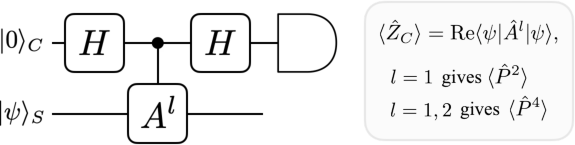
Figure 1: Quantum circuit of the translation-moment estimator; a Hadamard-test evaluates the real part of the translation moment ml=Re⟨A^l⟩.
- Boundary-Overlap Estimator: For DBC, boundary-local coherences (off-diagonal endpoint terms) are directly estimated via projective measurements on computational-basis superpositions (Figure 2). Probability differences from such measurements reconstruct the expectation values required for DBC corrections.
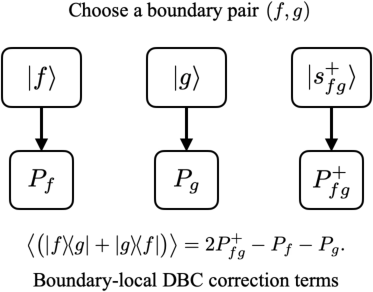
Figure 2: Schematic for the boundary-overlap estimator; endpoint and near-endpoint coherences are measured using superposition projections to realize boundary corrections.
- Potential Sampling: Diagonal potentials are measured via position-basis sampling and classical post-processing, avoiding circuit complexity.
Validation and Benchmarks
The methodology is validated both analytically and numerically:
- PBC Free Particle: Lattice Fourier modes reproduce the expected relativistic dispersion and show convergence to continuum values with increasing grid resolution (Figure 3).
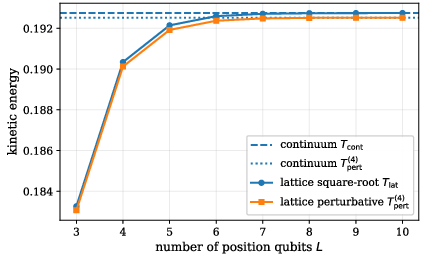
Figure 3: Comparison between continuum relativistic energy, exact lattice energy, and perturbative lattice energy for a PBC free particle, isolating discretization and truncation errors.
- DBC Square Well: The estimator-based DBC kinetic energy moments exactly match analytic sine spectra and matrix evaluations, demonstrating the estimator decomposition is complete and no approximation is introduced in boundary corrections (Figure 4).
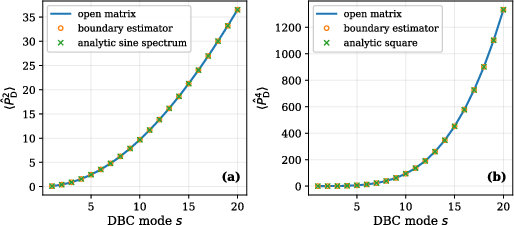
Figure 4: Benchmarking the DBC infinite-square-well; boundary-corrected cyclic estimators converge to analytic sine spectra and direct matrix evaluation.
- Smooth Potentials: Ground states for periodic and confining potentials are used to compare estimator reconstruction with direct matrix evaluation, again confirming tight numerical agreement (Figure 5).
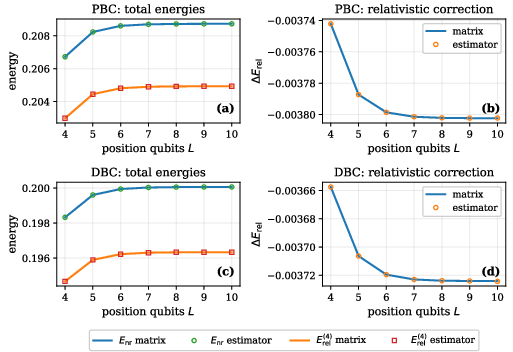
Figure 5: Full energy workflow benchmarking on smooth potentials; estimator reconstructions using translation and boundary measurements match direct matrix results across grid sizes.
- Statistical Scaling: Monte Carlo simulations show that the measurement error scales as O(M−1/2) with the number of shots, confirming statistical efficiency (Figure 6).
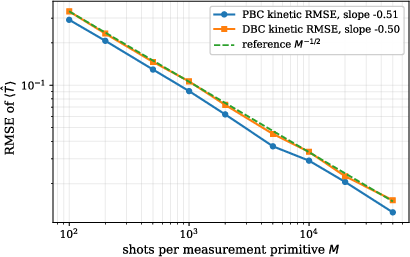
Figure 6: RMSE scaling for kinetic-energy estimation, confirming the expected inverse-square-root dependence on the number of measurement shots.
Key Numerical Results and Claims
- The boundary-corrected estimator formulas for DBC reconstruct the exact open-chain finite-difference operator, with maximum relative discrepancies below 10−13 for tested grid sizes.
- The translation-moment protocol for PBC and augmented boundary estimator for DBC provide measurement costs that are independent of system size up to fourth-order moment corrections.
- Statistical error for kinetic-energy estimation exhibits M−1/2 scaling regardless of boundary condition, with controlled increases for DBC due to additional boundary measurements.
- The estimator workflow remains stable and accurate across smooth, free, and box potentials.
Implications and Future Directions
This work establishes a foundation for boundary-aware quantum simulation of relativistic Hamiltonians on finite domains—critical for continuum quantum dynamics applications in fields such as quantum chemistry, condensed matter, and lattice gauge theory. The approach emphasizes the need for boundary-consistent definitions of lattice operators and demonstrates measurement protocols that do not require extensive ancilla use or circuit complexity. The methodology extends naturally to higher-order corrections and more accurate finite-difference stencils, although at increased observable complexity.
Practical applications in quantum variational algorithms, especially VQE for relativistic systems, can leverage this estimator structure directly. The separation of discretization, relativistic truncation, and statistical errors in the benchmark framework facilitates rigorous error analysis, critical for hardware implementations. The boundary-local correction viewpoint opens pathways for further research in higher-dimensional simulation, irregular geometries, and boundary-driven quantum phenomena.
Theoretically, the distinction between boundary treatments alters the spectral properties and observable estimators, signifying the importance of boundary conditions in the quantum simulation paradigm. Future work may extend these methods to multi-particle and interacting scenarios, integrate with error mitigation protocols, and generalize to more complex boundary geometries and symmetries, aiming for scalable relativistic quantum simulation beyond one dimension.
Conclusion
The paper constructs a compact, boundary-aware quantum simulation methodology for relativistic systems on one-dimensional domains, rigorously treating PBC and DBC and deriving measurement protocols that are efficient, robust, and directly implementable in first-quantized qubit registers. Validation against analytic and numerical benchmarks demonstrates the accuracy and practicality of the estimator framework. The results motivate further exploration of boundary-driven quantum simulation strategies in broader contexts, both computational and physical.