- The paper presents an exact analytic solution for the relativistic finite-difference equation with the ring-shaped Quesne oscillator potential, yielding discrete bound-state energies.
- The analysis employs orthogonal polynomials and SU(1,1) symmetry to derive quantization conditions and confirm the physical viability of the model.
- The methodology recovers the nonrelativistic limit and offers a foundation for extensions in relativistic quantum mechanics with anisotropic potentials.
Bound State Analysis of the Relativistic Finite-Difference Equation with the Ring-shaped Quesne Oscillator Potential
Introduction and Theoretical Framework
The paper rigorously addresses the exact analytic solution of the relativistic finite-difference equation for a particle subjected to the three-dimensional ring-shaped Quesne oscillator potential. The analysis leverages the finite-difference formulation of relativistic quantum mechanics, wherein the configuration space (r-space) and momentum space are carefully treated to retain manifest covariance and accommodate finite-difference operators. The ring-shaped Quesne oscillator, a generalization of the conventional harmonic oscillator with non-central (ring-shaped) angular dependence, is particularly relevant for modeling molecular and nuclear systems with significant anisotropies.
The finite-difference relativistic Hamiltonian incorporates both radial and angular operators, yielding a nontrivial effective potential landscape that dictates the bound-state spectrum and wavefunction structure. The separation of variables is executed systematically, reducing the problem to coupled angular and radial equations with distinct, analytically tractable forms.
Angular and Radial Solutions: Orthogonal Polynomials and Spectral Quantization
The angular component, after transformation to x=cosϑ, leads to a differential equation whose solutions are mapped onto Jacobi and specifically Gegenbauer polynomials. The quantization condition arises naturally from polynomial truncation, fixing the separation constant Λ in terms of quantum numbers k and m as Λ=L(L+1) with L=k+∣M∣, where M2=m2+(2m0α)/ℏ2. The angular wavefunctions manifest as
(sinϑ)∣M∣Ck(∣M∣+1/2)(cosϑ),
preserving orthogonality and normalization over the sphere.
In the radial sector, the analysis exploits the manifestly Hermitian structure of the finite-difference operator. The general solution is expressed in terms of continuous dual Hahn polynomials:
Rnk(ρ)=c~nk(−ρ)(μk)Mνk(ρ)Sn(ρ2;μk,νk,1/2),
where the parameters x=cosϑ0, x=cosϑ1 encode the details of the effective potential, and x=cosϑ2 labels the radial excitation level. The quantization condition for the energy eigenvalues emerges as
x=cosϑ3
imposing discrete bound-state spectra.
The approach guarantees that both energy levels and eigenfunctions possess proper nonrelativistic limits, reducing to Laguerre and associated Legendre polynomial solutions in the x=cosϑ4 limit, recovering the structural properties of the nonrelativistic Quesne oscillator.
Group-Theoretical Construction: x=cosϑ5 Algebra
A significant advancement presented is the demonstration of an x=cosϑ6 dynamical symmetry governing the radial subspace. Explicit forms of ladder operators (x=cosϑ7) and the Cartan generator (x=cosϑ8) are constructed, providing an algebraic route to the energy spectrum, in parallel with the analytic solution. The Casimir operator is evaluated on the basis of bound-state solutions, confirming the irreducibility of the representations encapsulating the radial spectrum. The explicit action of creation and annihilation operators on the wavefunctions substantiates the closure of the algebra and the structure of the Hilbert space.
Numerical and Structural Results: Potential Analysis and Probability Densities
The real and imaginary parts of the effective potential are dissected as functions of the radial coordinate and quantum numbers. The real part exhibits well-defined minima, indicating robust confinement and supporting the existence of discrete bound states; increases in angular momentum shift these minima outward and upward energetically.
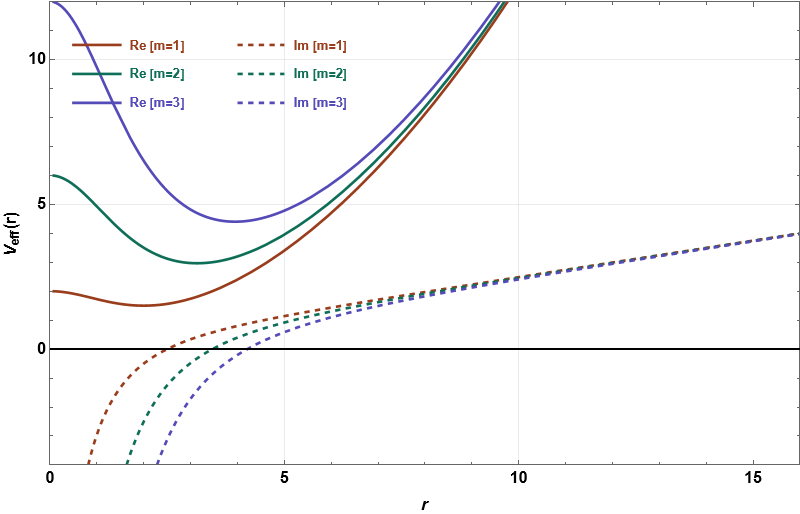
Figure 1: Real and imaginary parts of the relativistic ring-shaped Quesne oscillator effective potential x=cosϑ9 for different Λ0.
Analysis of the radial probability density Λ1 shows systematic extension and emergence of additional nodes/patterns as the radial quantum number Λ2 increases, indicative of higher excited states.
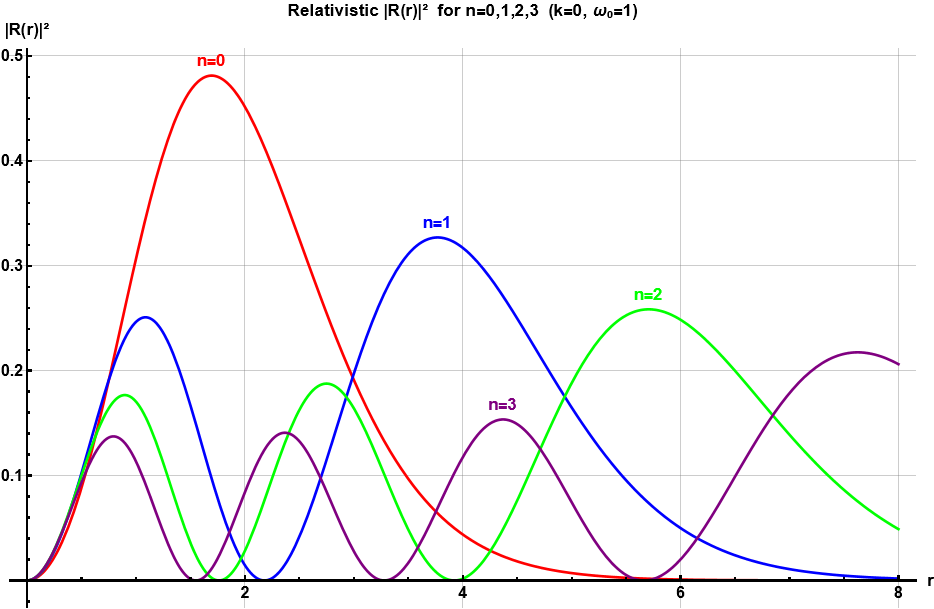
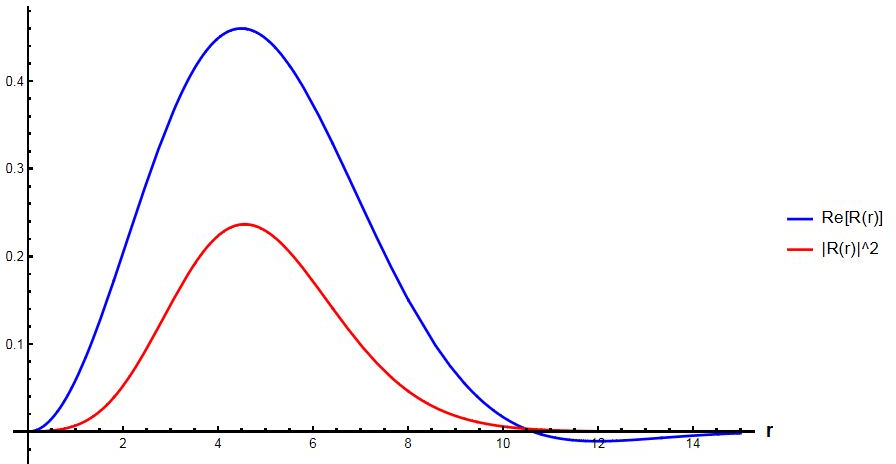
Figure 2: (a) Radial probability density Λ3 for several Λ4 at fixed Λ5 and Λ6. (b) Ground state radial function and its probability density.
The dependence of the energy eigenvalues Λ7 on the ring-shaped coupling Λ8 is monotonic, with all states shifting upward as Λ9 increases; the hierarchy of states with respect to angular and radial quantum numbers is preserved throughout.
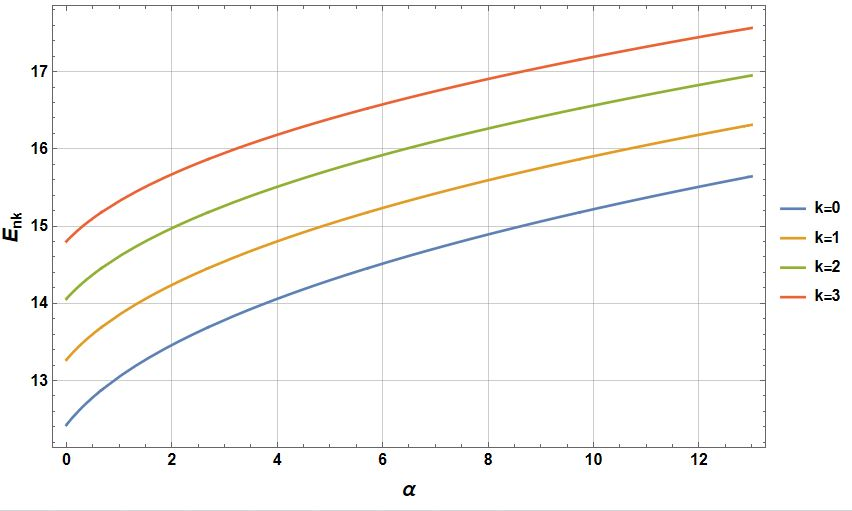
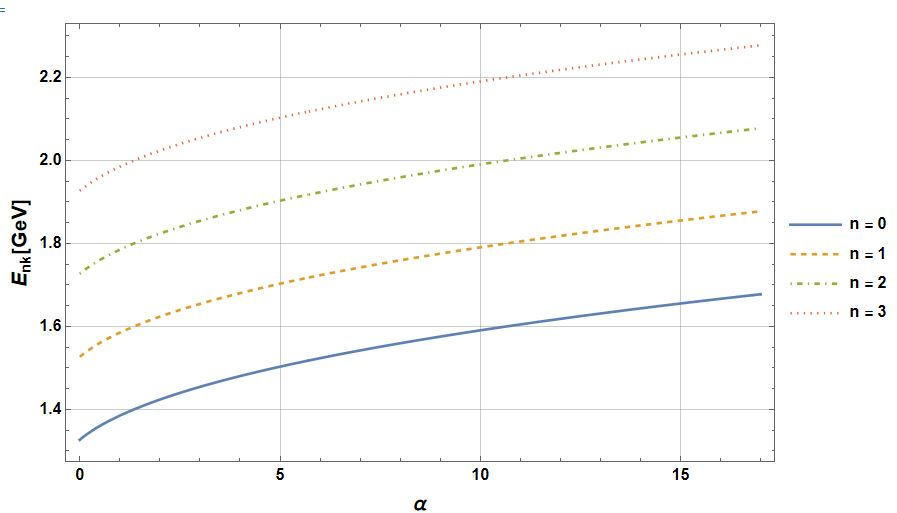
Figure 3: Variation of relativistic energy eigenvalues k0 versus ring-shaped coupling parameter k1 for different k2 and k3.
Three-dimensional probability densities k4 for various angular quantum numbers k5 are presented in the k6–k7 plane, revealing a transition from smooth single-mode distributions to highly structured, multi-modal patterns as k8 increases, reflecting the underlying angular momentum and its effect on spatial localization.
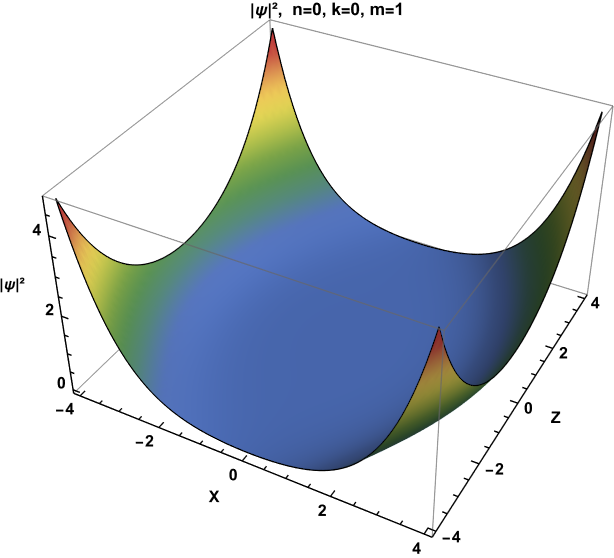
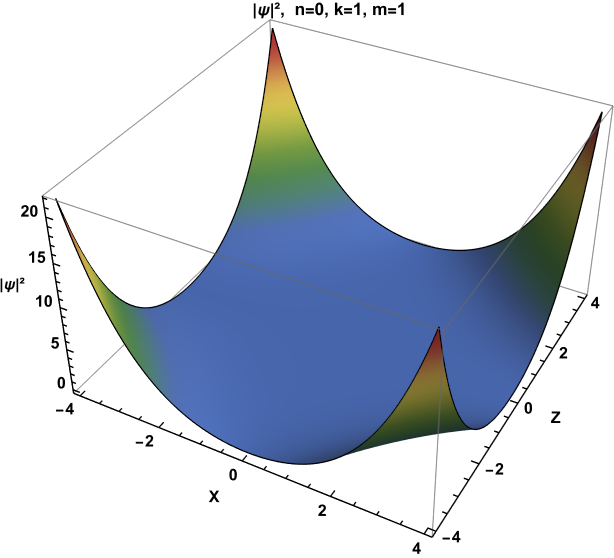
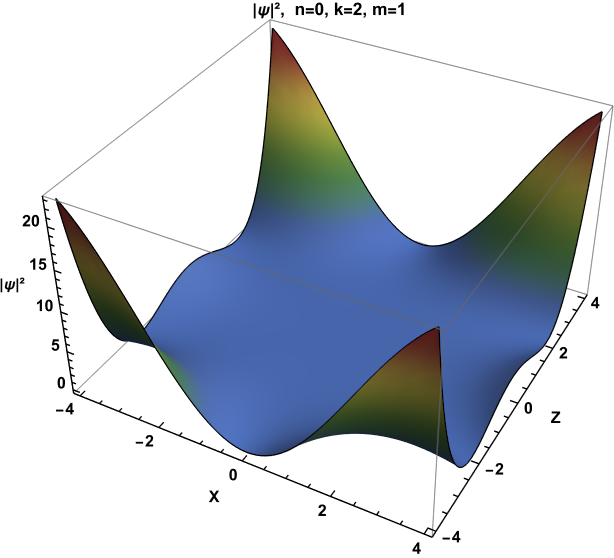
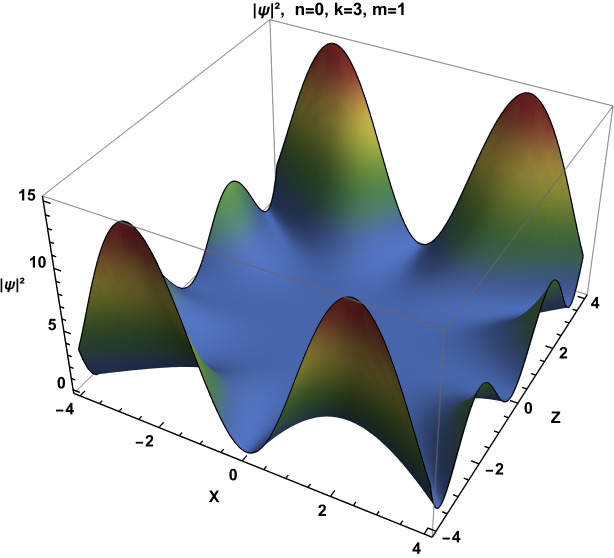
Figure 4: Three-dimensional spatial probability density k9 in the m0–m1 plane for m2 at m3.
Physical and Mathematical Implications
The results confirm that the finite-difference relativistic formulation with a non-central ring-shaped oscillator is analytically solvable, with discrete, stable spectra and wavefunctions displaying inherited symmetries from the nonrelativistic domain. The construction of exact bound-state solutions in terms of orthogonal polynomials is significant for applications in relativistic molecular and nuclear quantum mechanics, especially for systems with pronounced anisotropies.
From the group-theoretical perspective, the presence of an m4 dynamical symmetry in the radial sector enables potential extensions to coherent state constructions, algebraic derivations of transition matrix elements, and applications to exactly solvable models in quantum optics and quantum information, where non-compact symmetry algebras play a central role.
Numerically, the spectral and probability density analysis substantiates that relativistic corrections (specifically, nontrivial imaginary components in the effective potential) predominantly affect the near-origin regime but do not destabilize the spectrum. The theoretical machinery developed provides a template for further generalizations to potentials with more complex angular and radial dependencies, including additional spin-orbit coupling or external field effects.
Conclusion
The paper presents a comprehensive, exact analytic treatment of the relativistic finite-difference equation for the ring-shaped Quesne oscillator in three dimensions. The explicit construction of bound-state energy spectra, normalized wavefunctions, and the confirmation of an intrinsic m5 symmetry establish this model as a canonical example of a solvable relativistic quantum system with non-central potential. The model retains analytic tractability, correct nonrelativistic limit, and spectral stability under general parameter regimes.
These results are instrumental for further theoretical development of exactly solvable relativistic systems, providing a platform for applications to relativistic quantum chemistry, nuclear structure, and potential extensions to field-theoretic frameworks. Future directions include detailed analyses of scattering states, investigation of perturbative corrections, and exploration of the role of these structures in more complex, interacting quantum systems.